Broadband Contract Lengths Explained (1 vs 12 vs 18 vs 24 Months
If you’ve ever signed a broadband deal and then, three months later, spotted a cheaper one and thought, “Wait… why am I stuck paying this?”, you’re not alone.
Broadband contract lengths are one of the most misunderstood parts of choosing a new deal. They look simple on the surface. Pick 12 months. Or 24. Job done.
But the contract length you choose can quietly cost you more than the speed upgrade you’re chasing. Because once you’re locked in, two things start to matter a lot: price rises and exit fees. That’s when a “cheap” deal stops feeling cheap. And it’s why so many households end up riding out a contract they don’t even like.
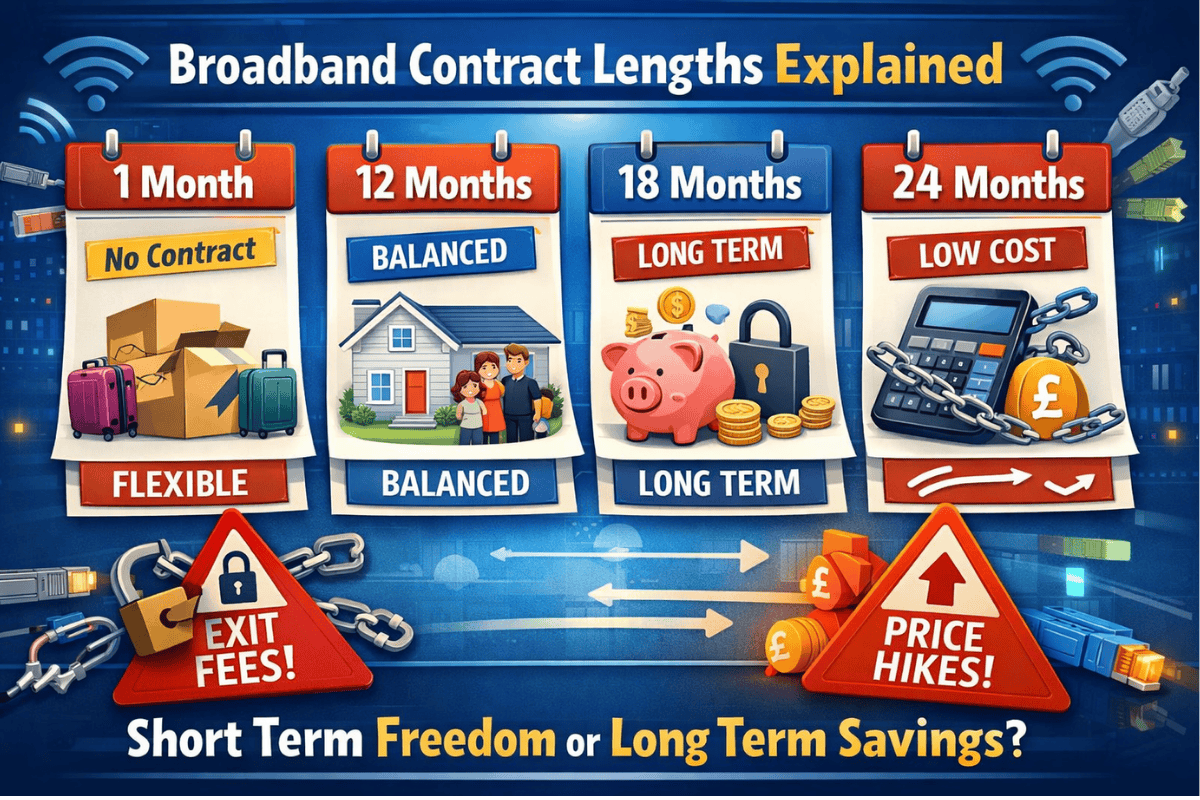
This guide will break down broadband contract lengths in plain English, including the real pros and cons of 1-month broadband UK options like rolling monthly broadband, versus 12-month broadband deals, 18-month terms, and 24-month broadband contracts. You’ll learn which contract length fits your life (renters, movers, families, budget-focused households), and how to avoid getting trapped by exit fees, broadband, and unexpected mid-contract costs.
Broadband Freedom is an independent comparison platform, so we’re not here to push providers or overwhelm you with tables. We’re here to help you make a decision you won’t regret later. If flexibility is a priority, start with No-Contract Broadband. And when you’re ready to sanity-check your options, use Compare Broadband Deals.
Quick answer: the best contract length for most households
There isn’t one “best” choice for broadband contract lengths because your life matters more than the headline price. But there are safe defaults. And for most UK households, a 12-month contract is usually the best balance of decent pricing, manageable commitment, and lower regret.
Use this quick decision guide:
- If you rent or might move in the next 6 to 12 months → choose 1 month broadband (rolling monthly broadband). Flexibility beats a small discount if you might need to leave.
- If you’re a homeowner and want the safest all-round default → choose 12-month broadband deals. For most people, this is the “least likely to bite you later” option.
- If you’re confident you won’t move and you want the lowest headline price → consider 24-month broadband contracts. Just accept the trade-off: you’re buying a longer commitment, and it can be expensive to escape.
- If you feel uncertain about money, work, or living plans → avoid long contracts by default. Uncertainty plus exit fees is how people get stuck.
- If you care most about budget predictability → lean shorter rather than longer. It’s easier to switch to a better deal than to be trapped in a worse one.
If flexibility is your priority, start with Monthly Plans and this guide to No-Contract Broadband.
1-month rolling broadband (no contract): what you gain and what you pay for
Rolling monthly broadband is exactly what it sounds like: you’re not tied into a long agreement. You pay month-by-month, and you can usually leave with short notice. In the world of broadband contract lengths, it’s the most flexible option by far. And for some households, that flexibility is worth more than a cheaper headline price.
Best for renters, short-term stays, uncertain budgets
A 1-month broadband UK plan tends to suit people whose lives are likely to change.
It’s a strong fit if:
- You rent and might move soon (or your tenancy is rolling)
- You’re in temporary accommodation or between homes
- You’re a student or working away for the short term
- Your budget is unpredictable, and you want the option to switch quickly
- You’ve been burned before and want control (no being “stuck”)
Key benefit: you avoid most exit fees and broadband problems because you’re not locked into a long minimum term. That alone can remove a lot of stress.
If you want to see what’s available in one place, use Compare No Contract Broadband Deals.
The real trade-off: flexibility vs slightly higher monthly pricing
Here’s the honest trade: rolling monthly broadband can cost a bit more per month than longer contracts. Not always, but often.
What you gain (pros):
- Flexibility to move house without paying to leave
- Easier switching if speeds or service aren’t right
- Lower “regret risk” if a better deal appears later
- Useful for short-term needs without overcommitting
What to watch out for (cons):
- Slightly higher monthly cost compared to 12 or 24-month deals
- Setup or activation fees in some cases (especially if you’re starting from scratch)
- Router return requirements (and potential charges if it’s not returned correctly)
- You may still need to give notice, so it’s not always “cancel today, stop tomorrow.”
The simplest way to keep this option honest is to check the total cost, not just the monthly figure. Use No-Contract Deals (Pricing) to see how pricing works and what’s included, then decide whether the flexibility is worth the extra monthly cost for your situation.
12-month broadband: the sweet spot for most switchers
If you want a “safe default” without overthinking it, 12-month broadband deals are usually it. In the world of broadband contract lengths, a year is long enough to get decent pricing, but short enough that you’re not locked into a choice that stops fitting your life.
This option tends to work well because it balances three things most households actually care about:
- Budget certainty: you get a defined period on a deal price, without a two-year commitment
- Flexibility: if you move, change jobs, or your needs shift, you’re not stuck for ages
- Lower regret risk: if prices drop or better options appear, you’re never far from your next switch window
If you’re actively choosing a 12-month deal, the quickest way to see what’s available is to Compare 12 Month Broadband Packages and then sanity-check against the wider market using Compare Broadband Deals.
Simple cost example (so you don’t get tricked by headline price):
Let’s say a 12-month deal is £27/month with a £10 setup fee.
- Monthly cost over 12 months: 12 × £27 = £324
- Setup fee: £10
- Total: £334 for the year
That “total over term” number is what your bank account feels, not the headline price.
Why 12 months often beats 24 months on risk
A 24-month deal can look cheaper per month. But it usually comes with more ways to get burned.
For most switchers, 12 months often wins on risk because:
- Less exposure to mid-contract price rises for broadband: the longer you’re locked in, the more chances there are for increases to hit while you can’t easily leave
- Lower chance of being trapped by life changes: moving house, relationship changes, job changes, budget changes… two years is a long time
- Exit fees hurt more when you’re early in a long contract: leaving a 24-month deal halfway through can cost real money
If your priority is the cheapest broadband contract length, don’t just chase the lowest monthly figure. For most households, the safest “cheap” is the one you can still escape from when life changes.
18 and 24-month broadband: when long contracts actually make sense
Long broadband contracts can be a smart money move. They can also be the reason people feel trapped in a deal they’ve outgrown. In other words, with broadband contract lengths of 18 and 24 months are a savings tool, but they come with real risk if your life is likely to change.
When a long contract saves money
An 18-month broadband contract or a 24-month broadband deal can make sense when your situation is stable, and you want the lowest monthly price.
Long contracts are usually worth considering if:
- You’re a homeowner and don’t expect to move soon
- Your household usage is stable (work, streaming, gaming needs are predictable)
- You want a set period to “not think about broadband.”
- The total cost over the term is clearly lower than a 12-month option
Example:
If a 24-month deal is £24/month, the total over the term is 24 × £24 = £576 (plus any setup fee).
If a 12-month deal is £28/month, two years of that could be 24 × £28 = £672 (plus two setup fees if you switch yearly).
That’s how long contracts can save money.
If you’re browsing options, start with Broadband Deals and focus on total cost, not just the headline monthly price.
When it traps you (price rises, moving, exit fees)
Long contracts only make sense if you don’t plan to move. Because the downside is simple: leaving early can be expensive.
Watch out for:
- Moving house: if your new place can’t get the same service, you may need to end the contract early
- Exit fees for broadband: leaving a 24-month deal halfway through can mean paying a chunk of the remaining months
- Mid-contract price rises for broadband: the longer you’re locked in, the more it matters how price increases are handled
For context, Ofcom has changed the rules so new contracts can’t use inflation-linked price rise terms and must show any in-contract rises clearly in pounds and pence. Here’s the reference: Ofcom rule change on mid-contract price rises.
Simple reality check:
A long deal is cheaper only if you can actually stay in it. If you might need to switch, learn the safest process first in How to Switch Broadband Provider.
The hidden costs that matter more than contract length
Broadband contract lengths matter, but they’re not the whole story. Two people can pick the same 12-month deal and pay very different amounts, simply because one person spotted the hidden costs early and the other didn’t. These are the “quiet extras” that turn a cheap deal into an expensive one.
Mid-contract price rises
Even if your monthly price looks fine today, it can change while you’re locked in.
What to look for (quick checklist):
- Does the deal include an in-contract price rise? If yes, how much and when?
- Is it a fixed increase in pounds and pence, or vague wording?
- What would the new monthly cost be after the rise?
Example:
If your bill rises by £5/month mid-contract, that’s £60 extra over a year.
On a 24-month deal, it can be £120 if the increase applies across the remaining term.
Practical tip: when comparing offers, always check the full term cost, not just month one. Use Compare Broadband Deals and sanity-check whether the “cheap” deal stays cheap.
Exit fees and switching timing
Exit fees are the main reason people feel stuck. And they’re usually avoidable if you plan.
What to check:
- Are exit fees listed clearly in the contract terms?
- How many months are left if you decide to leave early?
- Is it cheaper to wait until the end of your term rather than pay to leave?
Example:
If you leave with 6 months left on a £28/month contract, your exit fee could be “most of the remaining cost” (often reduced slightly). That’s still potentially well over £100 just to get out.
Practical tip: switch at the right time. Knowing the process helps you avoid service gaps and avoidable charges. Start here: How to Switch Broadband Provider.
Set up and router fees
Even a short contract can cost more if you ignore setup fees.
Common surprise costs:
- Setup/activation fees: a one-off charge to get you connected
- Router delivery fees: sometimes separate from setup
- Router return rules: some routers must be returned at the end (especially on rolling monthly broadband), and you may be charged if you don’t
Example:
A deal that’s £3/month cheaper isn’t really more inexpensive if it comes with a £30 setup fee and you’ll only stay for 6 months.
Practical tip: always calculate “total cost over the time you’ll actually stay”, not the full contract term if you’re likely to move or switch.
Contract length decision checklist
Use this checklist to choose between broadband contract lengths without overthinking it. Tick the answer that’s true for you, then follow the guidance.
- Will you probably move home in the next 6 to 12 months?
✅ Yes → 1 month broadband / rolling monthly is usually safest
❌ No → 12-month broadband deals are a strong default - Do you rent (or have a rolling tenancy) where plans change fast?
✅ Yes → lean rolling monthly to avoid exit fees for broadband
❌ No → 12 months is usually the better balance - Would an exit fee of £100+ genuinely hurt your budget?
✅ Yes → avoid long contracts; choose monthly or 12-month
❌ No → you can consider 18 or 24 months if the savings are real - Is your budget unpredictable right now (work, income, household changes)?
✅ Yes → shorter contracts reduce “trapped” risk
❌ No → longer contracts may suit you - Do you want the lowest risk option that still gives decent pricing?
✅ Yes → 12 months is the safest default for most households
❌ No → keep going through the checklist - Are you confident you will stay at the same address for 18 to 24 months?
✅ Yes → 18/24 months can make sense
❌ No → long contracts are usually not worth it - Do you get stressed by mid-contract price rises for broadband?
✅ Yes → shorter terms reduce exposure and give you faster switching windows
❌ No → long contracts may still be fine if you accept the trade-off - Is your household “set” (same people, same usage, same needs) for the next year?
✅ Yes → 12 months is ideal
❌ No → rolling monthly keeps your options open - Do you mostly want predictable monthly costs, even if it’s not the absolute cheapest deal?
✅ Yes → 12 months is usually best
❌ No → long contracts may be worth it if the total cost is meaningfully lower - If a better deal appears later, do you want the ability to switch quickly?
✅ Yes → rolling monthly or 12 months
❌ No → 18/24 months may suit you if stability matters more
Once you’ve got your likely contract length, use Broadband Comparison to match it to the right type of deal, then validate the real options using Compare Broadband Deals.