Broadband Price Rises and Exit Fees (How to Avoid Getting Trapped in 2026)
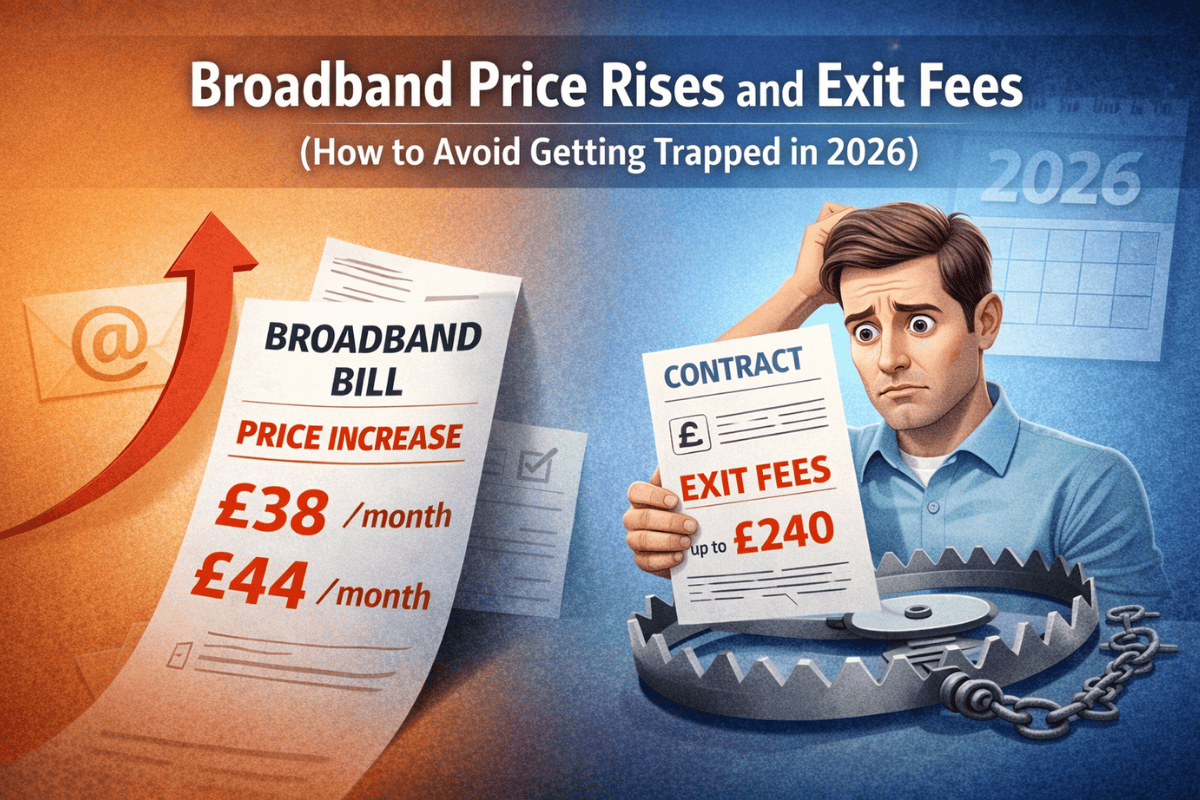
If you’ve opened your inbox to a “price rise notification” from your broadband provider, you’re not alone. One month the bill looks normal, the next it’s gone up, and the wording can feel deliberately vague: “annual adjustment”, “out of contract pricing”, “new price from next month”. It’s frustrating, especially when you’re already trying to keep household costs under control.
This guide is here to slow things down and make broadband price rises in 2026 understandable, not scary. The first thing to know is that not all price rises are the same. Some are built into the contract from the start, some kick in when your deal ends, and others come from add-ons you barely notice until they stack up. The rules and how providers present pricing have also shifted, which means contracts are often clearer than they used to be, if you know what to look for.
We’ll break down how mid-contract price rises work, what exit fees broadband really mean if you want to leave early, and when switching is allowed, safe, and worth it. If you’re already thinking about changing providers, it helps to compare options first using Compare Broadband Deals and understand the process via How to Switch Broadband Provider.
Quick answer: Can providers raise prices mid-contract?
Yes, providers can raise prices mid-contract, but only if the increase was clearly built into your broadband contract terms when you signed up, and they apply it exactly as stated.
This is where mid-contract price rises broadband gets confusing. Some deals include an in-contract increase as part of the agreement. If it was genuinely clear at the point of sale, the provider is allowed to apply it because you accepted that future price when you took the deal. (www.ofcom.org.uk)
However, rules have tightened. For new contracts covered by Ofcom’s changes, providers cannot rely on vague inflation-linked or percentage wording. Any in-contract price rise must be shown upfront in pounds and pence, clearly and prominently, so you can see what your bill will be and when it will change. The changes come into force from 17 January 2025 for relevant new contracts.
Price rises are not allowed in the way people fear most: a provider cannot suddenly increase your price beyond what you agreed at sign-up. When that happens, customers should be given notice and the right to exit without penalty because the provider is changing the deal you signed.
Why do people still get caught up in broadband price rises in 2026? Because the market still contains a mix of older-style contracts (harder to translate into real money until the rise lands) and newer, clearer contracts that spell out the exact increase in cash terms.
If you want to sanity-check your options against these rules, it helps to compare deals that show the full cost over time via Compare Broadband Deals, understand switching timing using How to Switch Broadband Provider, and consider flexibility through Monthly Plans.
The 3 ways broadband price rises hit households
Most people hear “price rise” and assume it’s one thing. It isn’t. Broadband bills usually creep up through three separate routes, and providers often use similar-sounding language for all of them. That’s how people get stung.
If you can spot which type you’re dealing with, you can usually predict what happens next, and whether you actually have options.
Annual in-contract rises
This is the classic “your monthly price is going up from April” message, even though you are still in your minimum term. It happens because the increase was written into your broadband contract terms when you signed.
What catches people out is not that it exists, but that it feels small in isolation. A couple of pounds here, then another uplift next year, and suddenly your “great deal” is not so great.
A real-world example: you sign up on a low headline price, then an in-contract rise lands a few months later, and your bill jumps. You did not do anything wrong. You just saw the teaser price, not the full story.
How to sanity-check it:
- Look for wording like “annual price adjustment” or a stated future price.
- Compare the total cost across the full term, not just month one. The easiest way to do that is to use a comparison view like Compare Broadband Deals, so you are not stuck comparing deals on headline monthly only.
End-of-contract hikes (out of deal pricing)
This is the sneakiest one because it feels like a punishment for doing nothing. Your contract ends, you roll onto a standard tariff, and the price jumps sharply. No new router. No faster speeds. Just a higher bill because you are no longer protected by an intro offer.
This is also where people confuse “mid-contract price rises” with “out-of-contract hikes”. They feel similar when you see the bill, but they are totally different situations.
A real-world example: your 18-month deal ends, and your bill rises the next month. You assume it is a new “price rise”, but it is actually your discounted pricing expiring.
If you have ever had that moment of “why is my broadband suddenly £10 to £20 more?”, this is usually the reason. For a concrete example of how this looks with major providers, see BT and EE out-of-contract price increases explained.
How to protect yourself:
- Check your end date now, not when the bill lands.
- Set a reminder 30 days before your deal ends and compare again before you roll onto a higher price.
- If you want to avoid being locked in when pricing feels unstable, a flexible option can help. Start with Monthly Plans or Compare No Contract Broadband Deals.
Add-ons and router fees
This is the slow leak. Your base broadband price might not move much, but extras quietly stack up:
- WiFi boosters or mesh add-ons
- Router delivery or “premium router” upgrades
- Security packages you did not mean to keep
- Call plans, landline bundles, or TV add-ons
A real-world example: you upgrade your WiFi setup to fix dead zones, then later notice the booster cost is recurring. Or you take a “free” add-on for three months and forget it, then it becomes a permanent line item.
How to spot it fast:
- Scan your bill for anything that is not the core broadband line.
- If you see multiple small charges, add them up. This is where the “cheap” deal becomes average.
If your bundle includes calls or phone add-ons, it can also help to understand how those costs are structured in advance via Call Pricing and Call Bundles.
The big takeaway: not every increase is the same, and the right response depends on which of these three you are looking at.
Exit fees explained (and how to avoid them)
Exit fees are the “price of leaving early”. If you are still inside a minimum term (12, 18 or 24 months, for example), the provider can charge you for ending the contract before the agreed end date.
Here’s the key thing most people miss: exit fees are rarely a random punishment. They are usually a straightforward calculation based on how many months you have left and what your monthly price is. That means you can often predict them, reduce them, or avoid them entirely if you time your move properly.
A simple way to think about it:
If you have X months left, the provider will often charge you a chunk of the remaining monthly costs, sometimes with small adjustments (for example, removing VAT or discounting certain elements). The exact formula varies, but the principle is consistent.
Real-world examples (numbers kept simple on purpose):
- You are paying £30/month and have 6 months left. Your exit fee might land somewhere in the region of £120 to £180, depending on how the provider calculates remaining charges.
- You are paying £45/month and have 12 months left. The exit fee can quickly feel “shocking” because even a reduced calculation still adds up over a year.
This is why people feel trapped. Not because switching is impossible, but because leaving at the wrong time can be expensive.
How to avoid exit fees (the smart, calm way)
1) Switch at the end of your minimum term, not when you get annoyed.
This is the biggest money saver. If you are only a few weeks away from the end date, wait and switch cleanly rather than paying to escape early.
2) Separate “price rise frustration” from “exit fee reality”.
If your bill has risen but the increase was part of your contract, you might still owe exit fees if you leave early. If the provider changes the deal in a way you did not agree to, your rights may be different. The detail matters.
3) Use the switching process properly so you do not create overlap charges.
A messy switch can mean you pay two providers for a short period. The safest path is to follow a structured switch process so the handover is clean, especially if you are keeping the same line type.
4) If you are moving home, check your options before cancelling.
Some providers let you transfer the service, some cannot serve the new address, and some will still charge exit fees if you cancel without checking first. Do not assume moving equals a free exit.
If you want the cleanest and easiest-to-follow walkthrough of how to change providers without triggering extra costs, use How to Switch Broadband Provider.
The safest ways to protect yourself from price rises
The goal is not to “beat the system”. It’s to stop getting surprised by your own bill. Most broadband price rises become painful for one reason: people compare deals on the headline monthly price, then ignore the fine print that changes the price later.
If you want protection, you need two habits: total-cost thinking and the right type of contract for your situation.
Choose clear pricing and compare the total cost, not the headline monthly cost
This is where most people overspend, and it happens in plain sight. A deal can look cheap on page one, then quietly become average once price rises, add-ons, or end-of-contract pricing kick in.
What to do instead:
- Treat the first-month price as marketing, not truth. The truth is what you pay across the whole term.
- Check whether an in-contract rise is built in. If it is, factor it in upfront so you are not shocked later.
- Look at the full bundle cost, not just broadband. TV add-ons, phone add-ons, and “included” extras can change what you really pay month to month.
- Decide what you actually need. A cheaper, stable mid-tier package often beats a top-tier package that creeps up in price.
If you want to take the emotion out of it, compare deals side by side and judge them on overall value and clarity. That’s how you avoid signing up for a deal that looks good today but becomes expensive later.
Consider rolling monthly if you need flexibility
If price rises are your main worry, flexibility is your lever. Rolling monthly plans can be a smart choice when you expect change, and you do not want to be pinned down.
Rolling monthly can make sense if:
- You are renting or might move soon. Being locked into a long-term deal is where exit fees become a problem.
- You want negotiating power. If your provider pushes prices up, you can leave without the “trap” feeling.
- You have been burned by end-of-contract hikes. Monthly keeps you closer to market pricing, because you can react quickly.
- You are in a temporary situation. Short-term living arrangements, new build delays, or waiting for full fibre rollout at your address.
The trade-off is simple: rolling monthly plans can sometimes cost a bit more per month, but they can reduce risk, avoid exit fees, and protect you from being stuck when prices move.
If flexibility matters, start by comparing options here: Compare No Contract Broadband Deals. If you want a clearer explanation of how monthly broadband works and when it makes sense, use Monthly Plans.
The momentum shift is this: once you compare total cost and choose the right contract type, broadband price rises stop feeling like a surprise and start feeling like a decision you already accounted for.
Switching is easier now, but do it the right way
Switching broadband used to feel risky because people worried about downtime, double-billing, or getting stuck in a messy cancellation loop. The big change is the One Touch Switch process, which launched on 12 September 2024 and is designed to make switching across networks simpler by letting you deal with your new provider, rather than juggling both sides.
That said, “easier” does not mean “automatic savings”. The people who win are the ones who switch with timing and contract terms in mind, not just emotion. This is especially true in the broadband price rises of 2026, where end-of-contract pricing and add-ons can quietly do more damage than the headline rise.
Here’s the clean, low-stress flow to follow:
Mini flowchart
- Check your contract status → Are you in a minimum term, or out of contract?
- Check what kind of price rise you’re facing → in-contract rise, end-of-deal hike, or add-ons?
- Compare like-for-like total cost → same contract length, same speed tier, same extras.
- Choose your new deal and place the order → pick an activation date that avoids overlap.
- Follow the switching steps exactly → avoid cancelling early unless you are specifically told to.
- Confirm the final bill → check for any remaining charges or add-ons that should stop.
If you want the switching steps in plain English, use How to Switch Broadband Provider. And if you want to sanity-check your options before committing, use Compare Broadband Deals to compare the real cost, not just the teaser price.
Price rise checklist
- Check if the deal includes mid-contract price rises, and if so, what the increase is in pounds and pence.
- Check the end-of-contract price (the “out of deal” monthly cost), not just the intro offer.
- Check the contract length and whether a shorter term is worth paying slightly more for flexibility.
- Check the exit fees method to know what leaving early could realistically cost.
- Check for router fees and add-ons (boosters, security, premium router), and whether they are paid later.
- Check if the deal price assumes paperless billing or direct debit, and what happens if you do not use them.
- Check for setup, delivery, or activation charges, especially if the monthly price looks unusually low.
- Check what you actually need for your home, so you are not upsold into speed you will not use.
- Check whether switching involves an engineer visit or installation work, and what the lead time is.
- Check the provider’s wording on price changes and notifications, so you know what “notice” looks like in practice.