ADSL Broadband Deals 2026: The Essential Guide to Standard Internet

Why are millions of UK households being pushed toward expensive full fibre plans when a simple copper connection might still suit your lifestyle? You’ve likely noticed the aggressive marketing; yet, for many, the priority remains finding a low-cost, reliable solution without being trapped in a long-term commitment. Securing the right ADSL broadband deals in 2026 requires a bit of savvy, especially as prices now start around £21.99 per month for basic 10 Mbps packages from providers like italk.
We understand the frustration of deciphering technical jargon and the genuine worry about hidden mid-contract price hikes. This guide empowers you to take back control; we’ll show you how to find the most flexible terms and whether standard internet still makes sense for your home. You’ll learn exactly how to navigate the "Great Digital Switchover" before the January 31, 2027, PSTN shutdown deadline to ensure you get broadband on your terms.
Key Takeaways
- Understand how ADSL uses legacy copper infrastructure to reach 99% of UK premises, offering a reliable fallback where fibre isn’t yet available.
- Compare the latest ADSL broadband deals to see if the cost savings of a 10 to 11 Mbps connection outweigh the benefits of switching to superfast fibre.
- Navigate the technical side of standard internet, from signal degradation issues to preparing for the nationwide copper network shutdown in January 2027.
- Secure a contract on your terms by identifying hidden costs and choosing flexible options that protect you from long-term price hikes.
What are ADSL Broadband Deals and How Do They Work?
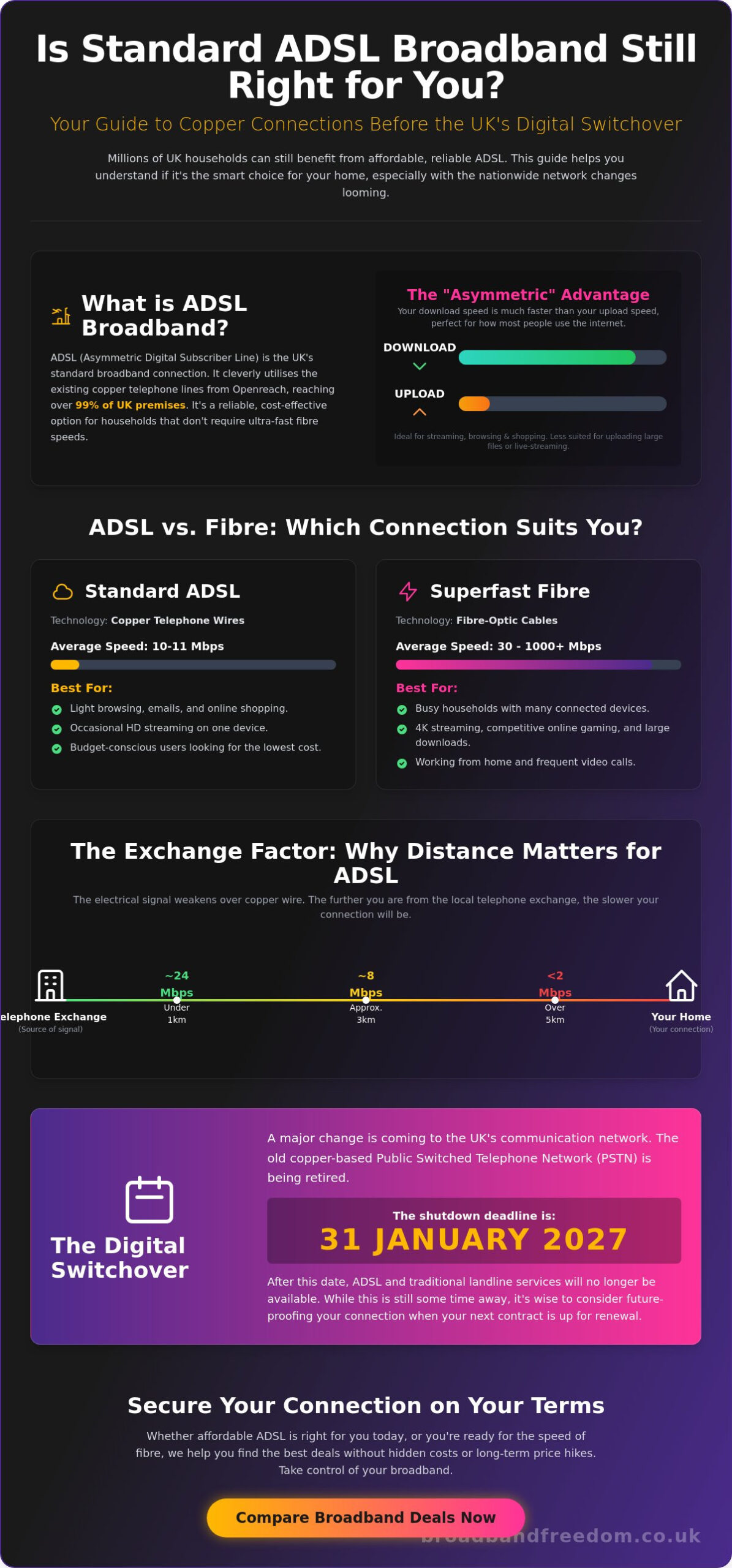
Standard broadband doesn’t have to be a compromise. ADSL is the baseline UK connection that utilises existing Openreach phone lines to provide internet without the need for specialist fibre installation. While the tech giants push for full fibre, this legacy infrastructure still reaches over 99% of UK premises. It remains a tactical choice for those who value simplicity and low monthly costs over raw speed. Choosing this option means you’re using the same copper wires that have delivered telephone services to British homes for decades.
Securing the best ADSL broadband deals in 2026 is about finding a sweet spot between price and utility. These packages are typically the most affordable entry point for home internet. If your household mostly checks emails, shops online, or streams the occasional film, paying for a gigabit connection is often an unnecessary expense. We see it as a specialized tool for light users who want to keep their monthly outgoings predictable and low.
The Meaning of "Asymmetric" in Your Connection
The "A" in ADSL stands for Asymmetric. This means your download speed is significantly faster than your upload speed. It’s a pragmatic design choice. Most people consume content rather than create it. If you’re browsing news sites or watching Netflix, you’re downloading data. This behaviour suits standard copper lines perfectly. However, if you’re a professional sending large files to a server, the slower upload speeds will be noticeable. This distinction matters because it helps you select a service based on how you actually use the web, not just the highest number on a marketing flyer.
ADSL vs ADSL2+: The Evolution of Copper
The technology has evolved since its inception. Original ADSL was quite limited in its capacity. The transition to the ADSL2+ standard brought a noticeable boost to the UK market. It pushed potential speeds up to 24Mbps; though most providers advertise an average of 10 or 11Mbps to stay honest about real-world performance. To understand the deeper mechanics of ADSL technology, you can explore how it manages different frequencies on a single wire. Most ADSL broadband deals you’ll find in 2026 are technically ADSL2+. This ensures you’re getting the most capable version of copper internet available before the network eventually moves toward a fully digital future.
The Technical Side: Understanding Speed, Stability, and Your Telephone Line
Why do two houses on the same street often experience completely different internet performance? Advertised speeds for ADSL broadband deals are usually based on what at least 50% of customers receive during peak evening hours, typically between 8pm and 10pm. However, your individual reality depends on several physical factors that providers cannot control. Understanding these variables helps you manage expectations and troubleshoot issues without waiting for a technician. For a deeper look at how these connections are defined globally, you can consult this Official Broadband Guide to see how standard connections differ from higher-tier services.
One critical piece of kit you’ll encounter is the microfilter. This small plastic box acts as a traffic warden for your telephone line. It separates the high-frequency digital data signal from the low-frequency voice signal used for calls. If you don’t use microfilters on every active phone socket in your home, you’ll likely experience frequent disconnections or audible noise during phone conversations. Modern master sockets often have these filters built-in, but older UK homes still require the external plug-in versions to maintain a stable link.
The Exchange Factor: Why Distance Matters
The physics of copper wire is the primary reason for speed variation. Signal degradation, or attenuation, occurs as the electrical signal travels from the local telephone exchange to your front door. The further the signal has to travel, the weaker and slower it becomes. If your home is within 1km of the exchange, you might see speeds close to the 24Mbps limit of ADSL2+. If you’re 5km away, your speed could drop below 2Mbps. Always use a postcode checker to get a realistic estimate before signing a contract. You can compare standard broadband deals to see which providers offer the best estimated speeds for your specific location.
Hardware Essentials for a Reliable Signal
Internal factors are just as important as external ones. Your router should be connected directly to the master socket, which is usually the point where the phone line enters your property. Extension cables and poor-quality internal wiring can significantly increase interference and slow your connection. Placing your router in a central, elevated position away from other electronics like microwaves or baby monitors will improve its behaviour. While providers often supply a basic hub, investing in a high-quality router can help manage multiple devices more efficiently, even on a basic 11Mbps line. This ensures your connection remains stable whilst you browse or stream.
ADSL vs Fibre Broadband: Deciding Which Connection Suits Your Home
Choosing between copper and fibre often feels like a choice between the past and the future. Whilst 97% of UK properties can now access superfast speeds of 30 Mbps or more, ADSL broadband deals remain a tactical baseline for many households. The primary difference lies in the delivery; standard ADSL offers average speeds of 10 to 11 Mbps, whereas entry-level fibre starts at 36 Mbps. If you’re deciding which suits you, consider the cost gap. For some, saving £5 to £10 per month is more important than having bandwidth they’ll never actually use. It’s about finding a solution on your terms, not paying for speed for the sake of it.
Reliability is the other side of the coin. Traditional copper wires are susceptible to environmental factors like water ingress in old underground pipes or electrical interference from household appliances. Fibre optic cables use light to transmit data, making them significantly more stable over long distances. We’ve come a long way since the development of the first asymmetric digital subscriber line (DSL) modem, and today’s fibre is undeniably more robust. However, for a single person checking emails and streaming in standard definition, the older copper tech still gets the job done reliably enough.
| Feature | ADSL (Standard) | FTTC (Superfast) | FTTP (Full Fibre) |
|---|---|---|---|
| Average Speed | 10-11 Mbps | 36-67 Mbps | 100-1000+ Mbps |
| Monthly Cost | Lowest (£) | Mid-Range (££) | Premium (£££) |
| UK Availability | 99% | 97% | Over 17.1 million homes |
The Copper Switch-Off: What It Means in 2026
The UK is currently in the middle of a massive infrastructure shift. Openreach plans to retire the analogue PSTN network by January 31, 2027. This means traditional phone lines are being replaced by a digital-only system called SOGEA (Single Order Generic Ethernet Access). If you’re looking for ADSL broadband deals today, don’t worry about suddenly losing your connection. "Standard" speed options will still exist on the new network; you might just need a newer router or a small adapter for your handset. The goal is a more reliable, digital-first Britain, but the choice to stick with a basic, affordable speed remains yours.
As you transition to modern digital services, it is also a great time to clear away old, redundant equipment from your property; for professional removal of legacy antennas and aerials, Dish Goodbye provides a reliable UK-wide service.
Who is ADSL Actually For?
We categorise the ideal ADSL user as a "Light User." If your online life consists of basic web browsing, social media, and the occasional Netflix show in SD, a 10 Mbps line is perfectly functional. It’s also a favourite for those on a strict budget or students in short-term accommodation who want to avoid the high setup fees of premium fibre. For those who explore Luxury Studio Apartments with providers like Unipad in Lancaster, these simple connections offer the perfect balance of affordability and utility during their studies. Some home workers even maintain a standard copper line as a secondary back-up. If your primary fibre line fails, having a separate ADSL connection ensures you stay online without relying on patchy mobile data.
How to Find the Best ADSL Deals whilst Navigating the Market
Compare. Select. Save. Finding the best ADSL broadband deals in 2026 requires looking beyond the flashy headline price. While a package might start at £21.99 per month, you need to calculate the total cost over the entire contract term to avoid nasty surprises. Start by checking availability for your specific postcode; as we’ve established, ADSL is now primarily reserved for areas where fibre hasn’t yet reached or for those specifically seeking a budget-friendly baseline. It’s about finding a solution that fits your life, not just the provider’s sales targets.
Keep a sharp eye out for "no upfront cost" offers. These deals are excellent for keeping your initial outlay at zero, but they sometimes carry slightly higher monthly fees. Conversely, paying a small setup fee of £15 or £20 can sometimes unlock a cheaper long-term monthly rate. Always verify if the line rental is included in the advertised price; in 2026, most UK providers bundle this, but it remains a factor in the overall value proposition. Taking ten minutes to read the summary of the deal ensures you’re getting broadband on your terms. If you’re setting up a home connection for the very first time, our first time broadband user guide walks you through every step of the process, from choosing the right speed to avoiding confusing contracts.
Identifying Hidden Costs and Price Hikes
Don’t ignore the small print regarding annual price increases. Most major UK providers now link their mid-contract hikes to the Consumer Price Index (CPI) plus an additional 3.9%. This usually happens every April. To get a true sense of value, calculate your Total Cost of Ownership across the 12 or 18-month term. Some savvy smaller providers use "price freezes" as a competitive advantage, promising that your rate won’t budge for the duration of your stay. This transparency is key to staying in control of your finances and avoiding "bill shock" later in the year. If you want to understand exactly how these annual increases affect your total spend, our guide to how to compare broadband deals and save on your terms in 2026 breaks down the true cost of every major UK package.
Flexible and No-Contract ADSL Options
Renters and students often need internet that doesn’t outstay its welcome. 30-day rolling contracts are the ultimate tool for flexibility, allowing you to cancel with just a month’s notice. While these often come with higher setup fees or slightly increased monthly rates, the freedom from long-term debt is often worth the trade-off. Because the copper infrastructure is already in place in 99% of UK homes, ADSL broadband deals are frequently the fastest and easiest connections to organise on a short-term basis. You can find flexible broadband deals here that match your specific living situation without the fear of being locked in.
Secure Your Connection on Your Terms with Broadband Freedom
Broadband Freedom acts as your expert friend, organising the chaos of the UK market so you don’t have to. We’ve seen how the telecommunications industry often relies on cold, corporate detachment; we choose a different path. Our goal is to help you find ADSL broadband deals that suit your lifestyle, not the sales targets of a provider. We believe in liberation from "analysis paralysis" by providing pragmatic, user-centric advice that puts you back in the driving seat.
Every household has unique constraints. You might be looking for a 24-month bargain to lock in a low price before the January 31, 2027, copper switch-off. Alternatively, you might need a monthly rolling deal for a short-term flat. Whatever your situation, our platform simplifies the process to save you both time and money. We focus on transparency, ensuring you understand exactly what you’re signing up for before you click "apply." It’s about getting broadband on your terms, without the fear of being trapped in a contract that doesn’t fit.
Our Comparison Framework
We don’t just list the big names. Our framework filters for the things that actually matter to you: speed, total cost, and true flexibility. We frequently find hidden gems amongst smaller UK providers who offer more competitive rates or better customer service. Our core offering includes a heavy focus on "No Contract" and "Student" deals, acknowledging that many users need agility rather than a long-term commitment. By comparing ADSL broadband deals through this lens, we ensure you see the full picture of the market, not just the most advertised options.
Our criteria include:
- Total Cost of Ownership: We calculate the full price including any setup fees.
- Contract Length: We prioritise options that offer 1-month or 12-month flexibility.
- Hidden Clauses: We highlight annual price hikes so you aren’t surprised in April.
Switching Made Simple
Switching your provider is now easier than it’s ever been. The "One Touch Switch" process is fully active across the UK, meaning your new provider handles the bulk of the admin for you. If you’re moving from one ADSL provider to another, the transition is virtually seamless with minimal downtime. You won’t need to spend hours on the phone to your old provider’s retention department. Take control of your digital life today and ensure your home connection remains reliable, affordable, and flexible. Freedom from high costs is just a few clicks away.
Take Control of Your Home Connection Today
Standard copper internet remains a reliable, cost-effective tool for households that don’t need the excessive speeds of premium fibre. By understanding the impact of exchange distance and the upcoming January 31, 2027, network transition, you can make a choice that avoids unnecessary monthly expenses. We specialise in helping you find the best ADSL broadband deals without the fear of hidden price hikes or restrictive long-term commitments.
Broadband Freedom is a trading style of Maxed Up Media Ltd, experts in UK lead generation since 2014. We focus on the flexible student and no-contract deals that larger providers often ignore. Our curated lists ensure you find a simple solution to a complex problem. Finding the right internet shouldn’t be a chore. Secure your digital independence and start saving on your monthly bills today.
Compare the best ADSL broadband deals on your terms today
Frequently Asked Questions
Is ADSL broadband being phased out in the UK?
Yes, ADSL is being actively phased out as part of the UK’s transition to fibre-to-the-premises (FTTP) technology. Openreach is moving away from legacy copper infrastructure, and you can generally only get new ADSL deals if fibre is physically unavailable at your property. By January 31, 2027, the traditional network will be fully retired, though "standard" speed digital equivalents will remain available for those who need them.
Can I still get ADSL broadband without a landline?
No, traditional ADSL requires an active copper telephone line to function, though modern SOGEA versions provide the same speeds without a separate voice call service. Historically, you had to pay for line rental alongside your internet. In 2026, most providers bundle these costs together, so while the physical wire is there, you don’t necessarily need a handset or a traditional phone contract to stay online.
Is ADSL broadband fast enough for Netflix and Disney+?
Yes, an average ADSL speed of 10 to 11 Mbps is sufficient for streaming Netflix or Disney+ in Standard Definition (SD) or even High Definition (HD) on a single device. Netflix recommends 3 Mbps for SD and 5 Mbps for HD content. However, if multiple people in your home try to stream or download simultaneously, you’ll likely experience buffering and significant slowdowns due to limited bandwidth.
How long does it take to install an ADSL broadband connection?
Installation typically takes between 10 and 14 working days from the moment you sign your contract. Because 99% of UK homes already have the necessary copper wiring, a technician rarely needs to visit your property. Your provider will simply send a router in the post and activate the signal remotely at the local exchange, making it one of the simplest ADSL broadband deals to set up.
What is the average cost of an ADSL broadband deal in 2026?
Prices for standard broadband in May 2026 start from approximately £21.99 per month for basic packages. For example, italk offers a 10 Mbps average speed deal at this price point, whilst BT offers a similar service for £29.99 per month. These entry-level costs make standard copper connections the most affordable baseline for households prioritising budget over high-speed performance.
Do I need a special router for ADSL2+?
Yes, you need a router that is compatible with the ADSL2+ standard, but almost every router supplied by UK providers since 2014 includes this as standard. If you’re using your own hardware, ensure it supports Annex A for UK lines. Most modern hubs are auto-sensing, meaning they’ll automatically detect whether they are plugged into a copper ADSL line or a faster fibre connection without manual configuration.
What happens to my ADSL connection during the 2025/2026 copper switch-off?
Your physical connection will remain, but the underlying service will move from the analogue PSTN network to a digital VoIP system. The final deadline for this switch is January 31, 2027. You won’t lose internet access, but you might receive a new router or a digital adapter for your landline phone. It’s a seamless transition designed to make the UK’s legacy infrastructure more reliable for the future.
Can I get a student-specific ADSL deal for just 9 months?
Yes, several providers offer 9-month contracts specifically tailored to the academic year, though these are becoming rarer as the market shifts toward 12-month or 30-day rolling terms. These ADSL broadband deals are ideal for students who don’t want to pay for a property they’ll leave in the summer. Choosing a
no-contract, rolling monthly option is often a safer way to maintain flexibility on your terms.
Related links
Beginners guide to internet jargon

Article by
Elaine Lang
Elaine has over 20 years across Marketing, Communications and Public Relations in the UK. She has worked across large UK corporations, including Commercial Banks and Airports, to online consumer finance and technology solutions. Elaine has post graduate qualifications in Marketing from the Chartered Institute of Marketing (CIM) and the Industry of Direct Marketing (IDM). She is a lifelong feline fan, sharing her home with around 4-6 cats for many years. This of course can be a challenge when trying to work at home, as they like to try to help!