Basic Broadband Deals in the UK: What Speed Do You Really Need?
If you are searching for basic broadband deals, the good news is this: basic does not mean bad. It just means you are buying for the way you actually use the internet, not for a fantasy version of your household. For plenty of people, that is the smarter move. You do not need ultrafast speeds to check emails, browse websites, pay bills online, stream the odd show, or join a video call now and then. The real trick is understanding what speed you genuinely need, what you can safely ignore, and where providers make a simple package look cheaper than it really is. To start comparing what is out there, Broadband Freedom’s Broadband Comparison, Compare Broadband Deals, and Compare Broadband Prices are useful places to begin.
Quick answer: what speed do you really need from a basic broadband deal?
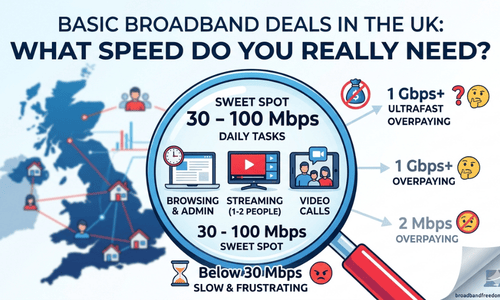
Most people looking at basic broadband deals do not need gigabit internet. They need a reliable connection that comfortably handles everyday use without forcing them to overpay. In broad terms, a decent connection has long been considered enough for browsing, streaming TV, and making video calls, while most UK homes can now access superfast broadband at 30 Mbit/s or above. Ofcom has also said customers should be shown the speed they are likely to get at busy times, not just an ideal headline number. If your household is light-use, one-person, or budget-focused, a modest fibre package may be all you need. For context, look at Broadband Speed Comparison, Internet Speed, and The Ultimate Guide Internet Speed Test.
Quick comparison table: what to check before buying a basic package
| What to compare | Why it matters | What to watch out for |
| Estimated speed | Shows what your home is likely to get | Headline speeds can look better than real-world performance |
| Contract length | Affects flexibility and switching options | Longer terms can lock you into more than you need |
| Setup fees | Changes true first-year cost | Cheap monthly deals can come with upfront charges |
| Price rises | Impacts affordability over time | Annual increases can hit cheaper packages hard |
| Connection type | Affects reliability and future-proofing | Older tech can be slower than it looks on paper |
| Home phone included or not | Can add cost you do not need | A basic deal is often better as broadband-only |
What counts as a basic broadband deal?
This is where it helps to forget the jargon for a second.
A basic broadband deal is not some special technical category. It is just a package aimed at people who want a simple, lower-cost internet connection without paying for speeds or extras they are unlikely to use.
That usually means a package designed for:
- browsing websites
- checking email
- online banking
- watching the odd bit of Netflix or catch-up TV
- light social media use
- occasional video calls
In other words, basic internet packages UK shoppers are not necessarily looking for the cheapest internet full stop. They are looking for the cheapest package that still works properly for their daily life.
That distinction matters.
Because basic does not mean unusable.
A lot of people hear “basic broadband” and assume it must be frustratingly slow. But that is not really the right way to think about it. If your household is light-use, a smaller package can be absolutely fine. The problem only starts when your usage no longer matches the package.
Broadband Freedom already has useful supporting pages here, including Best Broadband Plan, Monthly Plans, Broadband Type, and Full Fibre vs Standard Fibre vs ADSL. Those pages help frame what “basic” really means in practical terms.
What speed do you actually need for everyday use?
This is the question most people actually want answered.
And the answer is not one number for everyone.
It depends on how many people are in the home, what they are doing online, and whether several things are happening at once. Ofcom has noted that average home broadband speeds continue to rise as more people upgrade, but that does not mean every home needs that level of service. Older Ofcom guidance also points out that a decent connection can be enough to browse the internet, stream TV, and make video calls, while customers should be given likely busy-time speeds when buying.
Browsing, email and banking
If your internet use is mainly browsing websites, reading the news, shopping online, sending emails, and handling things like online banking, your needs are modest.
You do not need a top-end package for that.
A broadband for one person setup or low usage broadband UK package can often handle these tasks comfortably if the connection is stable and the speed estimate is realistic. That is why it is worth using Internet Speed and Broadband Speed Test as reference points when comparing entry-level deals.
Netflix and catch-up TV
Streaming changes the picture slightly, but not as dramatically as many providers would have you think.
If one person is watching Netflix, BBC iPlayer, or other catch-up services, a basic package can still be enough. The issue comes when several streams are happening together, especially at higher quality settings.
This is where people often overbuy out of fear. They assume streaming automatically means they need ultrafast broadband. In reality, a well-matched lower or mid-tier fibre package may do the job perfectly well. Relevant internal reads here include Boost Broadband Speed, Dial-Up to Fibre, and Full Fibre Broadband UK 2025.
Video calls for one or two people
Video calls are another common reason people panic and assume they need a huge package.
But for one or two people, occasional Zoom, Teams, or WhatsApp calls do not automatically mean you need premium broadband. What matters more is a stable connection and a realistic busy-time speed. Ofcom’s speed guidance specifically says customers should be told the speed they are likely to experience at busy times of day.
If video calling matters to you, Broadband Freedom’s Video Call Broadband 2025, Good Upload Speed UK, and The Ultimate Guide Internet Speed Test are all useful supporting reads.
What happens when several devices connect at once
This is where a basic package can start to feel less basic and more limiting.
One person browsing is easy. One person streaming is usually manageable, too. But if one person is watching Netflix, another is on a video call, someone else is scrolling TikTok, and a smart TV is updating in the background, things change.
That does not always mean you need gigabit broadband. But it does mean the cheapest package on the page may stop feeling like a good deal.
If your household has several connected devices, it is worth exploring Broadband for Smart Homes UK 2025, Fix WiFi Dead Zones 2025: Mesh, Powerline, Extenders, and Best Wi-Fi Box for Home: Top Routers and Mesh Picks.
Who basic broadband is best for
A basic package is not for everyone. But for the right household, it can be exactly the right buy.
One-person households
This is one of the clearest fits.
If you live alone and mostly use the internet for browsing, streaming now and then, shopping, admin, and a bit of social media, you probably do not need a premium package. That is where broadband for one person becomes a very practical search and a very practical solution.
Useful supporting resources here include Monthly Plans, Broadband With No Phone, and No Contract Broadband.
Light users
This is the core audience for this whole topic.
If your usage is light, a bigger package is often just wasted spend. Plenty of users end up paying for speed they rarely come close to using. That is why broadband for light users is such an important decision-stage keyword. It reflects a real buying moment.
Broadband Freedom’s Getting the Right Broadband Plan, Best Broadband Plan, and Compare Broadband Prices all naturally support this angle.
Second homes
Second homes are another strong use case.
If the internet is only used occasionally, there is often no need to pay for a full-fat package. In those cases, cost and flexibility matter more than peak speed. That is where shorter contracts or simpler entry-level packages may be more appealing than long fixed terms.
Relevant internal links here include Compare 1 Month Rolling Broadband, Rolling Monthly Broadband Renters 2025, and No Contract Broadband in the UK: The Ultimate 2025 Guide.
Households trying to cut costs
This is the biggest opportunity.
A lot of users are not looking for “better” broadband. They are looking for broadband that is good enough and cheaper than what they are paying now. That is exactly where cheap basic broadband and best cheap broadband deals fit.
Broadband Freedom already has several strong support pages here, including Cheap Broadband Deals, Best Broadband Deals, Pricing, and Why a Broadband Package Comparison Beats Staying Put.
When basic broadband is not enough
This part matters just as much as the money-saving angle.
Because not every household should go basic.
Remote work
If you work from home regularly, especially with video meetings, cloud-based tools, or large file uploads, a very basic package may start to feel restrictive. Stability matters here just as much as headline speed.
You do not necessarily need a huge package. But you do need something reliable enough to avoid dropouts and frustration. Good supporting links here include Video Call Broadband 2025, Good Upload Speed UK, and Internet Speed.
Gaming
Gaming is where entry-level packages can struggle more quickly, especially if there are multiple devices online at once. Download speed matters, but so do consistency, latency, and Wi-Fi quality.
If gaming is a regular part of life in your home, Broadband for Gamers UK 2025, Holiday Gaming Broadband 2025, and Best Wi-Fi Box for Home: Top Routers and Mesh Picks are better next reads than the cheapest comparison page alone.
4K streaming on multiple devices
This is another point where basic broadband can start to creak.
One stream may be fine. Several higher-quality streams at the same time are another story. If your household regularly streams across multiple TVs, tablets, and devices, a bigger package becomes easier to justify.
Useful internal links here include Broadband and TV Packages, Compare Latest Broadband With TV Packages, and Gigabit Internet UK 2025.
Busy family homes
A busy home usually needs more breathing room.
Several users, smart devices, video calls, streaming, gaming, and updates all competing for bandwidth can expose the limits of a basic package quickly. In those cases, it often makes more sense to buy a slightly stronger package than the absolute cheapest available.
Supporting content here includes Broadband for Smart Homes UK 2025, Broadband for Gamers UK 2025, and Full Fibre Broadband Coverage Hits 83% of UK Premises: What This Means for You.
How to compare basic broadband deals properly
This is where the smart buying happens.
Download speed vs real household usage
This should always be the first test.
Do not buy based on the fastest number on the page. Buy based on what your household actually does. Ofcom says consumers should be shown likely busy-time speeds, because those are often lower than maximum headline figures.
That matters because a smaller package with a realistic busy-time speed may be plenty for a light-use household, while a bigger package may simply be overspending.
Helpful internal links here include Broadband Speed Comparison, Internet Speed, and Broadband Speed Test.
Contract length and exit flexibility
A cheap monthly deal is not always good value if it ties you in for longer than you want.
That is especially true for renters, second homes, or anyone expecting their circumstances to change. Sometimes a slightly higher monthly price on a shorter contract is the smarter decision.
Broadband Freedom has strong supporting content here, including Broadband Contract Lengths Explained, 1 Month vs 12 Month Broadband Contracts: What’s the Real Cost?, Compare 12 Month Broadband Packages, and Compare 1 Month Rolling Broadband.
Set-up fees and annual price rises
This is where a lot of cheap deals stop looking cheap.
A package may have a low monthly rate but come with setup fees, router charges, or annual increases that change the picture over time. Ofcom introduced new rules from 17 January 2025 prohibiting inflation-linked or percentage-based mid-contract price rise terms in new contracts, and requiring providers to set out in-contract price rises in pounds and pence. Ofcom’s 2026 pricing report says these rules were introduced to improve transparency for consumers, though it also notes that flatter rises can hit cheaper packages proportionally harder.
That is why setup costs and price rises matter even more for budget shoppers.
Useful internal reads here include Broadband Price Rises and Exit Fees, BT and EE Out-of-Contract Price Increases Explained, Pricing, and Compare Broadband Prices.
Cost-saving tips before you switch
This is where readers can save real money.
Check your actual speed needs
Do not guess. Look at how you use the internet now.
If your home mainly handles browsing, streaming now and then, and basic day-to-day tasks, you may not need anything close to the biggest package available. Support pages like Broadband Speed Comparison and The Ultimate Guide Internet Speed Test help here.
Compare shorter and longer terms
Longer contracts can reduce the monthly rate, but they are not automatically a better value. If flexibility matters, the cheaper-looking long-term deal may not be the right choice. It is worth comparing Compare 1 Month Rolling Broadband, Compare 12 Month Broadband Packages, and Compare 24 Month Broadband Packages before deciding.
Do not pay for a gigabit if 30 to 100 Mbps will do
This is probably the biggest overspend trap in broadband.
Gigabit internet is great for the right household. But if your needs are basic, paying for that level of performance may just be unnecessary. Ofcom has noted that most UK homes can access superfast broadband, while average UK speeds continue to climb as take-up of faster services grows. That is useful market context, but it does not mean every household should buy the fastest package available. (www.ofcom.org.uk)
Good internal links here include Gigabit Broadband Coverage UK 2025, Gigabit Internet UK 2025, and Full Fibre Broadband UK 2025.
Look at broadband-only if you never use a home phone
If you never touch a home phone, dropping that part of the package can be an easy saving.
In that case, broadband-only may be cleaner and cheaper than a bundled package. Useful next reads include Broadband Without Landline Phone, Broadband Without Landline, and Broadband With No Phone.
FAQs about basic broadband deals
For broader questions, readers can also visit Broadband Freedom’s FAQ page.
What is the cheapest type of broadband?
Usually, the cheapest broadband is an entry-level package with lower speeds and fewer extras. But cheapest on paper is not always cheapest overall. Setup fees, contract length, and future price rises can all change the true value, so it is always worth comparing total cost rather than headline monthly pricing alone.
Is basic broadband enough for streaming?
Yes, often it is. For one person streaming casually, a basic fibre package may be enough. The problem tends to come when several people stream at once, especially in higher quality. That is when a low-cost package can start to feel stretched and a slightly stronger deal may be worth paying for.
Can I get basic broadband with no contract?
Yes, in some cases. No-contract or rolling broadband options do exist, and they can be useful for renters, short stays, or anyone who wants flexibility. The trade-off is that they may cost more each month than a longer fixed-term deal, so it is worth comparing both styles carefully before deciding.
Is full fibre worth it for light users?
Sometimes. Full fibre can offer better reliability and future-proofing, but light users do not always need to pay extra for the fastest full fibre package available. If a lower-cost fibre option already covers your daily use comfortably, that may be the better-value choice for your household.
Recommended next steps
The smartest thing about basic broadband deals is that they force a useful question.
Not “What is the fastest package I can get?”
But “What do I actually need?”
For plenty of people, that answer is much smaller than the market would have them believe. If you live alone, use the internet lightly, want to cut monthly costs, or simply do not need ultrafast performance, a basic package can be exactly the right fit. The key is making sure basic still means reliable, and not buying so cheaply that everyday use becomes frustrating.
Before you switch:
- check your real usage, not your assumed usage
- compare likely busy-time speeds
- review contract flexibility
- factor in setup fees and future price rises
- avoid paying for top-end speeds if a modest package will do
That is how you find basic broadband deals that feel like genuine value rather than just a low sticker price.
For the next step, start with Compare Broadband Deals, review Compare Broadband Prices, and use Broadband Speed Comparison to narrow down what actually fits your household.