Full Fibre Network Providers: Navigating the UK Landscape in 2026

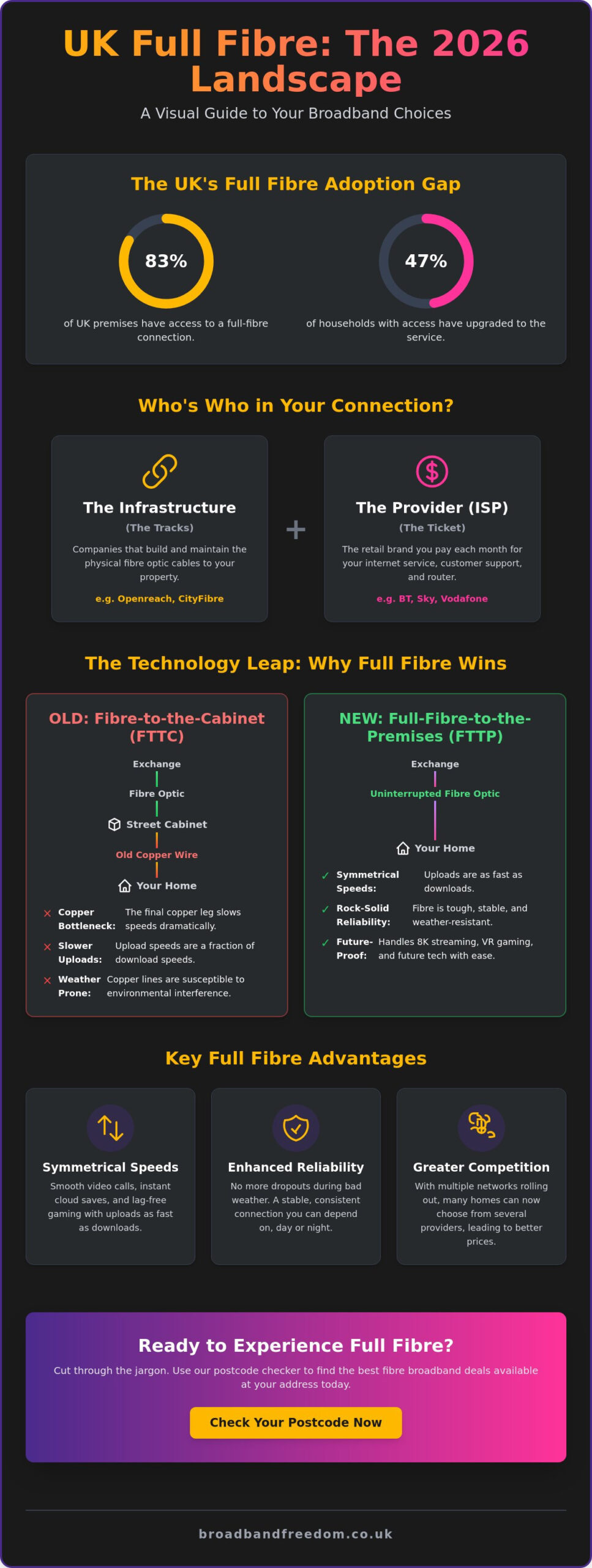
As of 2026, a staggering 83% of UK premises have access to a full-fibre connection, yet only 47% of households have actually taken up the service. It’s understandable if you feel hesitant about making the move. Between the household names you’ve used for years and the wave of new independent “Altnets” appearing in your street, the sheer volume of full fibre network providers can feel overwhelming. You want a faster connection; you don’t want the headache of deciphering who actually owns the cables versus who sends the monthly bill.
This guide simplifies the UK’s infrastructure so you can stop guessing and start choosing with confidence. We’ll break down the differences between national giants and local independent networks. You will discover which ISPs use which infrastructure and how to benefit from the “One Touch Switch” process. This ensures you find the perfect broadband deal or student package without the usual decision fatigue.
- Understand the difference between full fibre network providers that build the physical infrastructure and the retail brands that manage your monthly bill.
- Identify how national giants like BT and Sky utilise the Openreach backbone to deliver reliable connectivity to your home.
- Discover the role of independent “Altnets” like CityFibre and how they provide vital competition to traditional industry leaders.
- Match your household’s digital habits to the correct speed tier so you don’t overpay for bandwidth you won’t use.
- Use a postcode availability checker to cut through the jargon and find the best fibre broadband deals currently available in your area.
Understanding the Landscape of Full Fibre Network Providers in 2026
By May 2026, the UK’s digital map has undergone a radical transformation. Full Fibre (FTTP) is no longer a luxury reserved for new-build estates or major city centres; it’s the national standard for reliable home connectivity. With 83% of premises now able to access these ultrafast speeds, the conversation has shifted from basic availability to meaningful choice. You’re no longer stuck with whatever happened to be installed ten years ago. Instead, you can choose a service that matches your specific household demands.
Understanding how the UK internet infrastructure functions is the first step to making an informed decision. The market is more crowded than ever, but it’s also more transparent. Choosing between different full fibre network providers often comes down to which physical infrastructure has reached your street first and which retail brand offers the contract flexibility you need.
The Infrastructure vs Provider Distinction
It’s helpful to think of the broadband market as a railway. The company that owns the tracks is the wholesaler, whilst the company that sells you a ticket is the retailer. In many cases, the company digging up the road to lay glass cables isn’t the same one that sends your monthly bill. Most households interact with famous retail brands, but these companies often rely on third-party full fibre network providers to carry their data. This distinction is vital for troubleshooting. If there’s a physical break in the line, your ISP must coordinate with the network owner to fix it. Knowing who owns your “tracks” helps you understand the speed guarantees and repair times you can expect.
Why the Shift to FTTP Matters Now
Older “Superfast” connections (FTTC) were a halfway house. They used fibre to the green cabinet on your street but relied on ageing copper wires for the final journey to your home. This copper creates a bottleneck that limits speed and reliability. True Full Fibre replaces that copper entirely with light-speed glass strands directly into your router. By 2026, our data demands have scaled significantly. Households now juggle 8K streaming, immersive VR gaming, and constant cloud-based remote working simultaneously. Copper-hybrid lines simply can’t provide the symmetrical speeds or the low latency required for these tasks. Switching to a dedicated fibre line ensures your connection remains stable even during peak evening hours when the rest of the neighbourhood is online. If you’re still weighing up the upgrade, our in-depth analysis of whether full fibre is worth it for your household cuts through the common misconceptions to give you an honest picture of the real-world value.
The benefits of modern infrastructure include:
- Symmetrical Speeds: Uploading large files or video calling becomes as smooth as downloading content.
- Enhanced Reliability: Fibre cables are immune to the weather-related interference that often plagues copper wires.
- Postcode Competition: The rapid expansion of various networks means many homes now have two or three different fibre options.
If you’re ready to see which networks have reached your doorstep, you can compare broadband deals to find a package that prioritises your budget and speed requirements. With Openreach on track to reach 25 million homes by the end of 2026, the opportunity to upgrade has never been more accessible.
The Major Players: National Infrastructure and Their Partners
While the UK market is home to dozens of specialised companies, two giants provide the backbone for the vast majority of connections. Openreach and Virgin Media O2 are the primary full fibre network providers that most households rely on. These organisations build the physical infrastructure, whilst the brands you see in television adverts act as the interface for your contract and customer service. Choosing a provider on one of these national networks often offers the greatest peace of mind regarding long-term reliability and engineer support.
The expansion of these networks is often accelerated by the Project Gigabit programme, which ensures that even harder-to-reach areas aren’t left behind in the digital transition. This government-backed initiative works alongside commercial rollouts to ensure the UK hits its target of 99% gigabit-capable coverage by 2032. For most consumers, your choice will likely begin with a decision between these two established ecosystems.
The Openreach Network Ecosystem
Openreach is the largest and most widely available network in the country. It doesn’t sell broadband directly to consumers. Instead, it provides the “tracks” for a huge variety of retailers. Major household names like BT, Sky, TalkTalk, and Vodafone all utilise this single physical connection. This creates a significant advantage for you as a consumer. Because so many brands use the same infrastructure, switching between them is incredibly simple. You don’t usually need a new line installed or a visit from an engineer if you move from BT to Sky; it’s often a seamless “One Touch Switch” process handled behind the scenes.
Virgin Media O2 and the Nexfibre Expansion
Virgin Media O2 occupies a unique space in the market. Historically, they operated a completely separate cable network, but they are now rapidly transitioning to full fibre. To reach areas beyond their traditional footprint, they have partnered with nexfibre. This joint venture is a significant new player amongst full fibre network providers, aiming to reach 5 million additional homes by the end of 2026. Unlike older cable technology, these newer fibre builds often support symmetrical speeds. This means your upload speed can be just as fast as your download speed, which is a game-changer for content creators and heavy cloud users.
Selecting a deal on these national networks gives you access to some of the most stable connectivity in the country. If you want to see which of these giants has reached your street, you can compare broadband deals to view the latest offers and speed tiers available at your specific address.
The Rise of Altnets: Independent Full Fibre Networks
While the national giants provide the broad strokes of UK connectivity, a wave of independent full fibre network providers, known as “Altnets,” is filling the gaps with high-speed precision. These alternative networks build their own physical infrastructure from the ground up. They don’t rely on the old copper wires or the established Openreach tracks. This independence allows them to be more agile, often reaching specific towns or housing developments with technology that outpaces the traditional players. For you, this means more choice and, frequently, much better value for money.
Altnets have transformed from niche players into serious contenders. By May 2026, they’ve become the primary reason why many regional urban centres enjoy some of the fastest residential speeds in the world. They provide a vital layer of competition that keeps the “Big Two” on their toes. If an Altnet has arrived in your street, you’re often looking at significantly lower monthly costs and superior hardware compared to what you’d find on a national network.
CityFibre: The Multi-Gigabit Revolution
CityFibre is currently the leading challenger to the national status quo. They operate on a wholesale-only model, which means they build the network and then allow various independent ISPs to sell their services over it. This is great for consumers because it fosters a mini-marketplace of competing deals on a single, high-quality line. By 2026, CityFibre has hit a major milestone, with 8.5Gbps capabilities enabled across their entire footprint. This makes them a powerhouse for data-heavy households. You can explore our guide to broadband providers to see which brands are currently using the CityFibre backbone to serve your postcode.
Specialist Networks: Hyperoptic and Community Fibre
Not all Altnets aim for national coverage. Some focus on being the best in a specific niche. Hyperoptic, for example, has built a dominant position by specialising in large apartment buildings and social housing. They run fibre directly into the building, avoiding the complications of street-level digging. Similarly, Community Fibre has focused its efforts on London, providing exceptionally fast, reliable connections to millions of residents. A major advantage of these specialist full fibre network providers is their focus on symmetrical speeds. In these areas, your upload speed is just as fast as your download speed. This is a massive benefit if you regularly upload large files to the cloud or spend your day in high-definition video conferences.
For businesses who want to pair this high-speed connectivity with expert infrastructure management, you can explore Managed IT Support from specialists like Networking2000.
The trade-off with Altnets is simple: they offer incredible performance but limited reach. Whilst Openreach is available to the vast majority, an Altnet might only serve your specific street or building. However, if you’re within their coverage zone, you can often find gigabit-speed deals for under £35 per month, with some entry-level fibre packages starting as low as £17. It’s always worth checking if a local specialist has reached your area before defaulting to a national brand.
Choosing the Right Provider for Your Lifestyle
Finding the right fit depends on your daily habits, not just the technical specs of the full fibre network providers in your area. A professional gamer living alone has different requirements to a family of five with multiple 4K screens running at once. Don’t be swayed by the biggest number on the marketing flyer. Instead, focus on what your household actually does online. You want a service that fits your life, not a contract that limits your freedom.
By 2026, the market has matured to offer highly specific packages for different types of users. Whether you are a student moving into a shared house or a homeowner looking for a long-term reliable connection, the choice is yours. It is no longer just about who is the cheapest; it is about who offers the best value for your specific living situation.
Speed vs Value: Calculating Your Requirements
Start by assessing your current performance. Use a broadband speed test to see what you’re actually getting versus what you’re currently paying for. If you live alone or in a couple, a 100Mbps connection is usually plenty for seamless 4K streaming and high-definition video calls. If you’re a heavy-use family with dozens of connected devices, moving up to a 500Mbps or 1Gbps package ensures nobody experiences lag during peak times. Remember that Gigabit speeds are often more than a single user can actually utilise. Don’t pay for capacity you’ll never reach.
Contract Flexibility and Student-Friendly Options
Contract length is a critical factor, especially if you’re a student or a renter. Many major brands still try to lock you into 18 or 24-month terms, which can be a nightmare if you move house frequently. Look for no contract broadband deals if you need total liberation. For those in university cities, some providers now offer specific 9-month terms that align perfectly with the academic year. Be wary of mid-contract price hikes, too. Many national providers implement an annual price increase every April, often around £3.50 per month. Always check the small print to see if your monthly cost is truly fixed for the duration of the term.
In 2026, technical reliability is high across almost all full fibre network providers, making customer service the true differentiator. Look for brands with high independent ratings or those that prioritise UK-based support. When something does go wrong, you want a provider that answers the phone quickly and resolves issues without the corporate run-around. Transparency in pricing and honest communication are the hallmarks of a provider that respects your autonomy.
Ready to find your perfect match? You can compare broadband deals now to filter by speed, contract length, and monthly cost to find exactly what you need.
Navigating the Switch to Full Fibre with Broadband Freedom
The UK’s digital landscape has never been more vibrant or more complex. With dozens of full fibre network providers now competing for your attention, the power has shifted firmly into your hands. You no longer have to accept the default option provided by a single national giant. Instead, you can leverage this competition to secure a connection that matches your lifestyle, your budget, and your need for flexibility. Taking control of your home connectivity starts with cutting through the marketing noise to find the facts that matter.
Using a comparison service is the most efficient way to achieve this. We perform the heavy lifting by aggregating data from across the market, allowing you to see exactly which networks have reached your specific postcode. Whether you’re looking for a simple internet connection or comprehensive broadband and TV packages, our tools help you visualise your options without the headache of visiting dozens of different websites. It is about finding a simple solution to a complex problem.
How to Compare Providers Without the Jargon
We believe in transparency and consumer autonomy. That’s why we organise every offer by the conditions that actually impact your life: monthly cost, contract length, and upfront fees. You can easily compare broadband deals to see a real-time overview of the current market. Beyond the headline speeds, we help you identify added value, such as “free gifts” or vouchers that full fibre network providers often bundle with their premium packages. This ensures you aren’t just getting a fast connection, but the best overall return on your investment.
Securing the Best Deal for Your Property
Switching your provider is now a frictionless process thanks to the “One Touch Switch” regulation. If you’re ready to upgrade, follow this simple 3-step checklist to ensure a successful transition:
- Check: Use an availability checker to see which specific full fibre networks serve your home.
- Compare: Evaluate the deals based on your household’s actual data usage and your preferred contract duration.
- Commit: Select your new package and let the providers handle the technical switchover behind the scenes.
For a deeper dive into making the most of your budget, read our guide on comparing broadband deals and saving money. This resource focuses on helping you navigate the various “hidden” costs like annual price hikes and installation fees. By understanding these variables, you can choose a provider with total confidence.
Don’t let decision fatigue keep you on an outdated, slower connection. The infrastructure is ready, the deals are available, and the switching process is simpler than ever. Find your perfect full fibre match today and start enjoying the speed and reliability your digital life deserves.
Take Charge of Your Digital Future
The UK’s broadband market in 2026 offers more autonomy than ever before. You’ve seen how the distinction between national infrastructure and independent Altnets creates a competitive landscape that works in your favour. By understanding which full fibre network providers serve your street, you can stop settling for “good enough” and start demanding a service that matches your specific household habits. Whether you need the reliability of a national giant or the multi-gigabit power of a local specialist, the choice is entirely yours.
We’ve already performed the heavy lifting by conducting an expert comparison of 50+ UK providers. This allows you to cut through the industry jargon and focus on what matters: contract flexibility and fair pricing. From specialist student broadband deals to no-contract options for renters, we provide the tools you need to stay in control. Find the best full fibre broadband deals for your home today and experience the relief of a simple solution to your connectivity needs. You’re just a few clicks away from a faster, more reliable home.
Frequently Asked Questions
What is the difference between a network provider and an internet service provider (ISP)?
A network provider owns the physical cables and infrastructure, whilst an ISP manages your account, billing, and customer service. Think of the network provider as the company that builds the road and the ISP as the bus company that uses it to get you online. Many full fibre network providers operate as wholesalers, allowing multiple retail brands to sell their broadband deals over a single physical line.
Can I get full fibre broadband if I don’t have a landline?
Yes, you can absolutely get full fibre without a traditional landline. Unlike older “superfast” connections that relied on copper phone wires, FTTP uses dedicated glass cables to reach your home. This means you don’t need a functional phone socket to access the internet. You can choose broadband-only packages and stop paying for line rental that you don’t actually use or need.
How do I know which full fibre network is available at my address?
The easiest way to check availability is by using a postcode checker on a comparison site. These tools scan the databases of both national giants and local Altnets to show you exactly which full fibre network providers have reached your street. This saves you the time and effort of checking each individual provider’s website to see if they can actually serve your property.
Is full fibre more expensive than standard fibre broadband?
Full fibre is often priced very competitively and can sometimes be cheaper than older, slower connections. Because the UK market is so crowded in 2026, providers frequently offer aggressive introductory deals to win new customers. You’ll often find that the monthly cost for a 100Mbps full-fibre line is comparable to what you previously paid for a much less reliable copper-hybrid service. For a thorough breakdown of the costs and benefits, our guide on whether full fibre is worth it in 2026 analyses the genuine value of upgrading from older connection types.
What happens during a full fibre installation at my home?
An engineer will visit your property to bring the fibre optic cable from the street into your home. They usually drill a small hole in an exterior wall to install a box called an Optical Network Terminal (ONT). This device requires a standard power socket and replaces your old master phone socket. Once the ONT is active, you simply plug in your new router to start browsing.
Can I switch between providers that use different networks?
You can certainly switch, but it might require a new physical installation if you change networks. If you move from an ISP that uses Openreach to one that uses an Altnet like CityFibre, an engineer will need to install that specific network’s cable. The “One Touch Switch” process handles the administrative side, making it easier to coordinate the change between different infrastructure owners.
Are smaller ‘Altnet’ providers as reliable as the big national brands?
Smaller Altnet providers are often more reliable because they use the most modern, purpose-built fibre technology. They don’t have to deal with the legacy issues of old copper networks. A major benefit of these independent networks is that they frequently offer symmetrical upload and download speeds. This provides a much more stable experience for video calling and gaming than the asymmetrical speeds offered by some national brands.

Article by
Elaine Lang
Elaine has over 20 years across Marketing, Communications and Public Relations in the UK. She has worked across large UK corporations, including Commercial Banks and Airports, to online consumer finance and technology solutions. Elaine has post graduate qualifications in Marketing from the Chartered Institute of Marketing (CIM) and the Institute of Direct Marketing (IDM). She is a lifelong feline fan, sharing her home with around 4-6 cats for many years. This of course can be a challenge when trying to work at home, as they like to try to help!