Broadband for Shared Houses: The Ultimate 2026 Guide to Stress-Free Wi-Fi

What if the biggest threat to your housemate harmony isn’t the unwashed dishes, but a lagging connection during a 4K stream? You likely already feel the strain when four people try to work, game, and stream simultaneously on a single router. With major UK providers increasing monthly bills by up to £4 in April 2026, finding the right broadband for shared house living is about more than just speed; it’s about gaining control over your costs and your connectivity.
We agree that you shouldn’t have to choose between a high-speed connection and a contract that outlasts your tenancy. This guide promises to help you navigate the 2026 market, where 84% of UK premises now have access to full-fibre speeds. You’ll learn how to utilise Wi-Fi 7 to eliminate dead zones, why 12-month contracts remain the standard for students, and how to manage bill splitting without the usual arguments. It’s time to get your home internet on your terms.
Key Takeaways
- Calculate the bandwidth you actually need by allowing at least 25 Mbps per housemate to prevent buffering during peak evening hours.
- Match your broadband for shared house to your living situation by comparing 12-month student contracts against flexible 30-day rolling options.
- Optimise your Wi-Fi coverage by avoiding common “dead zone” traps like hallway router placement and considering mesh systems for larger properties.
- Protect your budget by identifying providers that offer transparent pricing and avoid the “analysis paralysis” of complex long-term contracts.
Table of Contents
What is Shared House Broadband and Why Does it Matter?

Shared house broadband is a high-capacity internet connection specifically engineered to handle the heavy, simultaneous demands of several independent adults living under one roof. While a standard family package might cope with one person streaming Netflix whilst another browses social media, a shared house functions as a perpetual stress test for hardware. In a typical House in Multiple Occupation (HMO), you might have four different 4K video streams running alongside a competitive gaming session and multiple video calls. This creates a massive strain on bandwidth that standard domestic routers simply weren’t built to manage.
Choosing the right broadband for shared house living means looking beyond basic speeds. It requires a connection that offers high throughput to ensure every housemate gets their fair share of the signal. As of May 2026, with 84% of UK premises now able to access Full Fibre (FTTP), the gap between standard connections and high-performance shared house deals has widened. A dedicated deal often includes more robust hardware or specific service guarantees that keep the whole house online without the dreaded buffering wheel.
The Challenges of Multiple Occupancy Properties
In 2026, unlimited data is a non-negotiable requirement. With the average UK download speed reaching 285 Mbit/s in 2025, households are consuming more data than ever before. Standard ISP routers often fail in larger, multi-storey UK properties because they struggle to broadcast signals through thick Victorian brickwork or across multiple floors. This leads to high latency, which affects housemates differently; a slight delay might be invisible to someone scrolling Instagram, but it’s a game-ender for a competitive gamer. Understanding the latest Wi-Fi standards helps in selecting hardware that can manage these competing frequencies effectively.
Broadband as a Shared Utility
Smart tenants now treat their Wi-Fi with the same priority as electricity, water, and heating. Reliable internet is no longer a luxury; it’s a fundamental utility that supports work, education, and mental health. When the connection is fast and stable, it removes a major source of friction and potential conflict between housemates. Shared house broadband serves as the digital backbone of a modern HMO. By prioritising a high-quality connection, you ensure housemate harmony and a stress-free living environment where everyone stays connected on their terms.
Calculating the Speed You Need: Mbps and Bandwidth for HMOs
Speed isn’t just a headline number on a marketing poster; it’s the physical capacity of your home’s digital pipe. When you share a broadband for shared house connection, that pipe is split between every device currently online. If your household has 100Mbps and four people are trying to use it at once, nobody is actually getting 100Mbps. You’re likely surviving on 25Mbps each, which is the bare minimum for a single 4K stream. To avoid evening arguments, you need to calculate your total household "peak load" rather than just looking at individual needs.
Upload speed is the often-ignored hero of a functional shared home. Whilst download speed dictates how fast you receive data, upload speed determines how well you perform on video calls or how quickly you can send large files to the cloud. If two housemates are on Microsoft Teams calls whilst another is gaming, a standard copper connection with a measly 10Mbps upload limit will buckle. For a truly lag-free experience, look for Ultrafast or Full Fibre packages that offer higher upload ratios. You can quickly see what’s available at your address by using a full fibre broadband checker.
The "Per Person" Bandwidth Rule
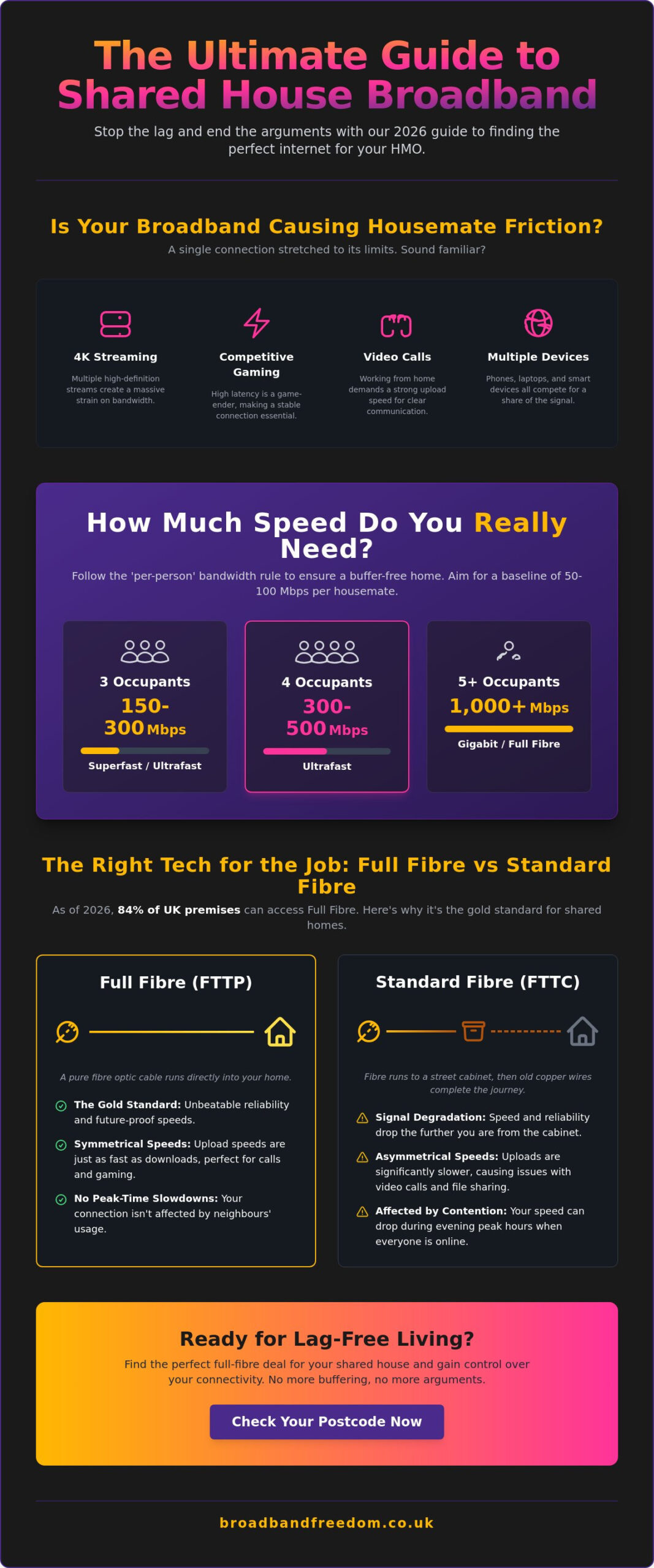
To ensure a buffer-free environment, aim for a baseline of 50-100Mbps per occupant. This provides enough headroom for high-demand activities without slowing down others. According to the Broadband Speed Guide, high-demand applications like 4K streaming require significantly more bandwidth than basic browsing. In 2026, we recommend these minimums for HMOs:
3 Occupants: 150Mbps to 300Mbps (Superfast/Ultrafast)
4 Occupants: 300Mbps to 500Mbps (Ultrafast)
5+ Occupants: 1,000Mbps (Gigabit/Full Fibre)
Full Fibre vs. Standard Fibre
Full Fibre (FTTP) is the gold standard because it runs a fibre optic cable directly into your property. Older Standard Fibre (FTTC) still relies on copper wires for the final leg from the street cabinet, which leads to signal degradation and slowdowns during peak hours. As of May 2026, Full Fibre is available to 84% of UK premises, offering much more reliable performance for busy homes. If your property is in a high-density area, switching to FTTP ensures your connection remains stable even when the whole street is online. You can compare the latest fibre deals to find a package that offers the speed you need on your terms.
Contract Flexibility: Choosing Between Student, Rolling, and Long-Term Deals
Your broadband contract should never outstay its welcome. If you’re on a standard 12-month tenancy, signing a 24-month agreement is a recipe for expensive exit fees when you move out. Most major UK providers implemented price rises of £3 to £4 in April 2026, making it even more vital to lock in a term that fits your specific schedule. Whilst 24-month deals often boast the lowest monthly price, the flexibility of a 12-month or even a 30-day rolling contract is usually the smarter choice for a broadband for shared house setup.
For the 2026 academic year, 12-month contracts remain the standard offering for students from providers like BT and Virgin Media. While true 9-month deals are rare in the current market, they occasionally surface to help students avoid paying for an empty property over the summer holidays. If your living situation is fluid or you’re on a short-term let, a no-contract deal provides the ultimate liberation. You’ll typically pay around £5 to £10 more per month compared to long-term plans, but you gain the power to cancel with just 30 days’ notice on your terms. For a deeper look at rolling and flexible options, our guide to short term broadband deals in 2026 covers everything from 5G hubs to student plans with next-day setup.
Managing the "Lead Tenant" Risk
Assigning a lead tenant is a common necessity, but it carries significant responsibility. This individual is legally liable for the monthly payments, even if a housemate moves out unexpectedly. To protect yourself, look for providers that offer easy account transfers or "move home" policies that don’t trigger new 24-month terms. Combining a flexible contract with bill-splitting tools ensures that the lead tenant isn’t left footing the entire bill if the household dynamic changes mid-year.
No-Contract and Bad Credit Options
Credit checks shouldn’t be a barrier to getting online. Many traditional providers require a credit score that international students or those with "thin" credit files might not have. No-contract broadband deals frequently bypass these rigorous checks, offering a vital lifeline for housemates who need immediate access without the red tape. You might encounter a higher upfront setup fee, but you trade that initial cost for total control. This approach provides the freedom to manage your digital life without being tied to a provider that doesn’t trust your financial history. Select a deal that prioritises your current needs over your past credit score.
Optimising Your Connection: Beating WiFi Dead Zones and Lag
Don’t let a bad layout ruin your connection. Most people leave their router exactly where the engineer installed the master socket, which is usually in the hallway or under the stairs. This is often the furthest point from the rooms where you actually need the signal. In older UK properties, thick solid brick walls act as sponges for Wi-Fi signals. This is especially true for the 5GHz band, which provides the fastest speeds but has the poorest range through obstacles.
Map your home’s performance for free. Download a signal-mapping app like WiFiman to find your property’s specific "black spots." Walk through every room and look for areas where the signal drops below -67 dBm. This data allows you to place your router or mesh nodes with scientific precision rather than guesswork. Simple changes, like elevating the router to head height or moving it away from large mirrors, can provide an immediate boost.
Mesh WiFi vs. Standard Extenders
Invest in a Mesh system if your house has more than two floors. Unlike standard extenders that create separate, weaker networks, Mesh nodes work together to create a single "blanket" of coverage. It is a technical reality that standard extenders often halve your available speed whilst Mesh maintains it through a dedicated wireless backhaul. This ensures every housemate enjoys the full potential of your broadband for shared house deal, regardless of which room they occupy.
Wired Solutions for Gamers and Professionals
Wireless signals are prone to interference from neighbouring networks and household appliances like microwaves. If you’re a competitive gamer or a professional working from home, a wired connection is the only way to guarantee 100% stability. Powerline adapters are an excellent alternative to running long cables; they turn your home’s existing electrical wiring into a data network. Just plug one unit near your router and another in your room for an instant, high-speed port. For those who want the absolute lowest latency, a direct Ethernet connection remains the undisputed king. Use self-adhesive trunking to keep cables organised and out of sight in shared areas.
Take control of your home network. Find the best full fibre deals and start enjoying lag-free living today.
Finding the Best Shared House Broadband on Your Terms
Finding the perfect broadband for shared house living requires a shift in focus from the "cheapest" headline rate to the most compatible service. By May 2026, the UK market has become increasingly complex. Major providers implemented monthly price rises of £3 to £4 in April 2026, making it vital to scrutinise the small print before signing. Use comparison tools to filter specifically for contract lengths that match your tenancy and speeds that accommodate every housemate’s peak-time usage. Since January 2025, Ofcom regulations have required providers to state any price rises in clear pounds and pence at the point of sign-up. This transparency is your best tool for avoiding "bill shock" midway through your agreement.
How to Switch and Save as a Group
Switching as a group is significantly simpler than it used to be thanks to the "One Touch Switch" process. This system ensures your new provider handles the cancellation of your old service, which reduces the risk of internet-free days during a move. When you compare broadband deals, look for new customer incentives like bill credits or vouchers that you can share amongst the household. Coordinate your start date for at least 48 hours before you move in. This ensures the connection is active the moment you unpack your first box, avoiding the stress of a digital blackout during your first week.
The Broadband Freedom Advantage
We act as your expert friend in a crowded and often confusing market. Unlike traditional giants that push rigid 24-month terms, we curate deals specifically for the modern renter’s lifestyle. Whether you need a 30-day rolling agreement to bypass credit checks or a 1,000Mbps Full Fibre connection to support a house full of streamers, we filter out the noise. Our platform focuses on "No-Contract" and "Full Fibre" options to ensure you stay in control of your digital life. Find your perfect shared house broadband deal today and secure a connection that works for everyone.
Before you hit the "order" button, run through this final checklist to ensure total housemate harmony:
Speed: Does the package offer at least 50Mbps per person for a buffer-free experience?
Price: Are the 2027 price rises clearly stated in pounds and pence rather than percentages?
Flexibility: Does the contract length actually match your tenancy end date?
Setup Time: Is there an engineer visit required for Full Fibre, or is it a simple plug-and-play router?

Take Control of Your Home Connection Today
Securing a reliable broadband for shared house setup is no longer about accepting the first deal you see. You now have the tools to choose a connection that matches your household’s peak demand and your specific tenancy length. By prioritising Full Fibre technology, which is now available to 84% of UK premises as of May 2026, you eliminate the evening lag that causes housemate friction. Whether you’re optimising your router placement or investing in a Mesh system to blanket your property in signal, the power to stay connected is firmly in your hands.
Don’t settle for rigid 24-month contracts that don’t fit your life. Our platform provides expert UK-based advice on Full Fibre availability and specialist student broadband comparisons to simplify your search. You can access exclusive no-contract deals that offer total flexibility without the long-term commitment. It’s time to get your internet on your terms. Compare the best broadband deals for shared houses on your terms and enjoy the freedom of a faster, fairer home network. You’ve got this.
Frequently Asked Questions
Is 100Mbps enough for a 4-person shared house?
A 100Mbps connection is the bare minimum for four people and often leads to buffering during peak times. This speed allocates just 25Mbps per person, which a single 4K stream fully consumes. For a household where multiple people game, stream, or work simultaneously, we recommend an Ultrafast package of at least 300Mbps to provide essential bandwidth headroom.
Can I get broadband for a shared house with no credit check?
Yes, you can secure a connection by selecting a 30-day rolling or no-contract deal. These flexible plans frequently bypass the rigorous credit history requirements associated with long-term 24-month agreements. Whilst you might encounter a higher upfront setup fee, it remains a reliable way to get broadband for shared house living on your terms without a perfect credit score.
What happens to the broadband if the lead tenant moves out?
The lead tenant remains legally responsible for the contract and all payments until the account is officially transferred or closed. If you are on a fixed-term deal, moving out early can trigger expensive early exit fees. We suggest choosing a 30-day rolling contract to allow for easy cancellation or account name changes if your household dynamic is likely to change.
Are there 9-month broadband contracts for students?
True 9-month student contracts are rare in the 2026 market, with most major providers favouring 12-month terms. If you only require internet for the academic year, a short term broadband or 30-day rolling contract is often the most cost-effective alternative. This allows you to cancel the service when you move out for summer, ensuring you don’t pay for an empty property.
How do we split the broadband bill fairly amongst housemates?
The most effective way to split costs is through a dedicated bill-sharing app or a shared house bank account. One reliable person should act as the named account holder whilst others set up automatic standing orders. This prevents the lead tenant from being left out of pocket and ensures the monthly £30 to £60 bill is always covered on time.
Do I need my landlord’s permission to install Full Fibre?
You must obtain written permission from your landlord if the installation requires drilling holes or fitting new external equipment. Most landlords approve these requests because upgrading to a Full Fibre connection adds long-term value to the property. Always check your tenancy agreement first to see if there are specific clauses regarding utility installations or modifications to the building.
Is it better to get a TV and broadband bundle for a shared house?
Bundles are only beneficial if every housemate agrees to use the specific TV service and share the increased monthly cost. These packages often come with more rigid 24-month terms that might not match your tenancy. For most shared homes, it is simpler and more flexible to stick to a high-speed broadband deal and manage individual streaming subscriptions separately.
What is the best router for a house with 5 or more people?
A Wi-Fi 7 mesh system is the superior choice for households with five or more occupants. Standard routers provided by ISPs often buckle when managing 20 or more simultaneous device connections. A mesh setup with multiple nodes creates a seamless network that maintains high speeds in every bedroom, ensuring that nobody suffers from signal drops during important calls or gaming sessions.
See our latest Broadband Offers
——————————————————————————–
Related links

Article by
Elaine Lang
Elaine has over 20 years across Marketing, Communications and Public Relations in the UK. She has worked across large UK corporations, including Commercial Banks and Airports, to online consumer finance and technology solutions. Elaine has post graduate qualifications in Marketing from the Chartered Institute of Marketing (CIM) and the Industry of Direct Marketing (IDM). She is a lifelong feline fan, sharing her home with around 4-6 cats for many years. This of course can be a challenge when trying to work at home, as they like to try to help!