When Should I Switch Broadband to Get the Best Deal?
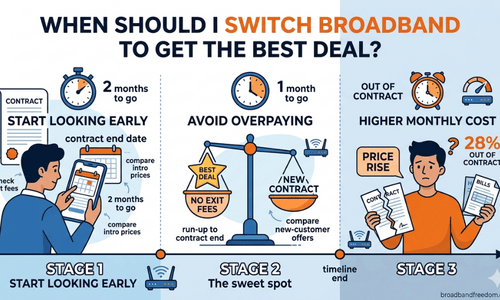
If you are asking when to switch broadband to get the best deal, the best answer is usually this: start comparing before your current contract ends, but not so early that exit fees wipe out the savings. Ofcom says 28% of broadband customers are out of contract, and those still in contract typically pay £7 to £9 less per month than out-of-contract customers on average. That means waiting too long can cost you, but switching too early can also backfire if penalties apply. The sweet spot is usually the run-up to contract end, when you can compare new-customer pricing without getting caught by avoidable fees.
Quick switching checklist
| What to check | Why it matters | What to watch out for |
| Contract end date | Helps you time the switch properly | Leaving it too late can push you onto a pricier out-of-contract rate |
| Exit fees | Can wipe out any early savings | Cheap new deals are not always cheap once penalties are added |
| Intro price | Good for shortlisting offers | Opening prices can distract from total value |
| Likely speed at your address | Tells you whether the new deal is actually suitable | Headline speed is not the same as what your property can get |
| Contract length | Affects flexibility and future switching | A low monthly price can come with a long lock-in |
| Setup and activation fees | Changes the true first-year cost | Upfront costs can narrow the real savings |
The best time to start comparing broadband deals
For most people, the best time to start looking is before contract expiry, not after.
Why? Because once you move out of contract, you are more likely to pay more than you need to. Ofcom’s February 2026 research says more than a quarter of broadband customers are out of contract, and that out-of-contract users still tend to pay more than customers who stay in a deal.
That means the smart play is to start comparing while you still have options, not after the old contract has rolled into a weaker rate.
A good practical rule is:
- check your contract end date first
- start reviewing offers before that date arrives
- compare against what you are currently paying
- make sure any savings survive setup costs and switching timing
This is where Broadband Freedom’s Compare Broadband Deals, Broadband Deals Today’s Best Deals, Broadband Comparison, and Compare Broadband Prices all fit naturally.
Another thing to keep in mind is that some of the strongest broadband deals for new customers are designed to win switchers, not reward people who sit on old contracts. That is why waiting until you are already overpaying is rarely the best move.
When switching early can still make sense
Usually, you want to move near the end of the term.
But not always.
There are a few situations where switching early can still be the right decision.
Poor service
If your broadband is unreliable, too slow, or no longer fits how your household uses the internet, waiting for the perfect contract date may not be worth the frustration. Sometimes, better performance is worth acting for.
To sense-check whether the issue is the package, the local availability, or your speed expectations, Broadband Freedom’s Broadband Speed Comparison, Internet Speed, and Broadband Speed Test are all useful places to start.
A cheaper deal offsets the penalty
This is the most important early-switch test.
If the saving on a new deal is big enough to outweigh the exit fee, switching early can still make financial sense. The key is to do the maths properly. Compare:
- remaining cost or exit charge on the old contract
- setup fees on the new one
- intro pricing on the new one
- total saving across the next year or contract term
If the numbers still work in your favour, then early switching can be rational, not reckless.
Relevant internal links here include Broadband Price Rises and Exit Fees, Pricing, and Why a Broadband Package Comparison Beats Staying Put.
Moving home
A move changes everything.
The old deal may not suit the new property, the new address may have different availability, or a better provider may now be realistic. That is one of the cleanest reasons to review everything rather than just carrying the old setup forward by default.
Useful internal links here include Broadband Moving Home, Broadband Availability Checker, and Best UK Broadband Coverage Map: Internet in My Area.
Better fibre is now available
This is another strong reason to act.
Openreach says customers should use its Fibre Checker to see what is available at their postcode and address, and notes that provider websites do not always update as quickly as its own checker. It also explains that postcode results can vary, and that a more personalised property-level view is often needed to understand what can actually be ordered.
So if full fibre or a stronger service has become available at your address, an early switch may be worth serious consideration.
Broadband Freedom pages that support this decision include Broadband Availability Checker, Broadband Coverage Map UK: Find the Best ISP, and Full Fibre Broadband Coverage Hits 83% of UK Premises: What This Means for You.
What to check before switching
This is where good timing becomes a good decision.
Exit fees
Always check them first.
They are the fastest way to turn a “deal” into a mistake. If you leave too early, the cost of exiting may wipe out the value of the new-customer offer.
Setup costs
Even if the new monthly rate looks brilliant, setup and activation fees can narrow the savings. Include those in the comparison from the start.
Intro prices
These are useful, but only as one part of the picture. A low opening rate is not enough on its own. You still need to look at the total contract cost and what happens later.
Likely speed at your address
This is a big one.
Do not switch based only on the biggest headline number. Openreach says availability should be checked by postcode and address because what is orderable varies by property, and provider sites may not always show the newest availability immediately. (Openreach)
Helpful internal links here include Broadband Availability Checker, Broadband Speed Comparison, The Ultimate Guide to Internet Speed Test, and Full Fibre vs Standard Fibre vs ADSL.
Contract length
A longer contract can reduce the monthly price, but it also shapes your next switching window. If flexibility matters, that should influence the deal you choose now.
Relevant internal links here include Broadband Contract Lengths Explained, 1 Month vs 12 Month Broadband Contracts: What’s the Real Cost?, and Compare 1 Month Rolling Broadband.
What usually happens during the switching process
This is the part many people overthink.
In reality, the system is designed to be simpler than it used to be.
Provider-led switch
Ofcom says the UK now uses a simpler switching process called One Touch Switch for broadband and landline services. Under this process, customers generally contact only the new provider, who arranges the switch and handles the process, rather than the customer having to manage both sides.
That is important because it makes switching broadband and saving a more realistic action for ordinary users, not just people happy to wrestle with admin.
Internal links that support this section include Switching Broadband Providers and How to Switch Broadband Provider.
Router delivery
Most switches involving a new service include router delivery or equipment instructions. It is worth checking dispatch timing, especially if you work from home or want the switch to happen smoothly around a specific date.
Helpful supporting pages here include A Guide to Broadband Installation and Best Wi-Fi Box for Home: Top Routers and Mesh Picks.
Downtime expectations
Ofcom describes One Touch Switch as easier, quicker, and more reliable than the old process, with the system designed to reduce unnecessary friction in switching. That does not guarantee every switch is identical, but it does mean the process is built to minimise hassle rather than create it.
One Touch Switch in plain English
In simple terms: you choose a new provider, give them the details they need, and they lead the change. That is much better than the old mental model many people still have, where switching felt like an awkward two-provider negotiation.
FAQs
For broader help, readers can also visit Broadband Freedom’s FAQ page.
Should I switch before my contract ends?
Usually, you should start comparing before your contract ends, but do not place the switch so early that exit fees wipe out the savings. The goal is to avoid rolling onto a pricier out-of-contract rate while also avoiding unnecessary penalties.
Will I lose internet during the switch?
Usually, the switching process is designed to be smoother than many people expect. Ofcom says One Touch Switch is intended to make broadband and landline switching easier and more reliable, with the new provider leading the process.
Can I keep my number?
Often, yes, especially where broadband and landline services are being switched through the normal process. But it is always worth checking with the new provider before placing the order if keeping the number matters to you.
Are the best deals only for new customers?
Many of the strongest intro offers are aimed at new customers, but that does not mean existing customers have no options. Ofcom says out-of-contract customers can often save by speaking to their current provider and signing up to a new deal with them, rather than simply staying on the old rate.
Final takeaway
So, when should I switch broadband to get the best deal?
Usually, before your contract ends, but not so early that exit fees undo the benefit.
That is the balance.
Start comparing before you fall onto an out-of-contract rate. Check whether a better fibre option is now available at your address. Work out whether the saving survives setup costs and penalties. And use the simpler switching process now in place to your advantage.
Before you move:
- check your contract end date
- compare total cost, not just intro pricing
- factor in exit fees and setup charges
- confirm likely speeds at your address
- pick a contract length that suits your next decision point
That is how you time the switch properly and actually save money.
For next steps, start with Compare Broadband Deals, review Broadband Deals Today’s Best Deals, and use How to Switch Broadband Provider plus Broadband Availability Checker to make the move at the right time.