What to Do When Your Broadband Contract Ends: The 2026 Action Plan

One in seven UK customers currently pays a ‘loyalty penalty’ on their household bills, effectively subsidising the cheaper rates reserved for new subscribers. This collective overspend was recently estimated at £451 million per year, yet many people remain hesitant to act because the switching process feels daunting. Understanding what to do when your broadband contract ends is the most effective way to stop this unnecessary drain on your monthly finances. You shouldn’t have to pay more for the same service just because you have been a loyal customer for years.
We understand that the prospect of losing your internet during a switch or getting tangled in complex technical jargon is frustrating. This 2026 action plan simplifies the entire process and puts the power back in your hands. You’ll learn how to navigate the latest Ofcom ‘pounds and pence’ price hike rules and use the One Touch Switch system to move providers seamlessly. We provide a clear checklist to help you escape the loyalty penalty, compare full fibre broadband deals, and secure a faster, more reliable connection on your own terms.
Key Takeaways
- Use your legal End of Contract Notification (ECN) as the starting gun for securing a better deal and avoiding the loyalty penalty.
- Conduct a 5-point audit of your actual speed requirements to ensure you only pay for the bandwidth you truly need.
- Learn exactly what to do when your broadband contract ends to avoid early exit fees whilst navigating the latest price hike regulations.
- Evaluate the benefits of switching versus haggling to see why new customer offers for full fibre often provide superior value.
- Streamline your search for specialised packages, such as student broadband or no-contract deals, to fit your specific lifestyle and budget.
Understanding the End of Contract Notification and the Loyalty Penalty
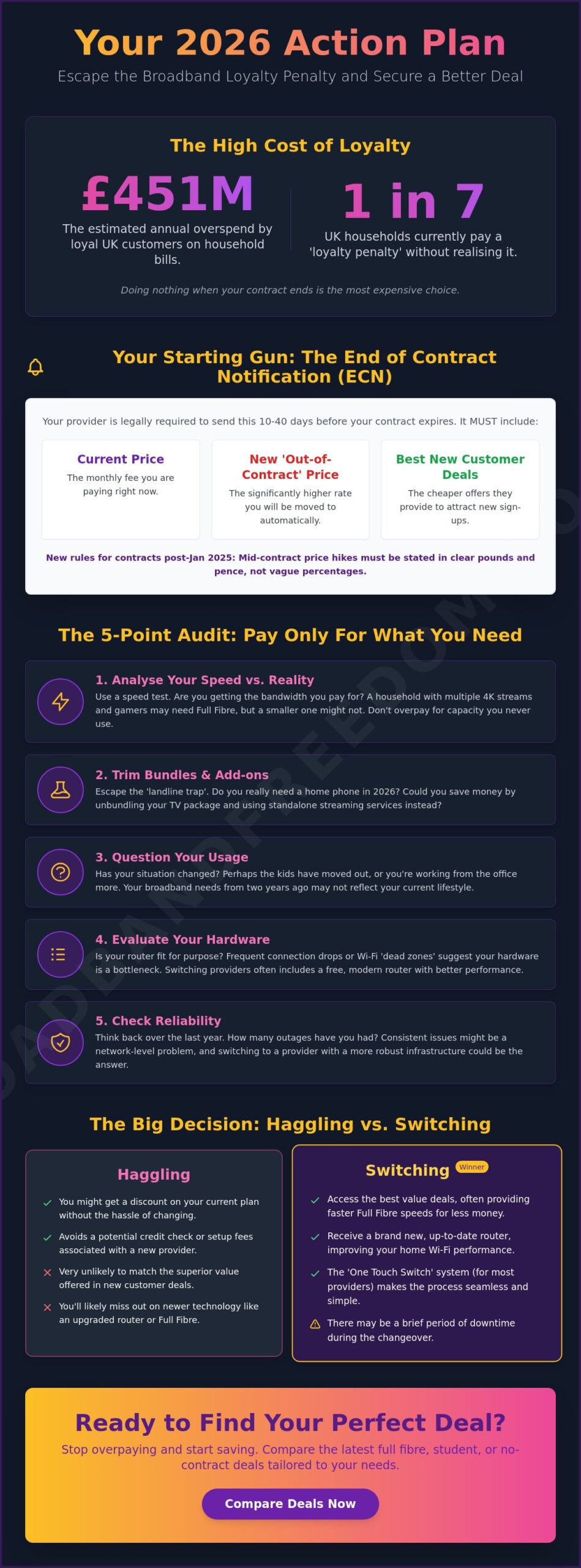
Your Internet Service Provider (ISP) is legally required to tell you when your commitment is ending. This document is known as an End of Contract Notification (ECN). Since February 2020, Ofcom has mandated that these alerts reach you between 10 and 40 days before your minimum term expires. Receiving one is the clearest signal for what to do when broadband contract ends. It isn’t just a courtesy; it’s a powerful tool designed to prevent you from falling into the ‘loyalty penalty’ trap.
The loyalty penalty is a surcharge that existing customers pay simply for staying with the same provider. A 2022 analysis estimated this cost at £451 million per year across the UK. Essentially, providers offer loss-leader rates to attract new sign-ups and then hike prices significantly once the initial term ends. They rely on customer inertia. They hope you’ll be too busy or too confused by the process to look elsewhere. One in seven UK households currently pays this premium, often without realising they are being overcharged for the same service.
This issue isn’t limited to residential broadband; businesses frequently face similar loyalty traps with their energy providers. For those managing a company, it is wise to compare business gas prices to ensure that commercial overheads are kept as low as possible.
What Your Provider Must Disclose in 2026
Transparency is mandatory in every ECN you receive. Your provider must list your current monthly price alongside the new ‘out-of-contract’ rate you’ll pay if you don’t take action. Crucially, they must also highlight the best deals they currently offer to new customers. For any contract signed after 17 January 2025, providers can no longer use vague CPI or RPI inflation percentages for mid-contract hikes. They must state these increases in clear pounds and pence at the point of sale. If you choose to leave immediately, your ECN will also clarify any notice periods required to avoid overlapping bills.
Why ‘Doing Nothing’ is the Most Expensive Choice
Choosing to stay on an expired deal usually results in an immediate price jump. For a customer on an average £22.86 package, a £4 increase represents an 18% hike. Staying out-of-contract also leaves you on legacy terms, meaning you might miss out on hardware upgrades or the transition to faster Full Fibre Broadband deals. Deciding what to do when broadband contract ends is the only way to avoid these automatic costs. The loyalty penalty is the surcharge paid by existing customers for service continuity.
The 5-Point Audit: Evaluating Your Current Broadband Needs
Before you commit to another 18 or 24 months, you must understand your actual usage. Most households simply roll over their existing service because it’s the path of least resistance. However, a structured needs audit is the most effective first step when deciding what to do when broadband contract ends. This process ensures you aren’t paying for bandwidth you don’t use or hardware that can’t keep up with modern demands.
Speed vs. Reality: Are You Overpaying for Bandwidth?
Start by using a broadband speed test to verify if you are actually receiving the speeds your provider promised. There is often a gap between advertised ‘average’ speeds and the reality of your home connection. If your test results are consistently lower than your package tier, you are paying for performance you don’t get. Determine if your household truly requires Full Fibre (FTTP). Whilst it is the gold standard for future-proofing, standard fibre might suffice for smaller households. If you have multiple users streaming 4K content, gaming, and working remotely amongst one another, the extra bandwidth is worth the investment. Otherwise, you might be overpaying for capacity you’ll never touch. If terms like FTTP, Mbps, or Gbps leave you confused, our broadband jargon buster explains every key UK internet term in plain English.
Bundles and Add-ons: Trimming the Fat
Finally, evaluate your hardware and reliability. Is your router still fit for purpose? If you’ve experienced frequent drops or ‘dead zones’ over the last two years, your current hardware might be the bottleneck. A new provider often means a fresh router with better range and stability. Knowing what to do when broadband contract ends starts with knowing what you don’t need. Once you have a clear picture of your requirements, you can confidently compare broadband deals that align with your lifestyle rather than your provider’s profit margins.
Haggling vs. Switching: Which Strategy Wins in 2026?
Deciding between staying with your current provider or moving to a new one is the core of what to do when broadband contract ends. Traditionally, many customers preferred to haggle, but the market has shifted. New customer deals almost always outperform retention offers because providers prioritise acquisition over loyalty. If you value total flexibility over the lowest possible monthly rate, you might even consider no-contract broadband deals. These allow you to leave at any time without penalty, which is ideal if your living situation is temporary or you simply dislike long-term commitments.
The Art of the Haggle: A Script for Success
If you prefer to stay, you must speak with the ‘Retention’ or ‘Cancellations’ department. These teams have the most authority to offer discounts that regular customer service agents cannot access. Before you call, have a competitor’s quote ready. Use direct phrases like, “I’ve seen a better deal elsewhere and I’m planning to leave unless you can match it.” Be prepared to walk away if they only offer ‘fake’ discounts that still exceed the current market rates. A small reduction of a few pounds is rarely worth the long-term cost of a new 24-month commitment.
Switching: The 2026 ‘One-Touch’ Advantage
Switching has become significantly easier since the One Touch Switch (OTS) system became fully operational on 12 September 2024. This process is ‘Gaining Provider-Led’, meaning your new provider manages the entire transition. They handle the cancellation of your old service and coordinate the start of the new one. This system has already processed nearly 2 million switches, greatly reducing the risk of downtime. Most providers are covered, though you may still need to manually cancel if you are moving to or from a provider that doesn’t use the national Openreach network, such as Virgin Media. Understanding these logistics is a vital part of what to do when broadband contract ends to ensure a seamless transition.
The Step-by-Step Switching Checklist for a Seamless Transition
Executing a switch requires precision to avoid overlapping costs or service gaps. Following a structured checklist is the best way to handle what to do when broadband contract ends. Start by identifying your exact contract end date. Leaving even a day early can trigger Early Termination Charges (ETCs), which often outweigh any potential savings from a new deal.
- Research local availability: Use a postcode checker to find Full Fibre (FTTP) options. Many regional areas have seen significant infrastructure upgrades since 2024.
- Calculate total cost: Look beyond the monthly headline rate. Factor in setup fees and the new ‘pounds and pence’ mid-contract hikes. Most major providers now implement fixed increases of £3 to £4 per month each spring.
- Timing is key: Place your order for a new service at least two weeks before your current deal expires to ensure a smooth handover.
- Return your hardware: Confirm the return procedures for your old router. Many providers now charge penalty fees if equipment isn’t returned in a prepaid envelope within 30 days.
Pre-Switch Preparation
Check if you are eligible for Social Tariffs if you receive certain benefits like Universal Credit. These deals offer stable, low-cost connectivity without the usual annual price hikes. Ensure your primary email address isn’t tied to your provider, such as a @btinternet.com or @sky.com account. If it is, you may lose access to your inbox shortly after leaving. Most UK broadband switches now take approximately 15 working days to complete from the moment you place your order.
The Final Handover
Back up your router settings or Wi-Fi passwords if you have custom configurations or a long list of connected smart devices. This makes setting up your new hub much faster. Once the switch is complete, check your final bill for any ‘pro-rata’ refunds. If you paid in advance, your old provider must return the overpayment for the days you weren’t using their service. Test the new speed immediately upon activation to ensure it matches the ‘Minimum Guaranteed Speed’ stated in your contract. Knowing what to do when broadband contract ends ensures you never pay for a service that underperforms.
Ready to start your search? Compare the latest fibre broadband deals to find your perfect match.
Finding Your Next Deal with Broadband Freedom
Deciding what to do when broadband contract ends shouldn’t feel like a second job. We have already performed the heavy lifting by researching and comparing the entire UK market so you don’t have to. Our platform acts as a savvy facilitator, moving you away from the rigidity of traditional industry giants and towards deals that respect your autonomy. Whether you need student broadband for a temporary house share or ultrafast fibre for a busy family home, we filter the noise to show you what actually matters.
Transparency is our North Star. We don’t just show you the introductory rates; we highlight the ‘real’ cost of ownership. This includes being explicit about those annual ‘pounds and pence’ increases that most providers now implement. By using an independent service, you gain a clearer understanding of the best broadband deals currently available. We ensure you are never surprised by hidden fees or restrictive terms that haven’t been clearly explained up front. This structured approach ensures that the path from inquiry to action is as frictionless as possible.
Why Compare with Us?
Using our comparison tool often grants you access to exclusive incentives and ‘free gift’ bundles that aren’t always visible on provider websites. We also cater to niche requirements that standard search engines might miss. If you are a competitive player, we provide expert guidance on finding low latency for gamers. Our focus remains on your lifestyle and constraints rather than just technical network specifications. This user-centric approach helps you find liberation from over-priced contracts whilst ensuring your connection remains reliable and fast.
Ready to Switch?
Finding your perfect match starts with our localised postcode checker. Simply enter your details to see which providers actually serve your front door. This avoids the frustration of falling in love with a deal only to find it isn’t available in your regional urban centre. Our simple 3-click process takes you from broad comparison to a confirmed order in minutes. Knowing what to do when broadband contract ends is only half the battle; having a streamlined path to action is what saves you money. Compare the latest broadband deals today and start saving.
Take Control of Your Digital Costs Today
Your contract expiry is the most powerful leverage you have to lower your bills and improve your service quality. By following this 2026 action plan, you can successfully avoid the loyalty penalty and move away from outdated legacy hardware. Deciding what to do when broadband contract ends is the first step toward a more reliable, cost-effective home connection that actually meets your daily requirements. You don’t have to accept automatic price hikes when better alternatives are just a few clicks away.
We provide an independent comparison of the UK’s leading providers, acting as specialists in Full Fibre and No-Contract deals. Our expert UK-based support and guidance ensure you have the transparency needed to make an informed choice without the confusion of technical jargon. We focus on your specific constraints, helping you find a package that fits your lifestyle perfectly while protecting your budget from unnecessary surcharges.
Find a better broadband deal today with Broadband Freedom and reclaim your consumer autonomy. You’re now equipped with the essential facts; start your switch today and enjoy a better connection on your own terms.
Frequently Asked Questions
What happens if I don’t do anything when my broadband contract ends?
You will automatically roll onto a monthly rolling contract, usually at a significantly higher price. This is where the loyalty penalty kicks in; your provider stops applying your initial discount, and your monthly bill jumps to the standard out-of-contract rate. Knowing what to do when broadband contract ends is the only way to prevent this automatic price jump and secure a better deal.
Can I switch providers before my current contract officially expires?
Yes, you can switch at any time, but you’ll likely face financial penalties for leaving early. Most providers charge an Early Termination Charge based on the number of months remaining on your minimum term. If you only have a few days left, it’s often worth the small fee to secure a superior deal, but switching months in advance is rarely cost-effective.
Will I lose my internet connection during the switching process?
Downtime is now minimal or non-existent thanks to the One Touch Switch system launched in September 2024. Your new provider handles the entire transition, ensuring your old service only stops once the new one is active. You might experience a brief loss of connection for a few minutes on the day of activation, but prolonged outages are rare under this new system.
Do I have to return my old router when I leave a provider?
Most major UK providers require you to return their hardware once your service ends. Routers are typically provided on a loan basis rather than as a gift. If you don’t return the equipment within the specified timeframe, usually 30 days, your old provider may charge a fee ranging from £30 to £80. Always check your final notification for return instructions.
How much notice do I need to give to cancel my broadband?
You typically need to give 30 days’ notice to cancel your broadband service, even if your minimum term has already ended. If you are switching via the One Touch Switch system, your new provider coordinates this notice period for you. If you are cancelling without moving to a new provider, you must contact your current provider directly to start the countdown.
What is an ‘Early Termination Charge’ and how can I avoid it?
An Early Termination Charge is a fee applied when you cancel a contract before the minimum term expires. It’s calculated based on your monthly rate and the time left on your deal. To avoid this, wait until you receive your End of Contract Notification. This document confirms exactly what to do when broadband contract ends and lists the dates you can leave penalty-free.
Can I keep my home phone number if I switch broadband providers?
Yes, you can usually ‘port’ your existing landline number to your new provider. You must inform your new provider during the sign-up process that you wish to keep your number. Don’t cancel your old service yourself before this is confirmed; the number must remain active to be transferred successfully. This is a standard feature for most Broadband and Phone Packages.
What are mid-contract price hikes and how do they work in 2026?
In 2026, mid-contract price rises are fixed ‘pounds and pence’ amounts rather than unpredictable inflation-linked percentages. Following Ofcom’s 2025 regulations, providers must state the exact increase in your contract at the point of sale. Most major networks now increase bills by £3 to £4 every spring. This transparency helps you calculate the total cost of your contract before you sign up.

Article by
Elaine Lang
Elaine has over 20 years across Marketing, Communications and Public Relations in the UK. She has worked across large UK corporations, including Commercial Banks and Airports, to online consumer finance and technology solutions. Elaine has post graduate qualifications in Marketing from the Chartered Institute of Marketing (CIM) and the Industry of Direct Marketing (IDM). She is a lifelong feline fan, sharing her home with around 4-6 cats for many years. This of course can be a challenge when trying to work at home, as they like to try to help!