How to Switch Broadband Provider: The 2026 Stress-Free Guide

Switching Broadband in 2026: Why It Is Easier Than Ever
For years, the thought of switching broadband provider brought on a familiar sense of dread. The process was often bogged down by long phone calls, high-pressure sales tactics, and the fear of being left without an internet connection. In 2026, that reality has changed. Thanks to new regulations and a focus on consumer power, changing your internet provider is now a straightforward process that you control.
- The “One Touch Switch” (OTS) revolution: This new system means you no longer need to phone your old provider to say you are leaving. Your new provider handles the entire process for you.
- How the “Gaining Provider Led” system works: The provider you are moving to takes charge of the switch, organising the changeover with your old provider. This puts you in control and protects your connection.
- Why 2026 is the year of Full Fibre migration: Millions of UK households are now able to access faster, more reliable Full Fibre (FTTP) broadband, making it the perfect time to switch and upgrade.
- The “On Your Terms” philosophy: The market has shifted from rigid, long-term contracts to a more flexible approach that puts your needs first.
The End of the Cancellation Call
The single biggest barrier to switching has been removed. With the One Touch Switch system, your new provider is required to notify your old one automatically when you sign up. This simple change eliminates the need for you to have that awkward conversation with a “retention department” whose only job is to persuade you to stay. While most switches on the Openreach network (which covers providers like BT, Sky, and TalkTalk) are this simple, there are rare exceptions where you might still need to contact your old provider, such as when moving between completely separate networks. (What is an Internet Service Provider?)
Guaranteeing Zero Downtime
The fear of losing your internet connection, especially when working from home, is a major concern. Ofcom, the UK’s communications regulator, has put strict rules in place to prevent this. A loss of service should not exceed one working day, and in most cases, the switch is seamless. If your switch is delayed or something goes wrong, you are entitled to automatic compensation from your new provider for the inconvenience. For a smooth changeover, schedule your switch day for a time when you have light internet needs and can easily plug in your new equipment.
Calculating the Cost of Moving: Contracts and Termination Fees
Before you switch, it is vital to understand your current contract to avoid unexpected costs. Most providers let you check your contract end date through your online account, saving you a call to customer service. If you are still within your minimum term, leaving early will likely result in Early Termination Charges (ETCs).
- Understanding Early Termination Charges (ETCs): An Early Termination Charge is a fee calculated based on the number of months remaining on your contract.
- The “Cooling-off Period”: After placing an order with a new provider, you legally have a 14-day “cooling-off period” to cancel without penalty if you change your mind.
- Identifying “Fixed Price” deals: When choosing a new deal, look for a “fixed price” promise. This protects you from mid-contract price hikes linked to inflation (CPI/RPI), which have become common.
When Can You Switch for Free?
The best time to move is in your “end of contract” window, which typically opens 30-45 days before your minimum term expires. At this point, you are free to switch to any provider without paying a penalty. You may also be able to leave for free if your current provider raises your monthly price above the rate of inflation (unless this was clearly stated in your original contract) or if you can prove you are not receiving the minimum guaranteed speeds they promised under Ofcom’s Code of Practice. (your rights as a consumer)
Hidden Costs to Watch Out For
While many deals come with no upfront costs, it is wise to check for potential extra fees. Some providers charge for router delivery or have a one-off activation fee. Also, consider the total cost. A cheap broadband-only deal might seem attractive, but if you need a landline, an all-in-one package could offer better value than “unbundling” the services separately.
Finding the Perfect Package: Speed, Price, and Flexibility
The UK broadband market is more competitive than ever, which is great news for you. With daily offers from around 30 of the best UK providers, you can compare the latest packages to find the perfect fit for your household’s needs, whether you are a light browser or a competitive gamer.
- Assessing your household needs: Consider how many people and devices will be online at once. A small household might be fine with standard fibre, whereas a family of streamers and gamers will benefit from the low latency of a dedicated broadband for gamers UK package.
- Fibre (FTTC) vs. Full Fibre (FTTP): In 2026, the key difference is reliability. Standard Fibre (Fibre-to-the-Cabinet) uses older copper wires for the final leg into your home, while Full Fibre (Fibre-to-the-Premises) uses fibre optic cables all the way, delivering superior speeds and stability.
- Why contract length matters: A 24-month contract often has the lowest monthly price, but a 12-month or no-contract deal provides more flexibility if your circumstances might change.
- Bundling TV and phone: Bundles can still offer great value, but with the rise of streaming services, it is worth checking if a broadband-only deal and separate TV subscriptions would be cheaper.
Choosing Your Speed Wisely
With Full Fibre now widely available, speeds of 100Mbps are becoming the new baseline for a modern, connected family. This is more than enough for multiple 4K streams, video calls, and online gaming. If your household has very heavy demands—such as downloading large files regularly or running a home business—it may be worth considering Gigabit (900Mbps+) speeds. For those in rural areas where fibre is not yet available, reliable ADSL broadband deals remain a viable option. (guide to changing your provider)
Flexibility for Students and Renters
Standard contracts do not work for everyone. If you are a student, a 9-month contract is ideal as it aligns with the academic year. For renters or those in short-term accommodation, rolling monthly deals provide the ultimate freedom to move without facing hefty exit fees. The key to avoiding the “loyalty tax”—where out-of-contract customers pay the highest prices—is to regularly compare broadband deals and switch when a better offer appears.
The Step-by-Step Guide to a Stress-Free Switch
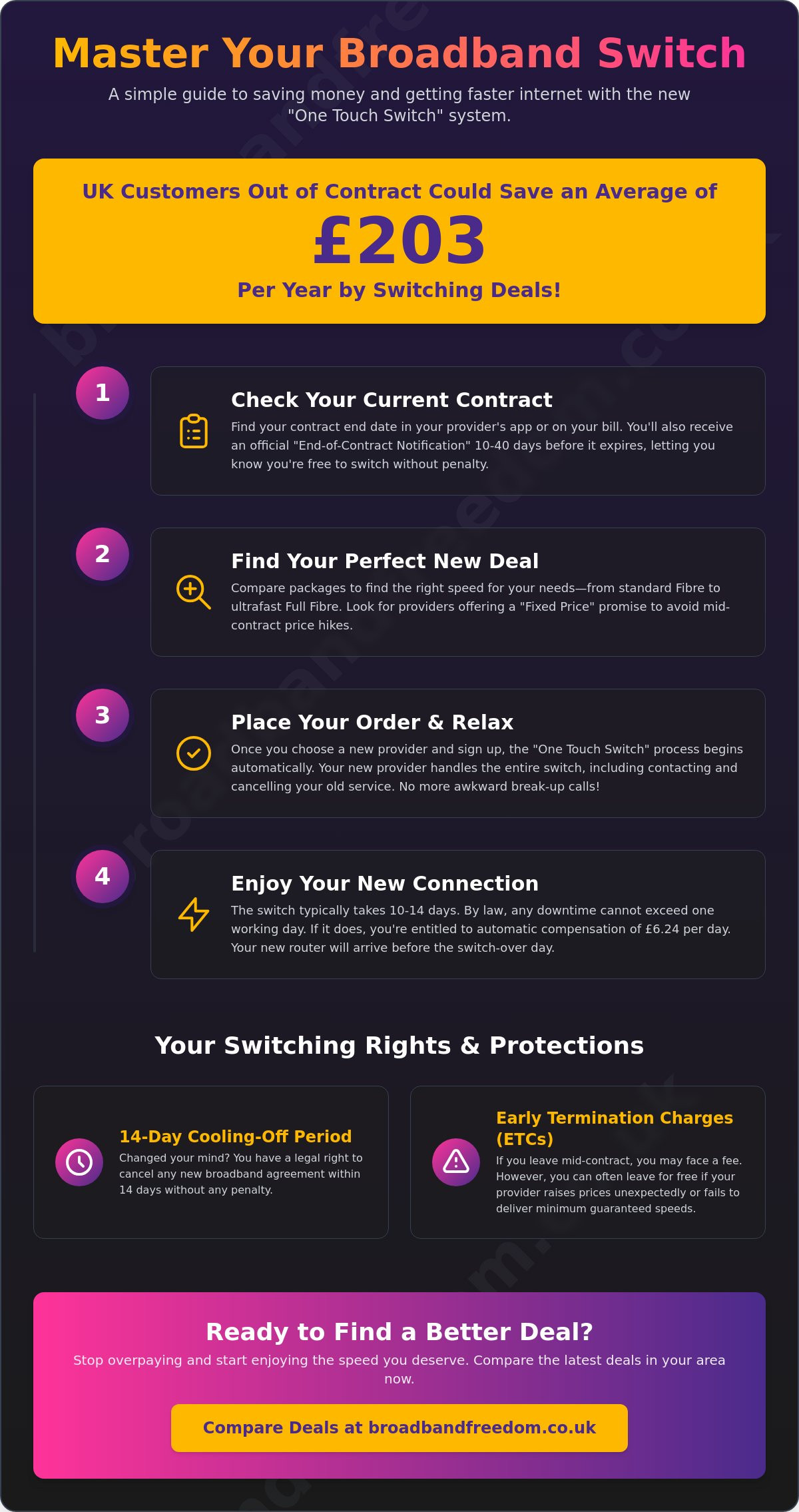
Ready to make the move? Follow these simple steps to ensure a smooth transition to a faster, cheaper connection.
- Use a comparison tool to find deals: The first step is to see what is available at your address. A good comparison tool shows you the best offers, updated daily, from dozens of providers in one place.
- Verify the “Price Promise” and contract length: Before you click “buy”, double-check the key terms. Is the price fixed for the whole contract? Are there any upfront costs? Make sure the deal is exactly what you expect.
- Place your order and receive your “Switching Notice”: Once you sign up, your new provider will start the OTS process. You will receive a notification from both your new and old providers confirming the switch and the date it will happen.
- The equipment arrival: Your new provider will send you a new Wi-Fi router in the post before your switch day. Keep it safe and ready for activation.
What to Do on Switch Day
On the day of the switch, your old service will stop and your new one will begin. The changeover often happens overnight or in the early morning. Simply unplug your old router and plug in the new one. Your provider will give you clear instructions. Afterwards, check if your old provider requires you to return their equipment; they will usually provide a pre-paid postage bag to make it easy. Finally, run a speed test to ensure you are getting the performance you are paying for.
Porting Your Landline and Email
If you have a landline, you can easily keep your existing phone number. Just make sure you tell your new provider you want to “port” your number during the sign-up process. A word of caution: if you use an email address tied to your old provider (e.g., @btinternet.com or @talktalk.net), you will lose access to it after you leave. To avoid this, it is best to switch to a free, independent email service like Gmail or Outlook to ensure long-term freedom and flexibility.
Broadband Freedom: Secure Your Next Deal on Your Terms
Switching your broadband provider should be an empowering experience, not a chore. We believe in putting you in control with flexibility, choice, and complete transparency. We cut through the noise and jargon to help you make a savvy choice.
- We curate the best UK deals: We bring together daily updated offers from around 30 of the UK’s best providers, so you avoid analysis paralysis and find the right deal quickly.
- A focus on what matters: Our platform helps you organise deals by your priorities, whether that is the lowest cost, the fastest Full Fibre speed, or a flexible no-contract term.
- Our commitment to you: We focus on highlighting deals with no upfront fees and provide options tailored for everyone, including students and renters.
Expert Help When You Need It
Think of us as the expert friend in the broadband market. We simplify the technical terms and complex contract conditions so you can understand exactly what you are getting. Our platform is designed to organise deals based on your specific priorities, such as cost, speed, or contract length, making your decision clear and confident.
Ready to Switch?
It is time to stop overpaying for slow, unreliable internet. With the One Touch Switch system, the power is back in your hands. Use our 2026 comparison tool to find a better, faster deal and make the switch on your terms. At Broadband Freedom, we promise transparency at every step of your journey to a better connection.
Find the best broadband deals on your terms
Frequently Asked Questions (FAQs)
Do I need to cancel my old broadband contract myself?
In most cases, no. Thanks to the “One Touch Switch” (OTS) system, when you sign up with a new provider, they will automatically handle the cancellation with your old one. You no longer need to make that dreaded phone call.
Will I lose my internet connection when I switch providers?
You should not. The switching process is designed to be seamless, with any potential downtime lasting no more than a few minutes. Ofcom rules also mean you are entitled to automatic compensation if the switch is delayed and you lose service for more than one working day.
Can I switch broadband provider if I am still in contract?
Yes, you can, but you will likely have to pay an Early Termination Charge (ETC). This fee is typically the total cost of your remaining monthly payments. It is usually more cost-effective to wait until your contract is about to end.
How long does it take to switch broadband provider in the UK?
The standard switching period is around two weeks. This gives both providers time to coordinate the changeover and for your new equipment to be sent to you. Your new provider will confirm the exact switch-over date with you.
Can I keep my landline number when I move to a new provider?
Absolutely. Your landline number is portable. Simply inform your new provider that you wish to keep your existing number during the sign-up process, and they will arrange for it to be transferred over.
What is the “One Touch Switch” process?
It is a new, simplified system regulated by Ofcom. It makes your new provider (the “gaining” provider) responsible for managing the entire switch, including contacting your old provider to cancel the service. This removes the hassle for you.
Is there a cooling-off period if I change my mind after switching?
Yes. By law, you have a 14-day cooling-off period after you place your order. During this time, you can cancel your new contract without incurring any penalties.
Will my new provider pay my early termination fees?
This is uncommon. While some providers may occasionally run special offers that include account credit to help offset termination fees, it is not a standard practice. You should assume you are responsible for paying any ETCs to your old provider.

Article by
Elaine Lang
Elaine has over 20 years across Marketing, Communications and Public Relations in the UK. She has worked across large UK corporations, including Commercial Banks and Airports, to online consumer finance and technology solutions. Elaine has post graduate qualifications in Marketing from the Chartered Institute of Marketing (CIM) and the Industry of Direct Marketing (IDM). She is a lifelong feline fan, sharing her home with around 4-6 cats for many years. This of course can be a challenge when trying to work at home, as they like to try to help!