BT vs Virgin Media Broadband: The Ultimate 2026 UK Comparison Guide
Choosing the highest advertised speed might actually be the worst way to pick your next internet provider. It’s easy to get lured in by “gigabit” promises, only to find your connection dropping during a vital work call or your monthly bill jumping unexpectedly. When comparing bt vs virgin media broadband in 2026, the right choice depends on your specific postcode and how many people are gaming or streaming in your house. You likely want a stable connection that doesn’t buckle during peak hours, and we’re here to help you find it.
This guide breaks down exactly what you get for your money, from BT’s 82% Full Fibre coverage to Virgin Media’s market-leading 2Gbps top speeds. We’ll show you how to avoid the “loyalty tax” and which provider offers the most stable connection for your home office. According to the latest Ofcom Quality of Service data, Virgin Media continues to face higher complaint volumes than BT. By examining official Virgin Media network reports and Openreach infrastructure updates, we’ll ensure you choose a package that fits your lifestyle and your budget without the headache of mid-contract surprises.
Key Takeaways
- Determine if you need Virgin Media’s market-leading 2Gbps download speeds or if BT’s more consistent Full Fibre upload performance better suits your gaming and streaming habits.
- Verify availability in your area by comparing BT’s expansive 82% Full Fibre reach against Virgin Media’s more selective 52% network footprint.
- Navigate the bt vs virgin media broadband price gap using the 2026 ‘Pounds and Pence’ rule, ensuring you understand exactly how much your bill will increase each year.
- Evaluate the best TV bundles for your household, weighing up the flexibility of EE TV’s swappable packages against the massive channel variety found in Virgin’s Mega Volt bundles.
- Learn how to sidestep the ‘loyalty tax’ by identifying the best time to switch between these two giants to secure the lowest possible monthly rate for your home.
Comparing Raw Speeds and Network Technology
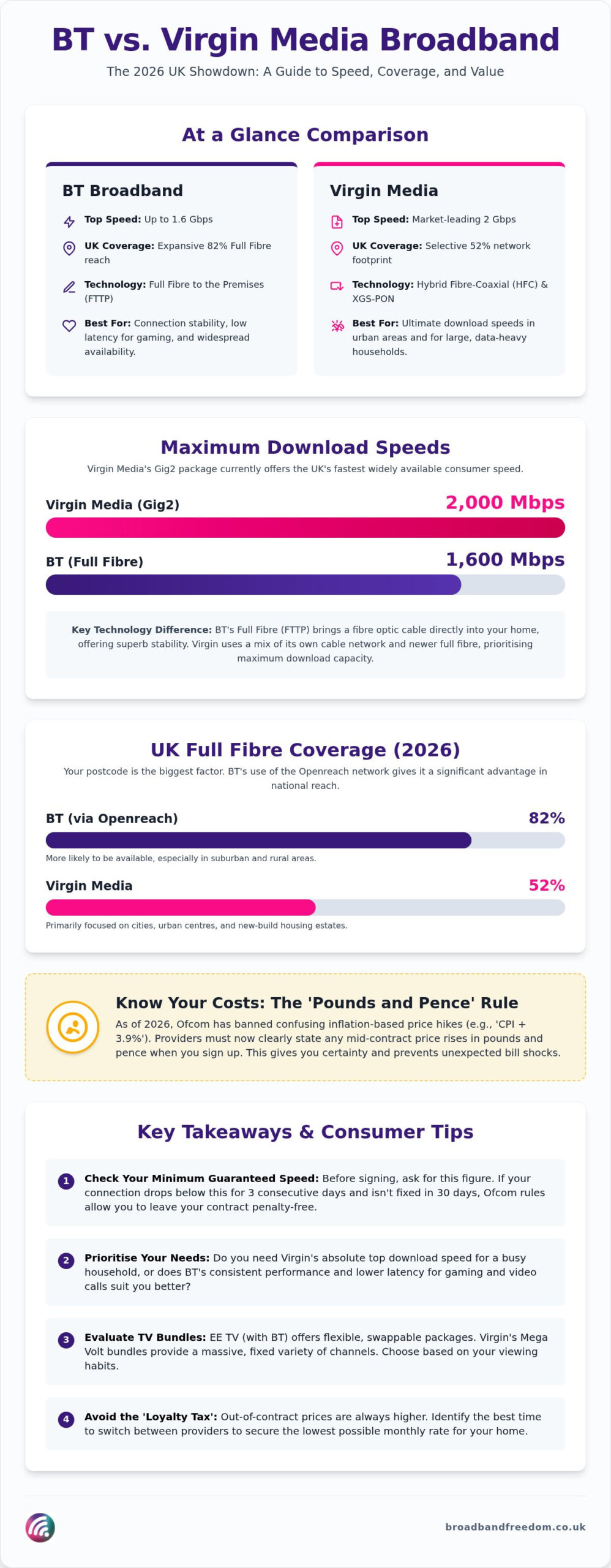
Understanding the technical backbone of your connection helps clear up the bt vs virgin media broadband debate. BT operates on the Openreach network, which has achieved 82% Full Fibre (FTTP) coverage as of 2026. This technology brings fibre optic cables directly into your home, replacing old copper lines entirely. In contrast, Virgin Media uses a mix of its legacy Hybrid Fibre-Coaxial (HFC) cables and the newer Nexfibre (XGS-PON) network. While BT focuses on widespread stability, Virgin prioritises raw capacity.
BT Full Fibre Performance
BT offers a variety of tiers starting at 100Mbps and reaching up to 1.6Gbps in selected areas. Because FTTP doesn’t rely on copper, it is significantly more stable than older part-fibre connections. Reliability is a major selling point for BT Group’s network infrastructure. Recent Ofcom data shows BT consistently delivers lower latency than many competitors, making it a favourite for gamers who need a lag-free experience across the UK.
Virgin Media Gig1 and Gig2 Speeds
Virgin Media currently holds the speed crown with its Gig2 package. This service offers a massive 2,000Mbps (2Gbps) download speed, which is roughly double BT’s top consumer offering. Historically, Virgin’s upload speeds were lower due to HFC limitations. However, the Nexfibre rollout uses XGS-PON technology to provide much faster, symmetrical upload speeds. If you aren’t sure what you’re currently getting, you can use this tool to check your Broadband Freedom internet speed.
Understanding Average Speed Standards
Ofcom regulations in 2026 require providers to advertise “average” speeds based on what 50% of customers actually receive during peak hours (8 pm to 10 pm). This is much more honest than the old “up to” claims. Virgin’s network often delivers higher bursts, but BT’s Openreach lines frequently show less fluctuation when the whole street is online. This consistency is vital for households where multiple people are working from home simultaneously.
Actionable Tip: Check Your Guarantee
Before you sign a 24-month contract, always ask for your “Minimum Guaranteed Speed”. If your provider fails to hit this level for three consecutive days and can’t fix it within 30 days, Ofcom rules often allow you to leave the contract without a penalty. This protection ensures you aren’t paying for a premium tier that your local infrastructure cannot actually support.
Availability and Coverage: Can You Get It?
The biggest factor in the bt vs virgin media broadband debate is your postcode. BT uses the Openreach network, which acts as a national wholesaler. Virgin Media operates its own independent cable and fibre lines. This means BT is often available in areas where Virgin isn’t. According to the UK Government’s “Project Gigabit” reports, the focus has shifted toward connecting the final 20% of hard-to-reach premises. Whilst BT’s network is more expansive, Virgin Media often provides the only high-speed alternative in densely populated urban centres. This infrastructure divide defines your choices.
BT and the Openreach Footprint
BT’s primary advantage is its sheer reach across the country. By August 2026, Openreach has extended Full Fibre (FTTP) to 82% of UK homes. Because many other providers like Sky and TalkTalk use these same lines, switching is often seamless. The national goal remains 99% coverage by 2030. If you live in a rural area, you’re far more likely to find BT than any other major competitor. You can easily compare broadband deals to see which Openreach-based providers serve your specific street.
Virgin Media’s Expanding Network
Virgin Media currently covers around 52% of UK premises. Their partnership with Nexfibre aims to reach 23 million homes by the end of 2026. This expansion is vital for competition. A Competition and Markets Authority analysis previously highlighted how the Virgin and O2 merger would bolster infrastructure investment. Virgin is frequently the exclusive provider for new-build housing developments. If you live in a city centre, you’ll likely have access to their gigabit services. Check your postcode now to see if these high speeds are available at your address.
Monthly Costs, Contract Terms, and Price Hikes
Navigating the financial side of your connection is now much simpler thanks to recent regulations. As of 2026, Ofcom has banned vague inflation-linked price rises like “CPI plus 3.9%”. This “Pounds and Pence” rule means both providers must tell you exactly how much your bill will increase in pounds and pence from the day you sign up. When weighing up bt vs virgin media broadband, you can now calculate the total cost of your contract with 100% accuracy. This transparency helps you spot the “loyalty tax”, where monthly rates often double once your initial discount ends.
BT Pricing and Contract Lengths
BT typically requires a 24-month commitment. While this is a long stay, it often secures the lowest monthly rate. You should also consider BT Halo, which offers a 4G or 5G backup if your main line fails. For large families, this peace of mind might justify the higher monthly cost, though many users find standard packages sufficient. You can find the latest fibre broadband offers to see how these bundles stack up against the competition. Upfront costs for BT usually cover the delivery and setup of your Smart Hub router.
Virgin Media Deals and Flexibility
Virgin Media is famous for its aggressive flash sales. It’s common to see deals bundled with bill credits or high-street vouchers. Unlike BT, they also provide no contract broadband options. These rolling 30-day plans are perfect for renters or students who don’t want to be tied down for two years. Historically, Virgin’s annual price hikes were amongst the highest in the industry, but the new Ofcom rules have forced a more honest approach to pricing. This makes it easier to compare their 18-month terms against BT’s longer contracts.
Actionable Tip: Set a calendar reminder for 30 days before your contract expires. This gives you enough time to browse new offers and switch without paying the out-of-contract premium. To get started, compare broadband deals today and see how much you could save by moving providers.
TV Bundles and Extras: Which Offers Better Value?
Bundling services can drastically reduce your monthly outgoings. BT has rebranded its television offering as EE TV, focusing on a multi-device experience. Virgin Media continues to push its Stream and TV 360 platforms, which integrate popular apps directly into the interface. According to Sarah Jenkins, Lead Analyst at Telecoms Insights, “The 2026 market shows a definitive shift toward cord-cutting, with 64% of UK households now preferring app-based streaming over traditional linear channel grids.” This shift makes the bt vs virgin media broadband choice even more critical for your living room setup.
Entertainment and Sports Content
BT offers unique flexibility by allowing you to swap your TV package every 30 days. You can switch from a cinema-heavy plan to a sports-focused one without starting a new contract. This is ideal for catching the football season on TNT Sports. Virgin Media remains the king of high-definition variety, offering more 4K channels than most UK providers. They also feature deep integration with Netflix and Disney+, often including these subscriptions in their higher-tier Broadband and TV Packages.
Mobile Convergence (Volt vs EE)
Choosing a provider often comes down to your mobile network. Virgin Media O2 offers “Volt” benefits, which automatically double your O2 mobile data and boost your home broadband speed to the next available tier. BT leverages its synergy with EE, providing multi-service discounts and “unbreakable” home Wi-Fi backed by the EE mobile network. These perks add significant value if you’re already a customer of their partner mobile brands. If you’re looking for the lowest possible monthly bill, combining these services is usually the smartest move.
Final Verdict: BT or Virgin?
The bt vs virgin media broadband winner depends on your priorities. If you live in a rural area or prioritise a stable, low-latency connection for gaming, BT’s Openreach network is your best bet. However, if you’re an urban dweller seeking the fastest possible download speeds and a massive entertainment bundle, Virgin Media is hard to beat. Always check your local coverage first to see which giant can truly deliver on its promises in your specific street.
Secure Your Best Home Connection for 2026
Finding the right fit in the bt vs virgin media broadband battle comes down to your personal requirements and postcode. If you value raw speed, Virgin Media’s 2Gbps capacity remains unmatched in many urban centres. However, BT’s Openreach network provides superior Full Fibre reliability for 82% of the UK. Use the new “Pounds and Pence” transparency rules to calculate your exact costs and avoid the loyalty tax before your current contract ends. By checking your minimum speed guarantee, you ensure you’re getting exactly what you pay for.
Take Control of Your Broadband Costs
Stop overpaying for a connection that doesn’t meet your needs. Our independent UK-based comparison helps you filter through the latest offers without any hidden fees. We provide daily updated pricing for 2026 to ensure you get the most accurate information available. It’s time to prioritise your home’s stability and your monthly budget. Compare the latest BT and Virgin Media deals now and take control of your digital life with confidence. You deserve a connection that works as hard as you do.
Frequently Asked Questions
Is BT or Virgin Media better for gaming in 2026?
BT is generally superior for competitive gaming because its Full Fibre (FTTP) network typically offers lower latency and more consistent ping rates. Whilst Virgin Media provides faster raw download speeds for large game updates, the stability of the Openreach infrastructure reduces the risk of lag during online matches. Gamers who prioritise a responsive connection over pure bandwidth should opt for BT’s fibre-to-the-premises service where available.
Can I get Virgin Media without a landline?
You can easily get Virgin Media without a landline by choosing one of their standalone broadband-only packages. Because Virgin operates its own independent cable and fibre network, it doesn’t require a traditional copper phone line to deliver internet to your home. This is an excellent way to lower your monthly bill if you primarily use mobile phones or VoIP services for calling.
What happens to my BT price if I move house?
Your monthly BT price usually stays the same when you move, provided your current package is available at the new address. You should notify the provider at least 30 days before your move to organise the transfer of services. If your new home only supports slower speeds, you may need to switch plans, which could lead to a change in your contract terms or pricing.
Does BT use the same cables as Virgin Media?
No, BT does not use the same cables as Virgin Media because they operate on two entirely distinct physical networks. BT uses the Openreach network, which it shares with other providers like Sky and TalkTalk. Virgin Media maintains its own private infrastructure. This is why the bt vs virgin media broadband choice is often restricted by which cables are physically buried under your street.
Who has better customer service, BT or Virgin?
BT consistently achieves higher customer satisfaction ratings than Virgin Media in official Ofcom reports. Recent 2026 data indicates that BT customers experience shorter call waiting times and more effective complaint resolution. Virgin Media remains one of the most complained-about providers in the UK, often struggling with technical support wait times. If reliable customer care is a deciding factor for you, BT is the stronger choice.

Article by
Elaine Lang
Elaine has over 20 years across Marketing, Communications and Public Relations in the UK. She has worked across large UK corporations, including Commercial Banks and Airports, to online consumer finance and technology solutions. Elaine has post graduate qualifications in Marketing from the Chartered Institute of Marketing (CIM) and the Industry of Direct Marketing (IDM). She is a lifelong feline fan, sharing her home with around 4-6 cats for many years. This of course can be a challenge when trying to work at home, as they like to try to help!