3 broadband prices, speeds and contract terms

The monthly price is only part of the deal. Compare 3 broadband deals by looking at download and upload speeds, contract length and any money-back guarantee. The European Commission’s broadband classifications define fast broadband as 30 to 100 Mbps and ultra-fast broadband as speeds above 100 Mbps, giving you a baseline for interpreting speed claims.
It’s easy to focus on the headline download speed and miss terms that affect your choice. Comparing 3 broadband deals side by side can help you see which option better matches your needs and how much flexibility you want from the contract.
This guide explains how to compare average download and upload speeds, contract lengths, money-back guarantees, monthly prices and annual price rises. You’ll also learn what to look for in the terms, so you can assess 3 broadband options by their full cost and commitment, not speed alone.
Key Takeaways
- Compare download and upload speeds with your household’s needs, and use the broadband speed categories to put advertised figures in context.
- Look beyond the contract length: understand how the money-back guarantee works and what its terms mean for you.
- Compare the monthly cost over the deal’s full term, including how and when annual price rises may apply.
- Check what “unlimited data” means in the package terms, then explore Broadband Freedom’s broadband and phone options alongside its other broadband deals.
Average download and upload speeds
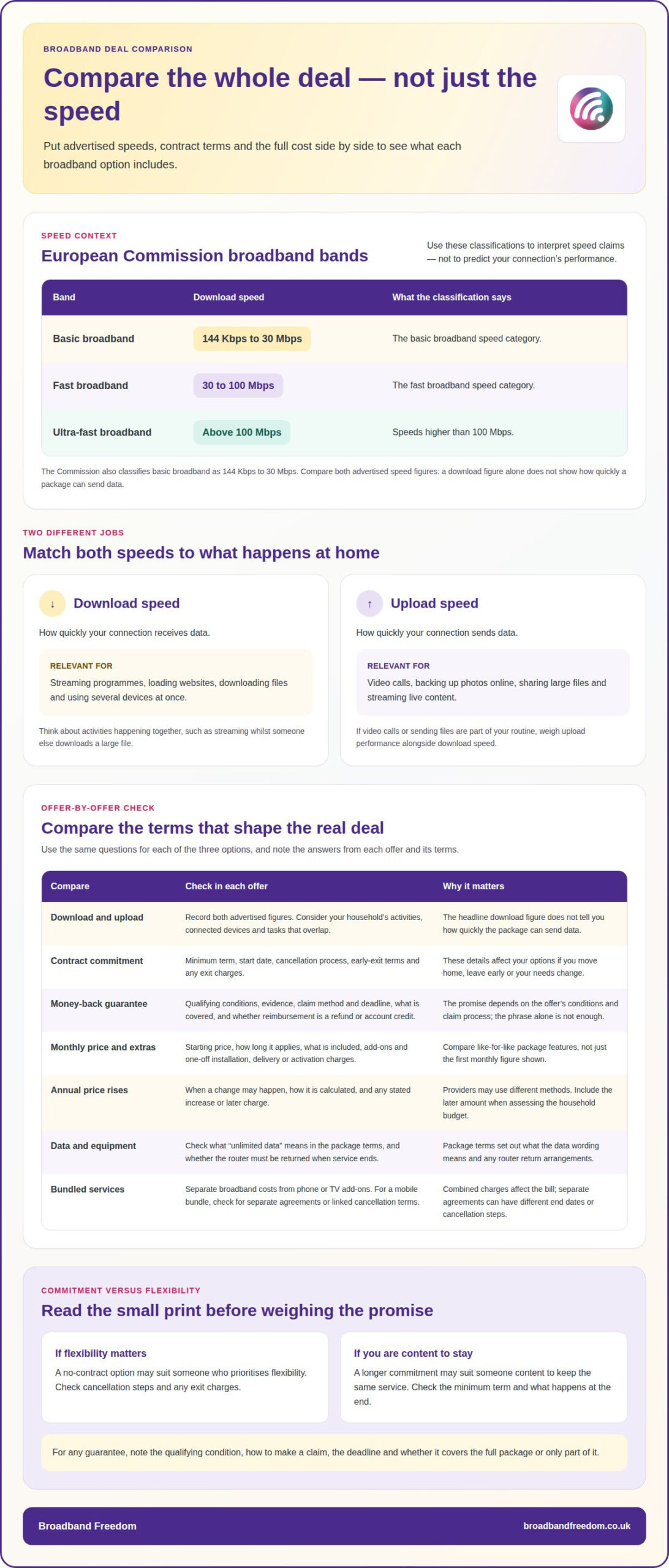
Compare both speeds, because downloading and sending data place different demands on home broadband. The European Commission classifies basic broadband as 144 Kbps to 30 Mbps, fast broadband as 30 to 100 Mbps, and ultra-fast broadband as above 100 Mbps. Use those bands to interpret speed claims, not as a prediction of your connection’s performance.
Download speeds
Download speed measures how quickly your connection receives data. It matters when streaming programmes, loading websites, downloading files or using several devices at once. For example, streaming a programme while someone else downloads a large file puts more demand on your connection than browsing a single webpage.
For a practical comparison, place 3 broadband deals side by side and note each advertised download speed. The European Commission’s categories provide context: fast broadband runs from 30 to 100 Mbps, while ultra-fast broadband exceeds 100 Mbps. Consider those figures alongside your household’s activities and connected devices.
Upload speeds
Upload speed measures how quickly your connection sends data. It matters when joining video calls, backing up photos online, sharing large files or streaming live content. Someone sending a large work file, for instance, may care more about upload performance than someone who mainly watches programmes.
Compare upload speeds as well as download speeds: the download figure alone doesn’t tell you how quickly a package can send data. If you regularly make video calls or share files, weigh upload performance against your routine. A household that mainly browses and streams may prioritise download speed instead.
Speed claims are a starting point, not the only factor in your experience. Connection type, devices and activity across your home can affect performance. Compare 3 broadband options using both advertised figures, then match them to the tasks you do most. A broadband speed guide can help you understand which speed range fits your usage.
Choose based on your actual routine. If several people stream, browse and download at the same time, consider how those activities overlap. If video calls and sending files matter more, pay closer attention to upload speed. The Commission’s speed bands add context, while comparing both figures helps you judge what each package is suited to handle.
Contract lengths and money-back guarantee
A broadband contract sets how long you agree to keep the service and what happens if you leave early. Compare the minimum term, cancellation process and any exit charges before choosing. A money-back guarantee is separate: its value depends on the promise, qualifying conditions and claim process set out in the offer.
Understand the commitment
Read the contract summary for the start date, minimum term and end-of-contract process. If you move home or your needs change, these details may affect your options. For example, if you might move before the minimum term ends, understand the provider’s early-exit terms before signing.
Also check what happens to any included router. The terms may explain whether you must return it when the service ends and how to do so. If broadband is bundled with a mobile service, check whether the services have separate agreements or linked cancellation terms. Separate agreements can mean different end dates or cancellation steps.
Read the guarantee conditions
Don’t rely on the phrase “money-back guarantee” alone. Find out exactly what qualifies, such as a stated service issue or a change-of-mind period. Then note what evidence is required, how to submit a claim, the deadline and whether reimbursement means a refund or account credit.
For example, if a guarantee applies only after you report a problem, the reporting method and deadline matter. Check whether it covers the full package or just one part. Record the relevant terms before ordering so you can weigh the promise against the commitment you’re accepting.
Use a short comparison checklist: minimum term, exit conditions, guarantee eligibility, claim steps and router return arrangements. A no-contract option may suit someone who prioritises flexibility, while a longer commitment may suit someone content to keep the same service. Compare these terms alongside the speeds and package details, using broadband deal comparisons to organise the options around what matters to you.
Monthly prices and annual price rises
Compare the monthly charge with the total price across the full contract. An introductory rate can change, so check the offer summary for the starting price, how long it applies and any later charges. Separate broadband costs from phone or television add-ons too, as these affect the total monthly bill.
Compare the full monthly cost
Start with the monthly amount, then check what it includes. Is the package broadband-only, or does it combine broadband with calls or television? For example, if you’re considering a broadband and TV bundle, compare its combined charge with the cost of the separate services you actually need.
Next, look for one-off charges in the order details. Installation, delivery or activation costs can affect what you pay at the start, even if the advertised monthly charge looks manageable. Compare the total commitment using the same package features and contract period, rather than judging deals by the first figure shown.
Understand annual price rises
Read the price-rise clause before ordering. It explains whether the monthly charge can change during the agreement, when a change may happen and how it is calculated. Don’t assume every provider uses the same method. The contract wording explains the timing and calculation for that specific deal.
For example, one offer may specify a set increase, while another may describe a different calculation. Note the starting charge and stated method, then consider how the change could affect your household budget. If the terms describe a rise after an introductory period, include the later amount in your comparison.
Network coverage and installation requirements affect which packages are available at your address, so compare deals you can actually order there. Review the monthly charge, included services, one-off costs and price-rise wording together. This gives you a clearer picture of the cost over time than looking only at the opening monthly rate.
Unlimited data
An unlimited data allowance means the package terms set no fixed monthly data limit. It says nothing about connection speed or whether the service suits your household. Check the package details for the allowance and any conditions attached to using the service.
What “unlimited” covers
Think about a typical week at home. One person might stream programmes, another might join video calls, and a games console could download updates. With a limited allowance, those activities count towards the stated data limit. An unlimited allowance is intended for use without that fixed monthly cap, subject to the offer’s terms.
Read the wording on fair use, traffic management and permitted activities. These terms explain any stated limits and how the provider manages network use. Don’t assume every package has the same conditions. Compare the exact wording, especially if your household regularly streams in high quality or uploads large files.
Match data terms to your routine
List the activities that use your connection, then compare them with the package description. For example, a household that streams every evening and downloads large game files may value unlimited usage. Someone who mainly checks email and browses websites may prioritise other package features.
Keep data allowance and speed separate. Unlimited data doesn’t mean downloads finish quickly: speed affects how fast information transfers. A package can offer unlimited usage and still have a speed specification, so assess both details independently.
Before choosing, read the package summary and full terms. Check the data allowance, restrictions, traffic-management wording and any differences between advertised and included services. If the terms use “unlimited” without explaining what it means, review the full package information before deciding. This helps you choose based on what your household actually does online.
Compare packages by their data terms as well as their speeds and contract conditions. Compare broadband deals to find options that fit your household’s usage and priorities.
Broadband Freedom: Broadband and Phone Packages
Broadband Freedom helps you compare broadband options, including Broadband and Phone Packages, if you want home internet and calls in one package. Consider how you use your landline, then compare the package terms with your needs for speed, data and contract flexibility.
If you’re also comparing entertainment options, Broadband Freedom offers Broadband and TV Packages. You can compare the latest offers from Virgin Media and BT alongside the other deal details covered in this guide. Focus on the features and terms that matter to your household, rather than choosing based on a single headline detail.
Visit broadbandfreedom.co.uk to explore the available comparisons.
Choose a deal that fits your next chapter
Make your next step a shortlist, not a rushed decision. If you’re comparing 3 broadband deal types, start with what your household needs now, then consider whether those needs may change. A move, a new study routine or more people working from home can shift which package feels right.
Broadband Freedom offers Full Fibre Broadband Deals, Fibre Broadband Deals and Standard Broadband Deals. These provide a starting point for comparing different types of home connection. Choose based on the package that fits your priorities, rather than defaulting to the option that sounds most advanced.
Use your shortlist to compare available deals and narrow down the terms that matter to you. Compare broadband deals with Broadband Freedom and take the next step at your own pace. A clear set of priorities can make choosing feel simpler, and help you move forward with confidence.
Frequently Asked Questions
What’s included?
Inclusions depend on the selected package and provider. Broadband Freedom compares offers; it doesn’t supply the connection itself. A broadband-only deal focuses on internet access, while a bundle may include phone or TV services. Enter your postcode to see offers for your address, then compare the package details to find out which services and terms apply.
What equipment is included, and are there setup or delivery fees?
A standard router is supplied free with Broadband Freedom deals, and an optional Dual-Band router upgrade is available at extra cost. Setup and installation charges vary by provider and package, so review the offer details for any applicable charge. Check delivery information in the deal terms too, and compare the total upfront requirements before choosing.

Article by
Elaine Lang
Elaine has over 20 years across Marketing, Communications and Public Relations in the UK. She has worked across large UK corporations, including Commercial Banks and Airports, to online consumer finance and technology solutions. Elaine has post graduate qualifications in Marketing from the Chartered Institute of Marketing (CIM) and the Industry of Direct Marketing (IDM). She is a lifelong feline fan, sharing her home with around 4-6 cats for many years. This of course can be a challenge when trying to work at home, as they like to try to help!