How to Complain About Your Internet Provider in the UK: A Step-by-Step Guide

Your broadband keeps dropping, or the speeds fall short of what you were promised, and your provider still hasn’t put things right. Knowing how to complain about internet provider UK households rely on can help you move beyond repeated calls and vague assurances. It’s understandable to worry that your complaint will be ignored, especially if you’re unsure what to record or where to take it next.
A strong complaint is documented, made formal and escalated through the right route. This guide explains how to build an evidence trail, describe the problem clearly and follow up. If it remains unresolved, you can generally take it to an approved Alternative Dispute Resolution scheme after six weeks, or sooner if your provider sends a deadlock letter. Ofcom’s complaint guide explains the escalation process, while its information on complaints handling clarifies the regulator’s role. You’ll know what to do next, without having to guess.
Key Takeaways
- Record when the broadband issue happens and gather relevant evidence, whether it’s a service fault, billing error or contract concern.
- Make your complaint clear and formal through your provider’s stated channel, with a timeline, supporting details and the outcome you’re seeking.
- Understand how to complain about internet provider UK customers use, including when an approved dispute resolution scheme may be the next step.
- Keep the provider’s response and your complaint records together so you can assess whether the issue has been addressed and decide what to do next.
How to complain about an internet provider in the UK: identify and record the problem
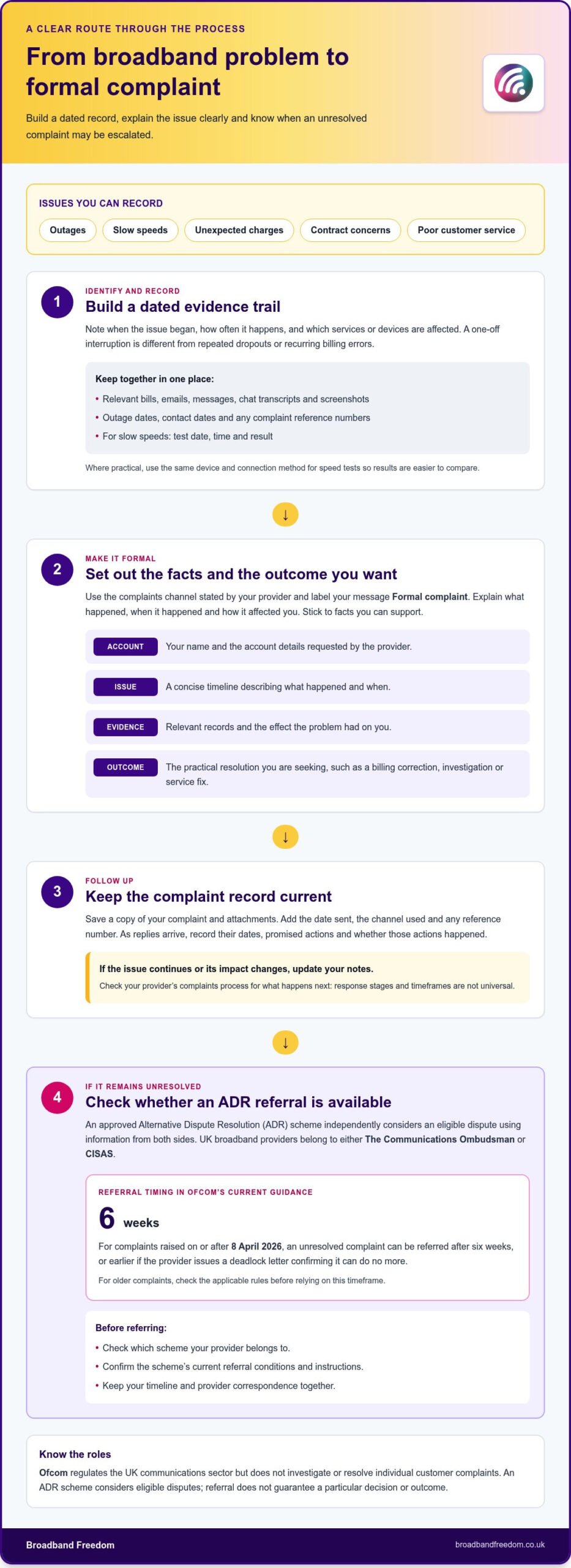
Outages, slow speeds, unexpected charges, contract concerns and poor customer service can all be grounds for a complaint. Start by noting whether the problem happened once or keeps returning. A brief interruption may be a one-off fault; repeated dropouts or recurring billing errors point to an ongoing issue. Basic checks can help you describe what’s happening, but troubleshooting doesn’t replace making a formal complaint.
A clear record helps you explain the issue and follow up consistently. Keep the complaint focused on the provider’s service and your experience. Ofcom, the UK’s communications regulator, has a broader role than handling individual customer complaints. Start by keeping your evidence and communication with the provider in order.
What evidence should you collect before complaining?
Build a simple timeline. Record when the issue began, how often it occurs, and which services or devices are affected. For slow speeds, note the date, time and test result. Where practical, use the same device and connection method each time so you can compare results more easily. You can find more information about internet speed as you gather results.
- Save relevant bills, emails, messages, chat transcripts and screenshots.
- Note outage dates, speed-test results, contact dates and any reference numbers.
A complaint record is a dated timeline of the problem and your contact with the provider. Store it all in one folder so you can find details quickly.
How do you describe a broadband problem clearly?
Be specific: explain what happened, when it happened and how it differs from the service you expected. Instead of writing “the internet is always slow”, give the dates and times you noticed slow speeds, whether the connection dropped, and which devices were affected. If you’re learning how to complain about internet provider UK services, these details make your account easier to understand and assess.
Stick to what you can show. Don’t claim the provider broke a speed guarantee unless your contract or evidence supports that. Describe the impact plainly, such as being unable to join a work call or use a paid service. Keep your original records in case you need to refer to them later.
How to make a formal complaint to your broadband provider
Once you’ve organised your notes, use the complaints channel set out by your provider and clearly label your message Formal complaint. This distinguishes it from a routine service query. Include your account details, a concise timeline, relevant evidence, the effect on you and the outcome you want. For a clear account of how to complain about internet provider UK households rely on, stick to facts you can support. GOV.UK explains Ofcom’s role in regulating communications, while your provider’s complaints process explains how to submit your complaint.
What should a formal broadband complaint include?
Keep the wording calm and focused. Attach evidence that relates directly to the problem, such as the relevant bill or speed-test record. State the practical resolution you’re seeking, whether that’s a billing correction, an investigation or a service fix.
- Account: Your name and the account details requested by the provider.
- Issue: What happened and when, in date order.
- Evidence and impact: Relevant records and how the problem affected you.
- Requested outcome: The action you want the provider to take.
A clear complaint states the facts, the evidence that supports them and the outcome you’re asking for.
How should you follow up with the provider?
Keep a copy of your message and attachments. Note the date you sent it, the channel used and any complaint reference number. As replies arrive, add their dates, any promised actions and whether those actions happened. If the issue continues or its impact changes, update your record. Check your provider’s complaints process for what happens next, as response stages and timeframes aren’t universal.
While your complaint is under way, you may also decide to review other options. If so, compare broadband deals separately. Comparing is an optional next step, not a way to resolve the existing dispute.
When can you escalate an internet provider complaint in the UK?
If your provider hasn’t resolved your complaint, an approved Alternative Dispute Resolution (ADR) scheme may be the next step. For complaints raised on or after 8 April 2026, Ofcom’s current guidance says you can refer an unresolved complaint after six weeks, or earlier if your provider gives you a deadlock letter confirming it can do no more. For older complaints, check the applicable rules before relying on this timeframe.
Check which scheme your provider belongs to and confirm its current referral conditions before applying. Ofcom’s complaints guidance explains when escalation may be possible. Keep your timeline and provider correspondence together, then follow the scheme’s instructions about eligibility and supporting documents.
What does an alternative dispute resolution scheme do?
An ADR scheme independently considers an eligible dispute between a customer and a communications provider, using information from both sides. UK broadband providers belong to either The Communications Ombudsman or CISAS. Each scheme has its own process, so check your provider’s membership and the scheme’s latest guidance before submitting your case. A referral doesn’t guarantee a particular decision or outcome.
Should you complain to Ofcom?
Ofcom regulates the UK communications sector, but it doesn’t investigate or resolve individual customer complaints. If you report a concern, the information may help Ofcom monitor issues across the industry. Reporting is not a substitute for taking your unresolved case to the relevant ADR scheme. Read Ofcom’s current instructions to understand what it accepts and how it uses reports.
The distinction helps you choose the right route: use ADR to seek consideration of an eligible individual dispute, and contact Ofcom to report a broader concern. If you’re considering a change after addressing your complaint, compare broadband deals separately, rather than treating a new deal as a resolution to the dispute.
After your broadband complaint: outcomes and next steps
When a reply arrives, compare it with the points you raised and the outcome you requested. Has the provider addressed each issue? Does its explanation match your records, and has it completed any promised action? A response may answer part of your complaint but leave another point unresolved, so assess each issue separately.
How should you assess the provider’s response?
If the problem continues, add the latest details to your timeline and follow the next steps in the provider’s complaints process or the relevant scheme’s decision. Keep the final decision, letters, emails and other provider correspondence with your original complaint record. This gives you a clear file of what you reported, what was promised and what happened afterwards.
Knowing how to complain about internet provider UK households rely on also means knowing when to take a separate next step. If you’re considering switching, review your contract terms first. Check whether you’re still within a minimum term and whether exit conditions or charges apply. Consider the timing of a new service too, so you can plan around the change.
When might comparing broadband deals make sense?
Comparing deals may be useful if you’ve reviewed the complaint outcome and are considering a different provider. Treat this as a separate decision, not a remedy for the existing dispute. Your complaint process and any steps needed to resolve it remain separate from arranging a switch.
As you weigh up alternatives, consider what matters in your household, such as the type of connection, contract flexibility or whether you need a bundled service. Broadband Freedom brings together options from major UK networks, including full fibre, fibre and standard broadband, so you can compare available packages against those priorities. A new deal won’t, by itself, resolve a complaint about your current service.
If you’re ready to explore alternatives, Compare broadband deals on your terms.
Take your next broadband decision into your own hands
Knowing how to complain about internet provider UK households depend on can put you in a stronger position to decide what comes next. Once you’ve considered the response and your contract terms, you can choose whether staying or switching better fits your needs. There’s no need to rush. Focus on the connection, flexibility and service that work for your household.
Broadband Freedom is a comparison platform that brings options from major UK networks together in one place, including full fibre, fibre and standard broadband. Comparing these alternatives is separate from your complaint, but it can help you explore available options before deciding whether to move.
Compare broadband deals on your terms and take your next step with confidence.
Frequently Asked Questions
How do I complain about my internet provider in the UK?
Use your provider’s published complaints channel and label your message a formal complaint. Include the account holder’s details, explain the issue and state the action you want, such as an investigation or billing correction. Keep a copy and note the complaint reference. The practical route for how to complain about internet provider UK customers use is to start with the provider, then follow its stated process.
Can I complain to Ofcom about my broadband provider?
You can report a concern to Ofcom, but it doesn’t investigate or decide individual customer disputes. Ofcom may use reports to monitor wider industry issues and inform its regulatory work. If you want your own unresolved case considered, check the relevant approved dispute resolution scheme instead. Read Ofcom’s current complaints guidance to choose the right route.
When can I take a broadband complaint to an ombudsman?
For complaints raised on or after 8 April 2026, you can generally refer an unresolved complaint to your provider’s approved Alternative Dispute Resolution scheme after six weeks, or sooner if you receive a deadlock letter. Check your provider’s scheme and its current eligibility rules. The two schemes are The Communications Ombudsman and CISAS; use the relevant scheme’s guidance to prepare your case.
What evidence do I need to complain about slow broadband?
Keep speed-test results with the date and time, and record whether you tested over Wi-Fi or a wired connection. Note repeated dropouts and whether the issue affects particular devices or times of day. Compare your results with the speed information in your contract or provider documents, but don’t assume a single test proves a service commitment was breached.
Can I switch broadband provider while a complaint is open?
You can consider switching while pursuing a complaint, but check your contract’s minimum term and any applicable exit conditions first. A switch doesn’t resolve the dispute, so keep your complaint correspondence and continue following the provider’s or scheme’s process. Before placing an order, consider how the changeover could affect your household’s connection and plan for any gap in service.

Article by
Elaine Lang
Elaine has over 20 years across Marketing, Communications and Public Relations in the UK. She has worked across large UK corporations, including Commercial Banks and Airports, to online consumer finance and technology solutions. Elaine has post graduate qualifications in Marketing from the Chartered Institute of Marketing (CIM) and the Industry of Direct Marketing (IDM). She is a lifelong feline fan, sharing her home with around 4-6 cats for many years. This of course can be a challenge when trying to work at home, as they like to try to help!