Compare Broadband Deals UK: Find the Right Plan for You in 2026

The cheapest broadband deal can be the wrong choice if it’s too slow for your household or unavailable at your address. To compare broadband deals UK providers offer, start with how you use the internet at home, not just the headline price.
It’s easy to feel swamped by packages, speed claims and contract details. This guide shows you how to build a shortlist using consistent criteria: speed, total cost, contract length and useful extras. You’ll also learn how to match advertised speeds to your household’s needs and what to consider before switching.
Availability matters too. Ofcom’s January 2026 figures show full fibre was available to 82% of UK residential premises, so the options vary by address. Broadband Freedom brings together daily updated offers from up to 30 providers, helping you compare deals for your home.
Key Takeaways
- Start with your household’s needs and address to focus on deals and connection types that suit your home.
- Use the same checklist to compare broadband deals across the UK, including monthly price, contract length, setup charges and included services.
- Check the terms for scheduled price changes, and treat advertised speeds as a guide rather than a promise of everyday performance.
- Before switching, shortlist a suitable plan and gather the account and address details needed to arrange the move.
Compare broadband deals in the UK by starting with what your household needs
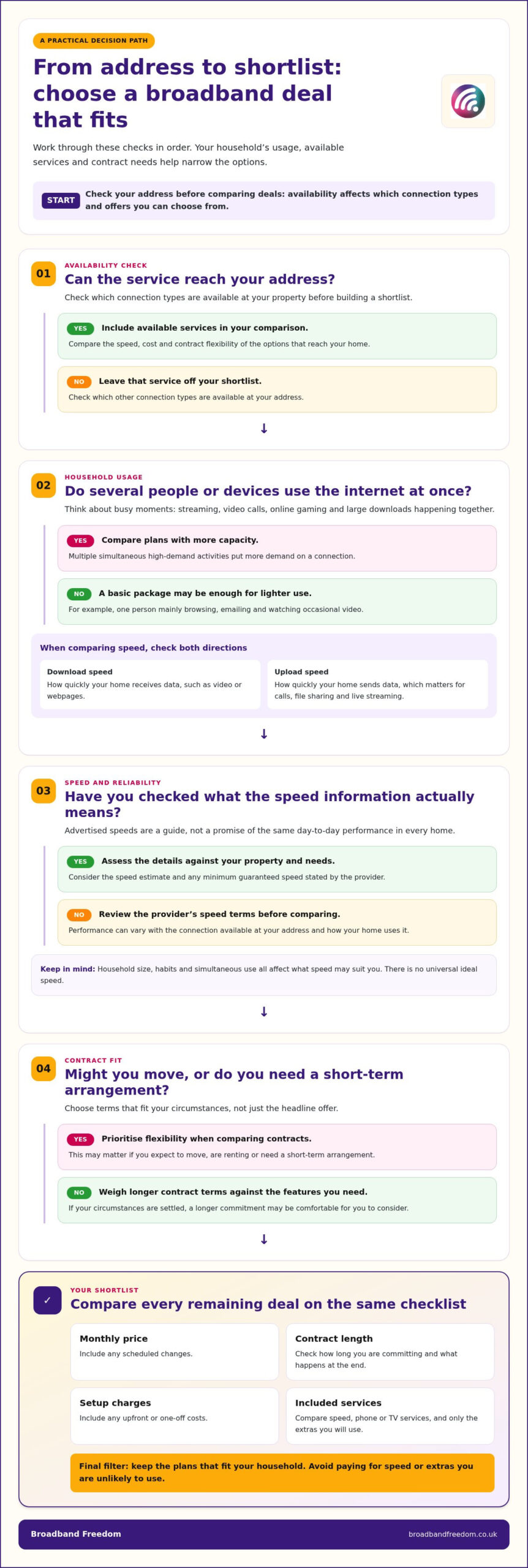
Comparing packages, speeds and contract options can quickly feel like another job. Make it manageable by starting with four priorities: household usage, suitable speed, full contract cost and flexibility. This keeps your shortlist focused on deals that fit, rather than headline offers that may not suit you.
A broadband deal is more than its monthly headline price: it’s the speed, terms, total commitment and extras you get for your household. Your address matters too, because it affects which connection types and offers are available. Check availability before building a shortlist, then use broadband deal comparisons to review options against your requirements.
Match broadband speed to the way you use the internet
Think about what happens online at the same time. One person streaming while another joins a video call, plays online games or downloads large files puts more demand on a connection than browsing alone. Include connected devices such as smart TVs and speakers when considering your household’s usage.
Download speed affects how quickly your home receives data, such as video or webpages. Upload speed affects how quickly it sends data, which matters for video calls, sharing files and live streaming. Advertised speeds help you compare plans, but don’t guarantee the same day-to-day experience in every home.
Check which broadband types reach your address
Standard broadband generally uses older copper telephone lines. Fibre broadband often brings fibre to a street cabinet, with a copper line completing the connection to your home. Full fibre runs fibre directly to the property. Use the Ofcom broadband coverage checker to explore which services reach your address.
UK broadband has developed across different networks and technologies. The history of UK internet provides background, but your immediate priority is checking which services are available at your property. To compare broadband deals UK households can access, check availability first, then weigh speed against cost and contract flexibility.
Compare broadband deals fairly: total cost, contract terms and extras
Once you’ve identified suitable speeds and connection types, compare each offer on the same terms. Use one checklist for every option, rather than judging plans by the monthly headline price alone.
| What to compare | What to check |
|---|---|
| Monthly price | What you’ll pay each month, including any scheduled changes. |
| Contract length | How long you’re committing to the deal and what happens at the end. |
| Setup charges | Any upfront or one-off costs listed for the deal. |
| Included services | Broadband speed, phone or TV services, and extras you’ll actually use. |
Look beyond the monthly headline price
One-off charges add to your initial outlay, while a longer contract commits you to the plan for more time. Check the deal details and calculate the total cost across the contract, including any stated price changes. Don’t assume a low starting price will stay the same.
Ofcom’s rules for new contracts taken out from 17 January 2025 require providers to set out any in-contract price rises in pounds and pence, rather than using inflation-linked or percentage-based increases. Read the provider’s wording to see when a change applies and how much it will add. See Ofcom’s guidance on contract price rises.
Decide whether a bundle or flexible contract suits you
Compare broadband-only plans with phone or TV bundles if you need those services. An included extra has little value if you won’t use it. If avoiding a long commitment matters more, explore no-contract broadband deals and compare their terms with fixed-length plans.
With your priorities clear, use the broadband deal comparison to review current offers against the same checklist.
Choose a UK broadband deal by speed, reliability and contract fit
A suitable deal should work for your household’s busiest online moments, not just look impressive on a comparison page. Use this method to narrow your options:
- Estimate usage: Think about how many people and devices are online at the same time.
- Check availability: See which services can reach your specific address.
- Compare terms: Weigh speed and reliability information against contract length and flexibility.
- Shortlist: Keep the options that fit your needs, rather than paying for speed or extras you’re unlikely to use.
Use household behaviour to shortlist speeds
For one person mainly browsing, emailing and watching occasional video, a basic package may be enough. If several people stream in high definition, join video calls, play online games or download large files at once, compare plans with more capacity. There’s no universal ideal speed: household size, habits and simultaneous use all make a difference. Our internet speed guide can help you judge what to look for.
Check the details behind speed and reliability claims
An advertised speed is a guide, not a promise that every household will experience that speed all day. Actual performance can vary with the connection available at your address and how your home uses it. Review the provider’s terms for the speed estimate and any minimum guaranteed speed, and check that the details apply to your property. Ofcom’s broadband speed guidance explains the speed information consumers may see when comparing services.
Contract fit matters too. If you expect to move, are renting, or need a short-term arrangement, flexibility may matter more than a longer commitment. If your circumstances are settled, you may be comfortable weighing longer contract terms against the features you need. Ready to compare broadband deals available to your household? Compare broadband deals for your address.
Compare broadband deals and move from shortlist to switch
You’ve narrowed down what matters. Turn your shortlist into a confident choice with a few final checks. Focus on what’s available at your address and what the contract commits you to.
- Confirm availability: Check that the shortlisted package can serve your property.
- Compare the full terms: Review contract length, charges, speed information and any scheduled price changes.
- Choose a suitable plan: Pick the option that fits your household’s use and need for flexibility, not simply the lowest starting price.
What to do before choosing a deal
Keep your current contract details and preferred start date to hand. Review the new package’s full terms, including any services you’ll be moving or adding, and follow the switching instructions for that offer. The information needed can vary, so having your address and current account details nearby can make the process easier.
Ofcom’s guidance on switching provider explains the UK switching process. Follow the instructions for your move, and don’t assume a start date or transfer arrangement until it’s set out in the offer.
Compare available deals for your address
Broadband Freedom is a comparison and referral platform. It helps you review offers and connect with a provider, which supplies the broadband service. Available packages vary by address, so checking your property helps keep your shortlist relevant.
Ready to take the next step? Compare broadband deals for your address and review the options that fit your needs.
Find a broadband deal that fits your home
The right plan isn’t simply the one with the lowest starting price. Match speed to your household’s usage, check which services reach your address, then compare the full contract terms, price changes and extras you’ll genuinely use. This needs-first approach makes it easier to compare broadband deals UK households can actually choose from, without getting lost in unsuitable packages.
Broadband Freedom brings together daily updated offers from up to 30 providers, including full fibre, standard broadband, bundles and no-contract deals. Availability and options vary by address, so use your location to focus your shortlist on relevant offers. Then weigh the terms against your priorities before deciding.
Ready to turn your shortlist into a practical next step? Compare broadband deals for your address and explore the options that fit your household.
Frequently Asked Questions
How do I compare broadband deals in the UK?
Start with your address and household needs, then compare available plans using the same criteria: speed, monthly price, contract length, setup charges and included services. Check for scheduled price changes before choosing. Broadband Freedom is a comparison and referral platform, not a broadband provider, and lets you compare offers from up to 30 providers. The provider you select supplies the broadband service.
What should I look for when comparing broadband deals?
Look beyond the advertised monthly price. Check the total commitment over the contract, including setup charges and any scheduled price rises, then weigh the speed and terms against your needs. Compare phone or TV extras only if you’ll use them. For new contracts, Ofcom says providers must state in-contract price rises in pounds and pence at the point of sale. Read Ofcom’s guidance on contract price rises.
Is full fibre broadband available at every UK address?
No. Full fibre availability depends on the property and network coverage. Ofcom reported that full fibre was available to 82% of UK residential premises in January 2026, which means it wasn’t available everywhere. Check your specific address rather than relying on a national figure. Ofcom’s coverage and speeds information can help you explore what may be available.
Can I switch broadband provider before my contract ends?
Yes, but review your current contract before switching. Leaving before the minimum term ends may mean paying an early termination charge, depending on your agreement. Ofcom’s One Touch Switch process allows the new provider to manage the switch between participating providers. Read the Ofcom switching guidance and follow the instructions for your move.
How do I know what broadband speed I need?
Base your choice on how your household uses the internet at busy times. Browsing and email place different demands on a connection from several people streaming, gaming or making video calls at once. Download speed affects receiving content; upload speed affects sending it, including during calls. There’s no single ideal speed for every home. Compare plans against your usage and review the speed information for your address.

Article by
Elaine Lang
Elaine has over 20 years across Marketing, Communications and Public Relations in the UK. She has worked across large UK corporations, including Commercial Banks and Airports, to online consumer finance and technology solutions. Elaine has post graduate qualifications in Marketing from the Chartered Institute of Marketing (CIM) and the Industry of Direct Marketing (IDM). She is a lifelong feline fan, sharing her home with around 4-6 cats for many years. This of course can be a challenge when trying to work at home, as they like to try to help!