How to negotiate a new broadband contract and cut your monthly price

Renewing with your current broadband provider can lower your bill, but it may also reset your commitment. To negotiate a new broadband contract in 2026, start 30 to 40 days before your current deal ends, and remember that a retention discount usually comes with a new minimum term and price-rise schedule.
It’s sensible to want a better monthly price without losing sight of the small print. A lower offer is only useful if its full-term cost, speed and terms work for you. You’ll learn what to ask the retentions team, how to use a competing deal in the conversation, and what to weigh before agreeing to stay.
We’ll also explain how a planned price rise can affect your options, when early exit fees may apply, and why timing your negotiation matters. With those details clear, you can decide whether to renew, negotiate or switch with more confidence.
Key Takeaways
- If a price rise wasn’t properly disclosed, you may have 30 days from the notification to cancel without an exit fee.
- Give the retentions team a specific competing deal and ask whether they can beat it, not just match it.
- Before switching mid-contract, find out how early termination fees could affect the overall cost.
- Compare the new deal’s full terms, including its price-rise schedule, before agreeing to renew.
Penalty-free exit rights after a price-rise notification
Check whether the increase was disclosed in your contract, then compare your exit rights with the cost of staying.
-
Check your penalty-free exit rights
Read the price-rise notification and your contract together. If the increase wasn’t properly disclosed, you must receive at least 30 days’ notice and have 30 days from that notice to cancel without an exit fee. If the rise exceeds the amount stated in your original contract, you can leave within a 30-day window without a penalty. Keep the notification and note its date.
-
Check your provider’s cancellation policy
Find your provider’s terms for the specific price rise, cancellation window and notice process. If you’re out of contract, you can leave with 30 days’ notice; once the minimum term ends, there’s no exit fee. Ask how the provider will handle cancellation before switching, and don’t assume every rise gives you the same exit rights. A provider’s policy must be read alongside your contract.
-
Compare competitor offers and set a target
Compare at least three alternative providers’ offers, then use a suitable deal as your target when negotiating. To negotiate a broadband contract in the UK in 2026, tell your provider the speed and monthly price you’re comparing, and ask it to beat the deal. Haggling can save £5 to £12 per month. Check availability by entering your postcode in a broadband checker; the broadband speed information can help you focus on speeds that suit your needs.
-
Review the rules on in-contract price rises
Check when you signed up and what price rise your contract states. Since 17 January 2025, providers must set out planned mid-contract rises in pounds and pence when customers sign up. New deals taken out after that date use a fixed annual increase rather than an inflation-linked one. Before accepting a replacement deal, check its price-rise schedule and whether the new minimum term changes your ability to leave. A lower starting price may not mean a lower total cost.
Talking to the retentions or cancellation team
You can switch without an exit fee once your minimum term has ended, or if you qualify for penalty-free cancellation after a price rise. To negotiate a renewal, explain what you currently pay, mention a competing offer and ask for a better deal.
-
Contact the retentions or cancellation team
Call your provider and ask for the team handling cancellations or retentions. Set aside 20 to 30 minutes for the negotiation, and have your account details and latest bill ready. If you’re paying more after a price rise, state the new monthly charge and ask what options are available. Don’t cancel before understanding the consequences for your service and any remaining contract.
-
Make your renewal case
Give a clear reason for calling: you want to renew, but your current tariff no longer suits your budget or needs. Name a comparable offer and ask the team to beat it, rather than simply match it. For example, if you’re speaking to Virgin Media, explain the monthly price and speed you want. Stay focused on those terms instead of accepting a faster package that costs more than you’re prepared to pay.
- Ask the adviser to confirm the full offer before you agree. A retention discount may start a new minimum term and bring a new price-rise schedule, so check both alongside the monthly charge. Ask when the new term begins, what happens to your existing tariff and whether any January increase is included. A lower opening price may not mean lower costs throughout the contract.
- Clarify your cancellation rights before ending the call. You have a legal right to cancel a broadband contract within 14 days. If your minimum term has ended, you can leave without an exit fee; a qualifying price-rise notification may also provide a penalty-free exit window. If neither applies, check the early termination charge before deciding. Compare broadband deals to give your renewal conversation a clear alternative.
Early termination fees
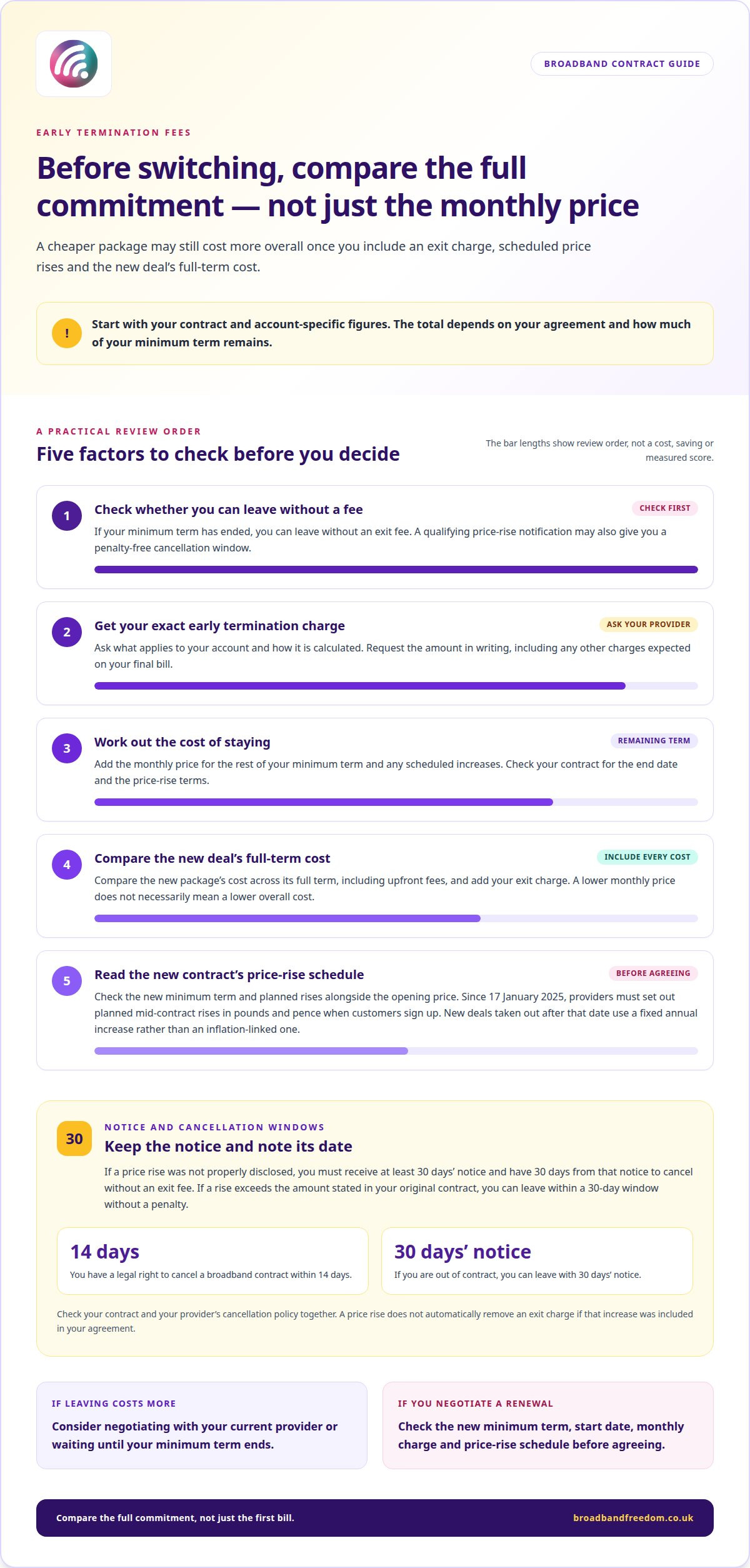
Leaving before your minimum term ends can make a cheaper package cost more overall. Work out whether switching still saves money after the exit charge.
- Find your contract end date and remaining minimum term. Read the terms on early termination fees and annual increases. UK broadband providers generally include annual price increases in their contract terms, so leaving early will very likely mean an exit fee. A price rise alone doesn’t automatically remove the charge if the increase was included in your agreement.
- Ask your provider for the fee that applies to your account and how it’s calculated. Request the amount in writing, alongside other charges on your final bill. The total depends on your contract and remaining minimum term, so use your account-specific figure rather than a general estimate. Check the contract cancellation guidance as you review the terms.
Compare the cost of leaving
- Compare the exit charge with the savings from switching. Work out the cost of staying for the remaining term, including your monthly price and scheduled increases. Then compare it with the new package’s full-term cost, including upfront fees. Once you add the exit charge, a cheaper monthly deal may still cost more overall. Compare the full commitment, not just the first bill.
- Before you negotiate a new broadband contract in 2026, check whether your circumstances give you a penalty-free exit right. If your contract has ended, you can leave without an exit fee. A qualifying price-rise notification can also provide a cancellation window without a penalty. Keep the notice and dates, then follow your provider’s cancellation process.
Choose your next step
- Use the fee calculation to decide whether to renew or switch. If you negotiate a new broadband contract in 2026, weigh the new commitment against the cost of leaving now. If switching early doesn’t save money, negotiate with your current provider or wait until the minimum term ends. Before signing, compare the new contract length, monthly price and annual increases. This gives you a clearer view of each deal’s total cost.
When to negotiate before a broadband contract ends
Start planning before your contract ends, not after your monthly price changes. Use the end date to schedule a renewal conversation and compare your options while you still have time to decide.
- Find your contract end date and set a reminder for 30 to 40 days beforehand. That’s the recommended window to negotiate with your broadband provider. Starting then gives you time to discuss a renewal, consider a switch and avoid making a rushed decision as your current deal expires.
- Look out for your provider’s end-of-contract notice. UK broadband providers must send one, warning you that the contract is ending 10 to 40 days beforehand. Use the notice to confirm your end date and review the terms you’ll move onto if you take no action.
- Compare broadband deals before contacting your provider. Keep a suitable alternative in mind, including its speed and contract length, so you can make a specific case for a better renewal. A Vodafone offer, for example, is useful only if it meets your household’s needs.
- Ask what changes if you renew with the same provider. A retention discount usually starts a new minimum term and comes with a fresh price-rise schedule. Since January 2025, new deals must state planned mid-contract price rises in pounds and pence, so review those terms before agreeing.
- Plan around annual increases as well as your contract end date. Providers are likely to apply annual price rises in late March or early April. If an increase falls near your renewal, ask how it affects the deal and what you’ll pay after signing.
- Compare the renewal terms with your alternatives before you commit. Check the full contract length, monthly price and stated increases, then decide whether staying or switching better fits your budget. Compare broadband deals to bring a clear alternative to your renewal decision.
Broadband Freedom: No Contract Broadband Deals
Broadband Freedom helps you compare broadband options when your current deal is ending or its renewal terms don’t suit you. For flexibility around contract commitments, explore No Contract Broadband Deals. If speed or connection type matters more, compare Full Fibre Broadband Deals, Fibre Broadband Deals and Standard Broadband Deals against your household’s needs.
Use the terms you’ve reviewed, including monthly price, contract length and scheduled price rises, to decide what suits you. A no-contract option may fit if avoiding a longer commitment is your priority; a fixed-term deal may better meet other needs. Compare the available options before choosing your next step.
Contact Broadband Freedom to discuss your broadband options.
Choose a deal that fits your next chapter
Let your priorities guide your decision, not just the headline monthly price. Consider how much flexibility you need, what speed suits your household and whether you’re comfortable starting another fixed term. A deal that fits your plans can be more useful than a discount that adds a commitment you don’t want.
As you negotiate a new broadband contract in 2026, keep your preferred terms clear. Decide what you’re willing to accept, what would make you switch, and which trade-offs matter most. That gives you a practical basis for weighing a renewal against other options, without feeling pushed into a quick decision.
When you’re ready to explore alternatives, Broadband Freedom can help you compare deals to suit your needs. Take the next step at your own pace: compare broadband deals and find an option that feels right for you.
Frequently Asked Questions
If I sign a new deal with the same provider, does the rise schedule reset?
A new deal usually comes with its own price-rise schedule, so treat it as a fresh agreement. Before accepting, ask the provider to confirm when the new price applies and how any planned increase will be calculated or set out. Compare the schedule with your current terms, and keep the offer details so you can check later bills against what you agreed.
Can I negotiate if I am still in contract?
Yes, you can ask your provider for a better deal whilst still in contract, but it doesn’t have to offer one. Explain what you want to change, such as the monthly cost or package, and ask whether a renewal or different tariff is available. Before agreeing, find out whether the change starts a new minimum term or alters your existing price-rise schedule.
Can broadband companies offer better deals to new customers?
Yes, providers can advertise deals for new customers that differ from renewal offers. Use a relevant advertised package as a comparison when discussing your renewal, but compare the full terms, not just the headline price. Check the contract length, planned price rises and upfront costs, then ask whether your provider can offer similar value on terms that suit you.
Can my provider raise prices more than once a year?
Your contract should explain planned mid-contract price rises, including their amount when you sign up to a new deal. If you receive another increase, compare its timing and amount with the terms you accepted, and read the notification carefully. Don’t assume an extra rise follows the same schedule; ask the provider to explain how it relates to your contract.
Can you cancel penalty free when a rise lands?
Not every price rise gives you a penalty-free exit. If the rise wasn’t properly disclosed, you must receive at least 30 days’ notice and have 30 days from that notice to cancel without an exit fee. You can also leave within a 30-day window if the increase exceeds the amount stated in your original contract. Keep the notice and record its date.
When should you contact your provider before your broadband contract ends?
Start the conversation 30 to 40 days before your contract ends. That gives you time to consider a renewal offer and compare it with alternatives without making a rushed decision. Check the end date in your account or contract, then contact the provider with the terms you want. Keep a record of the offer and any new agreement before accepting.

Article by
Elaine Lang
Elaine has over 20 years across Marketing, Communications and Public Relations in the UK. She has worked across large UK corporations, including Commercial Banks and Airports, to online consumer finance and technology solutions. Elaine has post graduate qualifications in Marketing from the Chartered Institute of Marketing (CIM) and the Industry of Direct Marketing (IDM). She is a lifelong feline fan, sharing her home with around 4-6 cats for many years. This of course can be a challenge when trying to work at home, as they like to try to help!