Penalty for leaving a broadband contract early in the UK

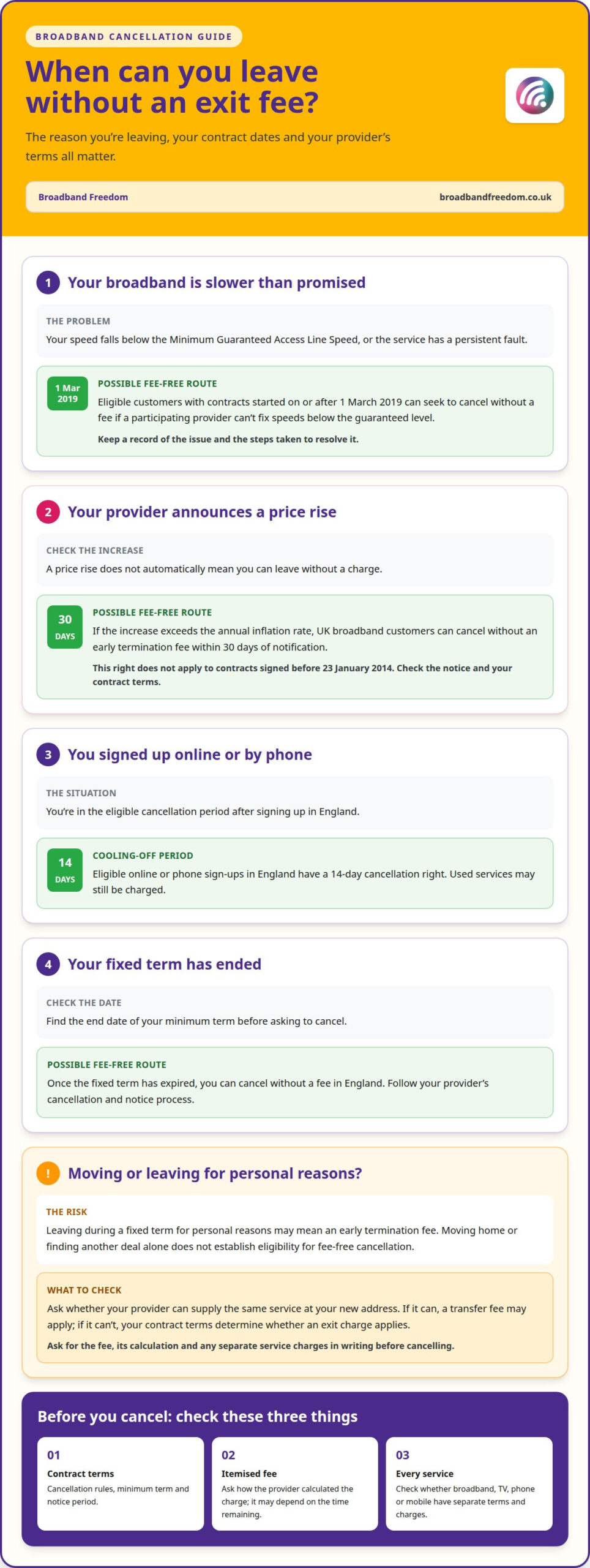
A slow or faulty broadband service may give you a way out without an exit fee. Otherwise, a penalty for leaving a broadband contract early may apply, with the amount depending on your contract and how much time remains. Broadband providers usually offer a 14-day cooling-off period, and eligible customers with contracts started on or after 1 March 2019 can seek to cancel without a fee if speeds fall below the Minimum Guaranteed Access Line Speed and a participating provider can’t fix the problem.
It’s understandable to worry that cancelling early could leave you with a large bill. The key is to find out whether an early exit charge applies, how it is calculated and whether your circumstances give you grounds to leave without one.
Here’s how to estimate a potential fee, understand common exceptions and take practical steps if faults or slow speeds are driving your decision. You’ll also learn what to consider before choosing another broadband deal.
Key Takeaways
- Read your contract’s cancellation terms and notice requirements to understand what may apply before you leave.
- Estimate an exit fee by looking at the remaining minimum term and how your provider calculates charges.
- If you’re moving or facing a price rise, check whether your circumstances could affect the fee you owe.
- For persistent faults or slow speeds, keep a record of the issue and the steps taken to resolve it before deciding what to do next.
How can I get out of a contract with my provider?
Start by checking your cancellation rights, then follow your provider’s notice process. In England, eligible online or phone sign-ups have a 14-day cancellation right.
Checking provider contract terms
Open your contract or account and find the cancellation, minimum-term and notice-period terms. Ask your provider to explain any clause you’re unsure about, including whether broadband, mobile, TV or phone services are treated separately. In England, The National Archives (legislation.gov.uk) says eligible phone, TV, internet or mobile contracts signed online or by phone can be cancelled without a fee within 14 days, though used services may still be charged.
Cancellation fees and notice periods
Ask your provider for its cancellation fee and required notice period before ending the service. Terms vary between providers and contracts, so don’t assume another customer’s fee or cancellation process applies to you. Check whether your agreement sets out separate exit charges for broadband and bundled TV, for example. Request an itemised explanation of any charge and confirmation of when your service will end.
Contacting the provider to cancel
Use the cancellation method set out in your provider’s terms, such as its account portal, phone line or written contact route. Clearly state that you want to cancel, identify the service and account, and give your requested date. Keep a copy of your message or note the call details. Ask for written confirmation of the end date, notice period and final bill.
Cancellation through a new provider
Can you switch broadband before your contract ends and have the new provider handle cancellation? A new provider may arrange the broadband switch, but this won’t automatically remove exit charges under your existing contract. Before ordering, confirm whether the switch covers every service you’re leaving. If mobile, TV or phone services are separate, contact your existing provider about those accounts and their notice requirements.
Estimating broadband early termination fees
Start by checking your package’s cancellation terms and how much time remains on your minimum term. Your provider’s calculation, not a simple estimate based on monthly bills, determines the amount.
Moving house and cancellation fees
If you move, ask whether your provider can supply the same service at your new address. If it can, a fee may apply to transfer the service instead of cancelling. If it can’t provide the service there, your contract terms determine whether an exit charge applies. Give the provider your new address and ask for the available options and costs in writing before arranging a switch.
Ofcom rules on early termination charges
UK broadband customers can cancel without an early termination fee within 30 days of notification if a price rise exceeds the annual inflation rate. This is the relevant price-rise exception; it doesn’t mean every increase gives you the right to leave free. Compare the increase notice with your contract terms, then act within the stated 30-day period if the rule applies.
Remaining bills after early cancellation
You don’t necessarily pay every remaining monthly bill as usual. Your provider may instead charge an early termination fee calculated under your contract terms. The remaining minimum term and the provider’s calculation affect the final amount, so ask for an itemised figure before cancelling.
For a BT contract, use the cancellation amount calculated for your package and remaining term, rather than multiplying your monthly bill by the months left. Ask BT to explain the calculation and any separate service charges. Treat this as a possible contribution, not a guaranteed payment, and include it when comparing the overall cost of switching to broadband deals.
Early termination fee eligibility
Whether a penalty for leaving a broadband contract early applies depends on your minimum term, contract terms and reason for leaving. If you cancel during a fixed term for personal reasons, your provider may charge an early termination fee. Once the fixed term has expired, you can cancel without a fee in England.
Can I cancel broadband without a fee if my provider raises prices? Yes, you can use the price-rise cancellation right within 30 days of notification if the increase exceeds the annual inflation rate. This right doesn’t apply to contracts signed before 23 January 2014.
Check how your contract handles price rises
Find the price-rise clause and compare it with the increase notice. For contracts started before 17 January 2025, terms may state an annual increase as a percentage or link it to inflation. For contracts started on or after 17 January 2025, the contract should state exactly how much the provider will increase the price each year. These details help you assess whether the 30-day cancellation period applies.
Know when an exit fee may apply
For example, if your minimum term is still running and you leave for personal reasons, your provider’s terms may set out a penalty for leaving a broadband contract early. The amount depends on the provider’s calculation and the time remaining, not simply on whether you’ve found another deal. Ask for the fee and its calculation before cancelling, especially if your package includes separate services.
Check your minimum-term end date, price-rise notice date and contract start date together. A price-rise notice gives you a specific window to act, while an expired fixed term means you can cancel without a fee in England. Keep the notice and your provider’s response in case you need to refer to the dates later. Moving home or finding a new deal alone doesn’t establish eligibility for fee-free cancellation.
Leaving because of a service fault or speed issue
A persistent fault or speed below your contract’s minimum guaranteed level may give you grounds to leave without paying remaining minimum-term charges. What matters is whether the problem meets the relevant threshold and whether your provider has had an opportunity to fix it. A brief slowdown alone doesn’t establish that you can cancel without a fee.
For contracts started on or after 1 March 2019, customers can seek early cancellation without a fee if speeds fall below the Minimum Guaranteed Access Line Speed and a participating provider cannot fix the problem. Providers signed up to the New Voluntary Codes of Practice on Broadband Speed have 1 month to fix a reported speed problem below that minimum.
Report the issue and keep a clear record
Measure your connection at different times and note when the problem occurs. Report the fault to your provider, describe its impact and ask for a reference number. Keep dated records of speed readings, outages and repair visits. This information helps show whether the connection remains below its guaranteed minimum after your provider’s attempts to resolve the issue.
Give the provider the chance to investigate before cancelling. If the fault continues, ask for the outcome of its investigation and whether the speed is below your Minimum Guaranteed Access Line Speed. Some providers allow customers to leave without a penalty if a fault cannot be fixed within a timeframe usually set at 30 days.
Contracts started before 1 March 2019 may still involve a fee when leaving because of slow internet. Check the contract date and document the fault history before deciding your next step. That evidence helps distinguish an ongoing service problem from an occasional dip in speed.
Broadband Freedom: No Contract Broadband Deals
Broadband Freedom can help you explore another broadband option after reviewing your current contract and any exit charge. Its No Contract Broadband Deals are worth considering if you don’t want to take on another fixed minimum term.
Compare the service and deal terms with your needs before choosing. A no-contract deal won’t automatically cancel your existing agreement or remove an early termination fee. Ask your current provider what you owe and arrange the end date before moving to a different service.
If you need more than broadband, Broadband Freedom also offers Broadband and Phone Packages and Broadband and TV Packages. These options let you consider the services you use together, rather than treating broadband as a separate decision. Read each deal’s terms and package details to make sure your choice reflects what you need.
Choose a deal around your circumstances
Think about why you’re leaving and what matters most in your next arrangement. If avoiding another fixed commitment is your priority, start with no-contract deals. If you want broadband alongside phone or TV, consider the relevant package. Broadband Freedom also features the latest offers from Virgin Media, giving you another option to weigh against your needs.
Before switching, account for any charge from your current provider alongside the new deal’s terms. This gives you a clearer picture of the overall cost, without assuming the new package will cover old contract charges. Broadband Freedom can help you compare available options and choose based on your circumstances. Contact Broadband Freedom to discuss your broadband options.
Choose your next broadband deal with confidence
Base your next decision on the service you need, the commitment you’re comfortable with and the total cost of changing. The penalty for leaving a broadband contract early is only one part of that decision. A deal that suits your household and usage can matter long after the old contract ends, so weigh flexibility alongside speed and package features. Whether choosing a home package or evaluating commercial connectivity—such as enterprise wireless solutions from providers like Maverick Innovation for businesses in Malaysia—matching contract terms to operational demands is always vital.
Broadband Freedom offers Full Fibre Broadband Deals, Fibre Broadband Deals and Standard Broadband Deals. Comparing these options can help you focus on what suits your circumstances instead of choosing based on a single headline feature. Take time to weigh the terms and service against your priorities.
Ready to explore your options? Compare broadband deals with Broadband Freedom and take the next step towards a connection that works for you.
Frequently Asked Questions
Can I cancel my broadband early?
Yes, but cancelling before your minimum term ends may trigger a charge under your agreement. In England, The National Archives (legislation.gov.uk) says eligible internet contracts signed online or over the phone can be cancelled without a fee within 14 days, although used services may still be charged. If you’re outside that period, check your contract’s exit terms and ask for a final cancellation figure.
Can I ever get out of my broadband contract without paying?
Yes. You may be able to leave without an exit fee if your fixed term has ended, an eligible price-rise cancellation right applies, or a qualifying fault or speed problem remains unresolved. For example, if your speed stays below the Minimum Guaranteed Access Line Speed, you may have grounds to cancel if your participating provider can’t fix the problem. Follow your provider’s complaint and cancellation process.
Why Calculate Your Broadband ETF?
Calculating your broadband early termination fee helps you compare the cost of leaving now with the value of switching or waiting. For example, a household moving home can compare a provider’s transfer option with cancellation and a new connection. Knowing the likely charge also helps you budget for overlapping services and assess any switching credit before committing to another deal.
How is an early termination fee for broadband calculated in the UK?
There’s no single calculation used by every UK provider. The amount is set by your provider’s contract terms and may depend on the remaining minimum term and package. Ask for an itemised estimate showing how the figure was calculated and whether bundled phone or TV services affect it. Then compare the amount with the cost of keeping the service until your contract ends.
What is the average broadband cancellation fee in the UK?
There isn’t one standard cancellation fee across UK broadband contracts. Providers use different terms and calculations, so an average won’t reliably predict your bill. For instance, two customers leaving on different dates or with different bundles could receive different quotes. Use your provider’s estimate, based on your account and intended cancellation date, to plan your next move.
How do I find my broadband contract end date and early exit fee?
Sign in to your provider’s online account and look for contract, billing or cancellation details. If the end date or fee isn’t shown, contact the provider and ask for both in writing. Give the account holder’s details and the date you’re considering leaving. Keep the response with your contract documents so you can refer to the quoted amount when planning a switch.

Article by
Elaine Lang
Elaine has over 20 years across Marketing, Communications and Public Relations in the UK. She has worked across large UK corporations, including Commercial Banks and Airports, to online consumer finance and technology solutions. Elaine has post graduate qualifications in Marketing from the Chartered Institute of Marketing (CIM) and the Industry of Direct Marketing (IDM). She is a lifelong feline fan, sharing her home with around 4-6 cats for many years. This of course can be a challenge when trying to work at home, as they like to try to help!