
How to Dispute a Broadband Bill in the UK: Your 2026 Guide

Could a higher broadband bill be valid under your contract and still be worth challenging? An unexpected charge can be hard to match to the monthly price you agreed, especially when the contract wording or price-rise notice is unclear. Broadband mid-contract price rises may be set out in your terms, but that doesn’t mean every increase or extra charge is correct.
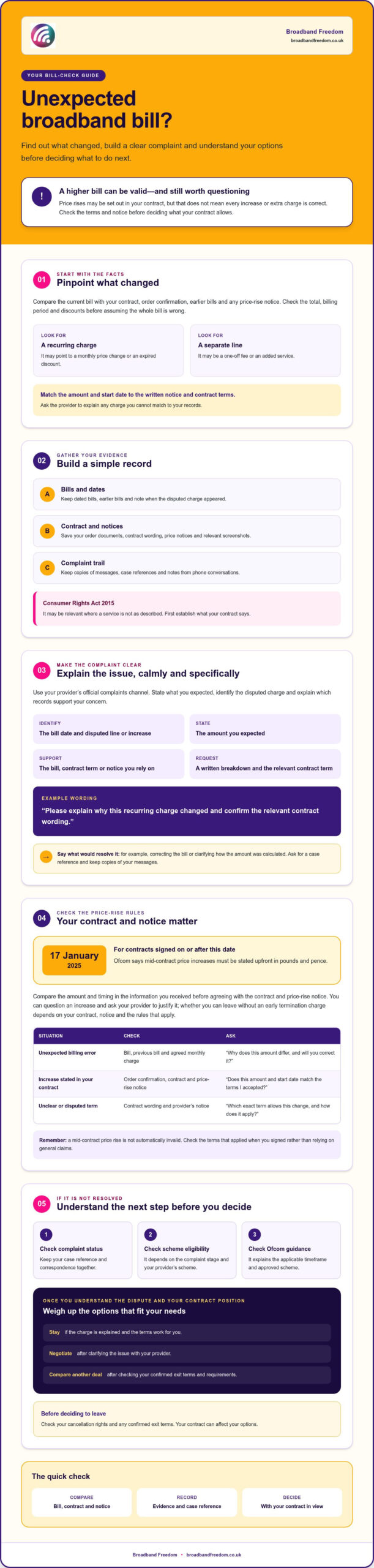
Start by comparing your bill with your contract and any price-rise notice. For contracts signed on or after 17 January 2025, Ofcom says mid-contract price increases must be stated upfront in pounds and pence. Check Ofcom’s guidance on telecoms price rises alongside your provider’s terms.
This guide explains how to identify what changed, raise a clear complaint and understand when you can take it further. You’ll also learn how to weigh up staying, negotiating or comparing another deal in light of your contract and needs. If your provider doesn’t resolve the issue, Ofcom’s complaint guidance explains the next steps.
Key Takeaways
- Compare the bill with your contract, earlier bills and any price-rise notice to pinpoint what changed.
- Make your complaint clear and evidence-based, and keep a record of messages and case references.
- Check the terms and notice carefully before challenging broadband mid-contract price rises, as your contract can affect your options.
- Once you understand the dispute and your contract position, weigh up staying, negotiating or comparing another deal.
How to dispute a broadband bill: identify what changed first
Start with the facts, rather than assuming the whole bill is wrong. Check whether the total, billing period or discount has changed. Then compare the bill with your contract, order confirmation, previous bills and any price-rise notice. This helps distinguish a calculation error from a one-off charge, an added service, an expired promotion or a change to your monthly price.
Is the higher bill an error or a mid-contract price rise?
Identify which charge changed and when it took effect. A recurring charge may indicate a price change or an expired discount; a separate line may be a one-off fee or an added service. Match the date and amount against the written notice and contract terms. Broadband mid-contract price rises aren’t automatically invalid, but ask your provider to explain any term or charge you can’t match to your records. For context, check Ofcom’s guidance on price rises.
What evidence should you gather before contacting your provider?
Keep dated bills, order documents, price notices, screenshots and earlier complaint messages. Note what would resolve the issue, such as correcting a charge or explaining how it was calculated. The Consumer Rights Act 2015 may be relevant where a service isn’t as described, but first establish exactly what your contract says.
Before contacting the provider, write a brief, factual summary. State the disputed amount, when it appeared, why you think it may be wrong and which records support your concern.
- Disputed amount: Which charge or total are you questioning?
- Date: When did it appear, or when was a change due to start?
- Explanation: What do you believe changed, and why is it unclear?
- Evidence: Which bill, contract term or notice supports your account?
How to complain to your broadband provider about a bill
Once you’ve pinpointed the discrepancy, raise it through your provider’s official complaints channel, such as its online form, app or published complaints address. Explain the issue clearly, ask for a case reference and save copies of your messages. If you speak by phone, note the date, the person or team you spoke to and what they said.
What should you say when disputing the charge?
Include the bill date, the disputed line or increase, the amount you expected and the evidence you’re relying on. Ask the provider for a written breakdown and the contract term it says supports the charge. Keep your message calm and specific. For example: “Please explain why this recurring charge changed and confirm the relevant contract wording.”
State what would resolve the complaint, such as correcting the bill or clarifying how the amount was calculated. Avoid assuming a price change is automatically invalid. If the issue concerns broadband mid-contract price rises, check your cancellation rights before deciding whether to leave.
When can you take an unresolved complaint further?
If the provider doesn’t resolve the issue, an external dispute-resolution scheme may be an option. Eligibility depends on the complaint stage and your provider’s scheme. Ofcom’s complaint guidance explains how to check the applicable timeframe and which approved scheme to contact. Keep your case reference and complaint correspondence together so you can refer to them if you escalate.
Once you understand the complaint status and any confirmed exit terms, you can consider alternatives. To explore what’s available for your address and requirements, compare broadband deals.
Can you challenge a broadband mid-contract price rise?
Yes, you can question an increase and ask your provider to justify it. Whether you can leave without an early termination charge depends on your contract, the notice you received and the rules that apply to your agreement. Check the terms that applied when you signed, rather than relying on general claims about broadband mid-contract price rises.
| Situation | Evidence to check | Question to ask |
|---|---|---|
| Unexpected billing error | Bill, previous bill and agreed monthly charge | “Why does this amount differ, and will you correct it?” |
| Increase stated in your contract | Order confirmation, contract and price-rise notice | “Does this amount and start date match the terms I accepted?” |
| Unclear or disputed term | Contract wording and provider’s notice | “Which exact term allows this change, and how does it apply?” |
What if the increase was stated in pounds and pence?
For contracts signed on or after 17 January 2025, Ofcom says any mid-contract price rise must be set out upfront in pounds and pence. Compare the amount and timing shown before you agreed with the current charge and notice. A stated increase isn’t automatically unfair or beyond challenge: flag any mismatch and ask the provider to explain it. Read Ofcom’s current price-rise guidance and your provider’s own terms.
What if the notice or contract wording is unclear?
Ask the provider to identify the exact term it relies on and explain how it applies to your bill. Keep the notice and response together in case you make a formal complaint. Don’t assume you can cancel without charge: check the contract, any notice deadline and the applicable rules before acting.
Once you understand your contract position, compare broadband deals to see what alternatives may fit your needs and address.
After disputing your broadband bill: stay, negotiate or compare
Before deciding what to do next, check whether your complaint is still open, when your contract ends and what exit terms your provider has confirmed. Don’t cancel or switch on the assumption that a disputed increase gives you a penalty-free exit. Your options depend on your contract and circumstances.
When is it worth comparing another broadband deal?
Consider comparing if the complaint remains unresolved, your current package no longer suits your household or you’re approaching the end of your contract. First check availability at your address, contract length and any applicable exit conditions. If flexibility matters, explore no-contract broadband options, and read the terms carefully before choosing.
Compare on your terms, not just the monthly price
Look beyond the headline charge. Compare the service and speed you need, contract length, recurring price and any stated broadband mid-contract price rises. Check whether the package includes services you’ll use, and note when any offer or discount ends. Ofcom’s guidance on price rises can help you understand what to check, while your provider’s contract sets out the terms that apply to your deal.
If your bill is corrected and the package still works for you, staying may be simplest. If the service or terms no longer fit, ask your provider whether it can offer a more suitable package. If you’re free to switch, compare alternatives against your needs and confirmed exit terms. Broadband Freedom compares and refers customers to provider offers; it doesn’t provide broadband service or resolve billing complaints. Available deals depend on your requirements and address.
Ready to review your options? Compare broadband deals against the service, price and contract flexibility that matter to you.
Take control of your next broadband bill
An unexpected bill doesn’t have to leave you guessing. Identify what changed, gather the documents that support your query and ask your provider for a clear explanation. If you’re challenging broadband mid-contract price rises, check your contract and any confirmed exit terms before deciding whether to stay or switch.
Choose the option that fits your needs
A correction may make staying the simplest choice; a conversation with your provider could clarify your package. If you’re considering a switch, compare the service and contract terms as well as the monthly charge. Broadband Freedom lets you compare offers from up to 30 providers, including full fibre, fibre, standard and no-contract broadband deals. Availability depends on your address and requirements, and comparing won’t resolve an open complaint.
Compare broadband deals and find an option that suits you. With the facts in hand, you can make your next move with greater confidence.
Frequently Asked Questions
How do I dispute an incorrect broadband bill?
Compare the disputed charge with your contract, earlier bills and any price-rise notices. Contact your provider through its official complaints channel, stating the bill date, the item you’re challenging and the evidence you have. Ask for a written explanation and, if appropriate, a correction. Request a case reference and keep copies of all replies. If unresolved, check Ofcom’s complaint guidance for escalation routes.
Can I cancel broadband if the price rises mid-contract?
You can’t assume every mid-contract increase gives you the right to cancel without charge. Check the terms you accepted, the notice you received and your provider’s explanation. Ask which contract clause applies and request the answer in writing. Your options depend on those details and the current rules. Read Ofcom’s guidance on price rises before giving notice or arranging a switch.
What should I do if my broadband provider rejects my complaint?
Ask the provider to confirm its final position in writing. Keep that response with your bills, contract and complaint records. Then check the provider’s complaints process and Ofcom’s current guidance to see whether an approved alternative dispute resolution scheme is available and when you can use it. The relevant scheme and escalation timing may vary, so confirm what applies to your provider.
Can I switch broadband while disputing a bill?
You may be able to compare other offers, but check your contract end date, any exit terms and the status of the disputed balance before switching. Continue pursuing the complaint separately and keep a written record. Compare the service, contract length and any stated price changes as well as the monthly charge. That way, you can judge whether another deal genuinely fits your needs.

Article by
Elaine Lang
Elaine has over 20 years across Marketing, Communications and Public Relations in the UK. She has worked across large UK corporations, including Commercial Banks and Airports, to online consumer finance and technology solutions. Elaine has post graduate qualifications in Marketing from the Chartered Institute of Marketing (CIM) and the Industry of Direct Marketing (IDM). She is a lifelong feline fan, sharing her home with around 4-6 cats for many years. This of course can be a challenge when trying to work at home, as they like to try to help!