Switch Broadband Provider in the UK: Your 2026 Step-by-Step Guide

Could switching be easier than the contract fine print makes it feel? If you want to switch broadband provider UK-wide, start by checking when your current deal ends and whether leaving early could trigger a charge. Then compare available packages against the speed, price and flexibility your household needs, rather than judging a deal by its headline offer alone.
It also helps to understand how the handover works. Since 12 September 2024, Ofcom’s One Touch Switch process has allowed residential customers to arrange a switch through their new provider, which manages the change and cancellation. This guide explains what to check, how to compare deals and what to expect during the move, including equipment and contract terms. For price-rise terms, see Ofcom’s guidance on in-contract price rises. By the end, you’ll have a clear checklist for choosing and arranging your next broadband service.
Key Takeaways
- Before you switch broadband provider uk, check your contract end date, notice requirements and any early exit charges.
- Understand how One Touch Switch works and follow the confirmation messages so you know what to expect during the handover.
- Compare deals like for like, including monthly cost, contract length, speed, setup terms and any phone or TV services.
- Choose a package around your household’s needs and what’s available at your address. Full fibre is one option, not a requirement for every home.
Switch broadband provider in the UK: when is it worth considering?
Switching broadband means moving your internet service to a different provider, not changing your Wi-Fi settings. It may be worth considering when your contract ends, the price changes, your connection no longer meets your needs, service problems persist or your household’s circumstances change. Compare the full package and the service available at your address, not just the advertised price or top speed.
Is it a good time to change broadband provider?
Start with what happens online in your home. Think about how many people are online at once, whether they stream video, join video calls or work from home, and whether slowdowns happen at particular times. These details help you decide what speed and connection type to compare. If you’re unsure, check broadband speed guidance before choosing a package.
Next, work out whether the issue is the service or the deal. If the connection is unreliable, a cheaper package may not fix the problem. If the service works well but the price or contract no longer suits you, comparing alternatives could be more useful. A switch is not automatically an upgrade, so compare the connection type, terms and expected speed as well as the price.
What should you check before starting?
Find your minimum-term end date in your agreement or online account. If you leave before it ends, early termination charges may apply. Read the relevant terms and ask your current provider what you would owe before placing an order. Check any notice requirements too, as they can affect when to arrange your switch. Ofcom, the UK’s communications regulator, provides consumer guidance on switching; its broadband switching advice explains the process.
Check whether your broadband is bundled with phone or TV services. Switching broadband could affect those services, so include them in your comparison and find out whether they need separate arrangements. If you are moving away from bundled television packages towards independent streaming options like serveuriptv4k.com, make sure your new connection offers sufficient bandwidth for high-definition viewing. Before you switch broadband provider UK-wide, be clear about what you want to change and what you need to keep.
How the UK broadband switching process works
For most residential broadband switches, the new provider coordinates the move through Ofcom’s One Touch Switch process. You contact the provider you’re joining, and it arranges the switch and tells your current provider that your service is moving. You generally don’t need to cancel your old broadband separately unless your new provider gives you different instructions.
What is One Touch Switch?
One Touch Switch has been in effect since 12 September 2024. It covers residential customers switching broadband, regardless of their current provider or network. The new provider guides you through the process, including any actions needed from you. Read Ofcom’s broadband switching guidance for the official scope and advice. Business services and parts of a bundle, such as TV, may follow different arrangements, so check what your order includes rather than assuming every service will move with your broadband.
Will your internet stop working during a switch?
The process is designed to coordinate the handover, but uninterrupted service isn’t guaranteed. Timing and any gap can depend on the services, networks and providers involved. A move to a different network or service type may need different steps from a straightforward switch, so follow the instructions you receive rather than relying on a general timeline.
Before the switch, check the planned activation date in your order confirmation. Keep messages from both providers accessible and act on any requests for information or action. If the date changes, or you’re unsure whether a phone or TV service is included, refer to your provider’s confirmation. Ofcom explains the consumer switching process; installation arrangements and contract terms depend on the package and provider.
Once you understand the handover, compare available deals against your needs. Compare UK broadband deals to see options from different providers before choosing where to switch.
Switch broadband provider in the UK: follow these practical steps
Work through these steps in order. Check your current terms first, compare packages that suit your household, then confirm the details before placing an order. Keeping your contract information and order messages together makes it easier to follow the changeover.
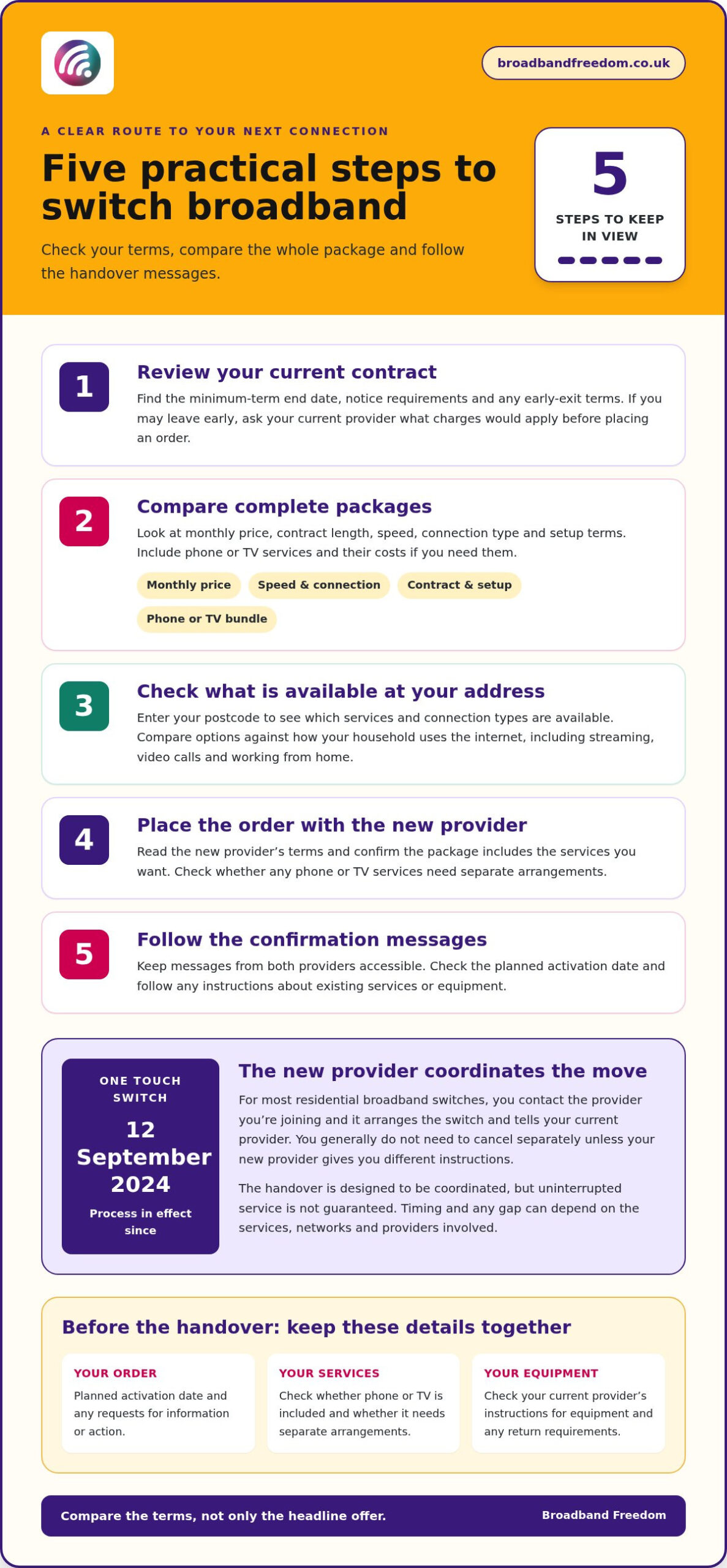
Follow these five steps
- Review your contract. Note the minimum-term end date, notice requirements and any early exit terms. Ask your current provider about charges if you’re considering leaving before the end date.
- Compare packages. Check the monthly price, contract length, speed, connection type, setup terms and included phone or TV services.
- Check availability. Enter your postcode to see which services and connection types are available at your address.
- Place your order. Read the new provider’s terms and confirm the package includes the services you want.
- Follow confirmation messages. Keep track of the planned activation date and instructions about existing services and equipment.
How to compare new broadband deals fairly
Compare the full cost and terms, not just an introductory offer. Check what you’ll pay during the minimum term, when the price may change and what the contract says about price rises. Then compare packages with similar speeds and connection types. If you need a phone line or TV service, include those costs and terms too, so you’re comparing complete packages rather than broadband prices alone. Compare broadband deals from different providers based on your requirements and address.
What happens to your current contract and equipment?
Exit charges, notice arrangements and equipment return instructions depend on your current provider’s terms. Check these before ordering, especially if you’re still in contract or have a phone or TV bundle. Find out which equipment needs to be returned and follow the instructions provided. If flexibility matters more than a fixed-term package, compare no-contract broadband options too.
Ready to weigh up your options? Compare broadband deals for your household and shortlist packages that match your needs and preferred terms.
Choose your next broadband deal and complete the switch confidently
Choose a package around your household’s needs and what’s available at your address. Full fibre is one option to compare, not a requirement for every home. Consider how you use the connection, the speed and connection type on offer, how long you want to commit for, and whether you need phone or TV services too.
Which broadband deal suits your household?
Think about how many people use the connection at once and what they do online. If several people regularly stream, make video calls or work from home at the same time, compare packages with that shared use in mind. If flexibility is a priority, compare no-contract broadband options. Explore different broadband providers in the UK and check which connection types are available at your address.
Compare available deals and take the next step
Before ordering, make sure the contract terms and included services suit you. Keep your order confirmation and messages from both providers, and follow their instructions. Activation arrangements vary, so use the date and guidance in your confirmation rather than assuming a fixed timescale.
Broadband Freedom helps you compare deals from up to 30 UK providers, with offers updated daily. Compare current UK broadband deals and find an option that fits your needs.
Make your next broadband switch with confidence
A smoother switch starts with knowing where you stand. Check your contract end date and any exit terms, then compare packages against your household’s speed, flexibility, phone and TV needs. Confirm what’s available at your address, compare the full contract terms and look beyond the headline price.
Take the next step at your pace
For eligible residential switches, One Touch Switch means your new provider coordinates the move. Timing and any service interruption can vary, so keep your order confirmations and follow provider instructions. Preparing your contract details and deciding what matters most can help you switch broadband provider UK-wide with clearer expectations.
Broadband Freedom helps you compare deals from up to 30 UK providers, with offers updated daily. The right option depends on your needs and what’s available where you live.
Compare broadband deals and find an option that suits you. Take the next step when you’re ready, with your priorities and contract details in hand.
Frequently Asked Questions
Can I switch broadband provider before my contract ends?
Yes, but leaving before your minimum term ends may mean paying an early termination charge under your current contract. Check your account or agreement for the end date, notice requirements and exit terms. Ask your provider what you’d owe before ordering a new service, then weigh that amount against the benefits of switching. If your contract is nearly over, you could plan the move around its end date.
How long does it take to switch broadband provider in the UK?
There isn’t one fixed switching time. The planned activation date depends on the new provider, the connection type and whether setup work is needed. Wait for the order confirmation and use its date as your guide. Ofcom explains how the residential switching process works in its broadband switching guidance. Follow provider messages if arrangements change.
Will I lose my internet connection when I switch broadband provider?
You may not lose service, but a gap can’t be ruled out. The handover is coordinated, yet the timing and any interruption depend on the providers, services and networks involved. Check the activation date in your confirmation and keep provider messages accessible. If you rely on broadband for work or essential calls, plan how you’ll manage if the connection is briefly unavailable.
Do I need to cancel my current broadband when switching?
For residential broadband switches handled through One Touch Switch, your new provider coordinates the switch and cancellation with your current provider. You generally shouldn’t cancel separately unless you’re instructed to do so. Follow the new provider’s messages and check whether bundled phone or TV services need separate arrangements. Ofcom’s guidance explains the process and what to expect.
Can I keep my landline number when I switch broadband provider?
You can usually ask to transfer your landline number to your new provider. Raise this when placing your order, before your current service is disconnected, and follow the provider’s instructions. Number transfer arrangements can depend on the services and providers involved, so don’t assume it will happen automatically. If keeping your number matters, make that clear at the start and wait for confirmation about the transfer.

Article by
Elaine Lang
Elaine has over 20 years across Marketing, Communications and Public Relations in the UK. She has worked across large UK corporations, including Commercial Banks and Airports, to online consumer finance and technology solutions. Elaine has post graduate qualifications in Marketing from the Chartered Institute of Marketing (CIM) and the Industry of Direct Marketing (IDM). She is a lifelong feline fan, sharing her home with around 4-6 cats for many years. This of course can be a challenge when trying to work at home, as they like to try to help!