
How to take a broadband complaint to an ombudsman

Could your small business take a broadband complaint to an ombudsman? Yes. In the UK, the broadband complaints ombudsman route is open to small businesses and not-for-profit organisations with 10 or fewer employees. You must usually complain to your provider first, then wait until it issues a deadlock letter or the relevant referral period has passed.
For complaints raised on or after 8 April 2026, unresolved telecoms complaints can be referred to an independent dispute resolution scheme after 6 weeks. If your complaint was raised earlier, the previous 8-week period applies. A deadlock letter can let you take the next step sooner.
When a broadband fault or billing issue disrupts your business, it can be difficult to know what to submit. This guide explains how to request a deadlock letter, organise evidence and understand how fees and decisions work. It also covers what an ombudsman considers, so you can explain the impact clearly and make an informed decision about escalating your complaint.
Key Takeaways
- Ask your provider for a deadlock letter in writing if you can’t resolve the complaint, and keep a copy of its response.
- Build a clear evidence file with key dates, relevant messages and records of the financial loss, hardship or inconvenience you experienced.
- Check the scheme’s decision process before accepting an outcome: acceptance deadlines and the time a provider has to comply depend on the scheme.
- Set out the outcome you want when you complain to your provider, then organise your evidence around what went wrong and how it affected your business.
What is a deadlock letter, and how do I get one?
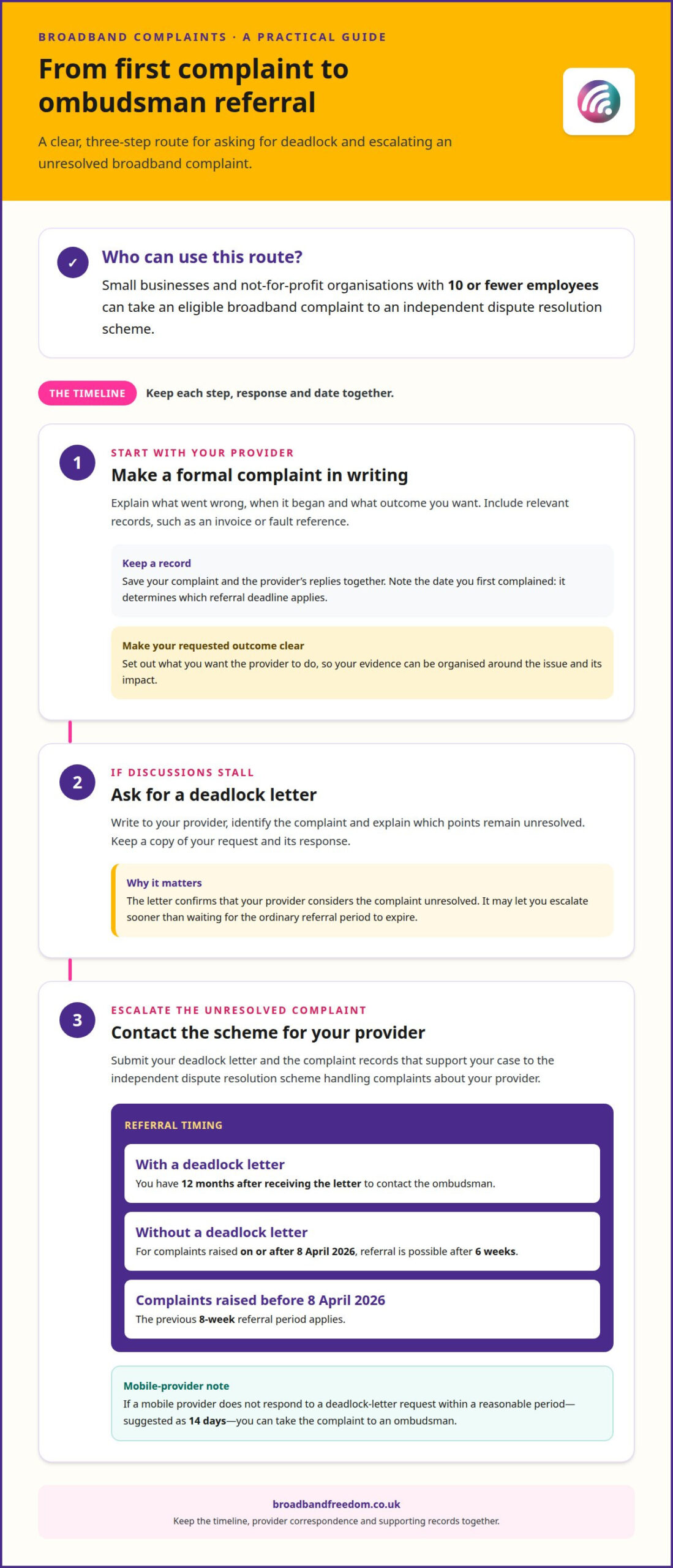
A deadlock letter confirms that your provider considers your complaint unresolved. It may let you escalate before the usual referral deadline.
-
1. Complain to your broadband provider first
Set out the problem in writing, explain when it began and state the outcome you want. Include relevant records, such as an invoice or fault reference. Keep your complaint and the provider’s replies together, and note the date you first complained. That date determines which referral deadline applies. Ofcom’s latest complaints guidance can help you understand the escalation route.
-
2. Request a letter of deadlock
If discussions have stalled, ask your provider in writing for a deadlock letter. Identify your complaint and explain which points remain unresolved. Keep a copy of your request and the provider’s response. The letter records that the provider considers its position final, giving you a route to escalate without waiting for the ordinary referral period to expire. Keep it with your complaint records.
-
3. Use the letter to escalate
Contact the independent dispute resolution scheme that handles complaints about your provider. You have 12 months after receiving a deadlock letter to contact the ombudsman. Without one, unresolved telecoms complaints first raised on or after 8 April 2026 can be referred after 6 weeks. Complaints raised before 8 April 2026 follow the previous 8-week period. The Communications Ombudsman’s complaint information explains its process. Submit your letter with the complaint records that support your case.
If a mobile provider does not respond to a request for a letter of deadlock within a reasonable period, suggested as 14 days, you can take the complaint to an ombudsman.
Information and evidence to include in a complaint
Prepare a focused evidence file for your broadband complaints ombudsman case. Link each record to the problem, its impact and the resolution you’re seeking.
- Build a dated timeline. Record when the problem began and list important events in order. Include service failures, disputed bills, missed appointments and provider responses. Note the dates of key calls or emails and include any complaint reference. A clear timeline helps the broadband complaints ombudsman follow events without searching through unrelated paperwork.
- Separate facts from their impact. Describe what happened in plain language, then explain its effect on you or your business. For example, distinguish a period without service from the work you couldn’t complete during it. Identify any financial loss, hardship or inconvenience, and explain how it relates to the complaint. State the outcome you’re seeking, such as correcting an account record.
Organise and explain your supporting evidence
- Choose records that support specific points. Attach relevant bills, payment records, provider correspondence, screenshots or fault references. Give each file a clear name, such as “May bill showing disputed charge”. If a phone conversation matters, note its date, subject and any action discussed. Leave out unrelated documents that could make the key evidence harder to find.
- Make the submission easy to follow. Put the timeline first, followed by your explanation and clearly labelled attachments. If the incident occurred more than 6 months earlier, the Communications Ombudsman asks you to explain why you didn’t complain at the time. Point to the evidence for each important statement, and keep a copy of the final submission and attachments.
Ombudsman fees and binding decisions
Check the scheme’s fees and decision rules before submitting, so you understand what accepting an outcome means.
-
Check complaint fees and compensation limits
Submit a complaint to the ombudsman without paying a consumer filing fee. Compensation limits are separate from fees. CISAS cannot consider UK telecoms claims above £10,000. That figure describes a typical award, not a guaranteed payment or a maximum claim.
Describe the loss and impact you experienced, and attach evidence to support the amount you’re seeking.
-
Understand binding decisions
Read the written decision carefully before choosing whether to accept it. An ombudsman examines evidence from both sides and decides in writing, without a hearing. If the award favours you, it sets out what the company must do to put things right. For a Communications Ombudsman decision, the provider normally has 28 days to act after you accept it.
CISAS has a different timetable: accept its adjudicator’s decision within 30 working days for it to become binding on the provider. The provider then has 20 working days to comply.
-
Respond if you disagree with the decision
Don’t accept a decision you disagree with before considering its effect. For CISAS, acceptance within 30 working days makes the adjudicator’s decision binding on the provider. If you reject it, that decision does not become binding on the provider through acceptance. Keep the decision and your submitted evidence together, and identify the specific finding or remedy you disagree with.
For a Communications Ombudsman outcome, review the written reasons and proposed remedy before accepting. The provider’s 28-day action period follows your acceptance.
How to complain to your provider before the ombudsman
- Use the provider’s official complaints channel. Find the complaints process on your bill, account or provider correspondence. Make clear that you’re submitting a formal complaint, not reporting a routine fault. Include your account details and a concise description, such as repeated evening disconnections or an unexplained charge. Ask for a complaint reference and keep it with your records.
- Describe the problem and the result you want. Give specific examples, such as the dates when service failed or the billing period you dispute. Explain how the issue affected your broadband use and what would resolve it. You might request a repair, a corrected bill or an explanation. Keep your request realistic and focused on the complaint.
Keep a record and track the referral deadline
- Keep the provider’s response and follow-up in writing. Save emails, letters and chat transcripts, and note the dates and key points of phone calls. If the provider proposes a fix, record what it plans to do and whether that addresses your complaint. If part of the issue remains unresolved, reply and explain what still needs attention.
- Track the referral deadline before escalating. For complaints raised before 8 April 2026, a communications provider has 8 weeks to resolve a consumer complaint before you can contact the Communications Ombudsman, unless it issues a Deadlock Letter sooner. Unresolved telecoms complaints raised on or after 8 April 2026 can be referred to an independent ADR scheme after 6 weeks. Record your complaint date to identify the relevant deadline.
Broadband Freedom
Broadband Freedom can help you compare broadband options if you’re considering a change after an unresolved complaint. It helps you compare available deals, but does not investigate complaints or decide disputes. Keep these tasks separate: use the ombudsman route to pursue your complaint, and compare deals if you’re weighing up a switch.
Start by identifying what matters to your household or business. Decide whether you need broadband alone, a phone package or television alongside your connection. Broadband Freedom offers Broadband and Phone Packages and Broadband and TV Packages, so you can compare options with the services you actually use.
If you’re considering a particular provider, Broadband Freedom features the latest offers from Virgin Media and the latest broadband offers from BT. Compare the terms and included services with your current arrangement before deciding whether to switch. An advertised deal does not resolve a complaint or replace any remedy you’re seeking from your existing provider.
It may make sense to explore alternatives once you’ve recorded the complaint outcome and decided whether to stay or switch. Base your choice on your needs, the services you rely on and the terms that suit your circumstances. If the dispute is still active, continue pursuing it through the appropriate complaints process. Comparing alternatives is a separate decision.
For a practical next step, explore broadband deals with Broadband Freedom and consider which options fit your requirements.
Frequently Asked Questions
Can small businesses use the telecoms ombudsman?
Yes. UK alternative dispute resolution is open to small businesses and not-for-profit organisations with 10 or fewer employees. Identify who holds the broadband contract before applying, as the scheme handles complaints about telecoms service providers, not phone retailers. For a business complaint, explain how the issue affected your operations and describe a practical outcome, such as correcting an account error.
Is the ombudsman really free?
Yes, consumers can submit a telecoms complaint without paying a fee to have it considered. However, schemes may have limits on the claims they can assess. CISAS cannot consider UK telecoms claims above £10,000. Before applying, work out the remedy you’re seeking and support any financial loss with records, such as bills, payment evidence or correspondence about disputed charges.
What can the ombudsman do, and how much compensation might I get?
An ombudsman reviews evidence from you and your provider, then issues a written decision that may set out what the company must do. This is not a fixed payout. Explain the disruption and support any claimed losses with relevant records.
What changed for broadband complaints on 8 April 2026?
Unresolved telecoms complaints first raised on or after 8 April 2026 can go to an independent ADR scheme after 6 weeks, rather than the previous 8 weeks. The date you first complained determines which period applies. Keep evidence of that date, such as a provider acknowledgement or a timestamped email, so you can establish when the complaint began.
Where can I get free advice about a broadband complaint?
Ofcom’s advice and complaints hotline is 0300 123 333 or 020 7981 7040. Citizens Advice also has a consumer helpline on 0808 223 1133. Before calling, note your provider’s name, account details and a brief timeline. For example, record when the connection failed and what response you received, so you can explain the issue clearly.
When can I take a broadband complaint to an ombudsman?
You can usually escalate after receiving a deadlock letter, then contact the scheme within 12 months. Without one, the relevant wait depends on when you first complained. To prepare for a broadband complaints ombudsman referral, identify the scheme that covers your provider and organise your complaint records. The broadband complaints ombudsman process is separate from asking your provider to resolve the issue first.

Article by
Elaine Lang
Elaine has over 20 years across Marketing, Communications and Public Relations in the UK. She has worked across large UK corporations, including Commercial Banks and Airports, to online consumer finance and technology solutions. Elaine has post graduate qualifications in Marketing from the Chartered Institute of Marketing (CIM) and the Industry of Direct Marketing (IDM). She is a lifelong feline fan, sharing her home with around 4-6 cats for many years. This of course can be a challenge when trying to work at home, as they like to try to help!