Most Reliable Broadband in the UK: How to Choose in 2026

The fastest broadband deal on the page isn’t always the one that keeps your household connected. The most reliable broadband uk option depends on more than advertised speeds or provider awards: the network available at your address and how consistently it performs matter too.
If dropped calls, buffering or interruptions to work and study are wearing thin, it helps to know what to compare. This guide explains how to assess reliability evidence, check the connection options available to you and weigh a deal against your household’s everyday needs.
Key Takeaways
- Look beyond advertised download speed. Reliability is about how consistently your connection supports everyday tasks.
- Compare outage reports, surveys, complaints and reviews as separate evidence. Check who published each finding and what it measured.
- To assess the most reliable broadband uk options for your household, define your essential needs, check address-specific availability and weigh the evidence alongside deal terms.
- Use recent, clearly sourced ratings as a guide, not a guarantee. The network available at your address can shape your experience.
What makes broadband reliable beyond headline speed?
Broadband reliability is about how consistently your connection stays available over time, not its peak speed or how satisfied customers feel with a provider. A connection that repeatedly drops can disrupt a video call, interrupt streaming or disconnect smart devices, even if its advertised speed looks impressive. No provider can be called the most reliable for every UK address: your experience depends partly on the network and conditions serving your home.
How is broadband reliability different from speed?
Speed describes how quickly data can move; reliability is about continuity. A fast connection can still be frustrating if it drops during a meeting or cuts out while you’re watching a programme. A customer satisfaction rating may reflect support, billing or the overall experience rather than connection stability. Keep these measures separate when comparing providers. For guidance on how much speed your household may need, see the site’s internet speed guidance.
Why does reliability vary between addresses?
The technology available at your home and local network conditions can affect the connection you receive. Even nearby properties may have different options, so a national survey or provider rating is useful context, not a prediction for your line. Use address-based availability to identify relevant networks and deals. Then compare providers and offers without assuming a result from another property will apply to yours.
Industry organisations offer useful background, but they don’t prove how stable an individual connection will be. For example, the Internet Service Providers Association (ISPA) provides context on the UK broadband industry, not a guarantee of performance. Start with the options available at your address, then weigh reliability evidence against your household’s needs. The broadband providers available to compare can help you view those options side by side.
How to assess broadband reliability evidence without being misled
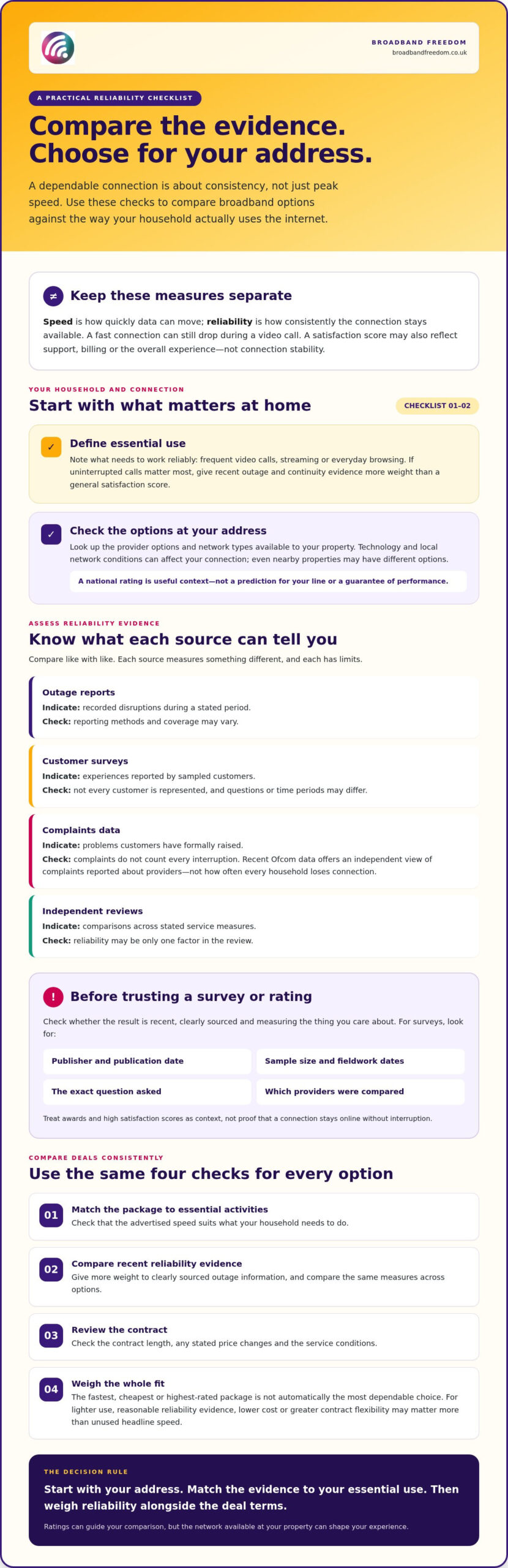
Different sources measure different things. Outage reports record service interruptions; customer surveys capture respondents’ experiences; complaints data records problems customers have raised; and independent reviews may combine reliability with speed, support or value. Keep these measures separate. An award or high satisfaction score can add context, but neither proves that a connection stays online without interruption.
| Evidence | What it indicates | Limitation |
|---|---|---|
| Outage reports | Recorded disruptions during a stated period | Reporting methods and coverage may vary |
| Customer surveys | Experiences reported by sampled customers | Not every customer is represented |
| Complaints data | Problems customers have formally raised | Doesn’t count every interruption |
| Independent reviews | Comparisons across stated service measures | Reliability may be only one factor |
What can customer surveys and provider reviews tell you?
Before relying on a survey result, check its publisher, publication date, sample size, fieldwork dates, exact question and provider comparison set. “No outages” may mean something different from “reliable” if respondents were asked about different time periods or experiences. Treat consumer research findings in the same way: check the date and stated measure, and don’t rely on a result if its methodology or source can’t be verified.
How should you use Ofcom data and industry reports?
Start with recent Ofcom complaints data for an independent view of complaints reported about providers. These figures indicate complaint levels, not how often every household loses connection. Use them alongside outage evidence and clearly described surveys, rather than treating one result as a definitive ranking of the most reliable broadband uk.
Once you’ve weighed the evidence, compare broadband deals available for your address. Use the same reliability measures to assess each option.
How to compare the most reliable broadband options for your needs
Use a consistent process to narrow down deals. A national rating can help you identify options to investigate, but it can’t tell you exactly how a connection will perform at your property. The fastest, cheapest or highest-rated package isn’t automatically the most dependable choice for your household.
Follow these steps to compare options
- Define essential use. Note what needs to work reliably, such as frequent video calls, streaming or everyday browsing.
- Check available networks. Use your address to see which provider options and network types are available. The broadband provider directory helps you explore providers, while availability remains specific to each property.
- Compare reliability evidence. Give more weight to recent, clearly sourced outage information and compare like with like. Treat ratings as supporting context, not a promise.
- Review deal terms. Check the contract length, any stated price changes and service conditions. Weigh them against the connection your household needs.
Which reliability signals matter most for your household?
If you rely on uninterrupted video calls, prioritise recent evidence about outages and continuity over a general satisfaction score. For lighter use, you may decide that a deal with reasonable reliability evidence, lower cost or greater contract flexibility is a better fit than paying for headline speed you won’t use. Match the evidence to your priorities.
What should you check before choosing a deal?
Start by comparing the options available at your property. Then check whether the advertised speed suits your essential activities, how long the contract lasts, and how price changes and service conditions are described. Use the same checklist for every deal instead of letting one standout rating decide for you. This makes it easier to compare the most reliable broadband uk options against your actual needs.
Once you’ve set your priorities, use the site’s broadband comparison guide to compare available deals and weigh their terms alongside the reliability evidence.
Find a reliable broadband deal that fits your address
There isn’t one national winner that can guarantee the steadiest connection at every home. Base your choice on recent, clearly sourced reliability evidence, then check which providers and networks are available at your address. Local network conditions can differ, so treat ratings as useful context rather than a promise about your own service.
A quick reliability checklist before you switch
Before settling on a deal, make sure you’re comparing like with like. A clear checklist keeps awards and headline speeds from overshadowing the details that matter to your household:
- Check that reliability findings have a recent publication date and named source.
- Separate evidence of interruptions from satisfaction scores, speed results and awards.
- Confirm that the deal’s availability, contract terms and service conditions suit your needs.
Then consider how you use broadband day to day. A package that looks strong on paper may not be the right fit if its terms don’t suit your household or its connection type isn’t available at your property.
Compare current broadband options in one place
Broadband Freedom is a comparison and referral platform, not an internet service provider. It brings together offers from multiple UK providers so you can view available options and compare their terms. You can compare up to 30 providers, although the options available depend on your address.
To identify the most reliable broadband uk option for your home, use reliability evidence as a guide, check what’s available at your address and choose a deal that fits your actual use. No comparison can promise that a connection will never be interrupted, but viewing options side by side can help you make a more informed choice.
Compare broadband deals available for your address and weigh them against your reliability priorities.
Make your next broadband choice with confidence
Your broadband needs can change over time. A new work pattern or extra connected devices may make different features more important, so revisit your priorities when you next review your deal.
There’s no single answer to which option is the most reliable broadband uk-wide. Focus on the connection and terms that suit your home rather than chasing a label. Broadband Freedom helps you compare offers from multiple UK providers, with options depending on your address.
Compare broadband deals available to your address and take a confident next step towards a deal that fits your household.
Frequently Asked Questions
Which broadband provider is the most reliable in the UK?
There isn’t one provider that can be named the most reliable broadband UK-wide for every household. Rankings depend on what was measured, who took part and when the research was conducted. Before choosing a provider, compare recent outage evidence and check whether it covers the network available at your property. A national result can help you shortlist options, but it can’t predict your individual connection.
Is full fibre broadband more reliable than part-fibre broadband?
Full fibre can reduce reliance on the copper line used in part-fibre connections, but that alone doesn’t guarantee fewer interruptions. Faults elsewhere on the network, power cuts or problems with your home Wi-Fi can still affect service. If both types are available, compare their reliability evidence and terms, and consider which connection suits your household rather than assuming the technology name settles the decision.
Can a broadband provider be reliable if customers report outages?
Yes. Outages can happen even on a service that performs consistently most of the time. Look beyond whether customers reported a fault: check how often interruptions occurred, how long they lasted, the period covered and how many customers were affected. A cluster of reports during one incident tells a different story from repeated disruptions over time, so read the measure and timeframe before drawing conclusions.
What should I do if my broadband keeps dropping out?
First, note when the connection drops and whether all devices are affected. If possible, test a device using a wired connection; this can help distinguish a Wi-Fi issue from a wider service problem. Restart your router and check your provider’s service updates. If dropouts continue, report them and share your notes. Ask the provider to investigate the line or network, and keep a record of fault references and responses.
Can I claim compensation for a broadband outage in the UK?
You may qualify under Ofcom’s automatic compensation scheme if your provider participates and the circumstances meet its criteria. Eligibility can depend on the type of fault and how long it takes to restore service, so check your provider’s terms and keep records of when you reported the problem. See Ofcom’s automatic compensation guidance for current scheme details.

Article by
Elaine Lang
Elaine has over 20 years across Marketing, Communications and Public Relations in the UK. She has worked across large UK corporations, including Commercial Banks and Airports, to online consumer finance and technology solutions. Elaine has post graduate qualifications in Marketing from the Chartered Institute of Marketing (CIM) and the Industry of Direct Marketing (IDM). She is a lifelong feline fan, sharing her home with around 4-6 cats for many years. This of course can be a challenge when trying to work at home, as they like to try to help!