ADSL Broadband Deals 2026: Finding Value in the Era of Full Fibre

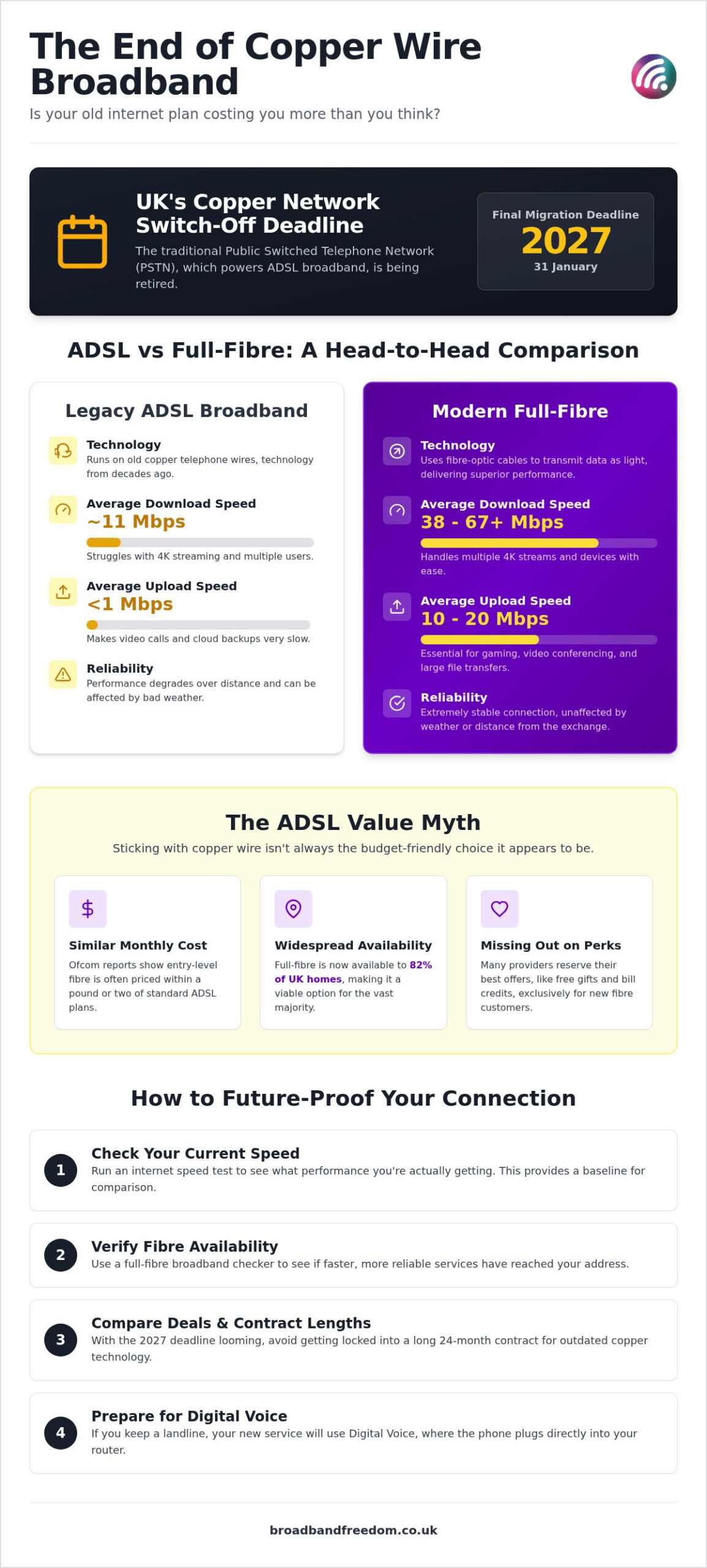
Could the internet plan you’ve used for a decade actually be costing you more than the latest technology? As we approach the 31 January 2027 deadline for the UK’s copper-wire switch-off, many households still rely on legacy connections. You might think sticking with your current ADSL broadband deals is the most budget-friendly move, but the market has changed. According to Ofcom’s 2026 reports, full-fibre is now available to 82% of UK homes, often at prices that rival older services.
We know how frustrating rising costs and rural connectivity limits can be. Whether you’re in a rural village or a city centre like Birmingham, it’s easy to feel confused by the national network transition whilst trying to keep your monthly outgoings low. Openreach has stated that the retirement of the PSTN network is a necessary step for a digital-first Britain. Determine if ADSL still offers genuine value for your specific needs or if you’re overpaying for outdated speeds. Secure a reliable connection amongst the final network transitions. Learn to spot transparent contract terms and avoid hidden price hikes. By comparing legacy copper against entry-level fibre and government-backed social tariffs, you can reclaim control over your home budget.
Key Takeaways
- Identify how the Openreach PSTN switch-off programme affects your connection and why standard copper-wire services are being retired by January 2027.
- Compare 11Mbps standard speeds with entry-level fibre to debunk the myth that legacy plans are the only way to save money.
- Master the steps to filter the latest ADSL broadband deals and find reliable “Broadband and Phone” bundles that maintain your landline access.
- Learn how to future-proof your home internet by transitioning to fibre networks without falling into the trap of hidden mid-contract price hikes.
- Identify the most cost-effective ways to combine your internet, phone, and TV packages for maximum value during the 2026 network transitions.
The Current State of ADSL Broadband Deals in 2026
ADSL is the traditional way many of us first got online. It stands for Asymmetric Digital Subscriber Line, which is a technical way of saying your internet travels over the same copper wires as your old home phone. Understanding what ADSL is helps explain why it’s now reaching the end of its life. While it was once the standard, ADSL broadband deals in 2026 are increasingly rare. Most households now see average speeds capped at just 10-11Mbps. This legacy service is primarily used by those in “fibre-last” rural locations or people still on older budget contracts.
Is ADSL Broadband Still Available in My Area?
Openreach issued “Stop Sell” notices for new copper-based services back in September 2023. This means if your local exchange has been upgraded to fibre, you can’t actually buy a new ADSL plan anymore. You’re likely only able to access these deals if fibre hasn’t reached your street yet. It’s a good idea to run an internet speed test to see how your current line is performing. If you’re struggling with buffering, check our full fibre broadband checker to see if a faster, more reliable upgrade has finally become available.
The 2026 Copper Switch-off: What You Need to Know
The UK is moving toward a fully digital future. Openreach has confirmed that the traditional Public Switched Telephone Network (PSTN) will be retired by 31 January 2027. This PSTN switch-off means that every service relying on old copper lines, including ADSL, must migrate to a digital alternative before the deadline. For most of us, this involves moving to a “Digital Voice” service where your phone connects to your router instead of the wall socket. As of July 2026, hundreds of thousands of premises are still making this transition. Planning ahead ensures you won’t face a sudden loss of service when the old network finally shuts down.
ADSL vs Fibre: Comparing Speed, Price, and Value
Standard copper connections often feel like a relic. Whilst ADSL broadband deals were once the budget king, the value gap has closed significantly. A standard ADSL line delivers roughly 11Mbps. In contrast, entry-level fibre offers 38Mbps to 67Mbps. This isn’t just about speed; it’s about stability. Copper wires are sensitive to heavy rain and your distance from the local exchange. Comparing broadband speeds shows that fibre provides a more consistent experience regardless of the weather. It’s a pragmatic choice for those who value reliability.
Speed and Performance in a Multi-Device Home
Modern multi-device behaviour demands more from our routers than ever before. An 11Mbps connection quickly buckles under the weight of 4K streaming and simultaneous video calls. One critical bottleneck is the upload speed. ADSL upload speeds usually sit below 1Mbps. This makes cloud backups and sending large email attachments painfully slow. If your household has more than two people online at once, legacy standard broadband rarely keeps up with your daily requirements. You need a connection that handles everyone at once without the frustration of constant buffering or dropped connections during important meetings.
The Hidden Costs of Legacy Standard Broadband
Many people stick with ADSL because they assume it’s the cheapest path. This is often a misconception. According to Ofcom’s 2026 pricing reports, entry-level fibre is frequently priced within a pound or two of standard copper. Legacy deals often include line rental fees that are simply bundled into the total. Modern fibre-only deals often remove these costs entirely. You also miss out on incentives. Many broadband with free gifts offers include vouchers or bill credits that aren’t available for ADSL. Before you renew, compare the latest broadband deals to see if an upgrade actually saves you money.
How to Find and Secure the Best Standard Broadband Offers
Finding the right connection requires a methodical approach. Start by using a comparison tool to filter specifically for “Standard” or “ADSL” plans. If you still rely on a traditional landline, prioritise “Broadband and Phone” bundles to keep your services unified. Verify the contract length carefully. With the 2027 switch-off approaching, avoid 24-month terms on legacy technology. Look for “no upfront cost” deals to keep your initial investment low whilst securing ADSL broadband deals that fit your current budget.
Flexible Options for Renters and Students
Temporary living situations require adaptability. For those in short-term accommodation, no contract broadband offers a solution without long-term commitment. ADSL is often easier to install in older rental properties that lack modern fibre infrastructure. Students should look for specific 9-month contracts that align with the academic year. According to the Government Digital Inclusion Strategy, maintaining access in diverse housing types remains a priority for national connectivity. Always check for student-specific discounts before signing.
Negotiating Your ADSL Contract Renewal
Don’t accept the first renewal price your provider offers. Under Ofcom rules, providers must notify you when your contract is ending. Use this notification as a prompt to discuss out of contract broadband deals with your current provider. Many households save significant amounts by switching from legacy plans to modern social tariffs. Ofcom reports these are priced between £10 and £24 per month for eligible users, yet 70% of eligible households remain unaware of them. Take control of your monthly outgoings and find the best broadband offers available today.
Future-Proofing Your Connection with Broadband Freedom
Broadband Freedom acts as a savvy facilitator in a rapidly changing industry. Our platform simplifies the move from copper-based technology to modern fibre by doing the heavy research for you. We highlight the importance of comparing broadband and phone packages together. This ensures you maintain landline connectivity whilst securing maximum savings on your monthly bills. We champion consumer autonomy by providing clear, honest data that traditional giants might hide. If you want a complete home solution, you can also explore the latest broadband with TV packages to find bundles that match your specific viewing habits and budget.
Why Use a Comparison Service in 2026?
The 2026 market is crowded with hundreds of smaller “alt-net” providers offering hyper-local services. We organise this chaos to find the best price for your specific postcode. Transparency is key to our process. We help you identify potential mid-contract price hikes, which Ofcom has regulated to ensure they are stated in “pounds and pence” rather than confusing percentages. This allows you to compare ADSL broadband deals against fibre options with total financial clarity. Our goal is to reduce decision fatigue by presenting only the most relevant, value-led options for your household.
Ready to Switch? Your Next Steps
Check your current availability via our site before your contract expires to avoid automatic rollovers. A stress-free switch requires a few simple steps. First, confirm your notice period with your current provider. Second, back up any cloud data or emails. Finally, check your router return policy to avoid unexpected fees. We are here to guide you through every step of the 2027 network transition as defined in the UK Digital Strategy. When you are ready to take control of your connection, compare the best ADSL and Fibre deals today and find the perfect fit for your home.
Secure Your Connection for the Digital Future
The national transition away from copper wires is a significant shift for UK households. Sticking with legacy ADSL broadband deals might seem simpler, but it often leaves you paying more for slower, less reliable speeds. With the January 2027 PSTN switch-off approaching, now is the time to evaluate your home setup. You’ve learned that entry-level fibre frequently matches or beats ADSL on price whilst providing the stability needed for modern multi-device homes. We provide expert guidance on the 2026 network transition to help you find the perfect balance of cost and performance.
Take Control of Your Home Budget Today
Our platform allows you to compare over 30 leading UK providers in seconds. We provide daily updated offers to ensure you never overpay for your connection. Stop overpaying for outdated technology that no longer meets your needs. Find the cheapest ADSL and Fibre deals for your home and take control of your digital life today. You deserve a connection that works for your budget and your lifestyle. It’s time to find a solution that offers both value and reliability.
Frequently Asked Questions
Is ADSL broadband being phased out in the UK by 2026?
ADSL is indeed being phased out as part of a national network upgrade. Openreach issued a “stop sell” on new copper products in September 2023 for any area where fibre is available. This means whilst you might still be using an existing connection, finding new ADSL broadband deals is becoming increasingly difficult. The entire copper network is scheduled for retirement by 31 January 2027.
Can I still get a landline with an ADSL broadband deal?
You can still have a home phone, but it’ll likely function differently than before. Traditional analogue landlines are being replaced by “Digital Voice” or VoIP technology. Instead of plugging your phone into a wall socket, you’ll plug it into your internet router. Most providers now bundle this digital phone service with their internet packages to ensure you stay connected throughout the transition.
How fast is ADSL broadband compared to Full Fibre?
ADSL is significantly slower than modern fibre alternatives. A standard copper connection typically offers average download speeds of 10-11Mbps. In contrast, entry-level fibre starts at roughly 38Mbps, whilst “Full Fibre” (FTTP) can reach speeds of 1,000Mbps or more. This speed difference is vital for households that stream video, play games, or have multiple people working from home simultaneously.
Is ADSL broadband the cheapest option for students?
ADSL isn’t always the most cost-effective choice for students in 2026. Whilst it was once the cheapest option, many providers now offer entry-level fibre at almost identical monthly rates. Students should prioritise flexible 9-month contracts or no-contract plans that match the academic year. Comparing the latest ADSL broadband deals against student-specific fibre offers is the best way to ensure you don’t overpay for basic connectivity.
What happens to my ADSL connection during the PSTN switch-off?
Your ADSL connection will eventually cease to function once your local exchange completes the switch-off. The deadline for this national migration is 31 January 2027. To avoid a loss of service, your provider will contact you to arrange an upgrade to a fibre or digital-only plan. It’s a pragmatic move to organise your switch early to ensure a seamless transition without any downtime.

Article by
Elaine Lang
Elaine has over 20 years across Marketing, Communications and Public Relations in the UK. She has worked across large UK corporations, including Commercial Banks and Airports, to online consumer finance and technology solutions. Elaine has post graduate qualifications in Marketing from the Chartered Institute of Marketing (CIM) and the Industry of Direct Marketing (IDM). She is a lifelong feline fan, sharing her home with around 4-6 cats for many years. This of course can be a challenge when trying to work at home, as they like to try to help!