Broadband for Shared Houses: The Ultimate 2026 Guide

Did you know that the average UK household now consumes over 450GB of data every single month? This figure, reported in Ofcom’s Connected Nations report, often doubles in properties with multiple occupants. We’ve all felt the frustration when a favourite show starts buffering because a housemate is gaming or downloading files. Finding the right broadband for shared house setups is the only way to guarantee a lag-free experience for everyone involved.
Achieving Digital Harmony in Shared Living
If you’re tired of arguments over bandwidth, use this guide as your roadmap to a better connection. We promise to help you navigate Full Fibre options and flexible contracts that actually match your tenancy length. You’ll learn why 500Mbps is the new standard for larger households. We’ll also explain how the Commonhold and Leasehold Reform Bill empowers flat-dwellers to request gigabit speeds. We’ve researched over 30 UK providers so you can stop worrying about lag whilst enjoying seamless streaming and working from home.
Key Takeaways
- Calculate your household’s speed requirements by allowing 50-100 Mbps per resident to ensure seamless simultaneous streaming and gaming.
- Match your internet commitment to your lease by exploring flexible 9-month or 12-month student-specific broadband for shared house deals.
- Identify why Full Fibre is the most reliable choice for managing the high volume of connected devices typical in modern multi-tenant properties.
- Follow our straightforward comparison steps to verify local gigabit availability and filter results by contract length to save money.
Why Shared Houses Need Specialist Broadband in 2026
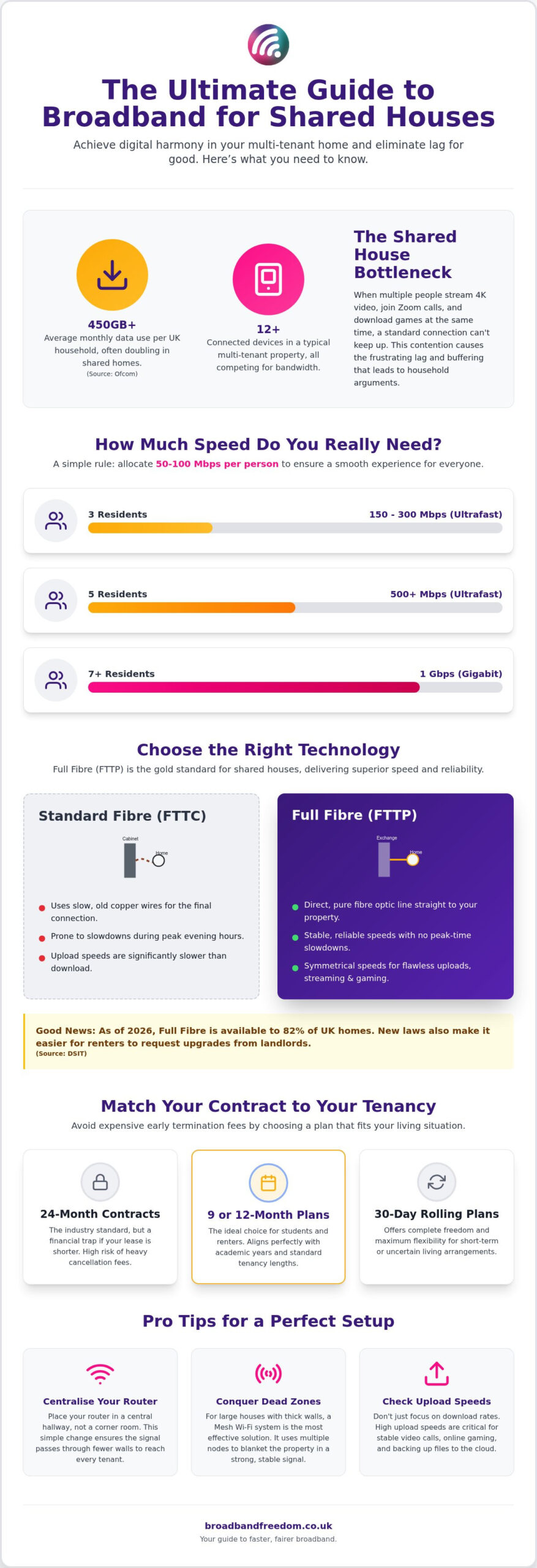
Living in a house share means your internet connection is a shared resource. When four people try to stream 4K video, join Zoom calls, and download games simultaneously, a standard connection often buckles. This is known as the shared house bottleneck. Choosing the right broadband for shared house setups is vital to prevent evening lag caused by bandwidth contention. According to Ofcom data for 2026, the average multi-tenant household now supports over 12 connected devices at once. Basic ADSL or entry-level fibre simply isn’t designed for this density. To understand the technical foundations, you can read more about what broadband is and how speed is measured.
The Impact of Multi-Device Usage
Solving Wi-Fi Dead Zones in Large HMOs
Many UK HMOs are older terraced houses with thick brick walls that block signals. If your bedroom is on the top floor, you might struggle to get a stable connection. Mesh Wi-Fi systems are the most effective solution here. These systems use multiple nodes to blanket the entire property in signal, ensuring no one is left with a weak connection. It’s a pragmatic way to ensure fairness in the house.
Calculating Speed: How Much Bandwidth Does Your Household Need?
Choosing the right broadband for shared house living starts with a simple calculation. You should ideally allocate 50-100 Mbps per housemate to avoid slowdowns. This buffer ensures that one person’s 4K streaming won’t interrupt another’s crucial gaming session or video call. If your household has multiple heavy users, aim for the higher end of that scale. Use this framework to find your ideal tier:
- 3 Residents: 150-300 Mbps (Ultrafast)
- 5 Residents: 500 Mbps (Ultrafast)
- 7+ Residents: 1 Gbps (Gigabit)
Low latency is also vital. It prevents the “lag” that ruins online gaming whilst others are working from home. Full Fibre (FTTP) is the gold standard here because it offers more stable pings and symmetrical upload speeds. It’s a smart move to compare broadband deals to ensure you’re getting a connection that handles every housemate’s needs without compromise.
Full Fibre (FTTP) vs Standard Fibre
FTTP provides a direct fibre line to your property. It avoids the old, unreliable copper wires that cause evening slowdowns in traditional fibre-to-the-cabinet (FTTC) setups. As of January 2026, data from the Department for Science, Innovation and Technology shows full-fibre is available to 82% of UK homes. You can use a broadband speed checker to see if your street is covered by these next-generation networks.
The Importance of Upload Speeds
Upload speeds are just as critical as download rates for modern shared houses. If you’re a student or remote worker, you need high upload bandwidth for stable Zoom calls and cloud backups. Limited upload capacity often causes “jitter,” making video calls freeze. New new laws for renters mean it’s now easier to request these high-speed upgrades from landlords. Always check the fine print for upload speeds, as some providers only advertise the headline download rate.
Contract Flexibility: Navigating Tenancy Lengths and Rolling Plans
Most providers push 24-month contracts because they offer long-term stability for the supplier. This creates a financial trap if your lease is only for a year. For a broadband for shared house setup, look for 12-month or student-specific 9-month plans instead. These align with academic terms and prevent heavy early termination fees. If your living situation is fluid, 30-day rolling plans offer total freedom. Under the Universal Service Obligation, you have a right to a decent connection, but you shouldn’t be forced into a contract that outlasts your stay. Beware of mid-contract price hikes that typically occur every April. Opting for a fixed-price deal ensures your monthly contribution remains predictable throughout the tenancy.
Organising the Bills and Account Ownership
Only one person can be the legal account holder. This Lead Tenant carries the credit risk if others don’t pay. Third-party split-billing services can automate this, but they often charge a fee. Setting up a communal pot is often safer for everyone involved. You can find more about flexible options in our guide to No Contract Broadband.
Use this checklist for a smooth setup:
- Agree on a payment date before the direct debit leaves the account.
- Choose a lead tenant with a stable credit history.
- Set up a dedicated house bank account for all utility payments.
Managing the Move-Out Process
Moving house doesn’t always mean paying exit fees. Many providers allow you to transfer the contract to a new address. If they can’t provide service at your new location, you may have a right to cancel without penalty. “Tenants should ensure the contract holder is someone staying the full term to avoid administrative chaos,” advises housing law expert David Smith. To find the right fit for your lease, compare broadband deals now.
Finding the Best Shared House Broadband Deals Today
Securing the right broadband for shared house living requires a methodical approach. First, use a postcode checker to identify which Full Fibre providers serve your property. This is crucial because gigabit availability varies significantly across UK urban centres. Next, filter your results by “Contract Length” to ensure the plan matches your tenancy agreement. Finally, look for “Free Gifts” or Reward Cards. These incentives can often be used to offset the first few months of communal bills, providing immediate financial relief for the household.
Why Compare with Broadband Freedom?
Choosing a provider shouldn’t feel like a chore. Our platform simplifies complex jargon into clear, actionable choices for housemates. Securing the best broadband for shared house relies on seeing the whole market at once. You can easily find Student Broadband Deals specifically designed for nine-month or twelve-month academic schedules. Before committing, it’s wise to check your Internet Speed requirements. By comparing at least 30 providers via a neutral platform, you avoid the “loyalty tax” and ensure you aren’t overpaying.
Final Checklist Before You Sign
Don’t rush into a contract without verifying the setup fee whilst checking router specs. You should decide if this cost is shared equally or paid by the lead tenant. Additionally, ensure the router can handle multiple devices. According to Citizens Advice, understanding the terms of switching is vital for renters. Always read the “Key Information Document” provided by the ISP. This document is a regulatory requirement that clearly outlines your monthly costs. Per Ofcom guidelines, providers must be transparent about potential price hikes.
Take Control of Your Household Connectivity Today
Finding the right broadband for shared house living doesn’t have to be a source of household stress. You now have the tools to calculate your speed requirements accurately and align your contract with your specific tenancy length. By prioritising Full Fibre and symmetrical upload speeds, you’ll eliminate the frustrating evening lag that causes friction between housemates. For those concerned about the logistics of changing services, Ofcom’s switching guidelines ensure a smooth transition between providers without service gaps.
Start Your Search for a Better Connection
We’ve already done the heavy lifting by researching the market for you. You can compare the best broadband deals for your shared house today and see options from over 30 UK providers in seconds. We offer expert-led advice for students and renters, alongside fixed price and no-contract options. You can also explore our full list of UK broadband providers to find the best local coverage. Don’t settle for a connection that can’t keep up with your digital life. Start your search now and enjoy a faster, fairer home network.
Frequently Asked Questions
Is 100Mbps enough for a 4-person shared house?
No, 100Mbps is often insufficient for a broadband for shared house setup with four active users. This speed only allows 25Mbps per person; the bare minimum for 4K streaming. If everyone is online simultaneously, you will likely experience buffering and lag. For a seamless experience, we recommend at least 200Mbps. Check your current internet speed requirements to ensure enough bandwidth for every housemate.
Can we get broadband without a long-term contract?
Yes, you can secure broadband for shared house living without a long-term commitment. Providers offer 30-day rolling contracts that provide ultimate flexibility. Whilst these plans often have higher upfront setup fees, they prevent expensive early termination charges. You can compare no-contract broadband deals to find the ideal solution for short-term tenancies or households where the future living situation remains uncertain.
Who is responsible for the broadband bill in a house share?
The lead tenant who signs the agreement is legally responsible for the entire monthly bill. Even if housemates fail to pay their share, the account holder remains liable. To protect your credit score, ensure everyone agrees to a payment schedule. Using a dedicated house bank account can help automate these communal contributions and reduce financial friction amongst the group.
What happens to the broadband if I move out before my housemates?
If you are the account holder, you remain responsible for the payments until the contract is transferred or cancelled. You should contact your provider to see if a remaining housemate can take over the account. If no one stays, you may face early exit fees if you are still within the initial term. Always check if your provider allows a “moving home” transfer instead.
Does the landlord have to provide broadband in a shared house?
Landlords are not legally required to provide an internet connection unless your tenancy agreement specifically states that bills are included. In most private rentals, tenants are responsible for choosing and paying for their own service. According to Citizens Advice, you should verify which utilities are your responsibility before signing. Most landlords won’t refuse high-speed upgrades as they increase the property’s long-term value. If you’re looking to invest in high-yield rental assets, you can explore BMV Property Sourcing and Serviced Accommodation Management to find deals that maximise returns.

Article by
Elaine Lang
Elaine has over 20 years across Marketing, Communications and Public Relations in the UK. She has worked across large UK corporations, including Commercial Banks and Airports, to online consumer finance and technology solutions. Elaine has post graduate qualifications in Marketing from the Chartered Institute of Marketing (CIM) and the Industry of Direct Marketing (IDM). She is a lifelong feline fan, sharing her home with around 4-6 cats for many years. This of course can be a challenge when trying to work at home, as they like to try to help!