5G Home Broadband vs Fibre: Which is Best for Your UK Home in 2026?
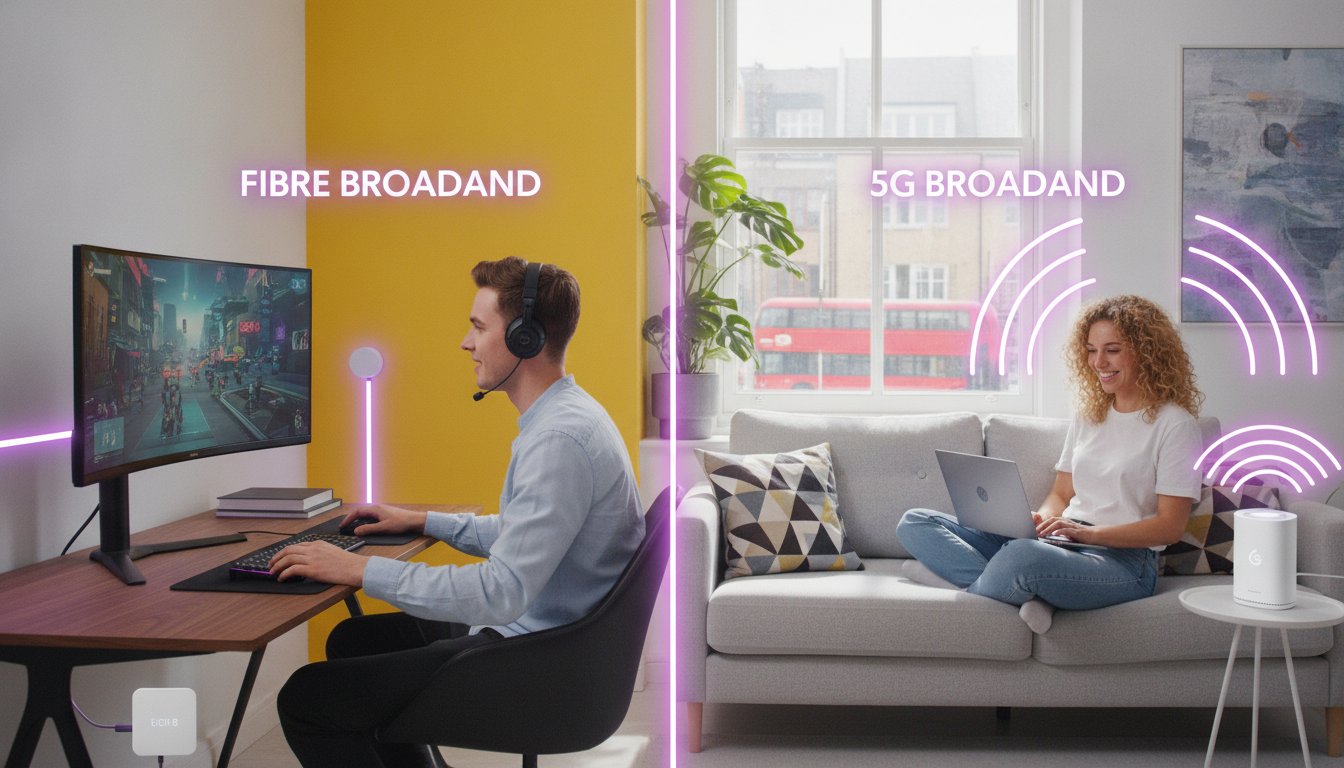
The most expensive fibre connection in your street might actually be slower than the 5G router sitting on your neighbour’s windowsill. It sounds unlikely, but as we move through 2026, the gap between mobile data and fixed lines has vanished for millions of UK households. Deciding between 5g home broadband vs fibre is no longer just about raw speed. It is about how you live, how often you move, and how much you dislike waiting for an engineer to drill holes in your walls.
Get a connection that just works from the moment you plug it in, without being trapped in a restrictive long-term contract. We know that finding the right balance between cost and reliability often feels like a chore. This guide provides the definitive comparison to help you choose the best connection for your specific lifestyle. We’ll examine the latest UK coverage statistics, compare real-world latency for gaming, and identify which options offer the ultimate flexibility for modern renters.
Key Takeaways
- Compare the essential performance differences between 5g home broadband vs fibre to see if a wireless setup can truly replace your fixed line.
- Understand the latency gap to ensure your connection supports seamless gaming and high-definition video calls without frustrating lag.
- Evaluate the trade-off between the instant, portable setup of 5G routers and the long-term reliability of a permanent Full Fibre installation.
- Learn how to avoid common pitfalls like mid-contract price hikes by comparing flexible, no-contract options that suit your specific living situation.
Understanding the 2026 Landscape: 5G Home Broadband vs Fibre Optic
The UK’s digital infrastructure has undergone a massive transformation. As of Spring 2026, approximately 88% of premises now have access to gigabit-capable connections. This shift is largely driven by the government’s Project Gigabit, which has already reached over 1.3 million hard-to-reach homes. Choosing between 5g home broadband vs fibre is no longer a niche debate; it’s a practical necessity as traditional copper-based ADSL lines are phased out across the country.
What is 5G Fixed Wireless Access (FWA)?
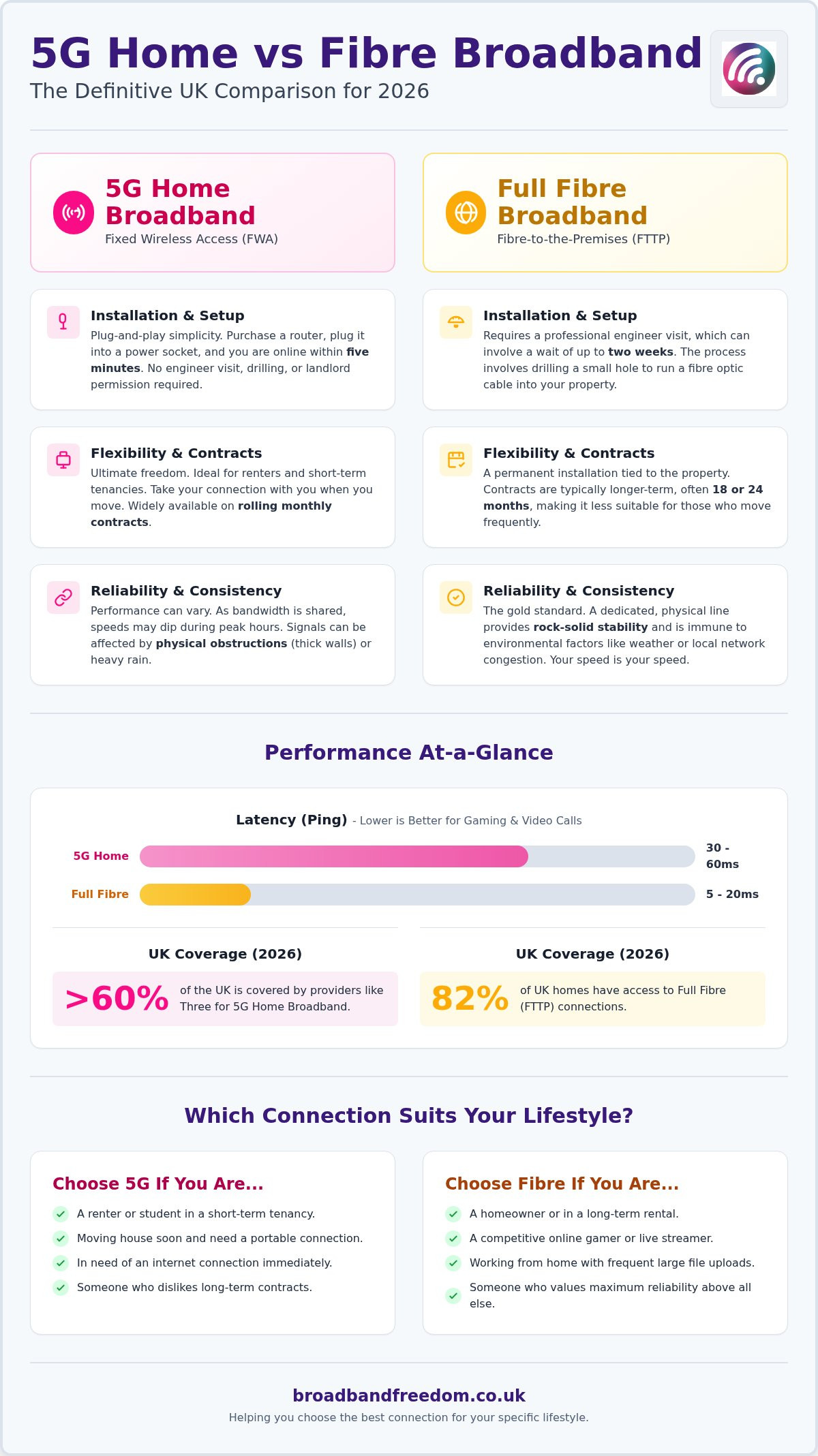
Think of 5G home broadband as a “fixed wireless” solution. Unlike a mobile hotspot on your phone, a dedicated 5G router is designed to handle dozens of devices simultaneously. It uses high-speed mobile signals but converts them into a robust Wi-Fi network for your entire house. When weighing up 5g home broadband vs fibre, the lack of an engineer visit is often the deciding factor for renters. There is no need for external cabling; you simply plug the router into a power socket and you’re online. Ofcom reports show network providers like Three already cover more than 60% of the UK, making this a functional choice for instant connectivity.
The Evolution of Full Fibre (FTTP) in the UK
Full Fibre, or Fibre-to-the-Premises (FTTP), represents the gold standard of reliability. We’ve moved beyond “superfast” (FTTC), which still relied on aging copper wires for the final leg of the journey. Modern FTTP uses pure glass-fibre cables directly into your property. This ensures that your speeds don’t drop during peak hours or rainy weather. If you want to see what’s available in your area, you can compare Full Fibre broadband deals to find the most stable connection. By January 2026, 82% of UK homes had access to these ultrafast lines, providing a level of consistency that wireless signals sometimes struggle to match.
Speed, Latency, and Reliability: The Performance Showdown
Both technologies can theoretically hit 1Gbps in 2026, but the real-world experience of 5g home broadband vs fibre differs significantly. Fibre delivers a dedicated stream of data through pure glass cables. 5G transmits signals through the air. This physical distinction affects everything from your morning video calls to high-bandwidth 8K streaming sessions.
Gaming and Video Conferencing: Why Latency Matters
Latency is the time it takes for data to travel from your device to a server. Fibre typically offers a crisp 5 to 20ms. In contrast, 5G often fluctuates between 30 to 60ms. For casual browsing, this is invisible. For competitive gaming, high ping causes “lag” that can ruin the experience. Fibre also offers superior symmetrical upload speeds, which is vital if you frequently upload large files or stream live content. Before you decide, check your current internet speed to establish your performance baseline.
Congestion and Consistency in 2026
Mobile networks rely on contention ratios. You share the local mast’s bandwidth with every smartphone in your vicinity. During peak evening hours, 5G speeds can dip whilst fibre remains rock-solid. Physical obstructions like thick walls or heavy rain can also degrade 5G signals. Industry experts often highlight that Full Fibre (FTTP) provides “absolute environmental immunity,” ensuring your connection doesn’t drop when the weather turns. This environmental reliability is especially important for those in rural areas managing livestock or looking to buy buckfast queen bees uk, where outdoor conditions and seasonal timing are critical. Whilst Wi-Fi 7 routers in 2026 help maximise local speeds, they cannot overcome a congested mobile mast. If reliability is your primary concern, you should compare the latest fibre deals to secure a dedicated line that isn’t affected by your neighbours’ data usage.
Installation and Flexibility: Why Your Living Situation Dictates the Choice
Your timeline for getting online often settles the 5g home broadband vs fibre debate before you even look at speeds. If you need a connection today, 5G is the clear winner. You can buy a router, plug it into a wall socket, and be online in five minutes. Fibre typically requires a wait of up to two weeks for an engineer to visit, drill through external walls, and mount hardware. This delay is often a deal-breaker for those who work from home and cannot afford a fortnight of downtime.
The Renters’ Advantage: 5G and Short-Term Plans
5G represents the ultimate freedom for students and those on short-term tenancies. You don’t need permission from a landlord to install new cables, and you can take your connection with you when you move house. Many providers in 2026 have embraced this flexibility by offering rolling monthly terms. You can easily compare no-contract broadband deals to avoid being tied to a property for 24 months. For those living with housemates, it’s worth checking our guide on internet for shared houses to see how mobile signals handle multiple high-demand users.
Fibre Installation: What to Expect in 2026
Fibre installation has become significantly less intrusive than it was a few years ago. Most modern UK homes now feature a pre-installed Optical Network Terminal (ONT) box. If your property already has one, you might qualify for a “Self-Install” kit. This arrives by post and eliminates the engineer visit entirely. Always check your hallway or living room for a small white box with a fibre port before signing a contract. If your home lacks this infrastructure, you will need a professional installation to enjoy the long-term stability of a fixed line. To find the best options for your area, compare the latest broadband offers to see which providers can get you connected fastest.
Cost Analysis and Value: Finding the Best 2026 Deal
When you weigh up 5g home broadband vs fibre, the winner often depends on your data consumption. Whilst 5G plans frequently offer lower entry-level monthly costs, Full Fibre usually provides a superior cost-per-Mbps for high-speed users. You should also stay alert to mid-contract price hikes. Most UK providers now use a standard formula of the Consumer Price Index (CPI) plus an additional 3.9% annually. These increases can significantly alter the lifetime cost of a 24-month contract.
Fibre users often find additional value through consolidation. Many providers offer substantial discounts when you compare latest broadband and TV packages. These bundles frequently include premium streaming services at a lower total cost than buying them separately, a benefit rarely found with standalone 5G mobile plans.
Hidden Costs: Hardware, Activation, and Delivery
Upfront fees can catch you off guard. 5G routers are typically provided for free on 12 or 24-month contracts, though rolling monthly plans might require you to buy the hardware. Conversely, fibre deals sometimes include activation or delivery fees for the router. According to the 2026 UK Broadband Pricing Index, entry-level 5G remains the most affordable path for single-user households. However, social tariffs are widely available for both technologies, offering discounted rates between £12 and £20 per month for households receiving financial support.
The Verdict: Which Should You Choose?
Your lifestyle is the final decider. 5G is the ideal choice for renters, students, or those living in short-term accommodation who prioritise a plug-and-play setup. Full Fibre remains the non-negotiable anchor for large families, professional gamers, and anyone requiring absolute reliability. Before you commit, always check your local 5G signal strength in every room of your house. If the signal is weak, even the cheapest plan won’t be a bargain. When you’re ready to switch, compare the best broadband deals on Broadband Freedom to find a contract that fits your budget and your home.
Take Control of Your Home Connectivity
Choosing between 5g home broadband vs fibre doesn’t have to be a source of decision fatigue. If you prioritise a five-minute setup and the freedom to move house without a penalty, 5G is your ideal companion. For families and home workers who require the rock-solid stability of glass-fibre cables, a Full Fibre connection remains the gold standard for 2026. Your living situation is the ultimate guide, but both technologies now offer the speeds needed for a modern digital life.
We’ve done the heavy lifting so you don’t have to. Our platform allows you to compare over 30 UK providers in seconds and browse daily updated offers on everything from student plans to no-contract deals. Whether you need the portability of a mobile signal or the raw power of a gigabit line, the right solution is just a few clicks away. Compare the latest 5G and Fibre broadband deals today and find the perfect match for your home. Finding the right connection should be a simple path to freedom, not a technical headache.
Frequently Asked Questions
Is 5G home broadband as stable as fibre for working from home?
Fibre is generally more stable than 5G for working from home because it uses a physical connection rather than wireless signals. Whilst 5G offers impressive speeds, its performance can fluctuate due to weather conditions or local network congestion. If your daily routine involves constant high-definition video calls or large file transfers, the dedicated consistency of a fibre line provides a more reliable experience for professional use.
Can I take my 5G home broadband router with me if I move house?
Yes, you can take your 5G router to a new address as long as there is sufficient network coverage. This portability is a primary benefit of 5g home broadband vs fibre for renters or students who move frequently. You simply unplug the device and plug it into a power socket at your new property. Always check your provider’s coverage map first to ensure a strong signal at the new location.
Does 5G home broadband have a data cap in the UK?
Most major UK providers, such as Three and Vodafone, offer unlimited data plans for 5G home broadband in 2026. This allows you to stream, game, and work without worrying about extra charges or speed throttling. However, some specific mobile-first plans or smaller providers might still implement fair usage policies. It is vital to read the contract terms to ensure your plan is truly unrestricted for heavy household use.
Will 5G eventually replace fibre optic broadband entirely?
5G is unlikely to replace fibre optic broadband entirely as both technologies serve different roles in the UK’s infrastructure. Fibre acts as the high-capacity backbone of the internet, whilst 5G provides a flexible, high-speed alternative for mobile or temporary setups. As household data demands for 8K streaming and smart devices grow, the physical reliability of glass-fibre cables remains essential for supporting the nation’s long-term bandwidth requirements.
How do I check if 5G or Full Fibre is available at my UK address?
You can check availability by using a postcode checker on an independent comparison platform or a provider’s website. These tools use updated data from Ofcom and network operators to show which services reach your specific property. Since 82% of UK homes now have access to Full Fibre, you likely have several ultrafast options. Comparing these deals side-by-side is the most efficient way to find a reliable connection for your home.

Article by
Elaine Lang
Elaine has over 20 years across Marketing, Communications and Public Relations in the UK. She has worked across large UK corporations, including Commercial Banks and Airports, to online consumer finance and technology solutions. Elaine has post graduate qualifications in Marketing from the Chartered Institute of Marketing (CIM) and the Industry of Direct Marketing (IDM). She is a lifelong feline fan, sharing her home with around 4-6 cats for many years. This of course can be a challenge when trying to work at home, as they like to try to help!