BT vs Sky Broadband: The Definitive 2026 Comparison Guide

Would you believe that eight in ten UK homes now have access to full-fibre, yet many of us are still overpaying for speeds we never actually see? Choosing between BT vs Sky broadband in 2026 has become a complex puzzle of “Superfast” branding and confusing mid-contract price hikes that can add £4 per month to your bill. Secure a stable gigabit connection that actually covers your entire house, rather than settling for dead zones and a mounting pile of expensive hardware.
Compare these two giants on the metrics that matter most to your daily life. This guide breaks down everything from BT’s latest EE TV bundles using Apple TV 4K to Sky’s multi-gigabit offerings reaching up to 5Gbps. You’ll learn how to navigate the 2026 Ofcom regulations, including the reduced six-week window for resolving complaints, whilst ensuring you get the service you pay for. Use our postcode comparison data to simplify the switching process and find a better deal without the usual stress.
Key Takeaways
- Compare entry-level tiers to see how BT vs Sky broadband speeds and monthly costs stack up for your specific household needs in 2026.
- Determine which provider offers the best hardware for your home layout by comparing the latest Wi-Fi 6 and Wi-Fi 7 router capabilities.
- Analyse the trade-off between Sky’s exclusive entertainment and BT’s flexible EE TV packages to ensure you only pay for the channels you actually watch.
- Master the One Touch Switch process to transition between providers seamlessly without having to coordinate cancellations yourself.
- Identify which provider best suits your lifestyle, whether you are a competitive gamer, a movie buff, or an existing mobile customer looking for a bundle.
BT vs Sky: Comparing Packages, Speeds, and Monthly Costs
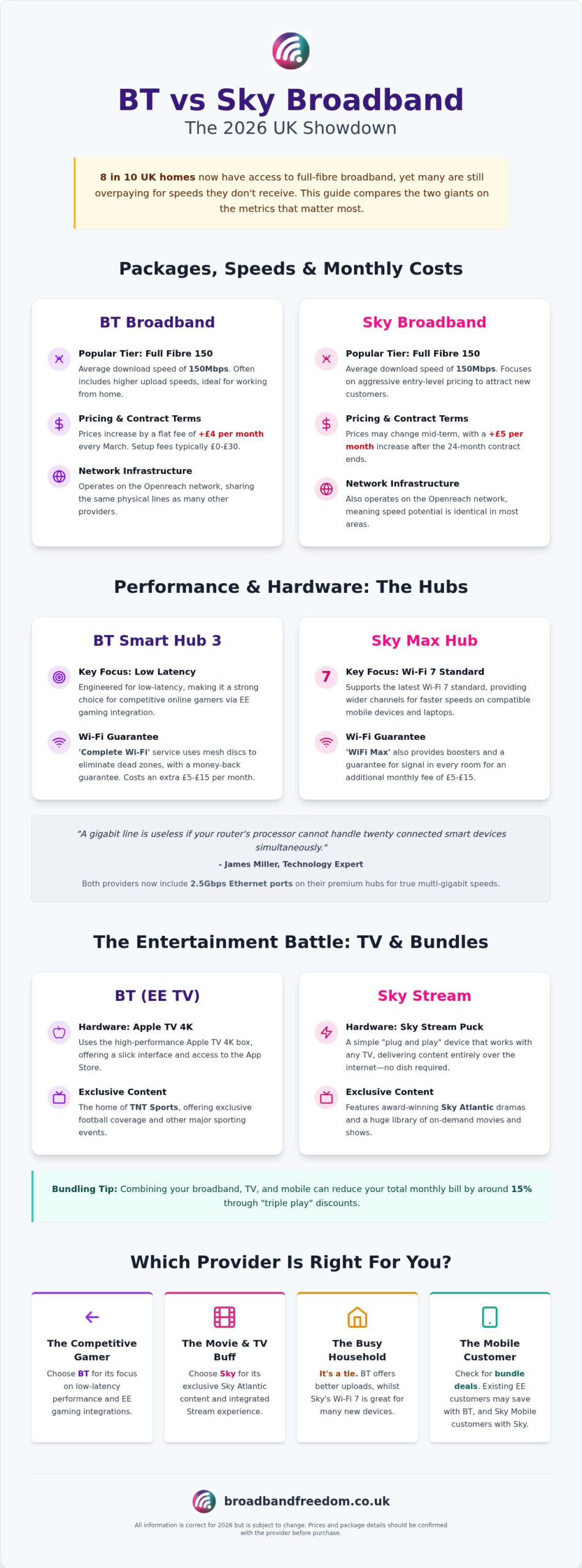
Choosing between BT vs Sky broadband often starts with their most popular tier: Full Fibre 150. Both providers deliver average download speeds of 150Mbps, which is ideal for a busy household streaming in 4K or working from home. Whilst the speeds are identical, the value lies in the extras. BT often includes higher upload speeds, whilst Sky focuses on aggressive entry-level pricing. Stop sticking with a legacy contract. If your initial 24-month term has ended, you’re likely paying a “loyalty tax” that could be £20 higher than a new customer deal. New customer rewards, such as gift cards or vouchers, can significantly offset your first year’s costs.
Full Fibre (FTTP) Availability in 2026
Access to these speeds depends on your local infrastructure. As of 2026, nearly 80% of UK homes can access full-fibre. Use a full fibre broadband checker to see if your street is ready for a gigabit upgrade.
The Openreach Infrastructure
Both brands operate primarily on the Openreach network. This means the physical cable coming into your home is often the same regardless of which brand you choose. For a deeper look at the infrastructure’s history and operational details, you can read the BT Group background. Because they share a network, your decision should focus on hardware and customer service rather than raw speed potential. You can compare other broadband providers to see how they utilize this same network.
Hidden Costs: Setup Fees and Price Hikes
Monthly bills are only part of the story. Setup fees usually range from £0 to £30, though these are often waived during promotional periods. Look out for mid-contract price hikes that affect your long-term budget. For new BT customers, prices will increase by a flat fee of £4 per month every March starting in 2027. Sky operates differently, stating prices may change during the term and adding £5 to your monthly cost once the 24-month contract ends. Always calculate the total cost over 24 months rather than just the headline monthly price to find the true winner in the BT vs Sky broadband battle.
Performance and Hardware: Smart Hubs vs Sky Max Hub
Hardware differences often dictate your daily experience more than the cable in the street. In the BT vs Sky broadband comparison, the router acts as the brain of your home network. BT’s latest Smart Hub 3 focuses on low-latency performance, making it a favourite for competitive gamers through its EE gaming integration. Sky’s Max Hub prioritises the latest wireless standards to ensure your mobile devices stay connected at peak speeds. If your current router is underperforming, you can find a better hardware deal that matches your home’s unique layout.
Router Specifications and Port Speeds
Modern hubs must handle dozens of smart devices without crashing. The Sky Max Hub supports Wi-Fi 7, which is the latest wireless standard providing wider channels and advanced data transmission for 2026 households. Both providers now include 2.5Gbps Ethernet ports on their premium routers to facilitate true gigabit throughput. “A gigabit line is useless if your router’s processor cannot handle twenty connected smart devices simultaneously,” says technology expert James Miller. These technical specifications are vital for maintaining a stable connection during peak evening hours when everyone is online.
Wi-Fi Guarantees and Signal Boosters
Signal dead zones are a common frustration in larger UK homes. BT’s ‘Complete Wi-Fi’ and Sky’s ‘WiFi Max’ both offer money-back guarantees if you don’t receive a signal in every room. These services usually include mesh discs or boosters for an extra monthly fee of £5 to £15. Use an internet speed test to document any weak spots before committing to an upgrade. When choosing between BT vs Sky broadband, remember that Sky connections undergo Dynamic Line Management (DLM) for the first 14 days, causing temporary speed fluctuations whilst the system stabilises your line.
The Entertainment Battle: Sky Stream vs EE TV Bundles
In 2026, the traditional satellite dish has become a relic of the past. Both providers now deliver their full entertainment suites over your internet connection, making premium content accessible to any home with a decent line speed. When deciding between BT vs Sky broadband, your choice often hinges on whether you prefer Sky Atlantic’s prestige dramas or TNT Sports’ exclusive football coverage. Bundling these services usually saves money compared to taking separate subscriptions, often reducing the total monthly bill by 15% through “triple play” discounts. This “no dish” requirement is a major win for renters who previously couldn’t install satellite hardware.
Sky Stream and Glass: The Integrated Experience
Sky Stream offers a “plug and play” setup that works with any television. The interface uses a “Playlist” feature instead of traditional recordings, storing your favourite shows in the cloud for easy access. Whilst the base package is competitive, be aware of add-on costs for 4K/HDR and ad-skipping features. You can compare the latest broadband and TV packages to see how these extras impact your monthly budget. According to Ofcom data, streaming-led services now dominate UK household viewing habits, with internet-delivered TV becoming the standard.
EE TV (BT): Flexibility for Sports Fans
BT’s rebranded EE TV service prioritises choice and adaptability. Their “Big Sport” and “Full Works” packages allow you to swap your channel line-up every 30 days. This is perfect for fans who only want sports during specific seasons. If you have an EE mobile plan, you can often unlock extra data or bundle discounts. For a more detailed look at the competition, check out our guide to sky broadband deals. Research from BARB shows that flexible bundling is the fastest-growing segment in the UK television market. Compare current entertainment bundles to find the most cost-effective solution for your home.
The Verdict: How to Switch and Save in 2026
In the BT vs Sky broadband showdown, your winner depends on your household priorities. Choose BT if you are a competitive gamer needing low latency or a sports fan who values the monthly flexibility of EE TV. Sky remains the superior choice for movie buffs wanting integrated access to Sky Atlantic or families looking for a seamless entertainment ecosystem. If you already have a mobile plan with either provider, check for exclusive convergence discounts that aren’t available to the general public.
The 3-Step One Touch Switch Process
Switching providers no longer requires awkward cancellation calls. Under the current Ofcom One Touch Switch regulations, your new provider handles the entire transition. This eliminates the stress of coordinating dates yourself.
- Step 1: Choose your new deal on compare broadband deals to find the best rate for your postcode.
- Step 2: Place your order online. Your new provider automatically notifies your old one to stop the service.
- Step 3: Receive your new router and go live on your chosen date without any gap in your internet connection.
Maximising Your Savings with Vouchers
Look beyond the monthly headline price to find the real value. Many 2026 deals include “Reward Cards” or “Bill Credit” that can be worth up to £150. These incentives effectively lower your monthly outgoings over the 24-month term. Check broadband with free gifts to see which vouchers are currently active. “Switching every 24 months is the only way to stay ahead of inflation and avoid the loyalty tax,” says consumer advocate Sarah Jenkins. These rewards are often time-sensitive, so act quickly when you see a high-value card.
Your 2026 Switching Checklist
Follow these steps to ensure a frictionless move. First, verify your current contract end date to avoid early exit fees. Second, use a postcode checker to confirm that full-fibre speeds are actually available at your front door. Finally, use a comparison tool to access “Online Exclusive” deals. These rates are often significantly lower than those found directly on provider websites. By taking control of your connection, you secure a faster, more reliable service at a fraction of the legacy cost. Stop paying for a service that doesn’t meet your modern requirements.
Secure Your Ideal Connection for 2026
Finding the right provider shouldn’t feel like a chore. You’ve seen that the choice between BT vs Sky broadband depends on your unique lifestyle. Gamers and sports fans might lean towards BT’s low-latency hardware and flexible EE TV packs. Movie lovers and existing mobile customers often find better value with Sky’s integrated ecosystem. Both providers now offer gigabit-capable infrastructure that covers nearly 80% of the UK, meaning your physical connection is more reliable than ever before.
Don’t let a legacy contract drain your budget any longer. Our platform offers an expert comparison of 30+ UK providers with daily updated pricing for 2026. We deliver independent and unbiased advice to help you navigate the One Touch Switch process with total confidence. You deserve a connection that supports your home without the frustration of dead zones or hidden fees. By switching now, you can escape the loyalty tax and secure the modern hardware your household requires.
Take control of your monthly outgoings today. Compare the latest BT and Sky broadband deals today to secure your perfect match. Your ideal home setup is just a few clicks away.
Frequently Asked Questions
Is BT broadband more reliable than Sky?
Both providers offer exceptional reliability because they primarily share the same Openreach infrastructure. According to Ofcom data from early 2026, broadband complaints have fallen to a record low of 6 per 100,000 customers across the industry. BT often performs slightly better in larger properties due to its established mesh disc system. Sky’s reliability has improved significantly with the rollout of Wi-Fi 7 hubs that better manage high-traffic households.
Do BT and Sky use the same cables?
Yes, both providers use the Openreach network to deliver services to the vast majority of UK homes. This means the physical fibre optic cable entering your property is identical regardless of which brand you choose. When comparing BT vs Sky broadband, the real difference lies in the router hardware and the customer support provided. Sky also utilises CityFibre in certain regions to offer multi-gigabit speeds that aren’t yet available on the standard Openreach lines.
Can I keep my Sky TV if I switch to BT broadband?
You can certainly keep your Sky TV subscription whilst using a BT internet connection. Modern services like Sky Stream and Sky Glass are platform-agnostic, meaning they function perfectly over any high-speed broadband line. You simply connect your Sky puck or TV to your BT Smart Hub via Wi-Fi or Ethernet. This allows you to enjoy Sky’s exclusive content, such as Sky Atlantic, whilst taking advantage of BT’s specific gaming or mobile bundle discounts.
Who is cheaper for Full Fibre in 2026, BT or Sky?
Sky typically offers the lowest headline entry prices for BT vs Sky broadband shoppers. Their 150Mbps Full Fibre plans often start between £22 and £23 per month, whereas BT’s equivalent tier is usually priced around £28.99. You must look at the total 24-month cost to see the true value. BT adds a flat £4 to your bill every March, whilst Sky increases prices by £5 once your initial contract term ends. Check for “new customer” vouchers to further reduce these costs.
How long does it take to switch from BT to Sky broadband?
The switching process usually takes between 10 and 14 days from the moment you place your order. Because both brands use the One Touch Switch system, you won’t need to speak with BT to cancel your existing service. Sky handles the communication with Openreach and coordinates the transition date. Your new hardware arrives by post a few days before the switch, and the actual downtime on the day of the transfer is typically less than an hour.

Article by
Elaine Lang
Elaine has over 20 years across Marketing, Communications and Public Relations in the UK. She has worked across large UK corporations, including Commercial Banks and Airports, to online consumer finance and technology solutions. Elaine has post graduate qualifications in Marketing from the Chartered Institute of Marketing (CIM) and the Industry of Direct Marketing (IDM). She is a lifelong feline fan, sharing her home with around 4-6 cats for many years. This of course can be a challenge when trying to work at home, as they like to try to help!