What is a Good Broadband Speed? A Simple Guide

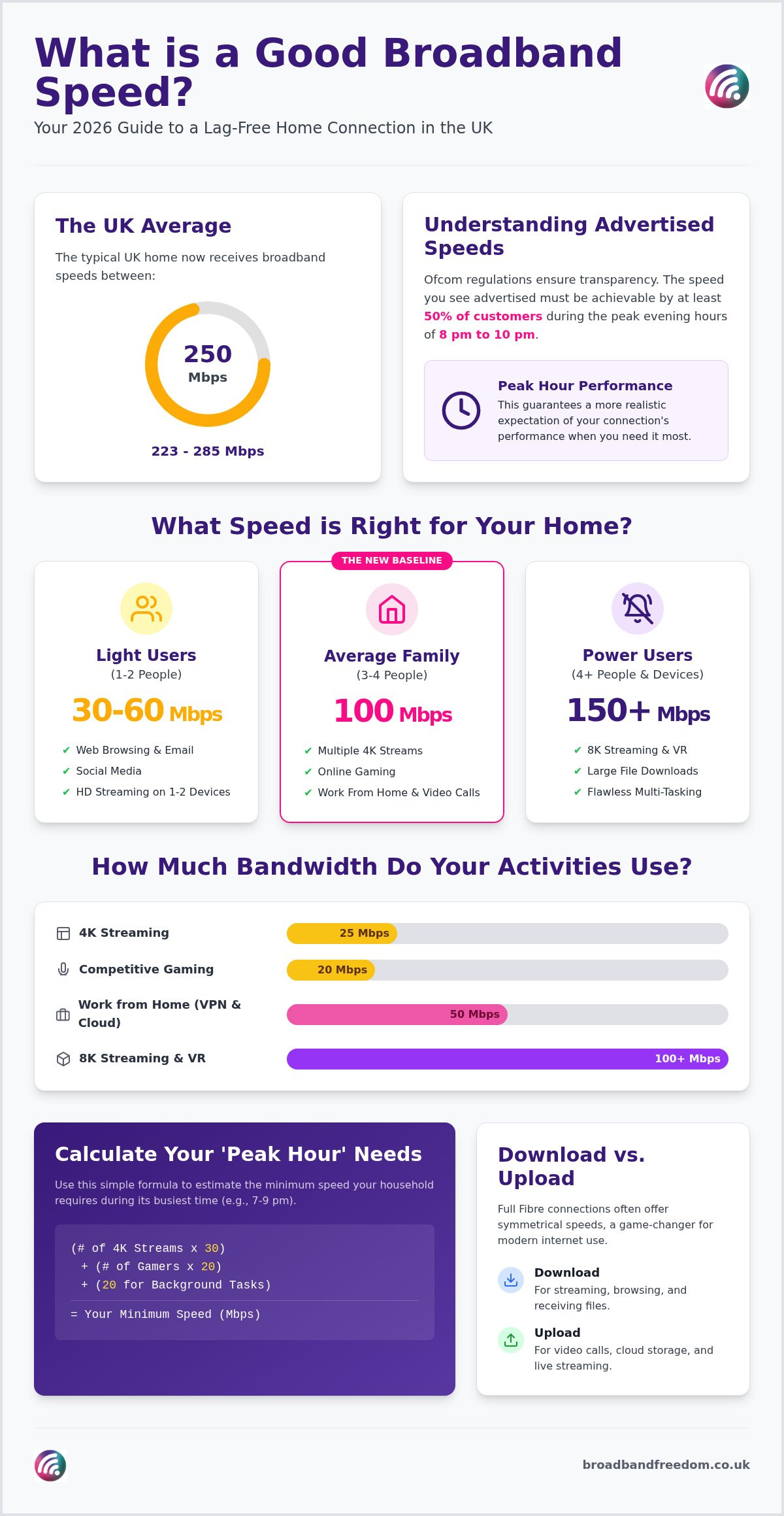
With the UK’s average broadband speed now reaching between 223 Mbps and 285 Mbps, identifying the right amount for your home is essential. You’ve likely felt the frustration of a dropped Zoom call or the stutter of a 4K movie during peak hours. Understanding what is a good broadband speed is the best way to eliminate decision fatigue and avoid expensive, unnecessary contracts. Ofcom’s latest Home Broadband Report suggests that many households overpay for headline speeds they rarely utilise, highlighting the need for a more calculated approach.
Meeting Modern Bandwidth Demands
We’ve synthesised the latest research from industry specialists to provide a pragmatic guide for your network. You will discover exactly how to calculate your household’s “Peak Hour” requirements and identify the hardware bottlenecks slowing you down. This article provides a clear roadmap to help you organise your digital life, avoid mid-contract price hikes, and secure a future-proof connection. We’ll show you how to move beyond confusing provider jargon and find a deal that respects both your usage habits and your monthly budget.
Key Takeaways
- Learn exactly what is a good broadband speed for your home by matching your Mbps to your household’s unique 2026 usage habits.
- Identify your “Peak Hour” requirements to ensure your connection handles simultaneous 8K streaming and video calls without a hint of lag.
- Master simple optimisation techniques to bypass the “WiFi Bottleneck” and get the most out of your existing router and hardware.
- Discover how to filter the best Full Fibre deals using guaranteed minimums rather than misleading “up to” marketing figures.
Defining a Good Broadband Speed in the UK for 2026
A “good” connection is one that handles every active device in your home without latency or the dreaded buffering wheel. For a standard UK family in 2026, 100Mbps has become the essential baseline for a smooth experience. Single-occupancy households or couples with light usage can still thrive on 30-60Mbps. The market has shifted significantly toward Full Fibre (FTTP). This technology replaces older “Superfast” (FTTC) hybrid connections that relied on ageing copper wires. To understand this technical evolution, you can read about what is broadband and how it has changed over the decades.
Transparency in Advertised Speeds
You don’t have to guess if a provider is being honest anymore. Under current Ofcom regulations, any advertised speed must be achievable by at least 50% of customers during the peak evening window of 8 pm to 10 pm. This rule helps you understand what is a good broadband speed by providing a realistic expectation of performance rather than a theoretical maximum. It’s about consistency across your entire day, not just a lucky burst of speed in the middle of the night.
Download versus Upload Performance
Why Regional Infrastructure Matters
National average statistics are often misleading because your connection quality depends on the specific cables in your street. Whilst 95% of urban households have access to gigabit-capable broadband, many rural locations still rely on older technology. Before you start comparing new deals, you should check your current internet speed to see what your home actually receives. This prevents you from overpaying for a high-speed tier that your local exchange cannot yet deliver.
Calculating Your Household Speed Requirements
To find out what is a good broadband speed for your property, you must first identify your “Peak Hour”. This is the specific time of day, usually between 7 pm and 9 pm, when every family member is online simultaneously. During these windows, your bandwidth is split across multiple streams, downloads, and background processes. If your total demand exceeds your incoming speed, you’ll experience lag. Most 2026 households now juggle more devices than they realise, from smartphones to smart fridges.
Bandwidth Benchmarks for Common 2026 Activities
Modern applications are heavier than ever. Whilst 4K streaming remains popular at 25Mbps, 8K content now requires a steady 100Mbps per stream to maintain high dynamic range (HDR) quality. Competitive gaming isn’t just about Mbps; it requires low latency (ping) under 20ms to ensure your actions register instantly. For those working from home, seamless VPN use and large cloud file transfers often require at least 50Mbps of dedicated headroom. You can use this guide on household speed requirements to see how different activities stack up.
The Multi-Device Multiplier: Summing Your Total Need
Your total requirement isn’t just about what you are actively doing. Smart home devices like security cameras and thermostats are always connected. We recommend a “Concurrency Multiplier” where you add 10Mbps for every smart device that stays online. Use this simple formula: (Number of 4K Streamers x 30) + (Number of Gamers x 20) + 20 (for background tasks) = Your Minimum Speed. If your calculation exceeds 150Mbps, you should compare broadband deals that match your household’s specific total.
Choosing Between 150Mbps and Gigabit Speeds
Many users wonder if they truly need a gigabit connection. If you’re a household of two people who mostly browse and watch Netflix, a 150Mbps Full Fibre deal is more than enough. However, if you have a large family with multiple 8K screens, VR headsets (50Mbps+ each), and professional WFH needs, 1Gbps provides necessary breathing room. It prevents one person’s large game download from slowing down everyone else’s experience. This distinction is key to finding what is a good broadband speed without overspending on capacity you’ll never use.
How to Test and Optimise Your Current Connection
Finding out what is a good broadband speed starts with an accurate reading of your current performance. Don’t rely on a single wireless test from your phone. For a clean result, plug a laptop directly into your router using an Ethernet cable. Turn off all other connected devices and close any background applications. Run tests at different times of the day, particularly during the peak evening window, to see how your connection holds up under national demand. Latency is the time it takes for data to travel to a server and back; it’s the primary cause of lag even if your Mbps looks high.
Identifying the WiFi Bottleneck
Your incoming fibre signal might be lightning-fast, but an old router can act as a bottleneck. By 2026, Wi-Fi 6 and Wi-Fi 7 have become the standard for handling dozens of simultaneous connections. These modern routers use advanced technologies to distribute bandwidth more efficiently amongst your smart home devices and streaming sticks. If your router is more than three years old, it likely lacks the processing power to manage the high-speed data packets delivered by a Full Fibre connection. You can check your hardware specifications against the latest Ofcom speed guide to see if your kit is up to the task.
Troubleshooting Hardware and Placement
Physical interference is a common speed killer. Follow the “centre of the home” rule by placing your router in an open, elevated position away from thick walls or large mirrors. Avoid tucking it inside a cupboard or behind the television. Consider the age of your hardware too. A five-year-old laptop or an older tablet might have a network card that physically cannot reach modern gigabit speeds. If your wired test is fast but your wireless devices struggle, your environment is likely the issue rather than the line itself.
Recognising When to Switch Providers
If you’ve optimised your setup but still see speeds well below your “Minimum Guaranteed Speed,” you may have a line fault or severe local congestion. Line faults are physical issues with the cables, whilst congestion happens when too many neighbours share the same local capacity. If your provider consistently fails to deliver the performance you pay for, it’s time for a change. You can compare broadband providers to find a service with a better reputation for reliability in your specific area. Before you commit, check the latest Ofcom customer service data to see which companies are currently leading the market for uptime and support.
Finding the Best Broadband Deals for Your Speed Needs
Securing the right package is about more than just picking the highest number. Once you’ve determined what is a good broadband speed for your household, you need a deal that actually guarantees that performance. Full Fibre (FTTP) has become the gold standard for 2026 because it delivers a level of stability that older copper-based networks simply can’t match. When you’re browsing new offers, always filter by the “Minimum Guaranteed Speed” rather than the “Up To” headline. This ensures you have a legal right to cancel if the provider fails to deliver your required Mbps.
Is Full Fibre (FTTP) Worth the Upgrade in 2026?
With 82% of UK homes now having access to Full Fibre, switching to a glass-fibre connection is the most effective way to eliminate lag for good. Unlike traditional cables, fibre optic lines are immune to the electromagnetic interference that often slows down older “Superfast” connections. This technology allows for symmetrical speeds, meaning your uploads are just as fast as your downloads. This is vital for the 2026 remote working landscape where high-res video calls and cloud backups are constant. Check the latest Ofcom customer service data to see which fibre providers currently lead the market for reliability.
Avoiding the Mid-Contract Price Trap
Many providers include annual price rises in their terms, which can quickly turn a cheap deal into an expensive burden. As of April 2026, Ofcom requires these increases to be stated in clear pounds and pence at the point of sale rather than being linked to confusing inflation percentages. If you’re wary of long-term commitments whilst testing a new speed tier, you can compare no-contract broadband deals for maximum flexibility. Currently, 28% of UK customers are out of contract and likely paying a “loyalty penalty,” so switching could significantly lower your monthly bills whilst increasing your performance.
How to Switch Providers for a Faster Connection
Moving to a new provider is now a seamless experience thanks to the “One-Touch Switch” process. Your new provider handles the entire transition, including the cancellation of your old service, so you don’t have to spend hours on the phone with your current ISP. This system was designed by Ofcom to encourage competition and help users access better infrastructure without the stress. Take the first step toward a buffer-free home and compare the latest broadband deals to find your perfect speed today.
Future-Proof Your Home Network Today
Determining what is a good broadband speed for your property is no longer about chasing the highest possible number; it’s about matching your connection to your specific lifestyle. By identifying your concurrency requirements and auditing your hardware, you’ve taken the necessary steps to eliminate lag for good. As technology continues to evolve, staying informed about your local infrastructure ensures you won’t be left behind by outdated copper lines. Empowering yourself with this knowledge allows you to negotiate from a position of strength and secure a service that truly delivers.
Take Control of Your Connection
Don’t let the complexity of the telecommunications market lead to decision fatigue or a “loyalty penalty” on your monthly bill. We’ve simplified the research process by aggregating the best offers from over 30 top UK providers to ensure you receive the most competitive rates. You can find a better broadband deal today with Broadband Freedom. Our daily updated offers and jargon-free advice are designed to help you organise a network that’s both efficient and affordable. Start your journey toward a buffer-free home now and enjoy a perfectly balanced connection.
Frequently Asked Questions
What is a good broadband speed for a family of 4 in 2026?
A connection of at least 100Mbps is the recommended baseline for a typical family of four in 2026. This capacity ensures that simultaneous high-definition activities, such as gaming and streaming, do not conflict. Dame Melanie Dawes, Ofcom Chief Executive, has noted that “reliable, high-speed internet is no longer a luxury, but an essential service for daily life,” which underscores the importance of choosing a speed tier that provides consistent headroom for every family member.
Is 50Mbps fast enough for working from home and Zoom calls?
For most individual professionals, 50Mbps provides ample bandwidth for standard video conferencing and cloud-based productivity tools. However, the quality of your experience often depends on the stability of your line rather than just the download figure. “For remote workers, the consistency of the connection is often more critical than the headline download speed,” suggests a lead researcher from the Department for Science, Innovation and Technology.
What is the difference between Superfast and Ultrafast broadband?
The primary distinction lies in the speed threshold and the underlying technology used to deliver the service. Superfast broadband is defined by Ofcom as speeds of 30Mbps or more, whereas Ultrafast typically refers to connections exceeding 300Mbps. Understanding what is a good broadband speed for your home often involves choosing Ultrafast Full Fibre to ensure your network can handle the data-heavy demands of future software updates and larger file transfers.
How much speed do I really need for 4K and 8K streaming?
Whilst 25Mbps is sufficient for a single 4K stream, 8K content requires a minimum of 100Mbps to account for high-resolution data packets. As video quality improves, the demand on your hardware’s processing power also increases. Experts at the International Telecommunication Union (ITU) suggest that as bitrates for immersive content grow, households should aim for higher overhead to prevent frame-rate drops during peak evening usage across multiple screens.
Why is my internet speed slower than what I pay for?
Discrepancies often occur because of “contention ratios,” which is the number of households sharing the same local bandwidth. If many neighbours are online simultaneously, your shared capacity may dip below the advertised maximum. When investigating what is a good broadband speed for your property, Ofcom’s “Better Broadband” initiative encourages users to monitor their performance and hold providers accountable to their minimum guaranteed speeds to ensure you receive the service promised at the point of sale.

Article by
Elaine Lang
Elaine has over 20 years across Marketing, Communications and Public Relations in the UK. She has worked across large UK corporations, including Commercial Banks and Airports, to online consumer finance and technology solutions. Elaine has post graduate qualifications in Marketing from the Chartered Institute of Marketing (CIM) and the Industry of Direct Marketing (IDM). She is a lifelong feline fan, sharing her home with around 4-6 cats for many years. This of course can be a challenge when trying to work at home, as they like to try to help!