Best Student Broadband Deals UK: Fast & Flexible Fibre

Why pay for Wi-Fi in an empty house whilst you’re home for the summer? Securing the best broadband for students uk shouldn’t mean being tethered to a rigid 24-month contract. We know that paying for a service you aren’t using feels like an unfair tax on your limited budget. This guide helps you find the most flexible deals for the 2026 academic year whilst avoiding common contract traps.
We’ll compare 9-month plans from Virgin Media, check Save the Student data, and use Ofcom speed guidelines to keep your shared house connected.
Key Takeaways
- Match your contract length to your actual tenancy to avoid paying for an empty house during the summer holidays.
- Calculate your household bandwidth requirements to ensure high-speed fibre can support five or more devices simultaneously without lagging.
- Discover how to find the most flexible broadband for students uk whilst avoiding common mid-contract price traps.
- Optimise your Wi-Fi signal in shared houses by using strategic router placement to eliminate dead zones in every room.
- Learn the step-by-step process for securing exclusive 2026 deals and bill credits through verified comparison platforms.
Navigating Student Broadband Deals in the UK for 2026
Student broadband is a distinct category of internet packages designed for the transient nature of university life. These plans prioritise shorter commitments and low setup fees to accommodate the typical academic cycle. Understanding the history of broadband access in the UK reveals how infrastructure has evolved to support these high-speed, flexible demands. According to Ofcom consumer protection rules, providers must now give you a one-page summary of the main contract terms before you sign up. This ensures you aren’t caught out by hidden clauses.
Why Standard Contracts Often Fail Students
The Rise of Academic-Year Specific Plans
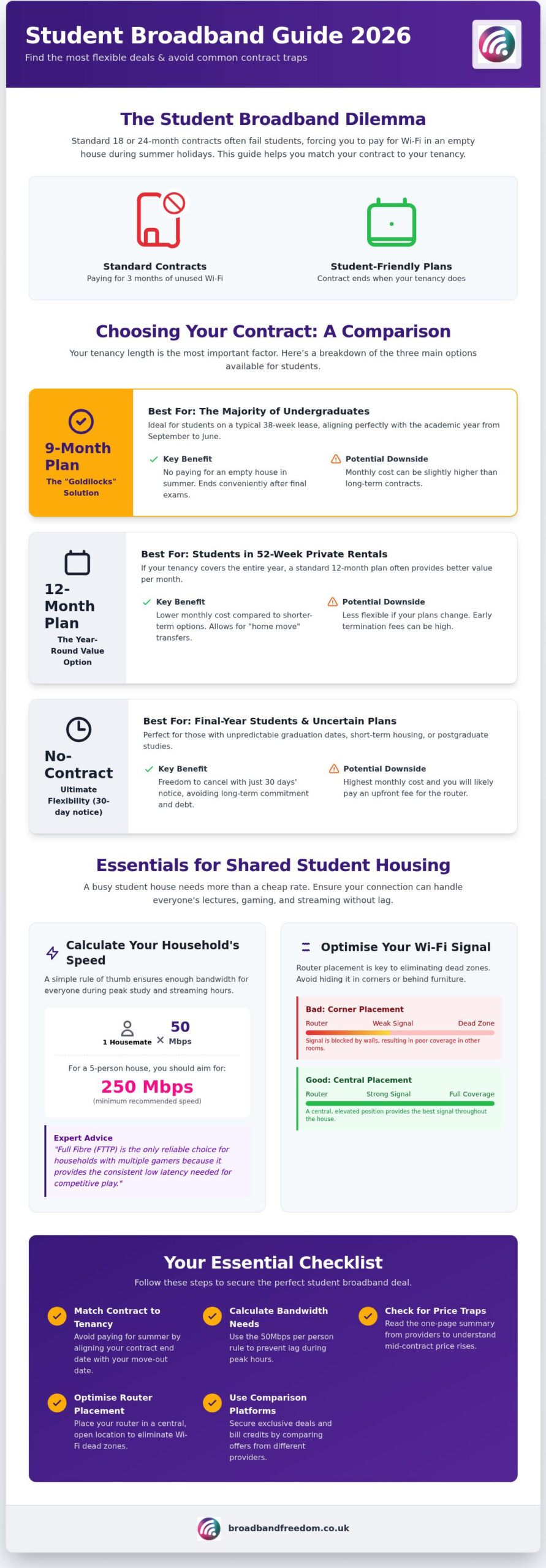
To solve the contract mismatch, many providers now offer 9-month “academic year” plans. These packages align with standard university term dates, typically running from September to June. Whilst the monthly cost may be slightly higher than a standard 24-month deal, the total annual spend is reduced because you aren’t paying for the summer. This pragmatic approach offers the relief of knowing your connection ends exactly when your exams do. You can use our comparison tool to filter specifically for these student-friendly durations.
Comparing 9-Month vs 12-Month and No-Contract Options
Choosing between contract lengths depends entirely on your tenancy duration. If you are on a standard 38-week lease, a 9-month deal is the most efficient choice for broadband for students uk. However, for 52-week private rentals, a standard 12-month plan often provides better value per month. A recent report by the Higher Education Policy Institute (HEPI) highlights that rising accommodation costs make every penny of your utility budget count. Always calculate the total cost of ownership (TCO) over the full term, including activation fees, to see the true financial impact.
Maximising Flexibility with Shorter Terms
If your future living situation is uncertain, prioritise flexibility. Under Ofcom’s general conditions, providers must offer 12-month contracts as the shortest “standard” deals available. If you move, check if your provider allows a “home move” transfer to avoid exit fees. This is particularly important under the Consumer Rights Act 2015, which protects you from unfair contract terms. For those in temporary or short-term housing, exploring no contract broadband allows you to cancel with just 30 days’ notice, preventing you from being locked into a property you have already left.
The Benefits of a 9-Month Academic Contract
A 9-month contract is the “Goldilocks” solution for the majority of UK undergraduates. These deals are specifically timed to expire in June, coinciding with the end of the summer term. Providers like Virgin Media and BT frequently offer these packages with no setup fees for students. Because these plans are tailored to the academic calendar, you won’t need to negotiate a contract exit whilst you are busy with final exams. This specialised broadband for students uk option provides a clean break for your housemate group, ensuring no one is left paying bills when the house is empty.
When to Choose No-Contract Rolling Plans
Rolling monthly plans are the best fit for final-year students or those in short-term postgraduate accommodation. Whilst the monthly cost is typically higher, you avoid long-term debt and potential credit score damage from unpaid summer bills. You will likely pay an upfront cost for the router, but the freedom to leave at any time is invaluable for those with unpredictable graduation dates. Check our compare no contract broadband deals page to see the latest 2026 pricing for these ultra-flexible options that put you in complete control.
Essential Factors for Shared Student Housing WiFi
Shared living requires more than just a cheap monthly rate. A typical five-person household often connects over 15 devices simultaneously, from laptops to smart speakers. This creates immense pressure on your bandwidth. Dr James Miller, a digital infrastructure consultant, states that “Full Fibre (FTTP) is the only reliable choice for households with multiple gamers because it provides the consistent low latency needed for competitive play.” The UK government’s broadband delivery reports highlight that FTTP is becoming the standard for modern digital demands. If you’re organising an internet for shared house setup, prioritising these speeds prevents evening lag during peak study hours.
Calculating the Right Speed for Multiple Devices
Use a simple rule of thumb: aim for 50Mbps per housemate. A four-person house needs at least 200Mbps to handle simultaneous 4K streaming and gaming. Don’t ignore upload speeds; these are vital for Zoom lectures and submitting large files. Whilst most broadband for students uk deals focus on download figures, a low upload speed will cause your video to freeze during seminars. For a deeper look at what these numbers mean, check our guide on internet speed requirements. This ensures you don’t overpay for bandwidth you won’t use or suffer with a connection that’s too slow.
Managing Bills and Avoiding End-of-Term Charges
Victorian terrace houses, common in university towns, often have thick internal brick walls that block Wi-Fi signals. Avoid placing your router in the hallway or tucked behind a sofa. Position it in a central, elevated spot to ensure coverage reaches every bedroom. To manage costs, use bill-splitting apps like Splitwise to ensure everyone pays their fair share on time. Research from Citizens Advice suggests that clear agreements amongst housemates prevent disputes later. On your last day, take a clear photo of the router and its serial number. This evidence protects you from unreturned equipment charges.
Ready to find the perfect speed for your group? Compare shared house broadband deals now.
How to Secure the Best Student Internet Deal Today
Applying for broadband for students uk requires specific documentation. You’ll usually need your university ‘.ac.uk’ email address to unlock exclusive rates. International students should have their passport or Biometric Residence Permit (BRP) ready for credit checks. Many providers offer a “soft” credit check that won’t impact your score. To avoid the frustration of moving into a house without Wi-Fi, book your installation at least 14 to 21 days before your tenancy starts. This window accounts for engineer availability and router delivery times. According to the Consumer Rights Act 2015, providers must ensure all contract terms are fair and transparent.
Using Comparison Tools to Maximise Savings
Smart shoppers use comparison platforms to find added value beyond the monthly price. You can often find hidden perks like bill credits or Amazon vouchers that aren’t available on the provider’s direct site. We recommend browsing our broadband with free gifts page to see which 2026 offers include high-value incentives. Our tool filters through 30+ providers, including the latest student offers from Virgin Media and BT. This saves you from performing the heavy lifting of research yourself. You can quickly compare broadband deals to see which ones offer the best total cost for your specific term dates.
Final Checklist Before Signing Your Agreement
Review the fine print before you commit. Many UK providers implement annual price increases every March or April. For instance, BT prices typically rise by around £4 each March, whilst Onestream increases by £2.75 in April. Verify the “Speed Guarantee” associated with your plan. Under Ofcom’s voluntary code of practice, if your speed drops below a specific level and the provider can’t fix it within 30 days, you may have the right to leave the contract early without penalty. Finally, double-check that your contract end date doesn’t exceed your move-out date to avoid paying for an empty house.
Secure Your Connection for the 2026 Academic Year
Securing the right broadband for students uk is about more than just finding the lowest price. It’s about matching your contract to your actual tenancy and ensuring your connection can handle the demands of a busy shared house. By prioritising flexible 9-month plans or rolling contracts, you avoid the “summer tax” of paying for an empty property whilst you’re away. We’ve explored how understanding your bandwidth needs and verifying contract end dates keeps your budget in check and your Wi-Fi fast.
Frequently Asked Questions
Do I need a student ID to get a student broadband deal?
You typically need a valid university ‘.ac.uk’ email address to verify your status for broadband for students uk. Some providers also accept verification through platforms like Student Beans or Totum. If you don’t have these, you may need to provide a letter of acceptance from your university. This ensures you access exclusive rates not available to the general public.
Can I get broadband for just 9 months in the UK?
Yes, several major UK providers offer 9-month academic year contracts designed to match standard term dates. Virgin Media and BT are well known for these flexible options. These plans allow you to avoid paying for an empty house over the summer. According to Ofcom, all providers must also offer a 12-month contract if requested, which is a useful alternative for longer tenancies.
Who is responsible for the broadband bill in a shared student house?
The individual who signs the agreement is legally responsible for ensuring the bill is paid on time. In a shared house, it’s common for one person to act as the lead tenant, but this carries financial risk if others don’t pay their share. We recommend using bill-splitting apps to manage contributions. Citizens Advice provides guidance on managing shared utility responsibilities to prevent credit score damage.
Is it better to get broadband with or without a landline for students?
Choosing a broadband-only deal is almost always the better option for students. Most modern broadband for students uk packages use SOGEA technology, which delivers fibre without the need for a traditional landline. Since most students rely on mobile phones for calls, paying for a line rental is an unnecessary expense. Removing the landline can often lower your monthly costs and simplify your setup process.
What happens to my broadband contract if I move house during uni?
Most providers allow you to transfer your contract to a new address, but this depends on service availability at the new location. You should contact your provider at least 30 days before moving. Be aware that some companies charge a “moving home” fee. If they can’t provide service at your new flat, you might still be liable for early termination charges unless your agreement follows the Consumer Rights Act 2015 or you’ve chosen a flexible plan.

Article by
Elaine Lang
Elaine has over 20 years across Marketing, Communications and Public Relations in the UK. She has worked across large UK corporations, including Commercial Banks and Airports, to online consumer finance and technology solutions. Elaine has post graduate qualifications in Marketing from the Chartered Institute of Marketing (CIM) and the Industry of Direct Marketing (IDM). She is a lifelong feline fan, sharing her home with around 4-6 cats for many years. This of course can be a challenge when trying to work at home, as they like to try to help!