The Ultimate Checklist for Internet and TV Bundles in 2026

The most expensive way to watch your favourite shows isn’t necessarily a premium subscription; it’s often the hidden cost of managing multiple streaming apps alongside a separate broadband provider. Choosing the right internet and tv bundles has become increasingly complex in 2026, especially with the latest Media Act regulations shifting how we access public service content. You likely feel overwhelmed by the choice between traditional satellite and modern streaming, or perhaps you’re anxious about those fixed pounds and pence price increases arriving every April.
It’s frustrating to feel like you’re paying for channels you never watch just to get the ultrafast speeds you need for 4K streaming. We’ve built this comprehensive checklist to help you reclaim control over your digital household. You’ll learn how to determine if a single monthly bill is truly cost-effective for your specific habits and how to leverage new Ofcom rules to avoid unfair penalties. We’ll break down exactly how to align your content needs with the right fibre speeds so you can enjoy premium sports and cinema at a genuine discount without the usual switching headaches.
Key Takeaways
- Audit your viewing behaviour to determine if you require live broadcast channels or if your household thrives solely on on-demand streaming apps.
- Verify that your connection supports 4K content by matching your entertainment habits with stable Full Fibre speeds to prevent buffering whilst the family is online.
- Compare internet and tv bundles as a strategic financial choice, ensuring the combined cost offers genuine value over paying for separate services.
- Identify hidden contract terms such as fixed annual price rises and equipment ownership rules to avoid unexpected costs at the end of your term.
- Master the “One Touch Switch” process to transition your services simultaneously without the stress of overlapping monthly bills.
Understanding Internet and TV Bundles in the UK Market
The UK media landscape has moved on. A modern bundle isn’t just a phone line and a few extra channels; it’s a high-speed digital ecosystem. Most major providers have now abandoned satellite dish installations in favour of internet-based TV (IPTV). This transition means your viewing experience is now entirely dependent on your broadband stability. If your connection drops, your television goes with it, making the quality of your underlying service more critical than ever.
This industry model is frequently described as a telecommunications triple play. It integrates your internet, television, and telephone services into a single contract. Providers offer these combined deals to increase customer loyalty, often passing on the savings to you through reduced monthly rates. They want to be your sole provider, and they’re willing to discount their premium content to secure that relationship.
Start by checking your local infrastructure. Before committing to any internet and tv bundles, verify if Full Fibre (FTTP) has reached your street. Whilst standard fibre handles HD well, 4K streaming across multiple rooms requires the consistent bandwidth only Full Fibre provides. You can compare the latest broadband with TV packages to find the best technology available at your specific postcode.
The Different Types of Bundles Available
Choose a package that matches your actual viewing behaviour. Broadband and Basic TV bundles typically provide a set-top box for Freeview channels with the ability to pause and record live broadcasts. Premium Entertainment bundles are designed for “box-set” fans, often including Sky Atlantic, HBO content, and integrated Netflix subscriptions. Sports-Centric bundles remain the most popular high-tier option, offering dedicated access to Sky Sports and TNT Sports without the hassle of managing separate third-party billing cycles.
Why Bundling Might Be Better Than Separate Contracts
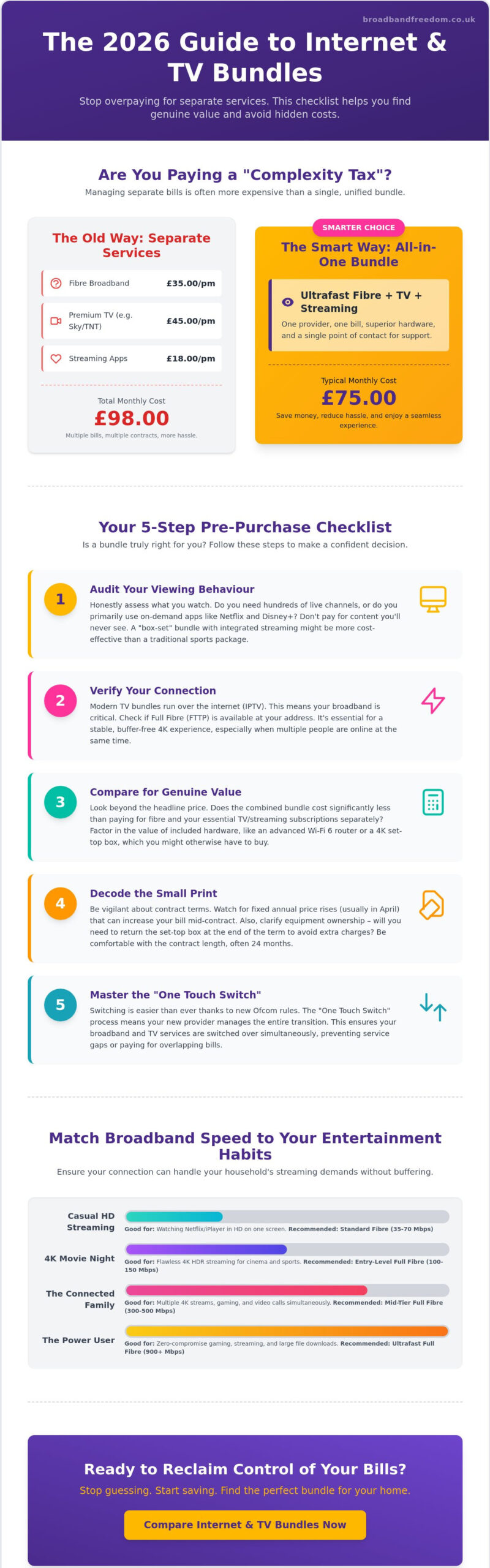
Bundling simplifies your digital life. You deal with one point of contact for technical support and pay one single monthly bill. It’s usually significantly cheaper than subscribing to fibre and multiple streaming apps individually. Beyond the cost savings, you often receive superior hardware. Providers frequently include advanced Wi-Fi 6 routers or 4K set-top boxes in these deals to ensure their content performs at the highest possible standard. It reduces decision fatigue and ensures all your entertainment hardware is designed to work together seamlessly.
The Essential Pre-Purchase Checklist: Is a Bundle Right for You?
Deciding between separate services or internet and tv bundles depends entirely on your daily habits. Most comparison sites simply list the cheapest price, but a deal is only a bargain if you actually use the features included. Start by auditing your household’s viewing behaviour. If you spend your evenings on Netflix or Disney+, a bundle with hundreds of live channels might be an expensive distraction. However, if your family gathers for live sports or terrestrial broadcasts, the convenience of a single interface often outweighs the cost of disparate subscriptions.
Contract length is another critical factor. Many providers offer their best rates on 24-month terms. Whilst this secures a lower price, ensure you’re comfortable with that commitment. Check Ofcom’s guide to saving money to understand how contract checking can prevent you from overpaying once your initial term ends. You should also evaluate your hardware. Modern smart TVs often have built-in apps that remove the need for a separate set-top box, potentially saving you equipment fees.
Step 1: The Content Audit
Be ruthless with your “must-have” list. Do you really need the full cinema package, or just the basic entertainment channels? If different family members want to watch different shows simultaneously, verify if the bundle supports multi-room viewing without hefty surcharges. Some internet and tv bundles now include popular streaming services in the base price, which can simplify your billing significantly. If Netflix is a non-negotiable part of your household’s entertainment diet, exploring broadband with Netflix included could be the most cost-effective way to consolidate your monthly outgoings. Before you sign, compare broadband deals to see how different providers balance content with monthly costs.
Step 2: The Infrastructure Check
Your home’s physical setup dictates your options. By 2026, most TV services run over your internet connection, making a traditional landline increasingly redundant. However, this puts immense pressure on your bandwidth. You should check your current internet speed to ensure it can handle the load. If you have four people streaming 4K content at once, you’ll likely need an Ultrafast Full Fibre connection to avoid frustrating lag. Confirm your property’s compatibility with the latest FTTP technology before finalising any agreement, as this remains the gold standard for high-end entertainment bundles.
Matching Broadband Speed with Your Entertainment Habits
Your broadband speed is the engine room of your entertainment setup. Choosing the right internet and tv bundles means looking beyond the headline price and focusing on raw performance. In 2026, most TV services have transitioned to internet-based delivery. A slow connection doesn’t just cause buffering; it stops your television from working entirely. High-definition content is the baseline, but 4K (Ultra HD) content requires a minimum stable speed of 25Mbps per stream. This figure represents the absolute floor. To avoid stuttering during a tense film or live match, you need a buffer of extra bandwidth to accommodate every other connected device in your home.
Full Fibre plays a vital role here. Unlike older hybrid connections, Full Fibre provides a direct line that doesn’t fluctuate when your neighbours go online. This stability is essential for modern internet and tv bundles, especially when you consider that a typical household now has dozens of connected devices. Upload speeds have also become more relevant. Interactive features, cloud gaming, and video calls all rely on your ability to send data back to the network quickly. A plan with poor upload performance can lead to input lag in games or glitchy interactive menus on your TV box.
Speed Recommendations by Household Type
Single occupants or couples typically find that 100-150Mbps is sufficient for HD bundling. This speed allows for one 4K stream whilst another person browses the web. For average families, 300-500Mbps is the sweet spot. It provides enough capacity for multi-screen entertainment across several rooms simultaneously. If your home is full of power users, gamers, or remote workers, Gigabit (900Mbps+) is the best choice for a future-proof home. It ensures that downloading a massive software update doesn’t ruin someone else’s 4K movie night.
The Impact of Wi-Fi Quality on TV Performance
Even the fastest connection can be ruined by poor signal distribution. A wired Ethernet connection is still king for 4K set-top boxes because it removes the risk of signal interference from thick walls or other electronics. If cables aren’t an option, look for premium providers that include Mesh Wi-Fi systems. These devices work together to create a seamless blanket of coverage throughout your property, which is particularly useful in larger homes amongst regional urban centres. Before you commit, compare latest broadband with TV packages to find high-speed options that include the latest hardware.
Decoding the Small Print: Contracts, Equipment, and Price Hikes
The legal small print shouldn’t be a maze designed to trap you. In 2026, transparency has improved thanks to Ofcom regulations that moved providers away from confusing inflation-linked price rises. When you browse internet and tv bundles, you’ll now see annual increases stated in clear pounds and pence rather than percentages. However, these fixed hikes still impact your wallet every April. For instance, BT, EE, and Virgin Media implemented a £4 per month increase in April 2026, whilst Sky increased broadband costs by £3 with additional TV package rises between £1 and £3.
Ownership of your hardware is another area where many consumers feel misled. You usually don’t own the set-top box or the router provided with your bundle. These are typically leased equipment that must be returned in good condition if you switch providers. Failing to return a 4K box or a high-spec router can result in significant “unreturned equipment” charges. Always check for hidden upfront costs too. Activation fees, delivery charges for your hub, and premiums for professional installation can easily add £50 or more to your first bill.
Calculating the Total Cost of Ownership
Teaser rates are designed to grab your attention, but they only tell half the story. To find the true value, calculate your total expenditure over the full 24-month term, including those scheduled April price jumps. Be wary of “add-on” costs that aren’t included in the base price. Many basic bundles only offer standard definition channels; you might have to pay extra for HD or Ultra HD versions. If you’re a football fan, read our guide on Broadband and Sky Sports Deals 2026 for specific sports cost breakdowns and hidden fees.
Contract Flexibility and Exit Fees
Life changes, but contracts often don’t. If you need to move house, check if your provider can port your services to the new address without restarting your 24-month term. Early exit fees are often calculated based on the months remaining on your deal, which can be prohibitively expensive. If you’re renting or prefer more freedom, compare long-term bundles against no-contract broadband options. Remember that some providers, including Sky, allow a 30-day penalty-free exit window when they notify you of an annual price increase, giving you a vital opportunity to haggle or switch. To see how these costs stack up across the market, you can compare broadband deals and find a plan that fits your budget.
Step-by-Step Guide to Switching Your TV and Internet Provider
Switching your home entertainment setup is no longer the administrative burden it once was. Thanks to the One Touch Switch process, you only need to contact your new provider to get started. They will handle the notification and cancellation with your current company, significantly reducing the complexity of moving between different internet and tv bundles. This system is designed to ensure your services transfer on the same day, preventing the frustration of being without a connection whilst you wait for a new installation. Contact your chosen provider, give them your details, and they will do the heavy lifting for you.
Timing is everything when avoiding double-paying for overlapping service periods. Most providers will align your new start date with your old end date automatically, but it is wise to confirm this during the sign-up process. Once your new service is live, focus on your old hardware. Return your old hub and set-top box immediately using the prepaid labels provided by your previous provider. Major companies now charge significant non-return fees, sometimes exceeding £100, if equipment isn’t sent back within 30 days. Clear your cupboards of old tech to ensure your final bill is exactly what you expect.
The Switching Timeline
- 14-day cooling-off period: Use this time to test the service thoroughly. If the broadband speeds don’t match the guarantee or the TV interface feels clunky, you have the legal right to cancel without penalty.
- Claiming Switching Credit: If your old provider charges an exit fee, many new providers offer “Switching Credit” up to £300. You typically need to send a copy of your final bill to their customer service team to redeem this.
- The Installation Test: Don’t let the engineer leave until you’ve tested the signal in every room. Verify that your 4K content streams without buffering and that your mesh system is correctly configured for maximum coverage.
Final Checklist Before You Commit
Before you sign the digital contract, perform one last audit. Confirm that the channel list includes the specific entertainment or sports programmes you identified during your content audit in section two. Check that the broadband speed is a “guaranteed minimum” for your specific postcode, not just an “up to” average. If you are still undecided, Compare Broadband Deals one last time to ensure that bundling is truly the most cost-effective path for your household’s unique viewing behaviour. Taking five minutes to double-check these details ensures you won’t be trapped in a deal that doesn’t fit your lifestyle.
Take Control of Your Home Entertainment Today
Securing the right digital setup is about more than just finding the lowest price; it’s about matching your household behaviour with the right technology. By auditing your actual viewing habits and verifying Full Fibre availability in your area, you can avoid paying for unused channels whilst ensuring your 4K streams remain buffer-free. Remember to look past the initial teaser rates and account for the fixed pounds and pence price increases that occur every April.
Choosing between the various internet and tv bundles doesn’t have to be a source of anxiety. We’ve performed the heavy lifting by aggregating deals from all major UK providers and offering expert advice on avoiding mid-contract pitfalls. You now have the framework to make a strategic financial decision that simplifies your monthly billing and enhances your viewing experience. Use our dedicated support to find the best Full Fibre options for your postcode.
Find and compare the latest UK Broadband and TV bundles here
You’re now ready to switch with confidence and enjoy a faster, fairer connection on your own terms.
Frequently Asked Questions
Is it really cheaper to get TV and broadband together in 2026?
Yes, bundling is typically more cost-effective than managing separate contracts for your home services. Providers offer a combined discount to encourage loyalty and simplify their own billing processes. You often save a noticeable amount over the full contract term compared to paying for standalone fibre and multiple streaming subscriptions. This approach also reduces administrative stress by consolidating your entertainment costs into a single monthly payment.
Can I get a broadband and TV bundle without a landline?
You can absolutely get a bundle without a landline in 2026. Modern Full Fibre technology allows for data-only connections that support both your internet and television services simultaneously. Most providers have moved away from requiring a traditional copper phone line for their premium packages. This shift helps reduce your monthly costs by removing line rental fees that you don’t actually need for your household behaviour.
Will I need a satellite dish for a modern TV and internet bundle?
You won’t usually need a satellite dish for the latest internet and tv bundles. Most major UK providers have transitioned to internet-based TV (IPTV), delivering all channels and on-demand content through your broadband connection. This makes installation much simpler and avoids the need for external hardware on your property. If you live in a flat or a listed building where dishes are restricted, these modern streaming-based bundles are an ideal solution.
Can I add Netflix or Disney+ to my existing broadband bundle?
Yes, you can integrate popular streaming services directly into your entertainment plan. Most modern packages allow you to add Netflix, Disney+, or other platforms as integrated add-ons to your monthly bill. This often comes at a slightly lower rate than paying the streaming platforms directly. If you want to explore the best options available, our guide to broadband with Netflix included breaks down the top UK deals and potential savings for 2026. Consolidating these apps into your main bundle makes it much easier to track your total entertainment spend every month.
What happens to my TV bundle if my internet goes down?
Your television service will likely stop working if your internet connection fails. Since modern TV boxes rely on your broadband to stream live channels and on-demand content, a total outage affects both services. However, if your box is also connected to a traditional rooftop aerial, you may still be able to watch basic Freeview channels. This highlights why choosing a reliable Full Fibre provider is essential for an uninterrupted viewing experience.
Are there any internet and TV bundles for short-term contracts?
Short-term internet and tv bundles are very difficult to find in the current market. Most providers require an 18-month or 24-month commitment to offset the cost of the provided hardware and installation. If you need total flexibility, your best option is to pair a no-contract broadband plan with individual monthly streaming subscriptions. This allows you to cancel or change your services whenever your circumstances change without facing heavy exit fees.
How much are the typical installation fees for a new TV and fibre bundle?
Installation fees vary significantly between providers and specific deal types. Some companies offer free setup to attract new customers, whilst others may charge an upfront fee for professional engineer visits or hardware delivery. Always check the contract summary for these one-off costs before you sign. These fees are separate from your monthly subscription and are usually taken with your first payment.
Can I keep my current recordings if I switch TV providers?
You cannot transfer recordings between different TV providers. When you switch, you usually have to return your old set-top box, which means losing any shows saved to its physical hard drive. Most cloud-based recordings are also tied to your specific account and will vanish once that contract ends. We recommend finishing your favourite series before your new installation date to avoid missing out on any content.

Article by
Elaine Lang
Elaine has over 20 years across Marketing, Communications and Public Relations in the UK. She has worked across large UK corporations, including Commercial Banks and Airports, to online consumer finance and technology solutions. Elaine has post graduate qualifications in Marketing from the Chartered Institute of Marketing (CIM) and the Industry of Direct Marketing (IDM). She is a lifelong feline fan, sharing her home with around 4-6 cats for many years. This of course can be a challenge when trying to work at home, as they like to try to help!