No Contract Broadband: 2026 Guide to Flexible Rolling Plans

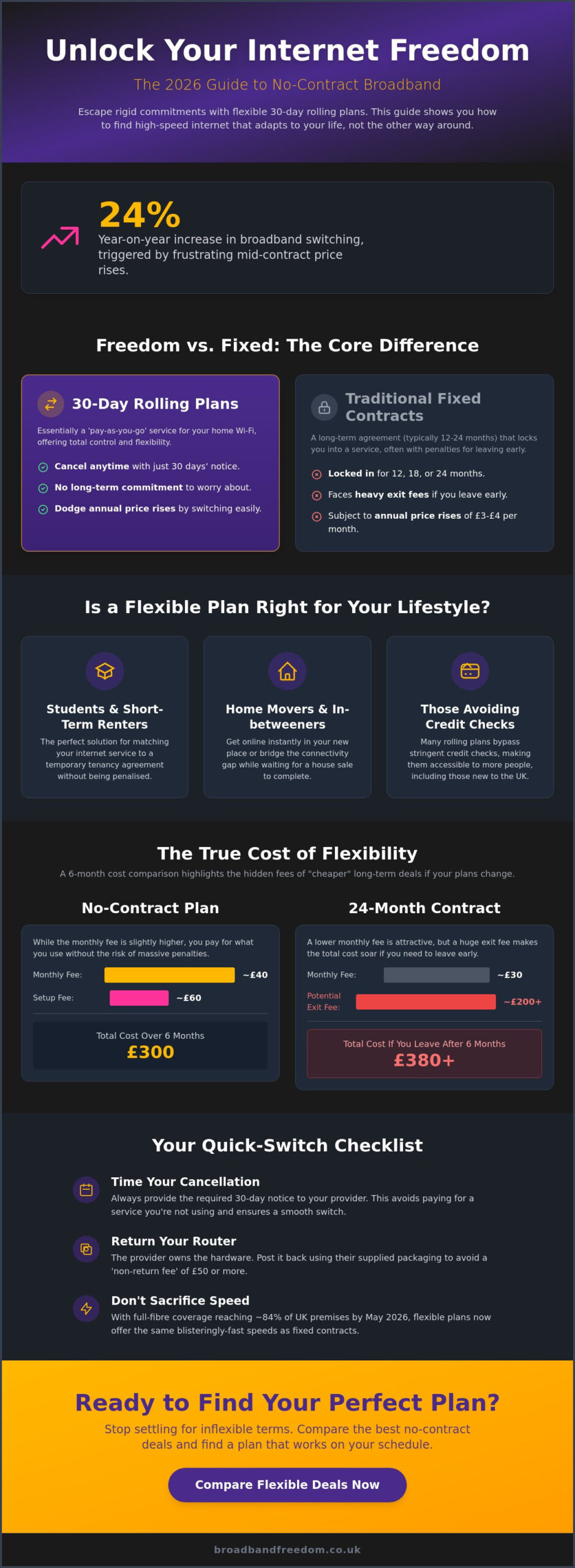
A study in early April 2026 revealed that mid-contract price rises triggered a 24% year-on-year increase in broadband switching. It’s frustrating to feel anchored to a rigid 24-month commitment when your life is in flux. You shouldn’t have to face high early cancellation charges just because you’re moving house or staying in a city for a short term. Finding no contract broadband that fits your lifestyle—essentially internet without contract and flexible broadband—is about reclaiming your autonomy.
We agree that flexibility is a right, not a luxury. You can secure high-speed internet without the long-term baggage of a traditional contract.
This 2026 guide promises to help you find a 30 day rolling broadband plan that offers broadband without credit check options and quick setup for short-term stays. We will break down the latest One Touch Switch regulations and show you how to navigate the current market to find the most adaptable service for your needs.
It’s time to stop settling for provider-defined terms and start choosing internet that works on your schedule.
Key Takeaways
- Learn how 30 day rolling broadband agreements function as a pay as you go broadband service to keep you in total control of your connectivity.
- Understand the trade-off between higher monthly premiums and the liberating freedom to walk away without facing heavy exit fees.
- Discover why no contract broadband is the ideal solution for students, renters, or anyone needing to bypass stringent credit checks, including broadband without credit check routes.
- Master the art of timing your cancellation to avoid overpaying whilst ensuring a seamless transition between properties.
- See how comparing niche providers alongside industry giants can help you find a bespoke deal that matches your specific living arrangements.
What is No Contract Broadband and How Does it Work?
The term "no contract" is a bit of a misnomer in the telecommunications world. When you sign up for no contract broadband , you are still entering a legal agreement with your Internet Service Provider (ISP). The crucial difference is the absence of a long-term minimum commitment. Instead of being locked in for 24 months, you operate on a 30-day rolling basis—also called 30 day rolling broadband. It’s essentially a pay as you go broadband model for your home Wi-Fi that prioritises your freedom over a provider’s balance sheet.
This setup offers a level of liberation that traditional plans simply can’t match. You pay your monthly fee, and the service continues until you decide otherwise. With full-fibre coverage reaching approximately 84% of UK premises by May 2026, these flexible plans now offer the same blistering speeds as their long-term counterparts.
You can choose between standard fibre, which uses older copper lines for the final stretch, or lightning-fast full fibre options. Both are available on rolling terms, meaning you don’t have to sacrifice performance for the sake of flexibility in a truly flexible broadband setup.
The 30-Day Rolling Mechanism Explained
Your billing cycle functions on a monthly renewal pattern. Every 30 days, your plan automatically rolls over for another month. If you need to leave, you simply provide a 30-day notice period. This is a far cry from the rigid 12 or 18-month commitments that often carry eye-watering exit fees. It puts the power back in your hands.
You don’t have to justify your departure; you just give notice and move on. This structure is ideal if you’re waiting for a house sale to complete or if you’re working on a short-term contract in a new city. This kind of 30 day rolling broadband keeps you firmly in control.
Contract-Free vs. Short-Term Contracts
It’s vital to distinguish between a true 30-day rolling plan and a "short-term" fixed contract. Some providers offer 6 or 9-month deals specifically aimed at the student market.
Whilst these are shorter than standard 24-month traps, they are still fixed terms. If you leave early, you’ll likely pay a penalty. A rolling plan is different because it never has an end date. It just keeps going until you say stop.
For those living in temporary accommodation, broadband for renters is a game-changer. It allows you to align your internet service with your tenancy agreement, no matter how brief your stay. If you’re in a shared property, choosing the right internet for shared house setups can make all the difference when multiple housemates are relying on the same connection. If you’re ready to see what’s available without the heavy commitment, you can compare no contract broadband deals to find a plan that respects your need for mobility and autonomy.
The True Cost of Flexibility: Monthly Fees vs Setup Charges
Flexibility can cost more. When you choose no contract broadband, companies risk losing money since you can leave after 30 days. To balance this, the monthly fees are usually higher than those for 24-month contracts. But just looking at the monthly cost is not enough. You should also think about the "Setup Fee." Many providers use this fee to cover equipment and setup costs early on.
In the short-term broadband market in the UK, setup fees can vary a lot. For example, NOW Broadband charges a £60 setup fee for their rolling contracts. On the other hand, Virgin Media has no setup fee if you use their "QuickStart" self-installation kit. If you choose to have an engineer come, it will cost £30.
These setup costs often come with the benefit of being able to leave anytime. Long-term contracts may not have these fees, but they keep you locked in with yearly price increases. In April 2026, many UK providers raised their prices by £3 to £4 each month. By using a rolling plan, you can switch to a different provider whenever a price increase happens, helping to protect your budget from inflation.
Calculating the Total Cost of Ownership
Total Cost of Ownership (TCO) for six months is all your monthly payments plus any fees for signing up, delivery, and setup. You also subtract any rewards or vouchers you have. This method helps you compare deals fairly.
When you check the Best No-Contract Internet Providers, you might notice that a higher monthly fee can be cheaper than a long-term plan with a big exit fee if you leave early. If you only need internet for a few months, paying £40 at first is better than dealing with £200 in cancellation fees later.
Hardware and Router Logistics
Many people get confused about who owns the hardware. Most companies that offer rolling contracts give you a router to use. You have to return it if you cancel the service. If you don’t send it back, you may have to pay a fee that can take away any savings you had. Some people prefer to use their own routers to avoid extra costs, but make sure your provider allows this.
For example, Hyperoptic charges different fees to set up service based on speed. Their 1Gbps plan has a £29 fee, but their 150Mbps plan costs £39 upfront. These fees help pay for the special equipment needed for fast internet. To find the best deal for you, compare different broadband plans based on how much you want to pay upfront and what fits your budget.
Is a 30-Day Rolling Plan Right for Your Lifestyle?
Choosing no contract broadband means you don’t have to make a long-term commitment. It’s a good option for people who need flexibility.
If you have had problems with credit checks before, rolling plans can help. Traditional providers often check your credit closely for long contracts because they are lending you money for the service and equipment over two years. Flexible plans usually have easier requirements, which is helpful for anyone trying to improve their credit score or living temporarily in the UK. These plans feel like pay-as-you-go broadband, but you don’t have to be locked in for a long time.
Another benefit is the "gap filler" strategy. If you are moving to a new home and your chosen full-fibre provider has a long wait for installation, you don’t need to be offline. Choosing no contract broadband can help. It keeps you connected while the workers finish the setup.
If you need an even more immediate solution to stay online during a move, SimOnly Club provides flexible eSIM plans that offer instant mobile data without the need for a physical router.
You can find some of the best no-contract plans that require minimal notice to exit, ensuring you aren’t paying for two services at once.
Broadband for Students and Short-Term Renters
University life runs on a nine-month cycle, yet most big-name providers try to push two-year deals. This mismatch often leaves one unlucky housemate stuck with the bill over the summer holidays. Opting for flexible broadband contracts means you can align your internet with your tenancy. You can simply switch off the service when you move out in June, making short term broadband UK choices straightforward for academic cycles. If you’re sharing with other students, understanding how to manage internet for shared house arrangements—from splitting costs fairly to ensuring enough bandwidth for everyone—can save you significant stress throughout the academic year.
The ‘Trial Run’ Strategy for Full Fibre
Marketing claims about internet speed can be misleading. A rolling plan, or internet without a long contract, lets you try a provider’s service without getting stuck. This is helpful for new homes, where internet may be unstable at first. Before committing, use a full fibre broadband checker to compare the latest broadband deals and find providers that offer a 30-day trial. If the speeds are not good enough, you can leave without losing money and keep your choices open.
How to Organise and Cancel Your No-Contract Deal
Signing up for no contract broadband is simple. You pick your plan, give your address, and choose when you want it to start. Since September 2024, the "One Touch Switch" rule means your new provider talks to your old provider for you. This makes it easier for you. But if you are changing from a rolling plan to a long-term plan, or the other way around, make sure your start date matches your notice period. This way, you can avoid being charged twice for two weeks.
A big benefit of rolling plans is that they give you flexibility during the price increases that happen every April. In April 2026, many providers in the UK raised their prices by £3 to £4. Since you are not locked into a contract, you can leave as soon as you get the notice about the price increase. You are not stuck; you can move on. This option to switch before prices go up helps you keep your budget in check.
The 30-Day Notice Trap
Don’t think that no long-term contract means you can leave right away. Most no contract broadband providers need a full 30 days’ notice to cancel. If you cancel on the 15th, you will still pay for the next 30 days. Set a reminder 35 days before you plan to move or change services. This way, you won’t start a new billing cycle that you don’t want.
Checking Your Real-World Performance
Once your service starts, run an internet speed test in the first week. According to the Ofcom voluntary code, if your speeds are below the "minimum guaranteed" level and the provider doesn’t fix it within 30 days, you can leave without a penalty. T
his data acts as your leverage. It shows if the service you’re paying for meets the advertised promise. If the provider doesn’t deliver, you can use these results to negotiate a better deal elsewhere.
Take care of your hardware. If you can, keep the original box. Most companies will give you a pre-paid envelope to return the router after you cancel. If you don’t send it back within 14 days, you may have to pay a fee that can be more than £50.
Want to manage your internet options? You can compare broadband deals today to find a provider that fits your needs and gives you flexible terms.
Find the Best Flexible Deals with Broadband Freedom
Broadband Freedom helps you find the best broadband options without hassle. We do the research and comparison for you. Our platform makes it easy to find no contract broadband that fits your lifestyle. You won’t need to deal with complex technical details; we focus on what matters to you.
Whether you are a student living with others or a professional on a temporary job, we match the right technology to your needs and offer flexible choices.
We bring together the industry giants and agile niche providers in one place. Whilst the ‘Big Four’ offer reliability, smaller providers often lead the way in adaptable service conditions. Transparency is our North Star. We ensure that "hidden" costs, such as the setup fees from NOW or activation charges from Hyperoptic mentioned earlier, are visible upfront. This clarity prevents the sticker shock often associated with flexible plans. By comparing a variety of providers, you gain a broader perspective on what’s possible beyond the standard 24-month trap.
Why Use a Comparison Service?
Using a special comparison tool is very helpful. You can quickly filter results to see only 1-month and 30-day broadband deals. This saves you from visiting many provider websites. Some good no contract broadband offers may be hidden in menus or only on comparison sites.
Your Path to Internet Autonomy
Getting a flexible plan is not just about avoiding long-term bills. It’s about finding an easy solution for where you live. You should be able to move, change, or cancel without worrying about big fees. This guide shows that flexibility is possible in 2026.
Don’t let a company control your living situation for two years. Take charge of your digital life and pick a plan that fits your needs. Enjoy internet service without a contract that works for you. Start looking now and enjoy the freedom of internet on your own terms.
Reclaim Your Digital Independence
Choosing no contract broadband is a pragmatic step toward total consumer autonomy. You’ve seen how 30-day rolling plans eliminate the anxiety of long-term traps and high exit fees. By prioritising your lifestyle over a provider’s rigid terms, you ensure your internet service remains as agile as your living arrangements. Our independent comparison tool provides a transparent breakdown of setup and monthly costs; this ensures you’re never surprised by hidden charges whilst searching for the best deal.
We have done the work to find the best flexible deals from top UK providers. You don’t have to choose 24-month contracts or worry about price increases anymore. You can now pick a service that offers convenience and freedom. Compare the latest no-contract broadband deals today.
Take the first step toward an easier and more flexible online experience. You are in control now.
About the Author: This guide was prepared by our senior telecommunications researcher, a specialist in UK broadband regulations and consumer advocacy with extensive experience in the digital connectivity sector.

FAQ
Can I get broadband for just one month in the UK?
Yes, you can secure internet for a single month by choosing a 30 day rolling broadband agreement. These plans function on a monthly renewal basis, allowing you to pay for the service as you go—much like pay as you go broadband. It’s an ideal solution for temporary accommodation or whilst you wait for a permanent full-fibre installation in a new property, and it suits short term broadband UK needs.
Is there a credit check for no-contract broadband plans?
Most providers perform a credit check, but rolling plans often have softer requirements than 24-month commitments. Because you aren’t being lent the cost of a long-term service, providers take on less risk. This makes no contract broadband a pragmatic choice for those rebuilding their credit score or residents on temporary visas and, in some cases, opens the door to broadband without credit check options.
Do I have to pay more for a 30-day rolling contract?
Typically, you’ll pay a higher monthly premium for the privilege of flexibility. Long-term contracts are often subsidised because providers are guaranteed your custom for two years. Because month-to-month access resembles pay as you go broadband, you should also expect upfront activation or equipment fees, as providers need to recoup the cost of setting up your connection without a guaranteed stay.
How much notice do I need to give to cancel a no-contract deal?
Standard practice in the UK requires a 30-day notice period to terminate a rolling agreement. Even though you aren’t tied to a long-term term, the billing cycle requires this month-long buffer to close your account. Always set a reminder to give notice at least 30 days before you intend to move out.
Can I get full fibre (FTTP) on a no-contract basis?
Full fibre is widely available on flexible terms, with approximately 84% of UK premises now having access to FTTP as of May 2026. Many providers offer 1Gbps speeds on rolling contracts, ensuring you don’t have to sacrifice performance for autonomy. You can use a full fibre broadband checker to confirm availability at your postcode and enjoy the fastest UK speeds whilst maintaining the freedom to switch.
Will I get a free router with a month-to-month broadband plan?
Hardware policies vary, but many flexible plans require an upfront payment for the router or a delivery fee. Providers are less likely to provide free high-spec equipment if you might leave after a month. Some niche providers allow you to use your own compatible hardware to reduce these initial setup costs.
Is no-contract broadband better for students than a 12-month deal?
A rolling plan is often the most cost-effective choice for the nine-month academic cycle. A standard 12-month deal forces you to pay for the summer months when the property is empty. Choosing a flexible plan allows you to align your internet service precisely with your tenancy agreement, saving you three months of unnecessary bills and supporting short term broadband UK patterns.
What happens to the router when I cancel my rolling contract?
You are usually required to return the equipment within 14 days of your service ending. Most providers lend the router rather than selling it to you. If you fail to post it back using the provided pre-paid envelope, yu’ll likely face a non-return fee that can be significantly higher than the initial delivery cost.
What’s the difference between a true 30-day rolling plan and a 6–9 month "short-term" student contract?
A 30-day rolling plan has no fixed end date and only requires 30 days’ notice to leave, so there are no early termination penalties. A 6–9 month student deal is still a fixed-term contract: leave before the end date and you’ll likely pay exit fees. Rolling plans are open-ended and stop when you say so; short-term contracts are simply shorter versions of standard fixed terms.
How can I avoid paying for two services (double billing) when I switch or move?
Align your 30-day notice with your new start date. Under One Touch Switch (in force since September 2024), your new provider handles the handover—just make sure your chosen start date falls after your 30-day notice ends. Set a reminder 35 days before moving to give notice, and avoid triggering a new monthly cycle you don’t need. Only overlap services if you truly need continuity.
How do setup and activation fees affect the total cost, and what’s the best way to compare deals?
Look at Total Cost of Ownership (TCO) for your actual stay: add monthly charges for your expected months plus activation/delivery/setup fees, then subtract any vouchers or rewards. Example trade-offs from the guide: NOW charges a £60 setup fee on rolling deals; Virgin may waive setup with QuickStart (engineer visit costs £30); Hyperoptic’s activation varies by speed (£29 for 1Gbps vs £39 for 150Mbps). For short stays, a slightly higher monthly price can still be cheaper overall than a "discounted" long-term plan once exit fees are factored in.
Can a rolling plan help me dodge mid‑contract price rises?
Yes. In April 2026, many UK providers raised prices by £3–£4 per month. With a rolling plan, you’re not locked in, so you can leave as soon as you receive a price‑increase notice and switch to a better deal. This agility is a practical way to protect your budget from annual hikes.
What should I do in the first month if speeds don’t match what was promised?
Run speed tests in your first week and keep records. Under Ofcom’s voluntary code, if your service falls below the provider’s minimum guaranteed speed and they can’t fix it within 30 days, you can leave without penalty. Report the issue promptly, get a case reference, and if it isn’t resolved in time, exercise your right to exit—then return any loaned router within the provider’s window to avoid non‑return fees.
Related links
Flexible broadband contracts: Guide to the internet on your terms
Compare no contract broadband deals – fast, flexible, no commitment
What is Rolling Contract Broadband? Pros and Cons
No contract broadband in the UK – the ultimate 2025 guide

Article by
Elaine Lang
Elaine has over 20 years across Marketing, Communications and Public Relations in the UK. She has worked across large UK corporations, including Commercial Banks and Airports, to online consumer finance and technology solutions. Elaine has post graduate qualifications in Marketing from the Chartered Institute of Marketing (CIM) and the Industry of Direct Marketing (IDM). She is a lifelong feline fan, sharing her home with around 4-6 cats for many years. This of course can be a challenge when trying to work at home, as they like to try to help!