Landline Rental Charges Explained: A 2026 Guide to UK Broadband Bills

Why are you still paying over £30 a month for a plastic handset that hasn’t rung in years? It feels like a financial relic, yet as of March 2026, a standard BT line rental costs £31.20 per month. You likely feel frustrated by "all-in" pricing that masks these costs, especially when your mobile handles every conversation. Having landline rental charges explained is the first step toward reclaiming your budget and finding liberation from unnecessary fees. We understand the confusion caused by the industry’s shift toward digital services and the anxiety surrounding the January 31, 2027, PSTN switch-off deadline.
This guide will help you unlock the mystery of your monthly bill and explain why these charges persist in our digital-first world. You will gain a clear understanding of your bill components and the confidence to choose a 2026-ready package that fits your lifestyle. We will look at the transition to Digital Voice and show you how to find broadband-only deals that start from around £19.74 per month. It is time to stop paying for services you don’t need and start managing your connectivity on your terms.
Key Takeaways
- Understand that line rental is an infrastructure fee for maintaining the UK’s digital network, rather than just a charge for a physical handset.
- Get landline rental charges explained to see how your monthly bill funds essential repairs and guaranteed emergency service access.
- Learn how to navigate the transition from analogue to Digital Voice technology ahead of the 2027 national switch-off.
- Identify the “bundle paradox” where adding a phone line can occasionally lower your total monthly cost compared to broadband-only deals.
- Discover how to avoid the “loyalty tax” by comparing flexible 2026 packages that provide broadband on your terms.
Table of Contents
What is Landline Rental and Why is it on Your Bill?
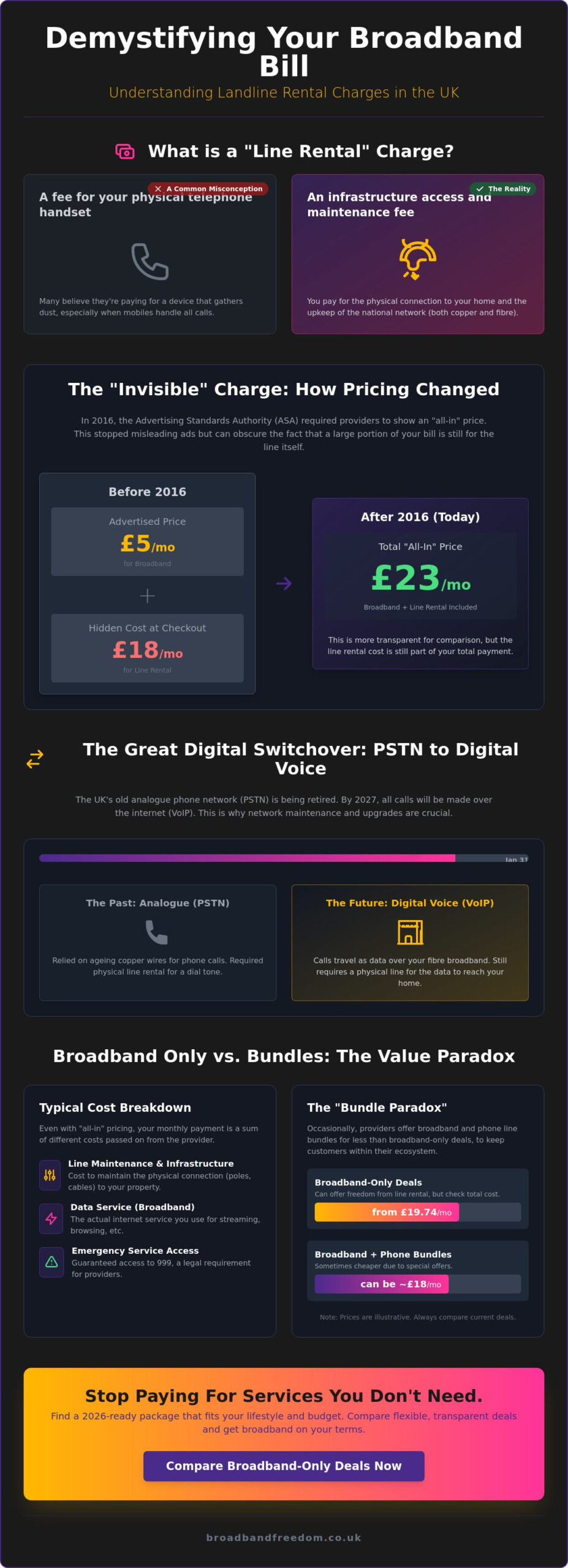
Line rental is an infrastructure access fee rather than a telephone service fee. It is the cost you pay to keep the physical connection to your home alive. To get landline rental charges explained properly, you have to look at the physical wires. Historically, this fee covered the maintenance of the copper network owned by Openreach. It was the price of keeping the history of the UK’s telephone network functioning through wind, rain, and age. Today, the reality is more complex. In 2026, your "line rental" helps fund the maintenance of remaining legacy copper and the rapid expansion of the full fibre network, which aims to reach 25 million premises by December 2026. Even if you never plug in a physical phone, that connection into your wall requires constant upkeep.
The "Invisible" Charge: All-In Pricing Rules
You might notice that your modern broadband quote doesn’t list line rental as a separate item. This is due to rules introduced by the Advertising Standards Authority (ASA) back in 2016. Before this change, providers would advertise "£5 broadband" in big letters, only for customers to find an extra £18 line rental charge added at the checkout. Now, providers must show the total, inclusive monthly cost. Whilst this makes comparing deals easier, it can hide the fact that a significant portion of your bill still goes toward the line itself. Always check the "Price Breakdown" or "Key Facts" document before you sign. This ensures you see exactly how much of your monthly spend is allocated to the infrastructure versus the actual data service.
Who Owns the Lines? Openreach vs. AltNets
Most UK providers, including BT, Sky, and TalkTalk, rely on the Openreach network. They pay a wholesale fee to Openreach to use their cables, which is then passed on to you as part of your monthly bill. However, the rise of "AltNets" (Alternative Networks) has changed the landscape. Companies like Virgin Media or Hyperoptic build and manage their own independent infrastructure. Because they don’t pay Openreach, their internal costs are structured differently. You are still paying for the "line," but the money goes directly toward maintaining their specific fibre or cable network. Having landline rental charges explained in this context helps you understand why prices vary so much between different streets. Your cost often depends on which physical network serves your home. Select a provider that offers the best value for your specific location to ensure you get broadband on your terms.
Why Do We Still Pay for Line Rental in 2026?
It is easy to feel like you are paying for a ghost service. If your mobile handles every call, why does your broadband bill still reflect the cost of a physical line? To have landline rental charges explained, you must look at the physical journey data takes to reach your router. Even as we approach the January 31, 2027, PSTN switch-off deadline, the "last mile" of infrastructure remains. This refers to the final stretch of cable, telegraph poles, and underground ducts that connect the national network to your specific property. Whether that cable carries an analogue dial tone or a high-speed digital signal, it requires constant maintenance to withstand the British weather.
Safety is another major factor. Providers are legally required to ensure you can reach 999 emergency services. This infrastructure isn’t free to run. As of July 2025, there were still 3.2 million customers on the old PSTN network who rely on this physical connection for basic safety. Even if you don’t plug in a handset, you are contributing to the national grid that keeps these essential services accessible for everyone. If you want to see if you can strip away these costs, you should compare the latest fibre deals to find a package that suits your specific needs.
Maintenance Costs in the Fibre Era
Full fibre (FTTP) is often marketed as "maintenance-free," but that isn’t the reality. Whilst fibre-optic cables are more durable than old copper wires, they still require physical upkeep. Engineers must still climb poles and dig up pavements to fix accidental breaks or upgrade local cabinets. In 2026, Openreach is increasing wholesale charges on copper lines to encourage the shift to digital. These costs are often bundled into your monthly price to fund the transition. You aren’t just paying for a dial tone; you are subsidising the upgrade to a faster, more reliable national network.
The Role of Universal Service Obligations
The Universal Service Obligation (USO) remains a critical part of the UK’s telecommunications landscape in 2026. This regulation gives every household the legal right to request a decent broadband connection. Your line rental fees help support this national goal and fund "social tariffs" for vulnerable customers. For example, eligible households can currently access broadband plans ranging from £15 to £23 per month. By paying your standard bill, you are helping to maintain a network that remains affordable and accessible for the entire country, regardless of their financial situation. Having landline rental charges explained through this lens shows that the fee is as much about national connectivity as it is about your individual home connection.
The Digital Voice Switchover: Is the Landline Dying?
The traditional landline is not strictly dying; it is undergoing a radical transformation. We are currently in the final stages of the UK’s move from the old Public Switched Telephone Network (PSTN) to digital technology, often called Voice over Internet Protocol (VoIP). If you have signed up for a new service recently, you likely noticed that your phone now plugs into your router rather than a wall socket. This is "Digital Voice" in action. Because the old copper network is being retired, providers are rebranding their costs. You might see "line rental" disappear from your bill, replaced by "service fees" or "broadband-only" charges. Having landline rental charges explained in the context of this switchover is vital for anyone looking to switch providers. The January 31, 2027, deadline means almost all 2026 connections are now digital-ready.
For businesses, this switchover is equally critical, as older equipment like analogue card terminals will need to be replaced with digital-ready alternatives. To learn more about specialised payment processing and card machines, Shift4 One UK offers modern solutions designed for the hospitality and retail sectors.
Copper vs. Digital Line Rental: What’s the Difference?
The shift from copper to digital changes how your money is spent behind the scenes. Legacy copper lines are high-maintenance and prone to crackling or failure during heavy rain. Digital lines are software-reliant and offer much clearer call quality. However, do not expect your bill to drop significantly just because the technology has changed. Whilst software is cheaper to maintain than physical copper, the initial cost of building the digital infrastructure is massive. You still need a working internet connection to make any landline call. If your broadband goes down, your digital phone goes with it. This is why providers are focusing on network resilience rather than price cuts in 2026.
SOGEA: The Technology Behind Landline-Free Broadband
You might have heard the term SOGEA mentioned during your last contract renewal. It stands for Single Order Generic Ethernet Access. In simple terms, it allows you to buy a broadband connection without a traditional phone service attached. This technology is the reason you can now find competitive ADSL broadband deals or fibre packages that don’t require a phone number. Even with SOGEA, you still pay a "line cost." This is because the physical wire or fibre-optic cable still enters your home. The service is simply "data-only," but the physical pipe that delivers that data remains a billable part of the infrastructure. Understanding this helps you see why landline rental charges explained as "infrastructure fees" makes more sense in a digital world. You are paying for the access, not the dial tone. If you want to explore how technologies like FTTP and SOGEA can help you secure broadband without a phone line whilst ditching unnecessary line rental costs, our dedicated guide covers everything you need to know.
This global shift towards digital-first connectivity is also reflected in the business sector. For organisations looking to modernise their infrastructure, NovaCloud Africa provides business-grade connectivity solutions that prioritise resilience and flexibility over traditional, hardware-heavy setups.
Broadband Only vs. Landline Bundles: Which is Best Value?
Most consumers assume that removing the phone line from their contract will automatically slash their monthly outgoings. Whilst this seems logical, the reality of the 2026 UK market is often more complex. You might encounter what we call the "Bundle Paradox." This is where a provider offers a "Broadband and Phone" package at a lower price than a standalone internet deal. It happens because providers use these bundles to increase customer loyalty, often subsidising the cost of the line to encourage you to take multiple services. Having landline rental charges explained in this context helps you spot when a "deal" is actually a trap. For instance, a Virgin Media bundle in May 2026 starts at £31.99, but you must check if a standalone equivalent offers better value once promotional periods end.
Always calculate the "Total Contract Cost" before signing. This includes any upfront activation fees and the price increase that usually hits after the initial 18 or 24 months. You should also be wary of hidden call connection fees. Even if your line rental is included in the headline price, making a single call could cost you a significant amount per minute if you haven’t opted for a specific call plan. To find the most transparent options for your home, you can compare broadband and phone packages to see the true cost of your connectivity.
When to Choose Broadband Only
Broadband-only deals are the ideal choice for mobile-first households where the landline handset has already been relegated to a junk drawer. If you live in an area with Full Fibre (FTTP) coverage, you are the perfect candidate for a data-only service. These packages offer simplified billing with no "surprise" call charges on your monthly statement. Since Full Fibre doesn’t technically require a traditional phone signal to operate, it is the natural home for those seeking a lean, high-speed connection without the baggage of legacy hardware. For a full breakdown of your options, our guide on broadband without a phone line debunks common myths and helps you identify the best technology for your home in 2026.
When a Landline Bundle Still Makes Sense
Despite the digital shift, bundles still offer genuine value for specific users. Families who regularly make international calls often find that landline add-ons are far cheaper than mobile roaming or international rates. A physical line also remains a vital backup if you live in a "not-spot" with poor mobile reception inside the house. Additionally, "triple play" deals that combine broadband, TV, and phone services often provide the biggest overall savings. If you already pay for a premium TV subscription, adding a phone line as part of a 2026 bundle might actually reduce your total monthly household expenditure.
Getting Broadband on Your Terms: How to Save
Taking control of your monthly outgoings starts with refusing to pay the "loyalty tax." This is the hidden premium you pay simply for staying with the same provider after your initial contract expires. Many UK households find their bills jump by 30% or more once their introductory offer ends. Now that you have had landline rental charges explained, you can use this knowledge as leverage. If your provider is charging you over £30 for a line you don’t use, it is time to act. Savvy consumers in 2026 are increasingly moving toward flexible, no-contract options. These deals are perfect for renters or anyone who values freedom over long-term commitment. You don’t have to be locked into a 24-month cycle just to get a fair price.
Negotiation is a powerful tool. When you call your current provider, mention specific figures. Point out that you know the PSTN switch-off is approaching on January 31, 2027, and that your old copper line shouldn’t command a premium price. If they can’t offer a deal that matches the market’s broadband-only rates, which start from around £19.74, be prepared to walk away. The power is in your hands to find a package that fits your lifestyle on your terms.
Switching to Save: The Process Explained
Changing providers is no longer the headache it used to be. In 2026, the "One Touch Switch" process is the industry standard. This means you only need to contact your new provider to start the move. They will handle the communication with your old company and organise the cancellation of your previous service. This system ensures your internet connection remains active throughout the transition. Just make sure to check your current contract end date first. Timing your switch to coincide with the end of your commitment avoids early exit fees whilst securing the best new-customer rates available.
Finding Your Perfect Package with Broadband Freedom
We act as your expert friend in the complex world of UK telecommunications. We have done the hard work of searching and comparing thousands of deals so you don’t have to. Our tools allow you to filter results by "Broadband Only" or "Full Fibre," ensuring you only see packages that meet your specific needs. Whether you are a student looking for a short-term deal or a family needing a robust bundle, we help you cut through the jargon. Ready to ditch the unnecessary fees? Compare the best broadband and phone packages today and start saving on your monthly bill.
Take Control of Your 2026 Broadband Bill
The mystery of your monthly statement is now solved. You have had landline rental charges explained as a vital contribution to the UK’s evolving digital infrastructure. Whether your home uses legacy copper or the full fibre rollout reaching 25 million premises by December 2026, you are paying for the physical access that keeps you connected. You now know that the "bundle paradox" can sometimes save you money; however, simplicity often lies in data-only deals. Don’t let traditional providers dictate your costs through outdated contracts or hidden fees.
We provide an expert comparison of the UK’s leading providers to give you transparent, no-hype advice. Our service focuses on flexibility and freedom from unfair contracts so you can manage your home setup on your terms. Ready to stop overpaying for services you don’t use? Find the cheapest broadband and phone deals on your terms. Liberate your budget from unnecessary charges and step into the digital future with confidence.
Frequently Asked Questions
Do I still need to pay line rental for full fibre broadband?
Yes, you still pay for the physical connection into your home even with a full fibre service. Whilst there are no copper wires to maintain, the provider must still fund the upkeep of the fibre-optic cables and local exchanges. Most providers now bundle this cost into your monthly headline price rather than listing it as a separate charge on your bill.
Can I get broadband without a landline in 2026?
Yes, you can select broadband-only deals that completely remove the telephone service from your package. These data-only connections are increasingly popular as the UK moves toward the 2027 digital switchover. Prices for these standalone broadband packages currently start from around £19.74 per month for speeds of 10Mbps or higher.
Why has my line rental charge increased mid-contract?
Your bill likely increased due to annual price hikes linked to inflation or changes in wholesale infrastructure costs. Openreach is increasing wholesale charges on copper lines throughout 2026 to encourage the transition to digital services. Most providers also add a set percentage, often 3.9%, on top of the Consumer Price Index (CPI) every April.
What happens to my line rental when the digital switchover is complete?
Once the PSTN network officially shuts down on January 31, 2027, the traditional line rental fee will be fully integrated into your broadband service fee. You will still pay for the physical line that brings data to your property. However, any voice calls you make will travel over the internet via VoIP technology rather than the old analogue network.
Is it cheaper to pay for line rental upfront for a year?
No, the option to pay for a year of line rental in advance has largely disappeared from the UK market. Following the 2016 ASA advertising rules, providers are required to show a single, all-in monthly cost. This change ensures that landline rental charges explained in your contract reflect the total price you pay each month without hidden upfront fees.
What is SOGEA and does it include line rental costs?
SOGEA stands for Single Order Generic Ethernet Access and it does include the cost of the physical line. It is a technology that allows providers to sell you broadband without a traditional phone service. You still pay for the maintenance of the cable entering your home, but the "dial tone" service is deactivated to keep costs lower.
Can I keep my old landline number if I switch to a broadband-only deal?
Yes, you can usually keep your number by porting it to a VoIP provider or a digital phone service. You must request this transfer before your current contract ends to prevent your old number from being disconnected. Many modern providers offer a digital "Virtual Phone" service that allows your old number to work through your internet router.
Do Virgin Media customers pay line rental to Openreach?
No, Virgin Media operates its own independent cable and fibre network and does not use Openreach infrastructure. When you see landline rental charges explained for Virgin Media, the fee supports their own proprietary network of underground cables. This is why Virgin can often offer different bundle prices compared to providers like Sky or BT who rely on the national Openreach grid.
—————————————————
Related Links
How to compare broadband and phone
Phone & Broadband for Pensioners
Call bundling – is it worth it

Article by
Elaine Lang
Elaine has over 20 years across Marketing, Communications and Public Relations in the UK. She has worked across large UK corporations, including Commercial Banks and Airports, to online consumer finance and technology solutions. Elaine has post graduate qualifications in Marketing from the Chartered Institute of Marketing (CIM) and the Industry of Direct Marketing (IDM). She is a lifelong feline fan, sharing her home with around 4-6 cats for many years. This of course can be a challenge when trying to work at home, as they like to try to help!