Flexible Broadband Contracts: The 2026 Guide to Internet on Your Terms

Signing a 24-month internet deal in 2026 is no longer a necessity; it’s a choice that could cost you hundreds in exit fees and rigid price hikes. Finding flexible broadband contracts is the smartest way to maintain total control over your digital life and your monthly budget. You likely feel the frustration of being locked into a service that doesn’t move with you, especially when major providers added up to £4 to monthly bills in April 2026. It’s stressful to worry about high penalties for moving house or changing your mind whilst in temporary accommodation.
We’re here to help you secure high-speed internet on your terms, without the burden of long-term commitment. This guide breaks down the best 30-day rolling deals available right now. We’ll explain how to understand the latest Ofcom "pounds and pence" price regulations and reveal how you can save an average of £183.60 a year by staying agile. Get ready to enjoy full-fibre speeds with the freedom to switch whenever you choose.
Key Takeaways
- Understand why flexible broadband contracts with 30-day notice periods are replacing rigid 24-month terms as the smart choice for UK consumers in 2026.
- Learn how to use the “Exit Fee Equation” to prove why a slightly higher monthly rolling cost often saves you more than a fixed-term deal if your living situation changes.
- Discover why short-term living arrangements, such as student housing or rental tenancies, no longer require you to pay for months of internet you won’t use.
- Identify critical features to watch for, including the difference between 30-day and calendar-month notice periods and hidden router recovery fees.
- See how our curated approach simplifies the market by highlighting providers that prioritise your autonomy and offer broadband on your terms.
Understanding Flexible Broadband Contracts and Why They Matter in 2026
Gone are the days when high-speed internet required a two-year commitment. Today, flexible broadband contracts have redefined how we connect by offering service agreements with a simple 30-day notice period. This shift marks a significant departure from the industry-standard 18 or 24-month lock-in periods that once dominated the UK market. For many, these long-term ties felt less like a service and more like a loyalty trap. Big providers often reward long-term customers with mid-contract price hikes, such as the £3 to £4 monthly increases seen in April 2026. Choosing flexibility means you can walk away whenever your circumstances change without facing the anxiety of extortionate early exit fees.
The emotional relief of finding a simple solution to a complex problem can’t be overstated. You shouldn’t have to feel "analysis paralysis" when looking at a map of providers. Instead, you should feel empowered to pick a service that fits your life right now. With 84% of UK premises now enjoying access to full-fibre technology, the market is competitive enough that you don’t need to trade your freedom for a stable connection. You can secure the speeds you need on your terms, ensuring your digital life remains agile and cost-effective.
Rolling 30-Day Contracts vs. No-Contract Broadband
You’ll often see deals advertised as "no-contract" or "contract-free" whilst searching for options. In legal terms, these are actually monthly rolling agreements. The billing cycle operates every 30 days, giving you the power to cancel or switch at the end of any monthly period. Whilst "contract-free" is a popular search term, every service requires a basic agreement to outline speed guarantees and usage terms. High-speed Broadband internet access is now a utility that should adapt to your life, not the other way around. Most flexible providers will collect their router back if you leave, but you won’t be tethered to a flat you no longer inhabit.
The Rise of Flexibility in the UK Telecoms Sector
By May 2026, UK consumer behaviour has swung firmly towards agility. We’ve seen a surge in "altnets" challenging the big three providers by offering competitive pricing without the 24-month anchor. This change is supported by Ofcom regulations introduced on January 17, 2025, which banned opaque, inflation-linked price rises. Now, any increase must be stated clearly in pounds and pence at the point of sale. This transparency has empowered users to reject rigid terms in favour of deals that respect their financial boundaries. Flexible broadband is a service that prioritises user autonomy over provider security.

The True Cost of Commitment: Comparing Rolling vs Fixed-Term Deals
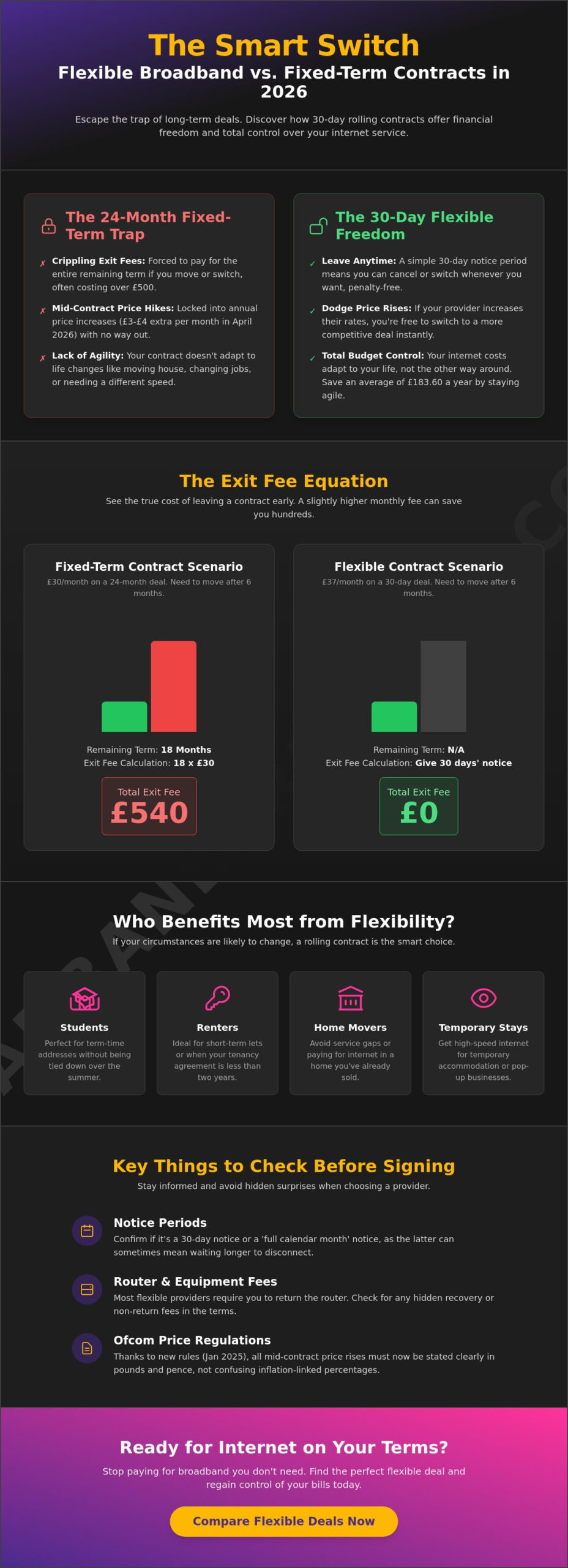
Choosing a rolling deal often feels like paying a premium at first glance. On paper, a standard 60Mbps fibre connection on a 30-day term typically costs between £33 and £40 per month, whilst a 24-month contract might sit closer to £25. However, the headline price is only half the story. You have to consider the "Exit Fee Equation". If you sign a two-year deal at £30 but need to move house after six months, you are usually liable for the remaining 18 months of the term. That could result in a final bill of over £500. In contrast, flexible broadband contracts allow you to stop paying the moment you stop using the service. This transparency eliminates the fear of a massive, unexpected charge hitting your bank account when your life changes.
There is also a psychological weight to long-term contracts that many consumers overlook. Teaser rates look attractive on day one, but they often jump significantly after the initial 12 months. Flexible pricing is honest. You know exactly what you owe every month without hidden penalties or "loyalty" traps. By prioritising your autonomy, you gain the ability to adjust your outgoings based on your current financial situation. This level of control is a powerful tool for maintaining a healthy budget in a fluctuating economy.
Avoiding Mid-Contract Price Hikes
Annual price adjustments are a fact of life for most UK internet users. In April 2026, major providers implemented increases of between £3 and £4 per month. Whilst these are now stated in pounds and pence rather than confusing percentages, they still add up over time. Fixed-term customers are usually forced to accept these hikes or pay a penalty to leave. Flexible users hold the power. If your current provider raises their rates, you can simply compare the latest no-contract deals and switch to a better rate. Monitoring "inflation-proof" rolling deals is much easier when you aren’t tethered to a provider by a legal anchor.
The "Hidden" Costs of Flexibility: Setup and Hardware
You should expect higher upfront costs when avoiding a long-term commitment. Providers often charge setup fees ranging from £0 to over £100 to recoup the cost of hardware and activation quickly. For instance, providers like Rebel Internet may charge up to £100 for a one-month setup. You can minimise these costs by looking for providers that offer "QuickStart" kits or self-install options. Most 30-day deals also require you to return the router when you leave. Failing to do so can result in a "hardware recovery fee", so always keep the original packaging to ensure a smooth exit.
Who Benefits Most from Flexible Broadband Contracts?
While many believe flexible broadband contracts are only for those in a hurry, they actually serve as a strategic tool for a wide range of UK households. In 2026, where the average download speed has climbed to 285 Mbit/s, access to high-quality internet shouldn’t depend on your ability to stay in one place for two years. This agility is particularly vital for the millions of people who find themselves in transitional life stages. Whether you are moving house, studying, or simply want to avoid a credit check hurdle, choosing a rolling deal puts you in the driving seat.
The "Bridge Scenario" is a perfect example of this utility. If you are moving into a new property and waiting for a specific Full Fibre provider to finish their local rollout, you don’t want to sign a 24-month contract with a secondary provider just to stay online. A 30-day deal acts as a "Moving House" bridge. It keeps you connected whilst the engineers complete their work. Once your preferred high-speed service is live, you can switch without paying a penny in termination fees. This approach ensures you never settle for a sub-par connection out of desperation.
For the "Credit Conscious" consumer, flexible deals often offer a smoother path to connectivity. Traditional long-term contracts are viewed by providers as a form of credit, often requiring a stringent check that can be a barrier for some. Many 30-day rolling providers have more relaxed requirements because the financial risk is limited to a single month. This makes it a pragmatic choice for anyone looking to build their credit score or avoid the stress of a formal application process whilst still enjoying reliable fibre speeds.
The Savvy Renter’s Strategy
Renters with 6 or 12-month tenancy agreements face a unique risk with standard contracts. If your tenancy ends and you move to a property where your current provider doesn’t operate, you could be hit with a massive bill for the remaining months. You can avoid this by coordinating your 30-day notice period with your move-out date. Simply call your provider four weeks before you leave to ensure your final bill aligns with your moving day. Broadband for renters on flexible rolling contracts is the favourite choice for UK digital nomads who value the ability to relocate without a digital anchor.
Testing the Waters: Try Before You Buy
With "altnets" now covering a larger portion of the UK, you might be tempted by a new, independent provider in your postcode. Using a flexible contract allows you to test their real-world reliability and customer service without a long-term risk. If the speeds don’t live up to the 285 Mbit/s average, you can leave within 30 days. If the service is excellent, many providers will allow you to transition from a rolling deal to a fixed-term contract later to take advantage of lower monthly rates once you’re satisfied with the performance.
Key Features to Look for in a Flexible Internet Provider
Comparing flexible broadband contracts requires a keen eye for detail beyond the monthly price. Whilst the freedom to leave is the primary draw, the quality of the service determines whether you actually stay. You should start by verifying the exact notice period required to cancel. There is a subtle but significant difference between a provider that asks for "30 days’ notice" and one that requires a "full calendar month". If you give notice on the 2nd of the month with a calendar-month policy, you could be stuck paying for nearly eight weeks instead of four. Always choose providers that offer a strict 30-day window to ensure your exit remains as agile as your entry.
You must also investigate "hidden" exit fees that can sour a no-contract deal. Whilst you won’t pay a penalty for leaving early, some providers charge a "router recovery fee" if you don’t return their hardware within a specific timeframe. Others may attempt to claw back an initial "discounted" setup fee if you leave within the first 90 days. Read the small print to ensure that "no contract" truly means no strings attached. High-quality customer support is equally vital. When you have the power to leave instantly, providers are often more motivated to resolve your issues quickly to keep your custom. Look for companies offering 24/7 UK-based help to ensure any technical glitches don’t disrupt your connection.
Alternative Networks
Alternative networks, or "Altnets", are currently leading the market in 2026 for flexible terms. Independent providers often offer more transparent 30-day deals than the traditional giants. These smaller networks frequently provide "Ultrafast" or "Gigabit" speeds on rolling terms, ensuring you don’t have to sacrifice performance for flexibility. Before you sign up, find the best flexible full fibre deals available in your specific postcode to see which Altnets are challenging the status quo in your area.
Fibre vs. Standard ADSL on Rolling Terms
With 84% of UK premises now covered by full-fibre networks, choosing an old-fashioned ADSL connection is rarely a smart move. Standard ADSL is becoming poor value even for short-term use because the price gap between copper and fibre has narrowed significantly. Even on a 30-day deal, you should demand a "minimum guaranteed speed". If a provider can’t promise to deliver close to the 285 Mbit/s UK average in your area, it’s better to keep looking for a more reliable fibre alternative.
Hardware and Router Flexibility
Check if your chosen provider allows you to use your own router. Some flexible deals allow this, which can save you from paying an upfront hardware fee. If you do use the provider’s equipment, ensure it is a "Plug and Play" model. For short-term users, you don’t want to spend hours configuring complex settings. The best flexible providers send pre-configured routers that get you online within minutes of plugging them in, respecting your time and your need for simplicity.
How Broadband Freedom Helps You Find Internet on Your Terms
Broadband Freedom acts as your savvy, expert friend in an industry that often thrives on confusion. We understand that searching for flexible broadband contracts can feel like a chore, especially when traditional giants hide their best terms behind 24-month anchors. Our mission is to organise the chaos of the UK market, presenting you with clear, actionable choices that respect your lifestyle. We don’t just list deals; we curate them. We favour providers who prioritise consumer autonomy and transparency, ensuring you never feel trapped by a service that no longer serves you.
By May 2026, the number of independent "altnets" has grown significantly, making it harder to track every local offer. We’ve done the hard work of digging through the fine print to identify which providers truly offer "no-contract" freedom versus those with hidden strings. You deserve a partner who values fairness and ease, moving you from inquiry to action as frictionlessly as possible. We focus on the relief of finding a simple solution to a complex problem, so you can stop worrying about your connection and start enjoying it.
The Comparison Advantage
Our platform is built for rapid information processing. Unlike generic comparison sites that focus solely on the "bargain basement" price, we allow you to filter specifically for agility. You can compare broadband deals by selecting your preferred contract length, instantly removing the rigid long-term options that don’t fit your needs. We are committed to total transparency regarding upfront costs. If a provider charges a high setup fee to recoup router expenses, we make sure you see that figure clearly before you click. This structured approach helps you avoid "analysis paralysis" and ensures the deal you select is the deal you actually get.
Your Next Steps to Freedom
Securing internet on your terms is a simple, three-step process designed to respect your time and intelligence. First, enter your postcode into our checker to see exactly which fibre or full-fibre networks are live in your street. Second, use our filters to narrow your search to 30-day rolling agreements. Finally, select the deal that matches your budget and speed requirements. You remain in total control of the switch from start to finish. There’s no need to settle for the "loyalty trap" of the big providers when you can have high-speed reliability without the lock-in. Find your flexible broadband deal today and experience the freedom of a contract that moves with you.
Take Control of Your Connection Today
The UK broadband market in 2026 is built for the agile consumer. You no longer have to settle for the loyalty trap of a 24-month contract that doesn’t fit your life. By choosing flexible broadband contracts, you gain the power to switch providers as your circumstances change; avoiding the stress of exit fees that can exceed £500. You can now leverage the latest Ofcom "pounds and pence" price transparency to ensure your monthly outgoings remain predictable and fair.
We’ve done the hard work of comparing the fine print so you don’t have to. You can compare deals from top UK providers in seconds and access expertly curated lists focused on your need for autonomy. Our platform ensures transparent pricing with no hidden exit fees. This allows you to maintain high fibre speeds without a long-term anchor. It’s time to stop overpaying for commitment and start paying for performance.
Find your perfect flexible broadband deal on your terms and enjoy the digital freedom you deserve.
Frequently Asked Questions
Can I get a 6-month broadband contract in the UK?
True 6-month contracts are extremely rare in the current UK market. Most providers offer either fixed terms of 12, 18, or 24 months, or they provide 30-day rolling agreements. If you only need a connection for half a year, a monthly rolling plan is your most pragmatic choice. It allows you to cancel exactly when you need to without facing the heavy early termination charges found in longer agreements.
Compare our Broadband No-Contract deals today
Is no-contract broadband more expensive than a 24-month deal?
You will typically pay a monthly premium of £5 to £10 for the agility of flexible broadband contracts. For a standard 60Mbps connection, rolling prices usually sit between £33 and £40 compared to the UK average contract cost of £30.84. However, the higher monthly rate is often offset by the lack of exit fees. You avoid the risk of paying out the remainder of a two-year deal if you move early.
Do I need a credit check for a 30-day rolling broadband contract?
Many flexible providers offer deals with more relaxed credit requirements or even no credit check at all. Since the service is paid for monthly and can be cancelled at any time, the financial risk to the provider is significantly lower than a two-year commitment. This makes rolling deals an excellent option for students or international residents who haven’t yet established a deep UK credit history.
How much notice do I need to give to cancel a flexible broadband deal?
The standard notice period for most rolling agreements is exactly 30 days. You should be careful to check if your provider requires a "full calendar month" instead, as this could lead to you paying for extra weeks depending on when you give notice. Providing clear, written notice four weeks before your move-out date is the best way to ensure your final bill is accurate and fair.
Will I get the same speeds on a no-contract deal as a long-term one?
Speed is determined by the infrastructure in your local area rather than the length of your agreement. You can access the same 285 Mbit/s average download speeds on a rolling deal as you would on a 24-month contract. Whether you choose a short-term or long-term plan, the physical connection to your home remains the same, ensuring your streaming and gaming performance never suffers because of your contract choice.
What happens to the router when I cancel my rolling contract?
Most providers require you to return the router once your 30-day notice period ends. They will usually send you a pre-paid postage bag to make this process as frictionless as possible. It is vital to return the equipment promptly; otherwise, you may be charged a "router recovery fee". Keeping the original packaging from the day of installation makes this final step much easier to manage.
Can I get Full Fibre (FTTP) on a flexible contract?
Full Fibre is widely available on flexible terms, with 84% of UK premises now having access to these high-speed networks. Many independent "altnets" lead the market by offering gigabit speeds on rolling 30-day terms to attract customers away from the traditional giants. This means you can enjoy the most advanced internet technology available in the UK without being forced into a restrictive long-term commitment.
Related links

Article by
Elaine Lang
Elaine has over 20 years across Marketing, Communications and Public Relations in the UK. She has worked across large UK corporations, including Commercial Banks and Airports, to online consumer finance and technology solutions. Elaine has post graduate qualifications in Marketing from the Chartered Institute of Marketing (CIM) and the Industry of Direct Marketing (IDM). She is a lifelong feline fan, sharing her home with around 4-6 cats for many years. This of course can be a challenge when trying to work at home, as they like to try to help!