Is It Better to Bundle Broadband and Mobile or Keep Them Separate?
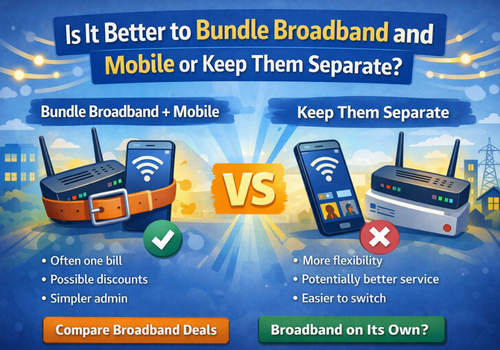
Sometimes bundling makes sense. Sometimes it does not.
That is the honest answer.
If a provider gives you a real discount across both services, the broadband is strong in your area, and the mobile plan genuinely suits your needs, a bundle can be a smart move. But if the home broadband is weaker than local alternatives, your SIM-only plan is already good, or you want more flexibility, keeping them separate is often the better choice. The right answer comes down to total cost, contract length, speed, coverage, and whether the bundle improves both parts of the deal, not just one. A good place to start is Compare Broadband Deals, Broadband Comparison, and Broadband Deals.
Quick comparison table
| Option | Best for | Main advantage | Main downside |
| Bundle broadband and mobile | Homes want convenience and possible discounts | One bill and simpler admin | You may compromise on broadband or mobile quality |
| Keep them separate | Users want flexibility and the best service in each category | More control and easier switching | More than one bill to manage |
| Broadband plus SIM-only | Budget-conscious users who already own their phone | Often cleaner and easier to compare | Bundle discounts may be missed |
| Broadband plus handset contract | Users tied to phone upgrades | Let you choose a stronger home broadband separately | Can become more expensive overall |
When bundling broadband and mobile makes sense
There are clear cases where a broadband and mobile bundle works well.
One bill
For some households, simplicity matters.
One provider. One payment. One account to manage.
That is a real benefit, especially if you do not want broadband and mobile sitting in separate renewal cycles with different providers and different billing dates. If convenience is part of what you value, bundling can feel cleaner and easier to live with. Supporting internal links here include Pricing, Compare Broadband Prices, and Broadband Comparison.
Family plans
Bundles can become more attractive when more than one mobile line is involved.
If a provider offers household discounts, extra SIM savings, or family-friendly billing, that can make the total package more compelling. This is especially true when the broadband is also strong enough for a busy home with lots of connected devices. Good internal reads here include Broadband for Smart Homes UK 2025, Broadband Deals, and Compare Latest Broadband With TV Packages.
Existing customer discounts
This is one of the few times a bundle can create obvious value quickly.
If you already use a provider for mobile or broadband and they offer a worthwhile discount on the other service, it may be worth considering. The important phrase there is worthwhile. Not every “existing customer” deal is genuinely better than what you could get elsewhere.
It is always worth checking the wider market through Compare Broadband Deals, Best Broadband Deals, and Broadband Deals Today’s Best Deals.
SIM-only users
This is often the cleanest type of bundle.
If you already own your phone and use a SIM-only plan, the mobile side is easier to compare. That makes it much clearer whether the bundle is actually saving you money or just packaging two average deals together. For readers weighing this up, Mobile Broadband Deals in the UK: A Complete Comparison Guide, Cheap Broadband Deals, and Broadband Deals are natural supporting pages.
When separate contracts are smarter
This is often the better answer than people expect.
Stronger local fibre elsewhere
A provider might have a good mobile offer but weaker home broadband in your area.
That is one of the biggest reasons not to bundle. The mobile side may look appealing, but if another provider offers better fibre, faster speeds, or stronger reliability at your address, separating the services can make much more sense.
Before committing to any bundle, check what is actually available where you live using Broadband Availability Checker, Best UK Broadband Coverage Map: Internet in My Area, and Broadband Coverage Map UK: Find the Best ISP.
Flexible renters
If you rent, move often, or just do not want to be locked in, separate contracts can give you much more control. A bundle may look tidy, but tidy is not always flexible.
Relevant internal links here include No Contract Broadband, Compare 1 Month Rolling Broadband, Rolling Monthly Broadband Renters 2025, and Broadband Contract Lengths Explained.
Users are already on a good SIM-only deal
If your mobile plan is already strong, bundling can actually make things worse.
This happens when users already have a cheap SIM-only contract with enough data and good coverage, then move into a bundle that reduces flexibility without adding enough value. In that case, it is often smarter to keep the mobile deal as it is and focus on getting the best home broadband separately through Compare Broadband Deals, Best Broadband Deals, and Broadband Comparison.
People are avoiding long lock-ins
Broadband and mobile do not always belong on the same timeline.
You may want to change your phone sooner than your broadband. Or switch broadband because a better fibre option becomes available in your area. Bundling can make that harder. If avoiding long commitments matters, separate contracts often give you more breathing room. Useful internal reads here include 1 Month vs 12 Month Broadband Contracts: What’s the Real Cost?, Compare 12 Month Broadband Packages, and Compare 24 Month Broadband Packages.
What to compare before choosing
This is where the decision gets real.
Total contract cost
Do not just compare the monthly headline number.
Look at the full cost across the term. That means factoring in:
- broadband monthly cost
- mobile monthly cost
- any handset payment
- setup fees
- price rises
- any reward or introductory credit
This is the quickest way to see whether the bundle is genuinely competitive. Good supporting links here include Pricing, Compare Broadband Prices, and Broadband Price Rises and Exit Fees.
Handset vs SIM-only
This changes the whole comparison.
If the mobile side includes a handset, the bundle may look stronger than it really is because the phone cost is blended into the monthly number. SIM-only is usually easier to judge. That is why many of the best mobile and broadband deals uk readers should consider are the ones built around SIM-only rather than bundled handset upgrades.
Broadband speed
The home internet still matters most for most homes.
Before choosing any bundle, ask whether the broadband is strong enough for your actual usage. Good internal pages to support that check include Broadband Speed Comparison, Internet Speed, Broadband Speed Test, and Full Fibre vs Standard Fibre vs ADSL.
Mobile coverage
A strong package on paper is no good if coverage is weak where you actually live and work. That is one reason why many users searching for bundle broadband and mobile or separate deals should not rush into a combined deal just because it sounds efficient.
Contract length
Always check how long you are tied in for. If the broadband and mobile commitments do not suit your real plans, the bundle can quickly become frustrating rather than helpful. Supporting reads include Broadband Contract Lengths Explained, Compare 1 Month Rolling Broadband, and No Contract Broadband in the UK: The Ultimate 2025 Guide.
Quick pros and cons
This is the simplest summary.
Bundling broadband and mobile: pros
- one bill
- easier admin
- can unlock discounts
- can work well for families
- often cleaner for SIM-only users
Bundling broadband and mobile: cons
- may compromise on broadband quality
- may lock you in too long
- weaker local fibre may be overlooked
- mobile side may not be as competitive as your existing plan
- handset bundles can hide true value
Keeping them separate: pros
- more flexibility
- easier to choose the best broadband for your address
- easier to keep a strong SIM-only deal
- cleaner switching later
Keeping them separate: cons
- more than one provider
- more than one bill
- no bundle discount if one is available
FAQs
For broader help, readers can also visit Broadband Freedom’s FAQ page.
Is bundling cheaper?
Sometimes, but not always. A bundle is only cheaper if the discount is real and both services are still competitive on their own merits. If the broadband is weaker locally or the mobile part is worse than your existing plan, the bundle may not be a better value overall.
Can I bundle broadband with a SIM-only plan?
Yes, and that is often the cleanest type of bundle. SIM-only makes it easier to see whether the provider is offering genuine value because the phone cost is not wrapped into the deal. That can make comparison much simpler than handset-based bundles.
Are bundles harder to switch?
They can be. Not always, but they often create more dependency between services. If broadband and mobile are tied together, one part may stop you from changing the other as easily. That is why contract timing matters so much when deciding whether to bundle.
Do bundles include better perks?
Sometimes they do. Some providers offer extra SIM discounts, Wi-Fi perks, or account benefits for bundling. But perks should be treated as extras, not as the main reason to choose the deal. The real value still comes from cost, coverage, speed, and flexibility.
Final takeaway
So, is it better to bundle broadband and mobile?
Only when the bundle improves both sides of the deal.
If you can get a real discount, the broadband is good in your area, the mobile plan suits your needs, and the contract length feels right, bundling can work very well. But if you already have a strong SIM-only deal, need flexibility, or can get better local fibre elsewhere, separate contracts are often the smarter move.
That is the real test.
Before deciding, compare:
- total contract cost
- handset vs SIM-only structure
- broadband speed
- local coverage
- contract length and switching flexibility
For next steps, start with Compare Broadband Deals, review Broadband Comparison, and sense-check the broadband side through Broadband Availability Checker before deciding whether the bundle is truly worth it.