Is Full Fibre Worth It? Debunking Myths and Analysing Value in 2026

The traditional copper phone network is entering its final months of service; the retirement process is expected to conclude by the end of 2026. This shift forces a vital question for millions of households: is full fibre worth it, or should you stick with your current connection? You’re likely tired of buffering during peak evening hours or dealing with unreliable connections that drop exactly when an important video call starts. It’s frustrating to feel like you’re paying for performance that doesn’t deliver when you need it most.
We’ll help you cut through the jargon of FTTP versus FTTC to discover the honest truth about this upgrade. According to an Ofcom report published on 13 May 2026, full fibre now reaches 82% of UK premises, yet only 12.4 million households have actually upgraded. This guide analyses the genuine value of modern connections and the progress of the UK government’s Project Gigabit. You’ll learn how to future-proof your home office and identify the best price-to-performance ratio for your budget.
Key Takeaways
- Identify the structural differences between FTTP and FTTC to avoid paying for outdated copper technology often marketed as “fibre”.
- Master the “Reliability Premium” to eliminate buffering during the 7pm-9pm peak, regardless of how many devices are connected in your home.
- Compare modern price-to-performance ratios to see why upgrading to a faster connection could actually lower your monthly cost per Mbps.
- Use our household checklist to determine if is full fibre worth it for your specific lifestyle, budget, and remote working requirements.
Breaking Down the Full Fibre Myth: Speed vs Real-World Value
2026 marks the definitive end of the UK’s reliance on Victorian-era infrastructure. The traditional copper network is being phased out, with the retirement process expected to be in its final stages by the end of the year. This transition makes the question of whether is full fibre worth it a matter of necessity rather than just a luxury. Many providers still sell “fibre” deals that actually use old copper wires for the final part of the journey. This “part-fibre” setup is the primary reason your connection might struggle during peak hours whilst your neighbours enjoy seamless streaming.
The Difference Between Fibre and Full Fibre
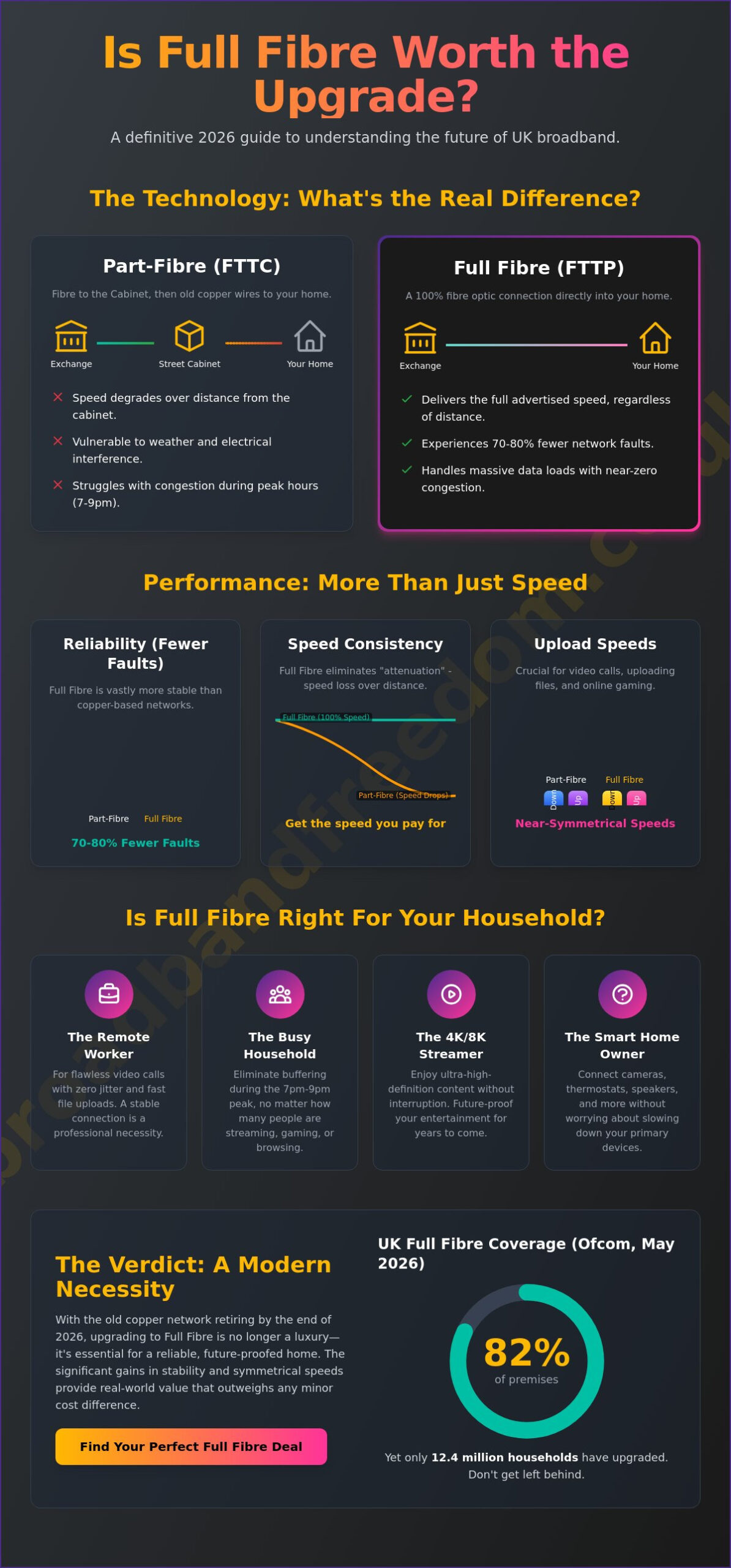
Understanding the technical differences between fibre connections is essential to avoid marketing traps. Standard fibre (FTTC) only brings the fast cable to the green cabinet on your street. From there, it relies on metal wires that are prone to interference and weather damage. Full fibre (FTTP) delivers a 100% glass connection directly into your home. “Light-based transmission is inherently more efficient because it doesn’t generate heat or encounter the electrical resistance found in copper,” explains one industry infrastructure expert. This structural change results in 70% to 80% fewer faults across the network.
Why 100Mbps on Full Fibre is Better Than 100Mbps on Copper
Headline speeds can be deceptive because copper connections suffer from a phenomenon called attenuation. Attenuation is the physical loss of signal strength as data travels through a copper wire; it causes speeds to drop significantly the further your home sits from the local exchange. Full fibre eliminates this distance-based slowdown. When you compare internet speed, a 100Mbps full fibre line delivers that full capacity regardless of your location. This reliability is exactly why is full fibre worth it for anyone working from home or managing a busy household. It provides a stable foundation that copper simply cannot match.
Why Reliability and Latency Outweigh Raw Megabits for UK Homes
Speed is often the only metric people consider when asking is full fibre worth it, but raw megabits only tell half the story. The real test of a connection happens during the 7pm to 9pm peak period when your entire street is online. Older copper-based networks often struggle with “congestion,” leading to those annoying pauses in your Netflix stream. Full fibre solves this through a “Reliability Premium.” Because the network is 100% glass, it experiences 70% to 80% fewer faults than copper. You can benchmark your current performance using our Broadband Speed Test to see if your line is actually delivering its promised capacity.
The Work-From-Home Advantage
Remote working has changed the requirements of a domestic connection. Whilst download speed is vital for watching video, upload speed is what keeps your video calls clear. Full fibre often provides symmetrical or near-symmetrical upload speeds, which drastically reduces “jitter.” Jitter is the variance in the time it takes for data packets to arrive; high jitter causes frozen screens and robotic audio during Zoom or Teams calls. “Latency is the true measure of a quality connection for the modern home office,” notes one network engineer. A stable connection ensures your professional presence remains uninterrupted, even when other people in the house are gaming or streaming in other rooms.
Future-Proofing for 2026 and Beyond
Our homes are becoming increasingly complex, with smart thermostats, security cameras, and multiple 4K devices competing for bandwidth. An industry analysis of fibre costs and infrastructure trends suggests that by the end of 2026, standard copper lines will no longer support the data demands of the average UK household. Upgrading now prevents the “bandwidth hog” effect, where one person downloading a large file slows down every other device. If you want a connection that handles 8K streaming and intensive smart home setups without breaking a sweat, it’s time to act. You can browse the latest Full Fibre Broadband Deals to find a package that matches your household’s specific needs.
Analysing the Cost: Is Full Fibre More Expensive in 2026?
Many consumers assume that high-speed technology carries a high-speed price tag. In reality, the price-to-performance ratio has shifted. Full fibre now often offers better value per Mbps than older “part-fibre” connections. Ofcom’s data from May 2026 confirms that 82% of UK homes now have access to these services, sparking fierce competition. “The market has reached a point where gigabit-capable speeds are priced similarly to older, slower products to incentivise migration,” says one industry analyst. You can Compare Broadband Deals to see how entry-level full fibre now matches or beats the cost of outdated plans, while resources like Internet and Wireless Deals illustrate the variety of promotional packages available in the wider fibre market.
The 2026 copper switch-off makes sticking with standard fibre a financial risk. Maintenance costs for the old network are rising; these costs are often passed to the consumer. Local authorities highlight the Benefits of upgrading to full-fibre, noting that it’s a vital utility upgrade for modern living. Staying on old tech won’t just be slower; it’ll be a poor investment as support for those lines dwindles.
Installation Costs and What to Expect
Installation anxiety is common, but the process is straightforward. An engineer typically takes about two hours to install an Optical Network Terminal (ONT) box inside your home. Most providers currently offer free installation to encourage the national migration away from copper. This removal of upfront costs makes the question of is full fibre worth it much easier to answer for budget-conscious households. You don’t need to worry about complex hardware sales; the focus is entirely on getting your home connected to the modern grid.
Hidden Savings: Reliability and Productivity
Think about the hidden costs of a poor connection. For a freelancer or remote worker, an hour of downtime during a deadline can cost significantly more than a monthly broadband bill. A stable connection reduces the need for expensive mobile data backups or “emergency” tethering when your line drops. Reliability isn’t just a technical metric; it’s a financial safeguard. In the same way that stable connectivity supports your work, Gemba provides a reliable banking infrastructure layer for businesses wanting to launch their own financial services. You can secure your home office today and stop overpaying for legacy technology by browsing the latest Full Fibre Broadband Deals.
The Verdict: Should You Upgrade to Full Fibre Today?
The answer to whether is full fibre worth it depends on your household’s digital behaviour. For homes with three or more active users or remote workers, the upgrade is a definitive yes. You require the stability to handle simultaneous video calls and high-definition streaming without the frustration of buffering. If you’re a single occupant who only browses social media, you might feel less urgency. However, with the copper network retirement accelerating, everyone should use our Full Fibre Broadband Checker to see if their property is ready for the future.
The “Who Is It For?” Checklist
Pragmatic decision-making starts with assessing your daily requirements. Full fibre is the logical choice if you regularly engage in the following:
- Gaming: Achieve the lowest possible ping for a competitive edge.
- 4K/8K Streaming: Enjoy crystal-clear visuals without interruptions.
- Multi-user households: Maintain speed even when every device is active.
- Home Office: Guarantee a professional connection for client calls.
Even for light users, there is a clear benefit to property value. A research briefing from the House of Commons Library highlights that the government’s Project Gigabit aims for 99% coverage by 2032. Installing this infrastructure now makes your home more attractive to future buyers who view high-speed internet as a non-negotiable utility. If full fibre isn’t yet available at your address, our guide on why you can’t get fibre broadband and what to do about it explains the specific technical barriers and how to check your availability using postcode and landline tools.
How to Switch Without the Stress
Switching providers is no longer the complex chore it used to be. The “One Touch Switch” process, fully active in 2026, allows your new provider to manage the entire migration. They will contact your old supplier and organise the transfer, preventing any overlap in billing. Transparency has also improved; Ofcom regulations now require providers to state any annual price increases in clear “pounds and pence” rather than confusing inflation-linked percentages. You can Compare Broadband Deals today to find a package that fits your lifestyle and budget perfectly.
Take Control of Your Digital Future Today
The transition from ageing copper wires to light-based glass strands is the most effective way to eliminate evening buffering and secure your home office. While peak speeds capture the headlines, the real value lies in the reliability and consistent performance that full fibre provides during the busiest hours of the day. With 82% of UK residential premises now having access to these services according to Ofcom data from May 2026, the infrastructure is ready to support your lifestyle. Deciding is full fibre worth it comes down to your need for a stable, high-performance connection that won’t let you down.
We’ve performed the heavy lifting by providing a transparent comparison of the UK’s leading network providers. Our expert support is available to help you navigate the switching process and find the best introductory rates without the stress. Don’t wait for the copper network to fail; take the proactive step toward a more reliable digital life. Compare the best Full Fibre deals available in your area today and enjoy the relief of a connection that just works.
Frequently Asked Questions
Is full fibre broadband more expensive than standard fibre?
Full fibre is no longer a premium-priced luxury. Market competition in 2026 has driven the cost of entry-level FTTP down to match or even undercut older FTTC plans. Determining is full fibre worth it often comes down to cost, and you’ll find that many providers offer these high-speed connections at the same monthly rate as standard fibre to encourage customers to leave the retiring copper network. Always check current deals to ensure you aren’t paying a “loyalty penalty” on an outdated copper contract.
Do I need a new router if I upgrade to full fibre?
You will usually receive a new, compatible router from your provider when you upgrade. Standard routers used for copper connections don’t have the necessary ports to connect directly to the Optical Network Terminal (ONT) box installed on your wall. This new hardware is specifically designed to handle gigabit speeds and provide better Wi-Fi coverage across your home. Your provider handles this as part of the setup; it ensures your home network is fully optimised for the new connection.
Will full fibre work with my existing landline phone?
Your landline will continue to work, but it will connect through your router using Digital Voice technology. The traditional copper phone network is being phased out across the UK by the end of 2026, meaning all home phones will eventually transition to an internet-based service. You can read more about the UK transition from analogue to digital landlines on the official government website. You can usually keep your existing handset and phone number, though you might need a small adapter.
How long does it take to install full fibre in a UK home?
Most UK home installations are completed within a two to three-hour window by a professional engineer. The process involves running a new fibre optic cable from the street to your property and installing an internal ONT box. “The physical rollout has become highly efficient, with engineers now able to complete the majority of residential connections in a single morning visit,” notes a 2026 infrastructure report. This quick setup minimises disruption to your daily routine while providing a permanent upgrade to your home’s connectivity.
Can I get full fibre if I live in a flat or rented property?
Full fibre is available to 82% of UK homes, including millions of flats and rented apartments. If you live in a multi-dwelling unit, the building often requires a block-wide installation before individual flats can connect. When asking is full fibre worth it for renters, consider that it provides a stable connection for working from home without permanent structural changes. According to Ofcom data, infrastructure providers are prioritising urban centres to reach as many tenants as possible. If you’re still unable to access full fibre at your address, our detailed guide on why fibre broadband isn’t available at your property and how to check your options can help you identify the specific barriers and viable alternatives in your area.

Article by
Elaine Lang
Elaine has over 20 years' experience in Marketing, Communications, and Public Relations within the UK. She has worked for large UK corporations, including Commercial Banks and Airports, as well as for online consumer finance and technology solutions. Elaine holds postgraduate qualifications in Marketing from the Chartered Institute of Marketing (CIM) and the Institute of Direct Marketing (IDM). She is a lifelong feline fan, having shared her home with around 4-6 cats for many years. This, of course, can be a challenge when attempting to work from home, as they often like to 'help'!