Full Fibre Broadband Checker: Find the Best FTTP Deals in 2026

Did you know that 84.33% of UK premises now have access to full fibre broadband, yet millions of households are still stuck on outdated, copper-based connections? It’s frustrating to pay for “superfast” internet that lags during a work call or drops out just as a game reaches its climax. You’re likely tired of confusing jargon and the annual dread of mid-contract price hikes that seem to appear out of nowhere. Using a reliable full fibre broadband checker is the first step toward reclaiming control over your home connectivity.
We agree that finding a better deal should be simple, not a research project. This article promises to show you exactly how to use a checker to identify the fastest FTTP providers at your specific postcode whilst avoiding the traps of hidden fees. You’ll discover how to navigate the 2026 market with confidence, ensuring you benefit from the latest Ofcom protections that mandate fixed-pound price increases instead of unpredictable percentages. We’ll guide you through the “One Touch Switch” process to make your upgrade as frictionless as possible.
Key Takeaways
- Distinguish between “Fibre” and “Full Fibre” to ensure your home is connected via a modern, reliable end-to-end fibre optic network.
- Use a full fibre broadband checker to search both national and independent network databases for the fastest speeds available at your specific postcode.
- Protect your monthly budget by identifying providers that commit to transparent, fixed-pound price increases rather than unpredictable inflation-linked hikes.
- Prioritise overall value by looking for “New Customer Only” perks and high-quality router hardware that supports stable WFH and gaming.
- Utilise the “One Touch Switch” process for a frictionless transition to a better provider without the usual administrative stress.
What is a Full Fibre Broadband Checker and Why Use One?
A full fibre broadband checker is a specialised digital tool designed to bridge the gap between marketing promises and technical reality. Instead of guessing what speeds you might receive, these checkers query live network databases to confirm exactly which cables are physically connected to your property. With UK full fibre availability reaching 84.33% in May 2026, using a checker is the only way to ensure you aren’t paying for “superfast” prices whilst receiving outdated, copper-based service. It empowers you to make a choice based on hard data rather than provider generalisations.
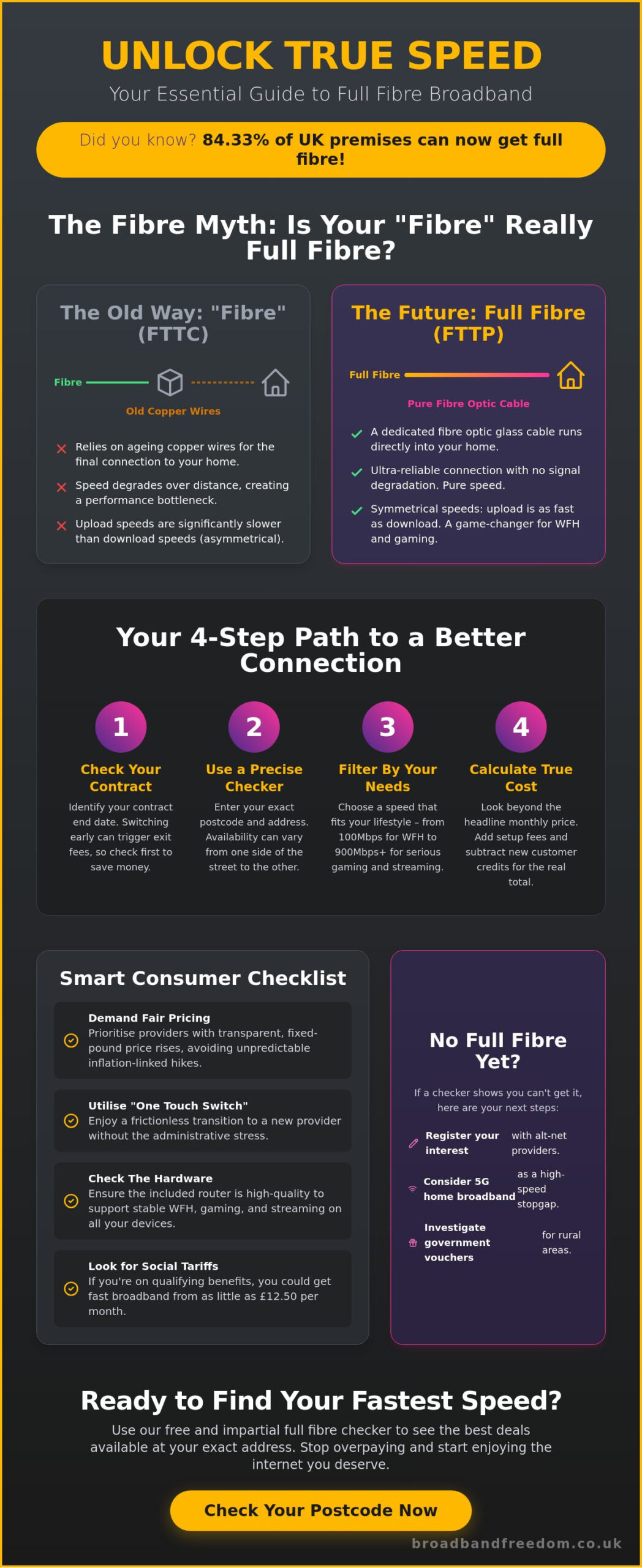
The distinction between standard fibre and full fibre is vital for your home setup. Most “fibre” connections in the UK are actually Fibre to the Cabinet (FTTC), which relies on aging copper wires for the final leg of the journey. This often leads to signal degradation and slower speeds. In contrast, Full Fibre, or Fibre to the Premises (FTTP), uses a dedicated glass connection directly into your home. You can explore the technical nuances of these different Fiber to the x (FTTx) configurations to understand why the physical medium matters so much for stability and speed. By 2026, the UK has reached a point where most households can finally move away from these legacy copper limitations.
The Technology Behind the Search
Full Fibre is a complete infrastructure upgrade. By replacing copper with glass, providers offer “symmetrical” speeds where your upload is as fast as your download. This is a Full Fibre exclusive. It’s a massive benefit for anyone who uploads large files for work or hosts live gaming streams. Moving to a dedicated FTTP line eliminates the bandwidth sharing that causes sluggish performance during peak hours, providing a private lane for your data.
Why Postcode Accuracy Matters
Broadband availability is a digital lottery. One side of your street might have gigabit speeds whilst the other is stuck on copper. This depends on the location of Distribution Points (DPs), the hubs where the network branches to homes. Always select your exact address from the dropdown menu, particularly for new builds where records may lag. Once confirmed, compare broadband deals to secure the best package for your specific property.
How to Use a Full Fibre Checker to Find Your Best Deal
Finding a better connection starts with a clear plan. Don’t rush into a new agreement without knowing your current status. First, identify your existing contract end date. Leaving a provider early can trigger significant exit fees that often negate any potential savings. Once you’re within your switching window, use a full fibre broadband checker to see exactly which networks have reached your front door. Always select your specific house number from the dropdown menu. This ensures the results reflect the physical infrastructure of your property rather than a general street average.
Filter your results based on your household’s actual requirements. A couple working from home might find a 100Mbps plan perfectly adequate, whilst a large family of gamers and streamers may require a 900Mbps Gigabit connection. You can use our guide on internet speed to help you decide which tier fits your lifestyle. Don’t just look at the monthly headline price. Calculate the Total Cost of Ownership by adding any setup fees and subtracting “New Customer” bill credits. If you’re on qualifying benefits, check for social tariffs. These essential packages can start from as little as £12.50 per month in 2026.
Refining Your Search Results
Customise your search to match your living situation. You can often reduce your monthly outgoings by looking for broadband and phone packages if you still require a landline. For those who prioritise flexibility, identifying no contract broadband deals allows you to switch without being tied down to a long term commitment. This is particularly useful for students or those in temporary accommodation who need high speed access without the 24 month tie-in.
What to Do if Full Fibre is Not Available Yet
If the full fibre broadband checker returns a negative result, there are still ways to improve your connection. Register your interest directly with alternative network providers. They use this demand data to decide where to expand their infrastructure next. In the meantime, consider 5G home broadband as a high speed stopgap. It often delivers speeds comparable to fibre without the need for a physical line. Rural residents should also investigate government vouchers, which can provide funding to help bring fibre connections to more remote locations. If you’re still struggling to access Full Fibre and wondering why can’t I get fibre broadband at your specific address, our dedicated guide uses Project Gigabit records to reveal the technical barriers and viable alternatives. Before you settle for a slower speed, compare the latest offers to see if a better alternative has recently launched in your area.
Interpreting Checker Results: Openreach vs AltNets
A standard search might only tell half the story. Whilst Openreach maintains the largest infrastructure, a comprehensive full fibre broadband checker should also account for ‘AltNets’; these are independent alternative networks like CityFibre or Gigaclear. By Q1 2026, 13.4 million UK premises had access to two or more FTTP networks. This competition, often called ‘overbuild,’ is excellent news for you. It means more choice and sharper pricing. Most major brands like Sky, BT, and TalkTalk operate via Openreach. If you want to access independent networks, you’ll need to look at specific local providers who have built their own glass-fibre paths to your street.
Don’t assume that a negative result from one network means you’re stuck with copper. Different providers have different build schedules. You might find that Openreach hasn’t reached your postcode yet, but a local provider has already finished their installation. Identifying which network a provider uses helps you understand the likely installation process. For example, if you switch from BT to Sky, you’re staying on the Openreach network, which makes the transition seamless. Switching to an AltNet usually requires a brand new fibre entry point to be installed in your home.
The Openreach Status Codes Explained
Understanding the terminology is key to managing your expectations. If your result shows ‘Planned,’ the network is in the design phase and could be 12 months away. ‘Coming Soon’ usually indicates that engineers are already working in your area, with a typical 3 to 4 month wait. Only ‘Available to Order’ serves as the green light for an immediate switch. Don’t be swayed by vague promises of future connectivity. Focus on what is live today to avoid being stuck in a long term contract on a slower line whilst waiting for a rollout that hasn’t arrived yet.
Finding Hidden Local Providers
Local challengers often provide a different level of service. These broadband providers frequently offer symmetrical speeds, meaning your upload is just as fast as your download. This is a game changer for cloud backups and video conferencing. Exploring Full Fibre Network Providers: Navigating the UK Landscape in 2026 will help you identify which independent networks are active in your region. Choosing an AltNet can often secure you a more modern router and better customer support than the industry giants. Check both national and local results to ensure you aren’t missing out on a superior connection.
Choosing Your Provider: Beyond the Checker Result
Speed is a powerful headline, but it isn’t the only factor in a great connection. Whilst a full fibre broadband checker confirms what is technically possible at your address, it doesn’t account for the daily reality of customer support. A 50Mbps difference in speed is often imperceptible during normal use, yet a provider with a poor reliability record can disrupt your entire work week. Prioritise companies with high satisfaction ratings over those offering the highest theoretical megabits. You should also scrutinise the hardware provided; a top-tier Full Fibre connection is only as good as the router distributing the signal throughout your home. High-quality routers with better range and stability are essential for larger British homes with thick walls.
Think about your wider household expenses when selecting a package. Bundling your internet with TV or mobile SIMs can often unlock significant savings compared to paying for these services separately. Many providers offer bill credits or free gifts to attract new customers in 2026, which can drastically lower your first year’s costs. Always check if these perks are offset by a higher monthly subscription after the initial period. To see the full range of available options, you can compare broadband deals that match your specific budget and usage patterns.
Avoiding the Mid-Contract Price Trap
The traditional CPI plus 3.9% price increase formula has historically left customers guessing their future bills. However, since January 2025, Ofcom regulations require providers to state mid-contract rises in clear pounds and pence. In April 2026, major providers implemented fixed increases of approximately £3 to £4 per month. BT, EE, and Plusnet increased by £4, whilst Sky stayed at £3. If you’re considering Sky as your next provider, our detailed review of Sky broadband deals in 2026 covers exactly how their pricing and bundle options compare across speed tiers. Look for providers that offer “Price Freeze” guarantees for the duration of your contract. A plan that costs £2 more per month initially might actually be cheaper over a 24-month term if it protects you from these annual adjustments. If you’re still weighing up whether the upgrade is worthwhile overall, our analysis of is full fibre worth it breaks down the genuine long-term value against the cost of staying on a legacy copper connection.
Installation Considerations for Renters
Tenants face unique challenges when upgrading to Full Fibre. Because FTTP requires a new physical line, you may need your landlord to sign a “Wayleave” agreement before drilling can begin. This is a simple legal document that grants the provider permission to install hardware on the property. If you’re on a short-term tenancy, no contract broadband offers the flexibility to leave without penalty if you move. If you do move house mid-contract, most providers will allow you to transfer your service, but you’ll need to use a full fibre broadband checker for your new address to ensure the same speeds are available. Early communication with your landlord can prevent delays and ensure a smooth installation on move-in day.
Finding the Best Full Fibre Deals in 2026
Securing a competitive rate requires a proactive approach to the current market. Your first move should be to use a full fibre broadband checker to see which networks have recently expanded into your postcode, as new infrastructure often brings aggressive introductory pricing. Once you identify your options, use a dedicated tool to compare full fibre broadband deals across both national giants and local challengers. Many companies reserve their most enticing perks, such as significant bill credits, for those switching from a rival network. If you’re eligible for a social tariff, you’ll find more than 30 providers now offer these essential plans to keep you connected for less. Smaller AltNet providers also frequently offer ‘Refer a Friend’ bonuses, which can effectively pay for a month of your service just for sharing a referral link with a neighbour.
Maximising Value with Bundles
Consolidating your home services into a single monthly payment often yields the highest savings. It makes sense to compare latest broadband with TV packages to see if a combined fee is lower than paying for separate streaming subscriptions. In 2026, many households are finally ditching traditional landlines in favour of VoIP (Voice over Internet Protocol), which uses your fibre connection for calls and removes unnecessary line rental fees. If you time your switch during peak sale periods like Black Friday, you’re more likely to find broadband with free gifts. These often include high-value tech like smart speakers or mesh Wi-Fi nodes that add tangible value to your new contract.
Final Checklist Before You Switch
Run through a final quality check before you sign any digital agreement. Ensure you are comfortable with every aspect of the service by verifying these three key areas:
- Average Speed vs Guaranteed Minimum: The guaranteed minimum is the figure that allows you to claim compensation or leave your contract if the provider fails to deliver.
- Setup and Installation Fees: Confirm whether the provider is waiving the cost of the engineer visit required to bring the new fibre line into your property.
- Cooling-off Period: You typically have 14 days from the start of service to cancel without penalty if the connection doesn’t perform as expected.
If the full fibre broadband checker promised gigabit performance but your real-world experience falls short, this cooling-off period is your ultimate safety net. It allows you to walk away and try a different provider without being tied into a long-term commitment.
Master Your Home Connectivity Today
You now have the knowledge to navigate the 2026 market with total confidence. By using a full fibre broadband checker, you’ve moved past the confusing terminology and identified exactly which networks are live at your postcode. Remember that the best deal isn’t always the fastest one; it’s the package that offers long-term price transparency, reliable hardware, and the specific flexibility your household needs. Whether you’re avoiding mid-contract hikes or seeking a student-friendly agreement, the power is in your hands.
Don’t settle for sluggish speeds or unpredictable costs when a better alternative is just a search away. We provide expert advice on over 50 UK providers and offer specialised support for renters to ensure your transition is as smooth as possible. Take the final step toward a more stable, high-speed home environment today. You’ve done the research; now it’s time to enjoy the results.
Compare the best Full Fibre Broadband deals today and join the millions of UK households already enjoying the benefits of a dedicated FTTP connection.
Frequently Asked Questions
How do I check if Full Fibre is available in my area?
Enter your postcode into a full fibre broadband checker to get an instant result based on live network data. These tools query the databases of infrastructure owners to confirm if the physical glass-fibre cables have reached your specific address. Always select your exact house number from the dropdown menu to ensure the most accurate result for your property. This avoids the disappointment of street-level generalisations that might not apply to your home.
What is the difference between Fibre and Full Fibre broadband?
Standard fibre (FTTC) still uses old copper telephone wires for the final part of the connection, whereas Full Fibre (FTTP) uses a dedicated fibre optic cable all the way into your home. This physical difference means Full Fibre is significantly more stable and capable of much higher speeds. It removes the interference and distance-related slowdowns common with older copper-based lines, providing a much more consistent experience.
Why does the checker say Full Fibre is available but my provider says no?
This usually happens when a network has installed the cables but your specific provider hasn’t yet purchased access to that infrastructure. Whilst a full fibre broadband checker might show the technology is live, certain retail brands only operate on specific networks. If your current provider can’t offer it, you may need to switch to a company that uses the infrastructure already installed in your street.
Can I get Full Fibre without a landline?
Yes, you can get Full Fibre without a traditional landline service. Because the data travels over fibre optic cables rather than telephone wires, the old requirement for line rental has been removed. Most modern packages are data-only, though you can often add a digital voice service if you still want to make calls using your home phone through your internet connection. This is a great way to reduce monthly costs.
How long does it take to install Full Fibre broadband?
A standard Full Fibre installation typically takes between two and three hours on the day of the engineer’s visit. You’ll usually wait one to two weeks from the date you place your order for the appointment to happen. The engineer will need to bring the fibre cable inside and install a small box on your internal wall, requiring a small amount of drilling to complete the connection.
Is Full Fibre broadband more expensive than standard fibre?
Full Fibre is often priced competitively with older superfast services, and sometimes it’s even cheaper when you factor in new customer incentives. Because providers are keen to move users onto modern networks, they frequently offer better value on entry-level FTTP plans. You don’t always have to pay a premium for the increased reliability and speed that Full Fibre provides compared to legacy copper connections.
What happens if I cannot get Full Fibre at my address yet?
If your address isn’t ready for Full Fibre, you should register your interest with network builders to influence their future rollout plans. In the interim, check if 5G home broadband is available at your postcode. This can offer a significant speed boost over standard fibre whilst you wait for a permanent fibre-to-the-premises installation to reach your specific street and provide a more permanent solution. For a detailed breakdown of the specific engineering and infrastructure barriers that may be affecting your postcode, our guide on why can’t I get fibre broadband explains the most common obstacles and how to overcome them.
Will I need a new router for Full Fibre broadband?
You will almost certainly need a new router that is compatible with an Optical Network Terminal (ONT). Most providers include a modern, pre-configured router as part of your new package at no extra cost. This hardware is designed specifically to handle the high-speed data throughput of a Full Fibre connection, ensuring you get the best possible signal and stability throughout your home for all your devices.

Article by
Elaine Lang
Elaine has over 20 years' experience across Marketing, Communications and Public Relations in the UK. She has worked with large UK corporations, including Commercial Banks and Airports, as well as online consumer finance and technology solutions. Elaine holds postgraduate qualifications in Marketing from the Chartered Institute of Marketing (CIM) and the Institute of Direct Marketing (IDM). She is a lifelong feline fan, having shared her home with around 4-6 cats for many years. This, of course, can be a challenge when trying to work from home, as they like to try and help!