Fibre to the Premises Deals: The Complete 2026 Guide to FTTP

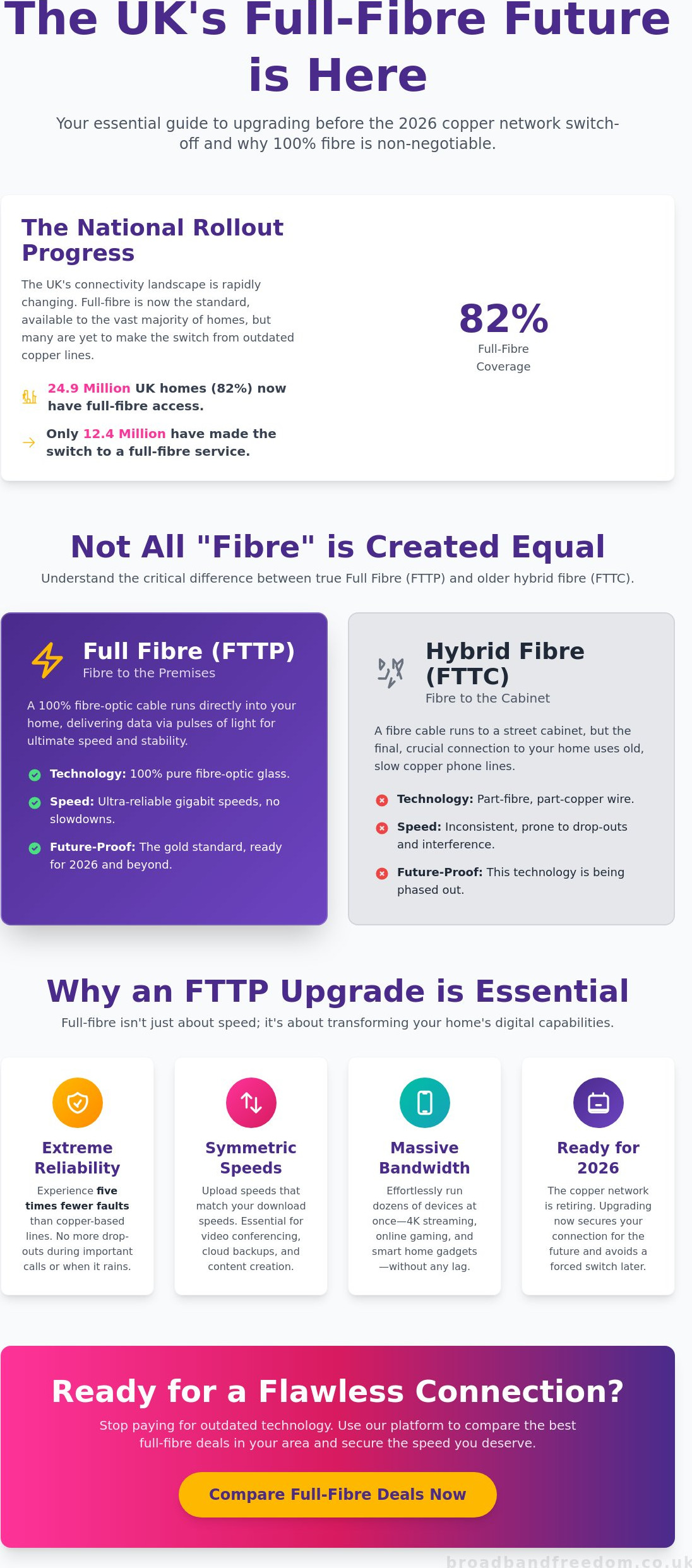
82% of UK homes now have access to full-fibre, yet only 12.4 million premises have actually made the switch from ageing copper wires. You’ve likely noticed your monthly bill increasing every April whilst your connection still stutters during a simple video call. It’s frustrating to pay for “fibre” only to discover it’s actually an FTTC hybrid service that relies on outdated technology. Finding the right fibre to the premises deals shouldn’t be a source of stress or constant jargon-busting.
Secure a connection that’s both fast and fair. You deserve a setup that handles 4K streaming and home office demands without the fear of messy installations or hidden costs. Use this guide to find the best full fibre deals whilst future-proofing your home for the 2026 copper switch-off. Learn how to use the “One Touch Switch” system to your advantage and identify which packages offer the reliability you need for a modern, connected household. Enjoy gigabit speeds for gaming and streaming without the headache of hidden fees or complex contracts.
Key Takeaways
- Prepare for the 2026 copper switch-off by understanding why a 100% fibre-optic connection is now a necessity for digital stability.
- Learn how to compare fibre to the premises deals effectively by calculating the total cost of contract and avoiding hidden mid-term hikes.
- Discover why smaller “AltNet” providers are often the smartest choice for securing gigabit speeds and superior reliability.
- Take the stress out of switching with a clear breakdown of the installation process, from the engineer visit to the ONT box setup.
- Simplify your decision-making by using our platform to filter full fibre broadband deals based on your specific speed and budget requirements.
Decoding Fibre to the Premises Deals in 2026
The UK is currently moving through a massive digital shift. By the end of 2026, the traditional copper network that has powered our phone lines for decades will be entering its final retirement phase. This isn’t just a technical update; it’s a total overhaul of how your home connects to the world. Fibre to the Premises (FTTP) represents the gold standard of this new era, delivering a 100% fibre-optic connection directly into your property without a single inch of old copper wiring. It replaces the fragile, weather-dependent metal cables with glass strands that transmit data as pulses of light at incredible speeds.
Searching for fibre to the premises deals is about more than just finding a faster download speed. It’s about future-proofing your home against the copper switch-off that is already well underway. Unlike older Superfast connections, FTTP doesn’t suffer from speed degradation based on how far you live from the green street cabinet. Whether you’re next door to the exchange or at the end of a rural lane, your speed remains consistent and reliable. Understanding FTTP technology helps you see why this direct link is the only way to guarantee the bandwidth needed for a modern household. This reliability is why 12.4 million premises have already made the jump as of early 2026.
FTTP vs FTTC: Why the distinction matters for your wallet
Many providers still market FTTC (Fibre to the Cabinet) as fibre, but this is often dubbed “fake fibre” by industry experts. Because FTTC uses copper for the final leg into your home, it’s prone to interference and dramatic speed drops. Investing in full fibre now saves you money in the long run by avoiding the inevitable need to upgrade when copper services are eventually switched off entirely, whilst ensuring you have the capacity for future tech. When you compare broadband deals, look for the Full Fibre label to ensure you aren’t paying for yesterday’s technology. Full fibre lines are significantly more resilient, with lower fault rates, which means fewer days lost to service outages.
The 2026 UK Connectivity Landscape
As of January 2026, 82% of UK homes (24.9 million) have access to full-fibre broadband. This rapid rollout means that for the vast majority of households, fibre to the premises deals are now widely available and highly competitive. Modern smart homes now require symmetric bandwidth, where upload speeds match download speeds, to handle multiple 4K streams, cloud backups, and lag-free gaming simultaneously. You can check if your property is “lit” for full fibre by looking for a small grey or black box (the CSP) on your external wall, or simply by using a fibre optic broadband checker to confirm which services reach your postcode. With coverage projected to reach 92% by 2028, the transition is no longer optional for those wanting a stable digital life.
Why Ultrafast FTTP is Replacing Traditional Broadband
Ultrafast FTTP isn’t just a minor upgrade. It’s a fundamental change in how data enters your home. Traditional broadband relies on electrical signals sent over copper wires, which are susceptible to interference from power lines and even the weather. FTTP uses pulses of light sent through glass fibres. This technological shift is why fibre to the premises deals are quickly becoming the standard for anyone who values a connection that doesn’t drop when it rains. You’re no longer at the mercy of ageing infrastructure that was originally designed for voice calls.
Beyond raw download numbers, the real revolution lies in symmetric speeds. For years, upload speeds were treated as an afterthought by major providers. Now, with the rise of high-definition video conferencing and cloud-based working, your upload speed is just as vital as your download capacity. FTTP allows for connections where you can send data almost as fast as you receive it. This makes it easier to back up large files to the cloud or host a clear, professional meeting from your spare room without the video freezing at the worst possible moment.
Reliability: Five times fewer faults than legacy lines
Full fibre is incredibly robust because light signals don’t degrade over distance like electrical ones do. This stability translates to a connection that is five times more reliable than part-copper alternatives. For those working from home, this means an end to the mid-afternoon drop-outs that plague older networks. Latency is the delay between sending a command and seeing the result on screen, making it the most critical factor for UK gamers seeking a lag-free experience. Because fibre signals travel at the speed of light, your ping remains consistently low, even during peak evening hours.
Bandwidth for the multi-device household
The average UK home now has dozens of connected devices, from smart speakers to security cameras. Traditional broadband often buckles under this pressure, leading to congestion where devices fight for a share of a limited signal. FTTP provides the massive overhead required to manage this traffic without anyone in the house noticing a slowdown. We’re seeing a clear shift where 100Mbps is no longer the benchmark for a fast home; 1Gbps is rapidly becoming the new standard for busy families. This future-proof bandwidth ensures your home is ready for 8K streaming and the next generation of VR devices.
You can learn more about what these numbers mean for your specific setup on our internet speed page. If you’re ready to see what’s available in your area, you can compare broadband deals to find a package that matches your household’s digital lifestyle. Securing one of the latest fibre to the premises deals now means you won’t need to worry about another upgrade for years to come.
Comparing FTTP Deals: Beyond the Monthly Price Tag
Finding the right fibre to the premises deals requires looking past the bold text on a provider’s homepage. A low monthly rate often hides the true “Total Cost of Contract,” which includes setup fees, router delivery charges, and annual inflation-linked increases. In April 2026, most major UK providers implemented price hikes of between £3 and £4 per month. If you’re on a 24-month term, that small increase adds up significantly over time. Always calculate the full cost over the entire contract period to see which deal actually leaves you better off.
The “Big Six” often rely on brand recognition, but AltNets (Alternative Networks) are frequently the ones offering the best value in 2026. These smaller, agile providers often build their own infrastructure and, crucially, many offer “fixed-price” guarantees. This means the price you sign up for is the price you pay until your contract ends, with no surprise hikes in April. Many also use aggressive voucher incentives or “free gift” cards to attract new customers, which can effectively pay for the first few months of your service if you use them wisely.
Contract flexibility: Long-term vs No-contract options
Commitment pays off if you’re settled in your home, as 24-month contracts typically offer the lowest monthly rates and free installation. However, if you’re a student or a renter, the flexibility of no-contract broadband is often worth the slightly higher monthly cost. These rolling monthly plans allow you to switch or cancel without facing the hefty exit fees that traditional providers charge. It’s a pragmatic choice for anyone who doesn’t want to be tied to a single address for two years.
Bundling services for maximum value
You can often unlock deeper discounts by combining your fibre to the premises deals with other home services. Opting for broadband with TV packages can be cheaper than paying for separate streaming subscriptions. As the UK moves away from traditional copper lines, the old-fashioned landline is being replaced by “Digital Voice” services that run over your internet connection. If you don’t need a home phone, many full fibre providers now offer “data-only” lines, which can shave even more off your monthly bill. Check if the package includes mesh WiFi hardware; these boosters are essential for ensuring your gigabit speeds reach every corner of a larger property.
Preparing Your Property for a Full Fibre Installation
Switching to one of the latest fibre to the premises deals is exciting, but the physical installation often causes unnecessary worry whilst you wait for the engineer. Unlike standard broadband that uses existing phone sockets, full fibre requires a new entry point into your home. An engineer from Openreach or an AltNet will visit to run a fresh fibre-optic cable from the street directly to your property. This might involve a small hole being drilled through an external wall, but the process is clean, professional, and usually completed within two hours.
On the day, you’ll need to decide where the cable enters. The engineer will pull the fibre through a protective tube and secure it to the outside of your house before bringing it inside. They’ll then install the Optical Network Terminal (ONT). This is the bridge between the light signals outside and your home network. You should think about where your devices are most used to ensure the cable entry point makes sense for your overall layout. Most engineers are happy to discuss the best route for the cabling to keep things as tidy as possible.
The hardware: ONT boxes and modern routers
Your old ADSL or FTTC router won’t work with this new technology because it lacks the necessary WAN port to talk to the ONT. Most fibre to the premises deals include a modern, high-spec router designed to handle gigabit throughput. For the best coverage, place this router in a central, open location rather than tucked inside a cupboard or behind the TV. A standard ONT box is roughly the size of a small paperback book, measuring about 18cm by 12cm, and requires its own dedicated power socket to function.
Tenant rights and landlord permissions
If you’re renting, you’ll need to inform your landlord before the engineer picks up a drill. Most landlords are happy to allow the upgrade as it increases the property’s value, but you should check your tenancy agreement first. In blocks of flats, a wayleave agreement might be required. This is a legal document giving the provider permission to run cabling through communal areas. It can sometimes delay the process, so it’s worth checking our broadband providers guide to see which companies have experience navigating these managed buildings.
Ready to start the process? You can compare broadband deals now to see which providers are currently installing in your postcode. Getting your home ready for the 2026 copper switch-off is a straightforward way to ensure you’re never left without a connection.
Finding Your Perfect Full Fibre Match with Broadband Freedom
Choosing between dozens of providers and hundreds of packages often feels like a full-time job. We’ve built our platform to strip away that confusion and put you back in the driving seat of your home connectivity. Instead of scrolling through endless lists of technical specifications that mean very little to the average user, you can filter results based on what actually matters to your daily life. Whether you need the lowest possible monthly rate or the fastest gigabit speeds for a busy family home, we do the heavy lifting by comparing the market in seconds. Our goal is to ensure you find fibre to the premises deals that fit your specific lifestyle without any of the stress or decision fatigue usually associated with switching providers.
Transparency acts as our North Star in everything we do. We prioritise clear, honest information about contract lengths and those frustrating mid-contract price hikes that catch so many people off guard every April. You deserve to know exactly what you’ll be paying in year two, not just during the initial honeymoon period advertised on billboards. By presenting the total cost of ownership upfront, we help you avoid the hidden traps often set by traditional industry giants who rely on complex jargon to hide extra fees. Use our tools to find a connection that offers the genuine reliability you need for working from home and the massive bandwidth required for the next generation of 8K entertainment.
Start your comparison journey today
Ready to see what’s available in your street? Use our broadband comparison tool to get started. We recommend using the “Full Fibre Only” filter to ensure you’re seeing the most modern technology available in your area. This simple step protects you from accidentally signing up for an outdated copper-based service that won’t meet your future needs. If you’re looking for more ways to keep costs down whilst upgrading your speed, check out our 2026 guide to saving for expert tips on securing the best value for money.
Expert support and advocacy
The 2026 copper switch-off is a major transition for every UK household, and it’s happening faster than many people realise. We’re here to act as your advocate throughout this change, ensuring you don’t get left behind with a sluggish or disconnected home. Thousands of customers trust us to provide honest, pragmatic advice that cuts through the marketing hype of the “Big Six” providers. We stay updated on the latest network rollouts and regulatory changes so you don’t have to spend your weekends researching infrastructure. Take the first step toward a more reliable home network today. Enter your postcode, compare the latest fibre to the premises deals, and secure your digital future with confidence.
Secure Your Digital Future Today
The transition to full fibre is no longer a distant prospect; it’s a vital step for any household wanting to stay connected through the 2026 copper network retirement. By now, you understand how to distinguish genuine FTTP from part-copper hybrids and why symmetric speeds are the backbone of a modern home office. Moving to a 100% fibre connection ensures your bandwidth remains reliable, even as your household’s demand for data grows with new VR and 8K technologies.
Broadband Freedom simplifies this transition by providing an independent and transparent comparison of the market. We aggregate the latest fibre to the premises deals from top UK providers, including specialist no-contract options for renters and dedicated student plans. You don’t have to settle for confusing jargon or hidden price hikes. Take control of your connectivity and find a package that respects your budget and your lifestyle requirements.
Compare the latest fibre to the premises deals now and enjoy the peace of mind that comes with a truly future-proof home network. Your faster, more reliable digital life is just a few clicks away.
Frequently Asked Questions
Can I get fibre to the premises in my area yet?
As of January 2026, 82% of UK households have access to full fibre. You can check your specific address by entering your postcode into our fibre optic broadband checker to see which providers have “lit” your street. If your property isn’t ready yet, the rollout is expanding rapidly with 92% of the country expected to reach coverage by the end of 2028.
Do I need a new phone line for FTTP broadband?
You don’t need a traditional phone line for this service. FTTP uses a dedicated fibre-optic cable that bypasses the old copper network entirely. This makes it a great choice for those looking for fibre to the premises deals that don’t require paying for line rental you don’t use. It’s a cleaner, more modern way to connect your home.
How much does it cost to install fibre to the premises?
Installation costs vary between providers, but many offer it for free if you commit to a 24-month contract. Some smaller AltNets might charge an upfront activation fee to cover the engineer’s time and hardware. Always check the “Total Cost of Contract” on our platform to see if these setup fees are included in the overall price before you sign up.
What happens to my landline when I switch to full fibre?
Your traditional analogue landline will stop working because the UK copper network is being retired. You can still have a home phone by using a “Digital Voice” service. This allows you to plug your existing handset into your new router and keep your current phone number whilst enjoying much clearer call quality over your internet connection.
Is FTTP better than Virgin Media cable broadband?
FTTP is often considered superior due to its symmetric upload speeds and significantly lower fault rates. Whilst Virgin Media offers impressive download speeds, their HFC (Hybrid Fibre-Coaxial) network often has slower uploads. FTTP provides a more consistent experience for gamers and remote workers who need a stable, low-latency connection that doesn’t fluctuate during peak hours.
How long does a full fibre installation take?
A typical installation takes about two hours to complete from start to finish. The engineer needs to run the fibre-optic cable from the street and install the ONT box inside your property. If your home requires more complex cabling or is in a block of flats, it might take slightly longer, but the engineer will explain the process before they start drilling.
Can I switch to an FTTP deal if I am still in contract?
You can switch, but your current provider will likely charge early exit fees if you’re still within your initial term. It’s often better to wait until your contract is ending to avoid these penalties. However, some providers offering fibre to the premises deals may provide credit or incentives to help cover your switching costs if you’re moving from a competitor.
What is the difference between FTTP and FTTH?
There is no practical difference between these two terms for the average consumer. FTTP (Fibre to the Premises) and FTTH (Fibre to the Home) both refer to a 100% fibre-optic connection that runs directly to your property. The industry uses them interchangeably to describe a line that doesn’t rely on any old-fashioned copper wiring for the final leg of the journey.

Article by
Elaine Lang
Elaine has over 20 years across Marketing, Communications and Public Relations in the UK. She has worked across large UK corporations, including Commercial Banks and Airports, to online consumer finance and technology solutions. Elaine has postgraduate qualifications in Marketing from the Chartered Institute of Marketing (CIM) and the Institute of Direct Marketing (IDM). She is a lifelong feline fan, sharing her home with around 4-6 cats for many years. This of course can be a challenge when trying to work at home, as they like to try to help!