Broadband for Renters: How to Organise Flexible Internet in 2026

Why should a 12-month tenancy trap you in a 24-month internet contract? With the average UK private rent reaching £1,377 in March 2026, the last thing you need is a “moving tax” in the form of a heavy early exit fee. Finding reliable broadband for renters often feels like a choice between sluggish speeds or unfair long-term commitments. We believe you should get internet on your terms, ensuring your home is connected from the day you move in.
We agree that the stress of landlord permissions and slow installation times can make moving house feel overwhelming. This article promises to show you how to secure high-speed internet that matches your tenancy length whilst avoiding hidden costs. You will get a clear preview of the best 30-day rolling contracts, the latest 2026 Ofcom pricing regulations, and your legal rights regarding full fibre installations.
Key Takeaways
- Avoid the “moving tax” by matching your contract length to your tenancy agreement to eliminate expensive early exit fees.
- Compare the freedom of 30-day rolling deals against the lower monthly costs of 12-month plans to find your ideal balance.
- Identify when you need formal landlord permission for new fibre lines and when you can simply switch providers without notice.
- Discover why 5G home broadband is the ultimate “renter’s hack” for instant, engineer-free connectivity on move-in day.
- Use our expert checklist to organise the best broadband for renters and ensure your WiFi is live the moment you get your keys.
Navigating the Rental Market: Why Standard Broadband Often Fails Tenants
The UK rental market moves fast. In March 2026, the average monthly private rent reached £1,377, leaving little room for wasted expenditure. Most major internet service providers still push 24-month contracts as the default. This creates a massive disconnect for the one-fifth of UK households living in private rented accommodation. If your tenancy agreement only guarantees six or twelve months, signing a two-year deal is a gamble you shouldn’t have to take. Finding the right broadband for renters means looking past the “teaser” prices and checking the small print for flexibility.
The year 2026 marks a significant shift in how we connect. The nationwide transition to Full Fibre and Digital Voice is almost complete. Whilst this offers incredible speeds, it often requires new physical lines. For a tenant, this adds a layer of complexity; you need to prioritise connectivity checks alongside rent and location. If a property doesn’t already have the right Broadband technology installed, finding flexible broadband for renters becomes even more critical to avoid being stuck without WiFi on move-in day.
The Financial Risk of Long-Term Contracts
Large providers usually calculate exit fees by charging a percentage of the remaining months on your term. If you move house six months into a 24-month deal, you could be handed a bill for hundreds of pounds. Many tenants assume they can just “take it with them,” but this often fails if your new flat lacks the same network coverage or infrastructure. An early termination charge is a primary financial hurdle for tenants that can turn a “cheap” deal into a very expensive mistake.
Identifying Your Renter Profile
Select a plan that reflects your lifestyle rather than the provider’s sales targets. Use these profiles to narrow your search:
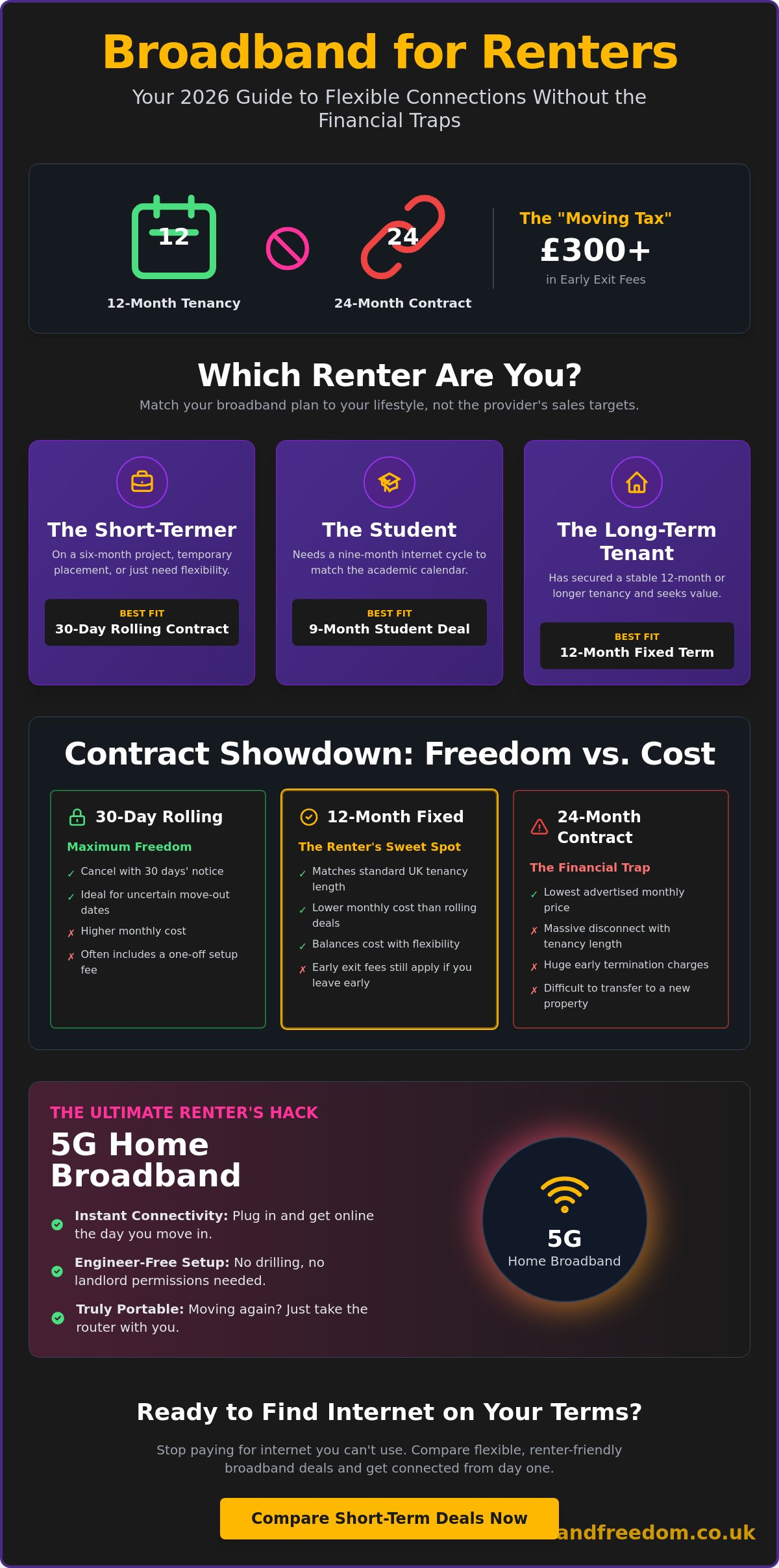
- The Short-Termer: If you’re on a six-month project or a temporary placement, a 30-day rolling contract is your best friend. You pay a bit more monthly but can cancel with four weeks’ notice.
- The Student: You typically need a nine-month cycle. Standard contracts leave you paying for an empty house over the summer. Specific student deals match the academic calendar perfectly.
- The Long-Term Tenant: If you’ve secured a stable 12-month tenancy, a 12-month fixed term often provides the best value. It balances lower monthly costs with a predictable end date.
Choosing the Right Contract Length: From Rolling Monthly to 12-Month Plans
Compare your options before you commit to a provider. The UK market in 2026 is built around three contract pillars: rolling 30-day terms, 12-month agreements, and the standard 24-month fixed term. While large providers lure customers with low monthly rates on 24-month deals, these often hide the true cost of an early exit. If your tenancy is an Assured Shorthold Tenancy (AST) for one year, a 24-month deal is a financial trap. Instead, look at flexible broadband contracts that align with your actual move-out date.
Freedom comes at a price. Setup fees for shorter contracts can range from £0 to over £100 in 2026. To amortise this cost, divide the total setup fee by the number of months you plan to stay. A £60 setup fee over a six-month stay adds £10 to your monthly budget. This is still significantly cheaper than paying a £300 early termination charge later. You can often find “hidden” 12-month deals by using comparison tools rather than visiting provider homepages, which tend to bury shorter terms in favour of high-commission 24-month packages. If you want to see what is available in your area right now, you can compare the latest short-term deals here.
The Case for No-Contract (30-Day) Broadband
Select a 30-day rolling plan if your move-out date is uncertain. These plans are perfect stop-gaps whilst you wait for a permanent fibre installation or if you are on a rolling monthly tenancy. In May 2026, providers like Three offer 5G home broadband on a rolling basis for around £28 per month. These deals offer the ultimate control; you simply give 30 days’ notice when you are ready to leave. For a comprehensive breakdown of every provider offering this level of flexibility, our guide to no contract broadband rolling plans in 2026 covers the latest One Touch Switch regulations and how to avoid credit checks. This level of autonomy is becoming a global trend, as seen in discussions around the FCC rules on broadband which highlight the importance of tenant choice over landlord-provider exclusivity.
Is a 12-Month Contract the “Sweet Spot” for Renters?
A 12-month agreement is the gold standard for most UK renters. It typically offers a lower monthly cost than rolling deals without the long-term risk of a 24-month commitment. For example, POP Telecom currently offers Fibre 40 for £35.00 per month on a 12-month term. This matches the standard UK tenancy length perfectly. If a provider only advertises 24-month deals, don’t be afraid to ask for a shorter term. Many will offer 12-month versions of their packages if you speak to their sales team directly, though you might miss out on some “free” gifts or initial bill credits. Finding the right broadband for renters often requires this proactive approach to ensure the contract ends when your keys are handed back.
How to Manage Landlord Permissions and Installation Hurdles
Securing the right broadband for renters often depends on a single factor: whether you need to drill a hole in the wall. You have a legal right to choose your own internet provider, but that right does not extend to making structural changes to the property. If you are simply switching between providers that use the existing Openreach phone socket, you do not need your landlord’s permission. However, the 2026 nationwide push for Full Fibre means most high-speed deals now require a new Optical Network Terminal (ONT) to be bolted to the wall. This is where communication becomes essential.
Landlords of older rental stock or listed buildings are often hesitant about new cabling. They worry about aesthetic damage or compromising the building’s envelope. As of May 2026, government consultations on “right to request” legislation are ongoing, but currently, you still need written consent for any new physical installation. If you are a student or a short-term tenant, you might find that landlords are more receptive to flexible internet plans that utilise existing infrastructure rather than requiring an engineer visit that involves power tools.
Step-by-Step: Securing Permission for Fibre
Check your hallway and living room for existing sockets before you call a provider. If you see a Virgin Media or an Openreach “Full Fibre” box already installed, you can likely get activated without any new drilling. If not, draft a polite email to your landlord or letting agent. Highlight that a Full Fibre installation increases the property’s value and makes it more attractive to future tenants. Offer to be present during the appointment to ensure the engineer places the ONT in a discreet location, such as behind a TV stand or inside a cupboard.
What to Do if the Landlord Says No
Don’t panic if your landlord blocks a fibre installation. You can still get online using non-invasive technology. 5G Home Broadband is a powerful “plug and play” alternative that requires zero cables or drilling. With 5G coverage reaching 65% of the UK in February 2026, it is a viable high-speed option for most city-dwellers. Alternatively, you can look into ADSL broadband deals which run through the traditional copper telephone line already present in almost every UK home. If the landlord remains stubborn, involve your letting agent. They can often mediate by explaining that high-speed internet is now considered an essential utility, similar to water or electricity.
Technology Options: Full Fibre vs 5G Home Broadband for Tenants
Choose your technology based on your flat’s layout and your landlord’s patience. Whilst Full Fibre (FTTP) remains the gold standard for stability, it’s often the hardest to secure in a rental. As we discussed regarding landlord permissions, the physical installation of fibre can be a dealbreaker. If you can’t get a new line installed, 5G home broadband is the ultimate renter’s hack for 2026. It bypasses the need for power tools and puts you in control of your connection from day one.
Reliability varies between these two options. For renters who work from home or game online, Full Fibre offers the lowest latency and most consistent speeds. However, 5G technology has matured significantly. By February 2026, 5G coverage reached 65% of the UK, making it a formidable rival to fixed lines. Before you commit to a mobile-based plan, check the signal strength inside your specific flat. Use your smartphone to run a speed test in the exact spot where you plan to place the router; thick Victorian walls can sometimes block signal even in high-coverage areas. If you need a connection that moves as fast as you do, find the best 5G and fibre deals for your postcode here.
5G Broadband: Plug-and-Play Freedom
Skip the engineer visits and the drilling. 5G home broadband is a “plug-and-play” solution that allows you to take your router with you if you move house unexpectedly. In 2026, 5G home broadband in urban centres often exceeds 300Mbps, which is more than enough for 4K streaming and simultaneous video calls. It’s particularly effective for shared flats with high device counts because modern 5G routers can handle dozens of connections without the bottlenecking seen in older copper-based broadband.
Shared Housing (HMO) Considerations
Decide who holds the contract before you sign up. In a House in Multiple Occupation (HMO), the “Lead Tenant” carries the financial risk for the entire household. If one person moves out early, the person named on the broadband account is still liable for the full monthly bill. Use third-party bill-splitting apps to ensure everyone pays their fair share whilst keeping the account in one person’s name for simplicity. For security, always set up a “Guest WiFi” network for visitors. This keeps your main connection private and prevents temporary guests from accessing shared devices like printers or smart speakers.
Finding Your Perfect Match: How to Organise Your Internet on Your Terms
Organise your move with confidence by taking control of your connectivity before you even pack your first box. The secret to finding the best broadband for renters is matching the service to your move-out date, not the provider’s sales cycle. By May 2026, the UK market has become more fragmented, with independent “Altnets” and 5G providers offering terms that vary wildly. Comparing the market is the only way to avoid the “loyalty tax” where long-term customers pay more than new sign-ups. Even on a short-term contract, you deserve a competitive rate that respects your budget.
Timing is everything when you are moving between flats. Follow this “Move-In Day” checklist to ensure you aren’t tethered to a sluggish mobile hotspot during your first week:
- 14 Days Before Move-In: Select your deal and place the order. This provides a necessary buffer for router delivery or an engineer visit.
- 7 Days Before Move-In: Confirm the delivery address with the provider. If the property is currently vacant, ask your landlord if they will allow the hardware to be posted early.
- Move-In Day: Plug in your router as soon as you get your keys. Run a speed test immediately to ensure the service matches the “average speed” promised at the point of sale.
Comparing Deals with Broadband Freedom
Use our search tools to cut through the industry jargon. You can filter results specifically by contract length, speed requirements, and upfront costs. We help you identify hidden fees that providers often bury in the small print, such as £10 router delivery charges or £35 activation fees. Our mission is to help you find broadband for renters on your terms. We prioritise flexibility and transparency so you can focus on settling into your new home rather than arguing with a call centre about exit fees.
The 14-Day Cooling-Off Period
Protect your consumer rights from the moment your service goes live. Under UK law, you have a 14-day cooling-off period to cancel your contract without penalty if the service doesn’t meet the advertised standard. This is vital in rental properties where signal dead zones or internal wiring issues might only become apparent after you have moved your furniture in. Test your bandwidth on day one using multiple devices in different rooms. Keep all original packaging and boxes for the first fortnight. If the speed is significantly lower than promised and the provider cannot resolve the issue, you have the freedom to walk away and try a different technology, such as switching from a fixed line to a 5G home broadband solution.
Take Control of Your Connection Today
Securing reliable broadband for renters is about prioritising flexibility over the default 24-month trap. You now have the tools to align your internet contract with your tenancy agreement and navigate landlord permissions for full fibre. Whether you choose a 30-day rolling fibre plan or the “plug and play” ease of 5G, you can avoid the financial sting of early termination charges. Remember to test your speeds during the 14-day cooling-off period to ensure your new home stays connected exactly as promised.
Don’t let a house move lead to “analysis paralysis” or unfair costs. We help you compare deals from all major UK providers and specialise in no-contract and short-term plans. Our expert advice is designed to help you avoid hidden exit fees so you can stay in control. Find the most flexible broadband deals for your new rental property here and get internet on your terms.
Enjoy the freedom of a connection that moves with you. Your new flat is waiting; make sure your WiFi is ready too.
Just as you deserve flexibility in your home connectivity, if you are a business owner, you should also have the power to grow your brand on your own terms; you can explore Founder Freedom Coaching to find out how expert leadership coaching supports B2C founders.
Frequently Asked Questions
Can I get a broadband contract for only 6 months?
You won’t typically find a fixed 6-month term from major providers, but a 30-day rolling contract provides the same level of flexibility. These no-contract deals allow you to cancel with just four weeks’ notice, which is ideal for short-term tenancies. In May 2026, many providers offer these flexible plans with average speeds of 60Mbps for between £33 and £40 per month. You pay a slightly higher monthly rate but avoid the risk of expensive commitment.
Do I need my landlord’s permission to change broadband providers?
You don’t need permission to switch providers if they use the existing telephone or fibre socket already installed in the property. However, you must get written consent if the new service requires an engineer to drill holes or install new external cabling. Most tenancies allow for “essential utilities,” but structural changes always remain at the landlord’s discretion. Always check your tenancy agreement for specific clauses regarding telecommunications and physical alterations.
What is the best broadband for renters in shared houses?
The best broadband for renters in student or shared houses is typically a 9-month student deal or a 30-day rolling fibre plan. These options prevent you from paying for the property over the summer months when it might be empty. In a shared house with multiple devices, prioritise a connection with speeds above 100Mbps. This ensures everyone can stream, game, and study simultaneously without facing frustrating lag or buffering during peak hours.
Can I take my broadband with me when I move house?
You can usually move your service to a new address, but it depends entirely on local network availability at the new postcode. If your current provider doesn’t cover your new home, they may treat the move as a contract cancellation, resulting in early termination charges. Always check the coverage map for your new property before you sign a new tenancy agreement. If you move frequently, a 5G router is often a more portable and convenient solution.
Is 5G home broadband good enough for working from home in 2026?
5G home broadband is absolutely sufficient for remote work in 2026, with average speeds often exceeding 300Mbps in urban centres. By February 2026, 65% of the UK had access to at least one 5G network, offering low enough latency for stable video conferencing and large file transfers. Just ensure you have a strong signal inside your specific room. Building materials like thick stone or foil-backed insulation can sometimes interfere with the wireless connection quality.
What happens if my landlord refuses to allow fibre installation?
If your landlord blocks a fibre installation, your best alternative is 5G home broadband or a standard fibre-to-the-cabinet (FTTC) deal. These options use existing copper infrastructure or wireless signals, meaning no new drilling is required. Whilst you might not get gigabit speeds, a 5G connection can still provide a very fast and reliable service for most households. You could also involve your letting agent to explain that fibre increases the property’s long-term market value.
Are there broadband deals with no credit checks for renters?
Yes, several providers offer broadband for renters without requiring a formal credit check. These are usually 30-day rolling contracts or 5G “pay-as-you-go” style plans where you pay for the service upfront. You may be asked to pay a higher setup fee or the first month’s bill in advance to mitigate the provider’s risk. This is an excellent way to get connected quickly if you have a thin credit file or have recently moved to the UK.
How much are the typical exit fees if I leave my contract early?
Typical exit fees are calculated as a percentage of the remaining months on your contract, minus VAT and a small discount for the provider’s saved costs. For many major ISPs, this works out to roughly £10 to £20 for every month left on the term. If you have 12 months remaining on a 24-month deal, you could face a bill exceeding £200. This highlights why matching your contract length to your tenancy is so important.

Article by
Elaine Lang
Elaine has over 20 years across Marketing, Communications and Public Relations in the UK. She has worked across large UK corporations, including Commercial Banks and Airports, to online consumer finance and technology solutions. Elaine has post graduate qualifications in Marketing from the Chartered Institute of Marketing (CIM) and the Industry of Direct Marketing (IDM). She is a lifelong feline fan, sharing her home with around 4-6 cats for many years. This of course can be a challenge when trying to work at home, as they like to try to help!