Compare Broadband Deals: The 2026 Guide to Saving on Your Terms

What if the lowest headline price you see today is actually a calculated trap designed to cost you significantly more by 2027? It’s exhausting to watch your monthly bill climb by fixed increments of £3 or £4 every April while you’re just trying to maintain a reliable connection for working from home. You deserve transparency, not a maze of “Full Fibre” jargon and hidden hardware fees. We believe it’s time to compare broadband deals with total confidence, moving away from corporate confusion and towards a solution that respects your budget.
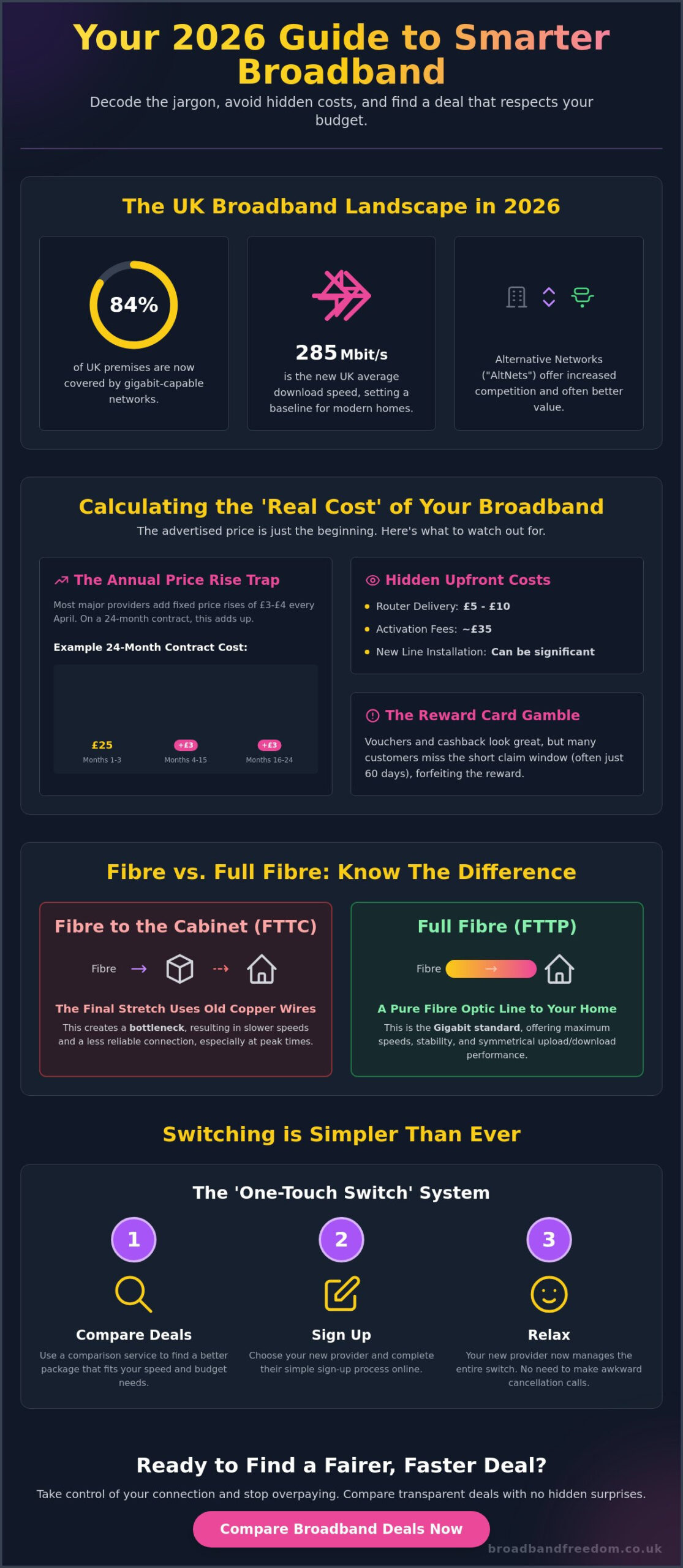
This 2026 guide promises to help you master broadband comparison, securing the UK’s average 285 Mbit/s speeds without the typical long-term contract traps. You’ll learn how to leverage the latest Ofcom regulations and the “One Touch Switch” system to find a package that fits your lifestyle perfectly. We’ll explore how to access the 84% of UK premises now covered by gigabit-capable networks while ensuring your costs remain predictable, transparent, and entirely on your terms.
Key Takeaways
- Understand the UK’s transition to Full Fibre and why the Gigabit standard is the new benchmark for reliable home connectivity in 2026.
- Learn how to compare broadband deals by calculating the true monthly cost, including the mandatory £3 to £4 annual price increases.
- Decode the “50% rule” for average speeds to ensure your connection remains stable when multiple devices are active at once.
- Identify the best savings through “Triple Play” bundles or maintain flexibility with the latest 30-day no-contract options.
- Use the simplified “One-Touch Switch” system to transition between networks quickly and without the usual administrative headaches.
Navigating the UK Broadband Market in 2026
The UK is currently finalising its transition from ageing copper wires to a modern, gigabit-capable infrastructure. As of May 2026, full-fibre broadband is available to approximately 84% of premises, which covers about 25.6 million homes. This shift means that a high-speed connection is no longer a luxury for the few. The average UK download speed has reached 285 Mbit/s, establishing a new baseline for what a household should expect from their provider. The latest Telecoms Access Review 2026-31 has further encouraged competition, making it easier for independent providers to use existing infrastructure to reach your front door on your terms.
Understanding the UK Broadband Market requires looking past the dominance of Openreach and Virgin Media O2. Whilst these giants still serve the majority, a surge in “AltNets” (alternative networks) has changed the game. Providers like CityFibre, Hyperoptic, and Community Fibre are laying their own cables, often offering faster speeds and better customer service than the traditional big four. When you compare broadband deals today, you aren’t just choosing a brand; you’re choosing the physical network that enters your home. Looking beyond BT, Sky, TalkTalk, and Virgin often reveals better value and more flexible terms.
Fibre vs Full Fibre: What is the Difference?
Many providers use the word “Fibre” as a broad marketing term, but the technology varies significantly. If you have Fibre to the Cabinet (FTTC), your data travels through fibre cables to a local street cabinet, then uses old copper phone lines for the final stretch to your house. This copper part is slow and prone to interference. Full Fibre, technically known as Fibre to the Premises (FTTP), uses a glass cable for the entire journey. This provides the “Gigabit” standard speeds and the stability needed for a busy home office. It also allows for symmetrical speeds, meaning your uploads are just as fast as your downloads, which is essential for cloud backups and video conferencing.
Why Comparing Now Saves More Than Ever
The “loyalty penalty” remains a significant drain on UK household budgets. Ofcom reported a real-terms price drop of 6% for broadband services in the year to September 2025, but these savings are only available to those who actively switch. If your current contract has expired, you’re likely paying a premium for a service that hasn’t improved. Knowing what to do when your broadband contract ends is the most effective way to stop this unnecessary drain on your monthly finances. When you choose to compare broadband deals in 2026, the process is smoother than ever thanks to the “One-Touch Switch” system. This regulation allows you to move between different networks without the stress of coordinating cancellation dates yourself. Taking control of your connection ensures you get the latest technology at a price that stays transparent and affordable.
Calculating the ‘Real Cost’ of Your Broadband Deal
Don’t let a flashy headline price fool you. The number you see in big, bold text is rarely what you’ll actually pay over the life of your contract. To find the real value, you need to calculate the “effective monthly cost.” This involves summing up every monthly payment, adding one-off activation fees, and then subtracting any guaranteed rewards. Only then can you see which provider is truly offering a bargain and which is just using clever marketing.
Hidden fees can quickly erode any perceived savings. Many providers charge between £5 and £10 for router delivery, whilst others might slip in a £35 activation fee. If your home requires a new line, professional installation costs can climb even higher. When you compare broadband deals, always check the “upfront costs” section before hitting the buy button. It’s these small, initial charges that often separate a great deal from a mediocre one. If you’re specifically trying to keep your monthly outgoings as low as possible, our guide to cheap broadband UK 2026 shows you how to target genuine value deals whilst avoiding hidden price hikes that inflate the total contract cost.
Just as you scrutinise broadband costs, it pays to ensure your other financial transactions are equally transparent. You can explore Money Transfers and other all-in-one financial services with FunZ to keep your outgoings predictable and fair.
The Impact of Mid-Contract Price Hikes
The landscape changed on April 1, 2026. Most major providers, including BT, EE, and Vodafone, now implement fixed-sum annual increases rather than percentage-based ones. These typically range from £3 to £4 per month. If you sign a 24-month contract in January, you’ll face two of these hikes before your term ends. By the final six months, you could be paying £8 more per month than your starting price. Choosing to compare broadband deals with providers who guarantee no mid-contract increases is the smartest way to maintain total budget control and avoid nasty surprises in your bank statement.
Vouchers, Cashback, and Incentives
Reward cards are a popular tactic to climb to the top of comparison tables. A £100 voucher might seem like it covers three months of service, but it’s only valuable if you actually receive it. Industry data suggests a significant number of customers miss the “claim window,” which often closes just 60 days after your service goes live. If the reward requires you to remember to click a link in an email three months from now, treat it with caution. It’s often safer to choose a deal with a lower base price and no price hikes than a more expensive one propped up by a one-off incentive that you might never actually claim.
Speed vs Stability: Finding the Right Connection Type
Don’t get blinded by big numbers. Advertised “average speeds” only need to be achievable by 50% of a provider’s customer base during the peak hours of 8 pm to 10 pm. This means half the users might be getting significantly less than the headline figure. When you choose to compare broadband deals, look for providers that offer a “minimum speed guarantee.” This gives you the power to walk away if your connection doesn’t perform as promised on your terms.
Stability often trumps raw speed in a busy household. If you have four people streaming 4K video whilst others are on video calls, bandwidth contention becomes a real issue. It isn’t just about the pipe coming into the house; it’s about how many devices are fighting for a slice of that data. Most modern UK homes now have over 10 connected devices, from smart speakers to thermostats. This volume makes “Ultrafast” connections of 300Mb+ the practical baseline for a frictionless experience. If you live with multiple housemates all competing for bandwidth simultaneously, our dedicated guide to internet for shared house setups in 2026 covers exactly how to choose and manage a connection that keeps every room reliably connected.
Broadband for Gamers and Remote Workers
For those who rely on a rock-solid connection, latency and jitter are the metrics that matter most. Latency, or “ping,” is the delay in data travel, whilst jitter measures the consistency of that delay. High latency causes lag in gaming and “freezing” during video calls. To ensure your setup is up to the task, check out our guide on the Best Broadband for Gamers UK 2026: Low Latency & High Speed. Reliable performance is the foundation of a productive home office and a competitive gaming setup.
Is Standard ADSL Still an Option?
Standard copper broadband is reaching its end of life. Openreach is actively phasing out the old copper network in favour of fibre across the UK. If you’re in a rural area where Full Fibre hasn’t arrived yet, you might still be looking at ADSL Broadband Deals 2026: The Essential Guide to Standard Internet. However, for many, 5G home broadband has become a faster, more flexible alternative to sluggish fixed lines. It’s about finding the right balance of availability and performance for your specific postcode.
Finally, remember the role of your hardware. A 1Gb connection is useless if your router can’t penetrate the walls of your home. If you compare broadband deals and find a great price, check the specs of the included router. Some budget providers save money by supplying basic hardware that struggles with WiFi range. Investing in a mesh system or choosing a provider known for high-quality routers ensures you actually feel the speed you’re paying for.
Tailoring Your Search: Bundles, No-Contract, and Student Deals
Finding the right package depends entirely on your living situation. If you’re a homeowner looking for a complete entertainment solution, “Triple Play” bundles that combine broadband, TV, and a landline often provide the deepest discounts. However, if you’re one of the 18% of UK customers who switched last year, you know that complexity can hide costs. When you compare broadband deals, you must decide if you value the convenience of a single bill or the flexibility of separate services. Getting your connection on your terms often means stripping away the extras you don’t actually use.
Affordability remains a priority for millions. For households on Universal Credit or other qualifying benefits, over 30 providers now offer social tariffs. These packages range from £12.50 to £24 a month, yet only 8.6% of eligible homes had signed up by June 2025. If you’re worried about a traditional credit check, these social tariffs and specific independent providers offer a reliable way to stay connected without the standard financial hurdles. It’s about finding a fair deal that respects your circumstances.
Broadband and TV Bundles: Value or Vanity?
Traditional giants like Sky, Virgin Media, and EE compete fiercely with massive entertainment bundles. These are excellent if you want premium sports or cinema channels integrated into your planner. However, “unbundling” is a growing trend amongst savvy consumers. Many users now pair a basic fibre connection with standalone streaming services like Netflix or Disney+. This avoids paying for hundreds of “junk” channels you never watch. Before committing, list your “must-have” channels to see if a bundle actually saves you money or just adds unnecessary monthly weight.
Short-Term and No-Contract Solutions
Renters and digital nomads often find 18 or 24-month commitments impossible. This has led to the rise of 30-day rolling no contract broadband. You’ll pay a price premium for this freedom, often in the form of higher monthly fees or upfront activation costs. Students also benefit from bespoke 9-month contracts that align with the academic year, preventing them from paying for an empty flat over the summer. To find the perfect fit for your lifestyle, compare broadband deals that prioritise flexibility over long-term lock-ins.
Organising a smooth exit from these plans is simple if you plan ahead. Whilst no-contract deals don’t have exit fees, they usually require a 30-day notice period. If you’re moving house, ensure you notify your provider early to avoid a final overlap bill. Whether you’re in a temporary flat or a student house, getting broadband on your terms means matching the contract length to your actual needs. This proactive approach ensures you never pay for a service you’ve already left behind.
How to Switch and Save on Your Terms
Switching providers used to be a logistical nightmare involving endless phone calls and awkward cancellation chats. Since April 3, 2023, the “One-Touch Switch” process has transformed how UK households move between networks. Now, your new provider handles the entire transition for you. You simply select a better deal, and they coordinate with your old supplier to ensure your service remains active until the new one is ready. This removes the friction that once kept people stuck in expensive, outdated contracts. If you want a full walkthrough of every step involved, our guide on how to switch broadband provider in 2026 covers the entire process from start to finish.
Timing is critical for a smooth transition. Start your search approximately four to six weeks before your current contract expires. Following a clear action plan for when your broadband contract ends ensures you avoid Early Termination Charges whilst securing the best available rates before your deal lapses. If you encounter any issues during the process, remember that as of April 8, 2026, the timeframe for automatic access to Alternative Dispute Resolution (ADR) for consumer complaints has been reduced to six weeks. You have more power than ever to ensure your provider behaves fairly and resolves issues quickly.
Don’t forget the hardware. Most routers remain the property of the provider and must be returned once your service ends. Failing to do so can result in “non-return” fees ranging from £30 to £80 depending on the model. Organise your return by using the prepaid packaging most companies provide. If you change your mind after signing up, you’re protected by a statutory 14-day cooling-off period. This gives you two weeks to test the service and ensure it meets your expectations on your terms.
Step-by-Step Switching Checklist
- Check your end date: Log into your current account to confirm exactly when your commitment ends to avoid exit fees.
- Compare broadband deals: Use our platform to filter by speed, cost, and contract length to find your perfect match.
- Place your order: Once you’ve selected a deal, your new provider will notify your old one. You don’t need to pick up the phone.
- Set up your router: Follow the simple instructions on your activation date to go live with your new connection.
Broadband Freedom: Your Advocate in the Market
We believe that finding a reliable connection should be simple, transparent, and empowering. Our platform is designed to cut through the marketing noise, helping you find a package that fits your lifestyle without the hidden price hikes mentioned earlier. We’ve done the hard work of searching and comparing so you can focus on enjoying a faster, cheaper connection. Take control of your monthly bills and find a deal that respects your budget. Compare the latest broadband deals now and start your journey towards total digital freedom.
Secure Your Digital Freedom Today
The UK broadband landscape has shifted significantly in 2026. You now have the power to bypass confusing jargon and annual price hikes that typically add £3 to £4 to your monthly bill. By focusing on the total contract cost rather than just headline bait, you can protect your household budget from unexpected surges. Whether you’re a gamer needing low latency or a student seeking a flexible nine-month term, the right connection is ready for you.
It’s time to stop overpaying for copper-based speeds and “junk” TV channels. When you choose to compare broadband deals through our platform, you receive a transparent comparison with no hidden agendas. We provide expertly curated deals for students, renters, and gamers, ensuring your choice is based on real value and long-term stability. Take advantage of the One-Touch Switch system to move your service effortlessly and start saving immediately. You deserve a reliable connection that exists entirely on your terms.
Find your perfect broadband deal on your terms today
Frequently Asked Questions
Is it better to get a broadband and TV bundle or buy them separately?
Choosing a “Triple Play” bundle is usually the most cost-effective option if you regularly watch premium sports or cinema channels. These packages offer a significant discount compared to buying each service individually. However, if you primarily use streaming apps, you’ll likely save more by selecting a standalone fibre deal and paying for separate subscriptions. Always calculate the “real cost” by adding your streaming fees to the base broadband price before making a final decision.
What happens if my broadband provider increases the price mid-contract?
As of April 2026, most major UK providers implement fixed-sum annual increases typically ranging from £3 to £4 per month. These must be clearly stated in your contract at the point of sale. If a provider introduces an unexpected increase that wasn’t specified when you signed up, Ofcom rules generally allow you to exit the contract without a penalty within 30 days of the notification. Always check the small print for these fixed-price clauses when you compare broadband deals.
Can I get broadband if I have a poor credit history?
Yes, you can secure a reliable connection without a traditional credit check by opting for a no contract broadband deal or a social tariff. Over 30 providers now offer social tariffs for households on Universal Credit, with prices starting from £12.50 a month as of May 2026. These plans don’t involve the strict financial screening used by major providers for 24-month contracts. This ensures you can get broadband on your terms regardless of your financial background.
How much broadband speed do I actually need for working from home?
A download speed of 50 Mbit/s is the baseline for a single person to handle video calls and cloud backups comfortably. However, in a multi-person household where others are streaming 4K video whilst you work, a 150 Mbit/s or “Ultrafast” connection is much more reliable. This prevents bandwidth contention and ensures your video conferencing remains stable during peak usage times. Higher upload speeds, found in Full Fibre packages, are also essential for sending large files quickly.
Do I still need a landline to get a fibre broadband deal?
You don’t need a landline for a Full Fibre (FTTP) connection because the data travels through a dedicated glass cable rather than old copper phone wires. This technology is now available to 84% of UK premises, allowing you to ditch the “line rental” fees that used to be mandatory. If you still want a home phone, many providers offer “Digital Voice” services that run over your internet connection instead of a traditional socket.
How long does it typically take to switch broadband providers in 2026?
Switching typically takes 15 working days from the moment you place your order to your service going live. The transition is handled in the background, and the actual downtime on the day of the switch is usually less than an hour. If you’re moving between networks that use different infrastructure, an engineer visit might be required, which could extend the timeline depending on local availability in your city. For a detailed breakdown of each stage, read our stress-free guide to switching broadband provider to know exactly what to expect.
Are no-contract broadband deals more expensive than long-term plans?
No-contract deals generally carry a higher monthly premium and often include upfront activation fees that are waived on longer commitments. Whilst you pay more for the flexibility of a 30-day rolling term, you avoid the risk of expensive Early Termination Charges if you need to move. For renters or students, this freedom often outweighs the small monthly saving offered by a rigid 24-month contract.
What is the “One-Touch Switch” and how does it work?
The “One-Touch Switch” is an Ofcom system that allows you to change providers by only contacting your new supplier. They take responsibility for informing your old provider and coordinating the transfer date. This process, which became standard for residential customers in April 2023, makes it effortless to compare broadband deals and move to a better service. It removes the need for you to have difficult cancellation conversations with your existing provider.

Article by
Elaine Lang
Elaine has over 20 years across Marketing, Communications and Public Relations in the UK. She has worked across large UK corporations, including Commercial Banks and Airports, to online consumer finance and technology solutions. Elaine has post graduate qualifications in Marketing from the Chartered Institute of Marketing (CIM) and the Industry of Direct Marketing (IDM). She is a lifelong feline fan, sharing her home with around 4-6 cats for many years. This of course can be a challenge when trying to work at home, as they like to try to help!