Guide to the Latest Broadband Technology in the UK

What if your sluggish internet connection has nothing to do with the cable in your street and everything to do with the hardware in your hallway? It’s frustrating to pay for premium speeds only to face lag during a gaming session or a pixelated video call whilst working from home. You’ve likely felt the headache of deciphering the latest broadband technology, struggling with jargon like XGS-PON while worrying about mid-contract price hikes. Recent industry reports indicate that six million people in the UK were out-of-contract and overpaying as of July 2026, often because the technical barriers to switching seem too high.
This guide will demystify these innovations to help you build a future-proofed home network and secure lower monthly bills. We’ll explore the leap to 10Gbps full fibre, the arrival of Wi-Fi 7, and how to use the “One Touch Switch” process to upgrade without the stress. With 87% of UK premises now gigabit-capable according to Ofcom data from early 2026, there’s never been a better time to take control of your connectivity and enjoy zero-lag streaming.
Key Takeaways
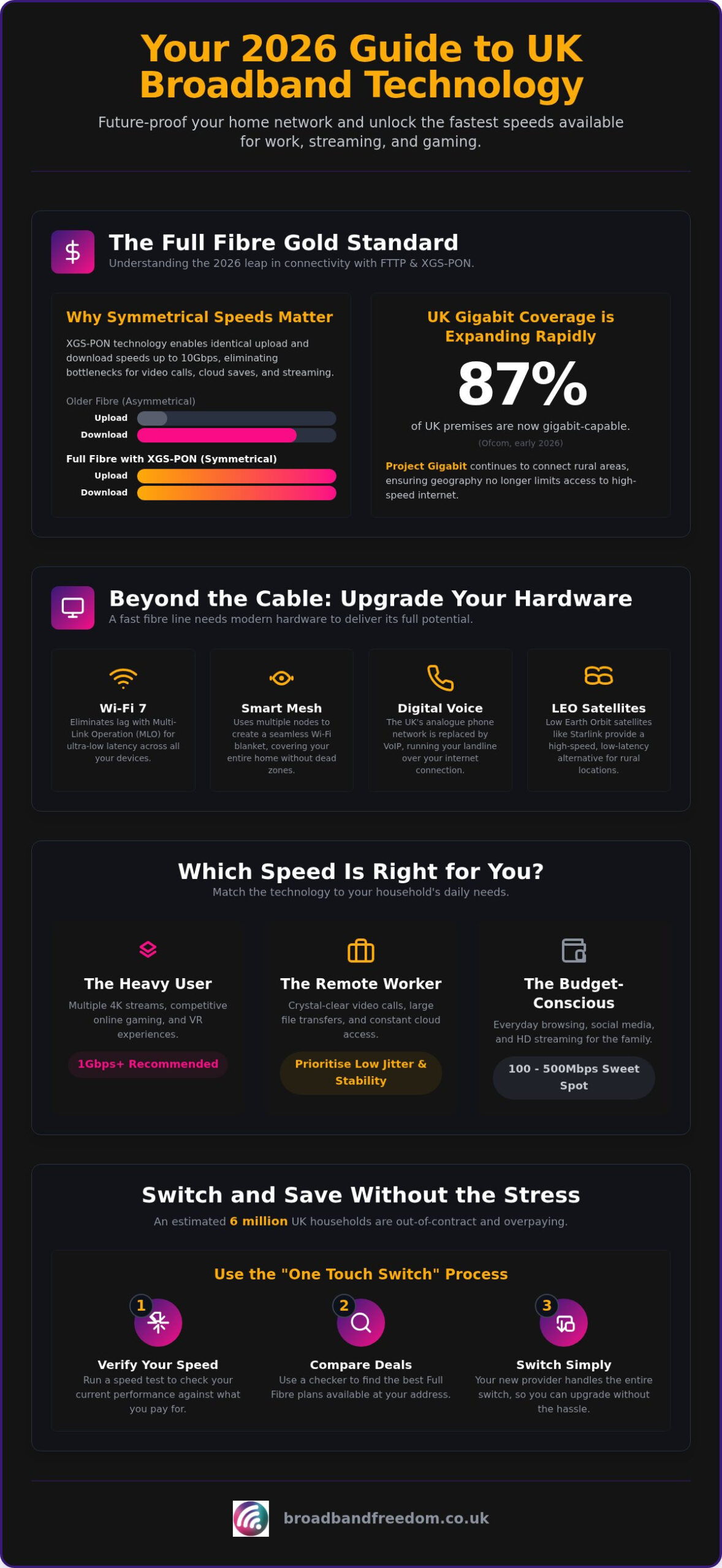
- Learn why Full Fibre (FTTP) is the 2026 gold standard and how XGS-PON technology enables symmetrical speeds of up to 10Gbps for your home.
- Understand how the latest broadband technology like Wi-Fi 7 uses Multi-Link Operation to eliminate lag, even when multiple devices are streaming at once.
- Identify the specific connectivity requirements for your household to choose between high-speed gigabit plans or stability-focused packages for remote work.
- Discover how to verify your current performance and use the “One Touch Switch” process to move to a superior deal without facing unexpected exit fees.
The 2026 Full Fibre Revolution: XGS-PON and Gigabit Speeds
FTTP (Fibre to the Premises) is the 2026 gold standard for UK connectivity. It replaces old copper wires with pure glass fibre, delivering data directly to your door without interference. The engine behind this shift is XGS-PON, a specific type of Passive Optical Network (PON). This technology supports symmetrical speeds of up to 10Gbps, ensuring your connection handles heavy traffic without breaking a sweat. It represents a fundamental leap from the lopsided speeds of previous decades.
Rollout Milestones and Availability
According to the latest Ofcom Connected Nations report, gigabit-capable broadband now reaches 87% of UK premises. Openreach also confirmed in August 2026 that XGS-PON will be available to an additional one million homes within the next 12 months. This rapid expansion makes the latest broadband technology accessible to the vast majority of households. You can use a full fibre broadband checker to see if your street has been upgraded.
Why Symmetrical Speeds Matter in 2026
Historically, UK internet was lopsided. You likely had fast downloads but sluggish uploads. In 2026, your upload speed is just as vital. High-bandwidth tasks like cloud-based AI processing and 8K video conferencing require a massive upstream pipe. Modern full fibre plans offer identical speeds both ways. This ensures your video feed doesn’t freeze whilst you’re presenting to a global team or uploading large creative projects. It’s the relief of finding a simple solution to a complex bandwidth problem.
Project Gigabit: National Coverage Update
The DSIT Project Gigabit initiative continues to bridge the gap in rural areas. By targeting hard-to-reach locations, the programme has significantly improved rural connectivity. Official government data from 2026 indicates that remote premises are seeing the fastest growth in gigabit availability. This initiative ensures that geography no longer limits your choice of the latest broadband technology, providing equal opportunities for remote workers across the country regardless of their postcode.
Beyond the Cable: Wi-Fi 7 and Hardware Innovations
A lightning-fast fibre line is useless if your router acts as a bottleneck. Wi-Fi 7 (802.11be) is the essential partner for gigabit speeds, designed to handle the massive throughput of the latest broadband technology. According to the Wi-Fi Alliance, the “Wi-Fi Certified 7” program ensures that Multi-Link Operation (MLO) drastically reduces latency amongst smartphones and laptops. This hardware is no longer a niche luxury; industry forecasts suggest that Wi-Fi 7 access point shipments will reach 117.9 million units globally by the end of 2026.
Smart Mesh and Digital Voice Transitions
Many providers now include Smart Mesh systems by default to eliminate home dead zones. These systems use multiple nodes to blanket your home in signal. Simultaneously, the UK is completing the transition from analogue PSTN lines to Digital Voice technology. This shift means your home phone now runs via VoIP over your internet connection. As detailed in Ofcom’s guidance on the digital switch-over, you can keep your existing number whilst switching to a full fibre package. Check if your provider offers a Wi-Fi 7 router when browsing the latest broadband deals to match your hardware to your line speed.
Low Earth Orbit (LEO) Satellites for Rural UK
If full fibre hasn’t reached your street yet, Low Earth Orbit (LEO) satellites like Starlink offer a powerful alternative. Unlike traditional geostationary satellites that orbit at 35,000km, LEO satellites sit much closer to Earth. This proximity results in low-latency performance that rivals some fixed-line connections. The UK Government’s trials of satellite connectivity have proven these systems can deliver high-speed access to the most remote corners of the country. This technology provides a vital safety net whilst you wait for the national fibre rollout to reach your specific location.
Matching Technology to Your Lifestyle: Which Plan is Best?
Identifying your specific requirements is the first step to navigating the latest broadband technology. A “Heavy User” household with multiple 4K streams and VR gaming requires a 1Gbps plan to maintain performance, whilst “Remote Workers” should prioritise low jitter for stable video calls. For the “Budget-Conscious”, the sweet spot usually sits between 100Mbps and 500Mbps. According to Ofcom’s guide on choosing a broadband service, matching speed to your household size prevents you from overpaying for unused bandwidth. Compare broadband and phone packages to bundle services and lower your monthly costs.
Broadband for Students and Renters
Shared houses and short-term tenancies demand high-speed access without the burden of long-term traps. Opting for no contract broadband provides the same latest broadband technology as standard deals but with a flexible, rolling monthly term. This adaptability is vital for the UK’s growing rental market. The Government Digital Inclusion Strategy highlights the importance of accessible internet for those with fluid living situations. It’s an empowering choice that ensures you aren’t paying for an empty flat during house moves or summer breaks.
Gaming Technology: Reducing Latency in 2026
For competitive gaming, “Ping” and “Jitter” are more critical than raw download speed. Ping measures the time data takes to travel, whilst jitter tracks the variation in that delay. Full fibre is the superior choice because its infrastructure inherently provides lower latency than older copper systems. As noted in the Ofcom Online Nation report, the demand for stable, low-latency connections has increased alongside the rise of cloud gaming. To find the most reliable setup for your home, compare broadband deals and look for providers with strong peering agreements.
Future-Proofing Your Home: How to Switch and Save
Run a speed test to see if your current setup is failing. If your hardware is years old, it likely won’t support the latest broadband technology available in your area. Next, check your contract end date to avoid exit fees. Since the “One Touch Switch” regulation took effect in September 2024, your new provider handles the entire transition, making it easier than ever to move. Knowing your status gives you the autonomy to negotiate or jump to a superior deal without the administrative headache.
Use Broadband Freedom to compare latest broadband with TV packages for an integrated entertainment experience. This often secures a better total price than buying services separately. If you live in an area where full fibre rollout is ongoing, look for “Full Fibre Guarantees”. These plans allow you to upgrade to FTTP for free as soon as the glass fibre reaches your street. It’s a practical way to ensure your home stays at the cutting edge of connectivity.
Avoiding Mid-Contract Price Hikes
The 2026 regulatory landscape allows you to leave a contract penalty-free within 30 days if a provider raises prices beyond the terms you signed. However, it’s better to avoid the stress entirely. Prioritise providers that offer “Fixed Price Promises”. These contracts guarantee your monthly bill stays the same for the entire duration of the term. Choosing these deals helps you manage your household budget whilst enjoying the latest broadband technology without unexpected financial surprises.
Maximising Value with Free Gifts
Searching for broadband with free gifts like vouchers or tech hardware can significantly lower your first-year costs. Always calculate the total contract value before signing. Sometimes a high-value gift masks a more expensive monthly rate that costs you more over two years. Aim for a balance: a competitive monthly fee paired with a useful perk that adds genuine value to your digital lifestyle. This savvy approach ensures you get the best tech at a fair price.
Take Control of Your Digital Future
The UK’s connectivity landscape has shifted. You no longer have to settle for inconsistent speeds or outdated hardware. By embracing the latest broadband technology, you’re securing a home network that handles everything from 8K streaming to AI-driven remote work. Remember that the combination of XGS-PON fibre lines and Wi-Fi 7 routers is the key to unlocking true gigabit performance. Switching has never been simpler thanks to the One Touch Switch regulation, which removes the administrative burden from your shoulders.
We’ve done the heavy lifting by researching the market so you don’t have to. You can compare over 30 UK providers in seconds and access daily updated offers tailored to your specific needs. Our expert guidance on the full fibre rollout ensures you’re always ahead of the curve. Find the best full fibre deals for your home today and enjoy the relief of a fast, reliable connection that just works.
Frequently Asked Questions
What is the fastest broadband technology available in the UK in 2026?
XGS-PON is currently the fastest broadband technology available to UK residential properties. This specific type of full fibre connection enables symmetrical upload and download speeds of up to 10Gbps. While standard gigabit plans are common, providers using XGS-PON can deliver performance that is significantly higher. This technology ensures your home network handles the most demanding tasks without the latency issues found in older copper-based systems.
Is Wi-Fi 7 worth it if I only have a 100Mbps broadband plan?
Wi-Fi 7 provides benefits beyond raw internet speed, but it isn’t essential for a 100Mbps plan. Its primary advantage for you would be reduced latency and better handling of multiple devices within your home. If you have many smart gadgets or consoles, the Multi-Link Operation (MLO) tech helps them communicate more efficiently. However, you won’t see an increase in your external download speeds until you upgrade your broadband package itself.
Can I get full fibre broadband without a landline?
You can absolutely get full fibre broadband without a traditional landline. Full fibre (FTTP) uses a dedicated glass cable that doesn’t rely on the old copper telephone network. This means you can choose “data-only” packages, which are often more cost-effective. If you still want a home phone, most providers now offer Digital Voice services. These allow you to make calls over your internet connection instead of a standard wall socket.
What happens to my old phone line during a full fibre installation?
Your old copper phone line typically remains in place but becomes redundant for voice calls. The UK is currently transitioning to a fully digital network, meaning analogue services are being retired. During a full fibre installation, the engineer provides a new connection point for your router. If you decide to keep a home phone service, it will plug directly into your new router or a specialised adapter rather than the old socket.
How do I know if my current router supports the latest broadband speeds?

Article by
Elaine Lang
Elaine has over 20 years across Marketing, Communications and Public Relations in the UK. She has worked across large UK corporations, including Commercial Banks and Airports, to online consumer finance and technology solutions. Elaine has post graduate qualifications in Marketing from the Chartered Institute of Marketing (CIM) and the Industry of Direct Marketing (IDM). She is a lifelong feline fan, sharing her home with around 4-6 cats for many years. This of course can be a challenge when trying to work at home, as they like to try to help!