How to Get Broadband Installed When Moving Home

Imagine finally collapsing onto your sofa after a long moving day, only to realise you’re in a total digital dead zone because your Wi-Fi isn’t active yet. It’s a common nightmare that adds unnecessary friction to an already exhausting process. We know that moving home and getting broadband installed often feels like a logistical minefield, especially when you’re juggling estate agents and packing boxes. You want your connection to work the moment you step through the door, but the fear of hidden fees or missing out on Full Fibre can make the search feel overwhelming.
You can achieve a seamless transition with the right preparation. This guide helps you manage the logistics of moving, from checking if Full Fibre is available at your new postcode to managing the standard two-week installation lead time. We’ll show you how to use the “One Touch Switch” process to your advantage and avoid unexpected exit fees. By following our week-by-week timeline, you’ll secure the best value deals and eliminate connectivity gaps. We’ve done the heavy lifting so you can enjoy day-one internet without the stress.
Key Takeaways
- Start your planning at least four weeks in advance to streamline the process of moving home and getting broadband installed without service gaps.
- Evaluate your new property’s connectivity potential by checking for Full Fibre (FTTP) availability to ensure you secure the best value and speed.
- Determine if you need a professional engineer or a simple self-install by identifying the location of the master socket or ONT box upon arrival.
- Secure a seamless connection on day one by testing your router immediately and placing it in a central, unobstructed position for maximum signal strength.
Planning Your Broadband Move: The Essential 4-Week Timeline
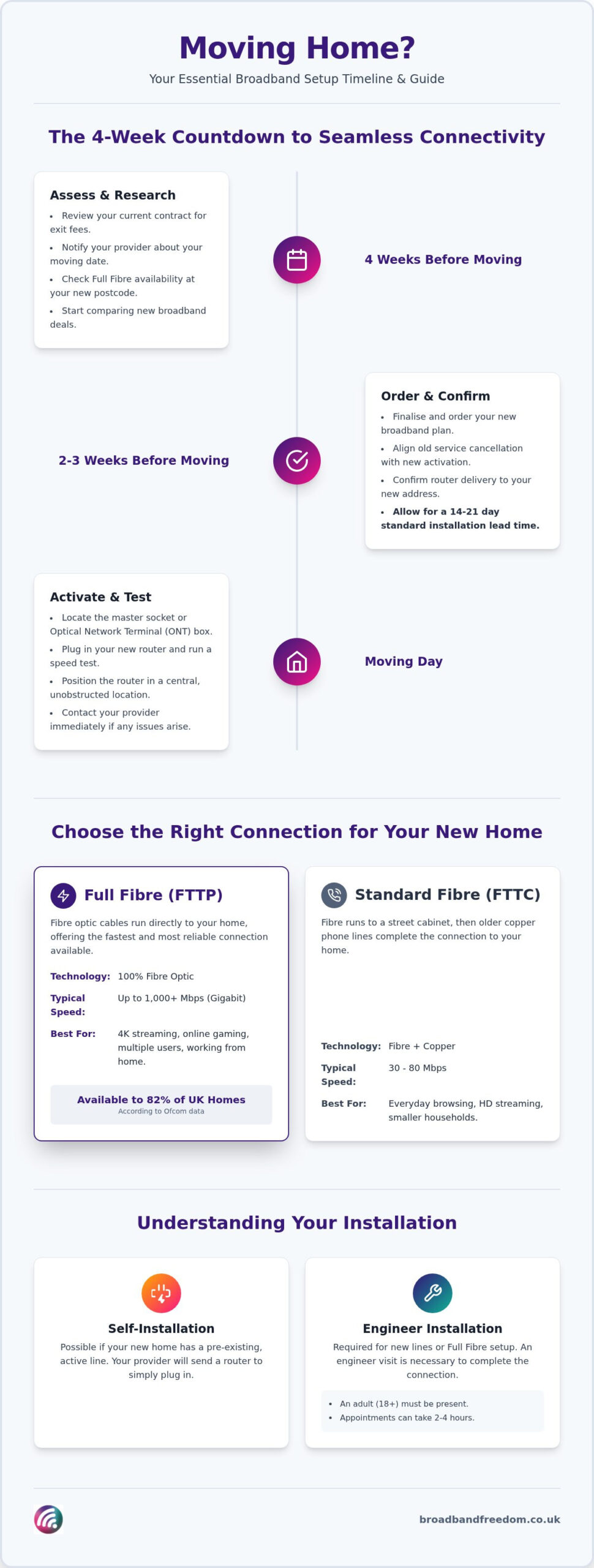
Start your preparation exactly one month before your scheduled move-in date. This four-week window is crucial for moving home and getting broadband installed without a hitch. By acting early, you avoid the common pitfall of arriving at a new house with no way to connect to work or family. It’s the best time to audit your current service and scout for superior options.
Assessing Your Current Contract
First, review your current contract to see if you’re liable for exit fees or if your provider offers a simple home-moving transfer. Understanding different types of broadband connection available at your new address helps you decide whether to stick or switch. Notify your current provider of your move immediately whilst checking for better deals at your new postcode to ensure you aren’t overpaying.
Why You Must Notify Your Provider Early
Standard lead times for UK broadband installations typically range between 14 to 21 days. This is why notifying your provider early is vital when moving home and getting broadband installed. Giving four weeks’ notice ensures your router arrives at your new address before you do. This proactive approach prevents you from paying for two services simultaneously by aligning your old service cancellation with your new activation date.
Broadband Readiness for New-Build Properties
If you’re moving into a new-build, the infrastructure might differ from older homes. Confirm with your developer if they’ve installed Openreach or alternative fibre lines. Use our full fibre broadband checker to see exactly what’s available at your new postcode. Some developers have exclusive agreements with specific providers for the first few months, so verify this early. If your completion date is uncertain, consider no-contract broadband deals to maintain flexibility during the move.
Comparing the Best Broadband Deals for Your New Property
Moving home and getting broadband installed is the perfect opportunity to audit your digital life. Start by evaluating your household bandwidth needs based on the number of active devices. If you have four people streaming 4K video whilst working from home, your requirements will differ significantly from a single occupant. Consider consolidating your monthly household bills by looking for broadband and phone packages. Many providers also offer ‘free gift’ incentives, such as retail vouchers or smart hardware, which are particularly helpful when kitting out a new property.
Full Fibre vs Standard Fibre: Which Do You Need?
Full Fibre (FTTP) offers gigabit speeds amongst the most stable connections in the UK. It delivers data directly to your door via fibre optic cables. Standard fibre (FTTC) is often cheaper but relies on older copper telephone lines for the final stretch, which can limit performance. To determine your current requirements, use an internet speed test before you move. According to Ofcom’s Spring 2026 update, full-fibre is now available to 82% of UK homes, meaning you likely have more choice than ever before.
The Benefits of No-Contract and Flexible Plans
If your move-in date is likely to shift, consider no contract broadband. These flexible plans prevent long-term commitment whilst you settle into a new area. They’re ideal for renters or students who may only occupy a property temporarily. Choosing a rolling monthly plan removes the stress of hidden exit fees if your circumstances change. This flexibility is a major advantage when moving home and getting broadband installed during a complex relocation. You can always compare broadband deals later to find a more permanent, fixed-term solution once you’re fully unpacked.
Understanding the Installation Process and Potential Hurdles
Moving home and getting broadband installed involves determining your specific installation type. A self-install is often possible if the previous occupant left an active line or the necessary hardware behind. If not, a professional engineer must visit to complete the connection. Locate your master socket or ONT box immediately upon arrival to check for damage. If these components are missing, notify your provider straight away to avoid lengthy delays. Ensure an adult over 18 is present for the entire appointment window, as complex setups can take between two and four hours to complete properly.
What to Expect During a Full Fibre Installation
For Full Fibre, engineers install an Optical Network Terminal (ONT) inside your home near a power socket. The ONT acts as the essential bridge between the external fibre optic cables and your internal router. This process often requires external work, such as routing cables along walls or through gardens. You should prepare for small holes to be drilled for cable entry into the property. Once the hardware is physically set, you can compare the best broadband deals to finalise the process of moving home and getting broadband installed.
Managing Landlord Permissions and Wayleave Agreements
Once you’ve navigated the logistics of moving home and getting broadband installed, the focus shifts to day-one performance. Plug in your router immediately to confirm the line is active. For the best WiFi signal, position your hardware in a central, unobstructed location away from thick walls, large mirrors, or electronic interference. Don’t forget to update your billing address and contact details with your provider to ensure your account remains secure and invoices arrive on time. Finally, use Broadband Freedom to verify you’ve secured the most competitive rate for your specific postcode.
Bridging the Gap with Temporary Mobile Solutions
Activation delays can occasionally occur despite the best planning. If your line isn’t live on arrival, set up a mobile hotspot on your smartphone to maintain basic connectivity for essential tasks. For a more robust short-term solution, consider a 4G or 5G home router on a rolling monthly contract. These plug-and-play devices provide instant internet without needing an engineer visit. If you’re moving to a more remote location, check UK Government data for gigabit vouchers designed to help rural premises access high-speed infrastructure.
Why Comparing Simplifies Your Move
Choosing a comparison service allows experts to perform the heavy lifting whilst you focus on the physical logistics of your move. You’ll gain access to exclusive deals often hidden from direct provider websites, ensuring you don’t overpay during an expensive relocation. This proactive approach helps future-proof your new home with the latest Full Fibre technology from the start. By delegating the search, you ensure that moving home and getting broadband installed remains the simplest part of your journey. It’s about finding a tailored solution that fits your specific lifestyle and budget constraints.
Take Control of Your Digital Move Today
Securing a seamless internet connection doesn’t have to be the most stressful part of your relocation. By starting your four-week timeline early, you ensure that moving home and getting broadband installed is a smooth, day-one success rather than a logistical headache. Remember to verify Full Fibre availability at your new postcode and address any Wayleave or landlord permissions well in advance to avoid engineering delays. We’ve simplified the process by doing the heavy lifting for you.
You can access expert guidance for home-movers and explore daily updated Full Fibre offers from across the market. Whether you need a flexible no-contract plan or a high-speed bundle, we help you find the perfect fit for your new lifestyle. Don’t leave your connectivity to chance when you can secure the best possible start in your new property. Compare the best UK broadband deals for your new home today and choose from over 30 leading providers. Your new home deserves the best connection from the moment you unlock the door.
Frequently Asked Questions
Can I take my current broadband deal to my new house?
You can usually transfer your existing contract to a new property if your current provider offers coverage at that postcode. Check your agreement for specific “home mover” policies, as some companies charge a small administrative fee for the transition. If you’re out of contract, moving home and getting broadband installed is the perfect time to compare new Full Fibre deals to ensure you’re getting the best possible value for your new property.
How much does it cost to get broadband installed in a new home?
Installation costs vary depending on the provider and the existing infrastructure at your property. Many UK providers offer free activation or waive installation fees when you sign a new 12 or 24-month contract. However, if your home requires a brand-new line or an engineer visit for Full Fibre setup, you might encounter a one-off charge. Always check the terms of your chosen deal before committing to avoid any unexpected upfront costs.
What happens if my new home doesn’t have a phone line?
If your new property lacks a traditional phone line, it’s often not an issue for modern connections. Full Fibre (FTTP) technology uses dedicated fibre optic cables that don’t rely on old copper telephone networks. If you choose a standard fibre service that requires a line, your provider will arrange for an Openreach engineer to install one. This process is usually managed entirely by the new provider during your initial order and setup phase.
How long does it take to get internet after moving in?
Standard lead times for moving home and getting broadband installed typically range from 14 to 21 days. This duration allows for engineer scheduling and hardware delivery to your new address. To ensure you have internet on your move-in day, it’s best to start the process at least one month in advance. Proactive planning helps you avoid the common “dead zone” period where you’re left without a connection while waiting for line activation.
Do I need a new router when I move to a different provider?
You will almost certainly need a new router if you switch to a different provider during your move. Most UK broadband companies provide pre-configured routers designed specifically for their own network hardware and security protocols. Using the new equipment ensures you get the best speeds and technical support. Remember to return your old router to your previous provider if requested; failing to do so can result in a significant non-return fee.

Article by
Elaine Lang
Elaine has over 20 years across Marketing, Communications and Public Relations in the UK. She has worked across large UK corporations, including Commercial Banks and Airports, to online consumer finance and technology solutions. Elaine has post graduate qualifications in Marketing from the Chartered Institute of Marketing (CIM) and the Industry of Direct Marketing (IDM). She is a lifelong feline fan, sharing her home with around 4-6 cats for many years. This of course can be a challenge when trying to work at home, as they like to try to help!