Best Broadband and Phone Deals in the UK: How to Compare Packages Without Overpaying
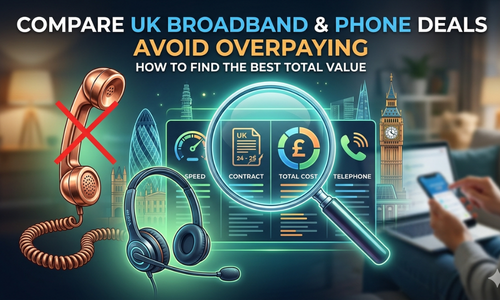
If you are searching for the best broadband and phone deals UK shoppers can genuinely trust, the smartest move is not to chase the lowest advertised monthly price. It is to understand exactly what is included, how long you are tied in for, whether calls are bundled in, and what the package could really cost over time. A broadband and phone deal can still be a good fit in 2026, but only if it matches how your household actually uses the internet and home calling. If you start by comparing total value instead of headline pricing, you are already in a much better position. You can compare package styles and offers more broadly through Broadband Freedom’s Broadband Comparison, Compare Broadband Deals, and Broadband Deals pages.
Quick answer: what you need to know before choosing a broadband and phone package
The best broadband and phone deals UK customers should consider are the ones that balance speed, contract flexibility, call usage, and real monthly cost. Some households still benefit from broadband and phone packages, especially if they want one bill and still use a home phone regularly. Others will save more by going broadband-only. Before choosing a deal, check the contract length, whether calls are actually included, any setup charges, and what happens after the initial promotional period ends. If you want a broad view of current offer types, start with Today’s Best Broadband Deals and Compare Broadband Prices.
Quick comparison table: what to check before you buy
| What to compare | Why it matters | What to watch out for |
| Monthly price | Helps you budget | Intro pricing can make a deal look better than it is |
| Contract length | Affects flexibility and switching freedom | Longer terms can lock you in |
| Calls included | Not every package includes useful call bundles | “Phone included” can still mean limited call options |
| Line rental | Impacts total value | Sometimes included, sometimes baked into the price |
| Setup fees | Changes the first-year cost | Cheap monthly deals can come with upfront charges |
| Price rises | Affects long-term affordability | Check if the price changes during or after the term |
Do you still need a broadband and phone package in 2026?
Sometimes yes. Sometimes no.
That is the honest answer.
Broadband and home phone bundles used to be the standard. For years, if you bought broadband, a landline often came with it, whether you wanted it or not. But the market has shifted. The traditional landline is gradually giving way to digital voice services, where calls are delivered over the broadband connection rather than the old copper phone network.
That change matters because people still search for the best broadband and phone provider, expecting the same kind of bundle they might have bought years ago. In reality, many broadband and phone packages UK households see today are structured differently. The phone element may still exist, but the technology behind it is changing.
Broadband Freedom already covers this transition in Do You Still Need a Landline in the Digital Age? and Why the Bell Tolls for Thee, O Landline. Both are useful if you want to understand why older-style bundles are changing and why that affects what you should buy now. For a more general look at the changing broadband landscape, Full Fibre vs Standard Fibre vs ADSL also helps frame how modern home connectivity is evolving.
So who still benefits from a broadband and phone package?
Usually:
- Households that still use a home phone regularly
- People who prefer a single bill
- Homes where the mobile signal indoors is poor
- Users who want evening, weekend, or anytime call bundles
- Older customers who feel more comfortable with a familiar home number
And who often does not?
- Younger households that rely almost entirely on mobile
- Streaming-first homes that barely use voice calling
- Renters who want flexibility
- Users are trying to keep costs as low as possible
The key is to be realistic. If the phone part of the bundle is not something you will genuinely use, it may not be adding value at all.
What is usually included in broadband and phone deals?
This is where small details make a big difference.
A package may sound simple. Broadband plus phone. Job done.
But once you look closer, you will usually find that there are several moving parts, and they are not always explained clearly enough.
Broadband speed and connection type
The broadband side of the deal still matters most. If the connection is not right for your household, the package is not right, no matter how good the call bundle sounds.
You should check:
- The connection type, such as standard fibre or full fibre
- The estimated speed for your property
- Whether the package is suitable for streaming, browsing, video calls, or remote work
- Whether the provider is offering an older entry-level package or a more future-proof service
If you are not sure what speed is suitable, Broadband Freedom has useful supporting content including Broadband Speed Comparison, Internet Speed, and The Ultimate Guide Internet Speed Test. These are helpful if you want to judge whether a package is genuinely suitable or simply cheap.
Anytime calls, evening and weekend calls, and call bundles
This is another area where people can make assumptions that cost them later.
Some packages include anytime calls. Others include evening and weekend calls. Some offer a basic phone line with calls charged separately. And some may offer optional extras rather than a built-in call bundle.
So when you see terms like:
- anytime calls
- weekend calls
- unlimited calls
- call add-on
- home phone included
Do not assume they all mean the same thing.
Broadband Freedom’s Call Bundles page is especially useful here because it helps explain the differences more clearly. If you are comparing deals and the wording feels vague, treat that as a sign to slow down and check the details.
Line rental, setup fees, and price rises
A lot of shoppers still ask whether line rental is a separate charge.
In some cases, the answer is not really anymore in the old-fashioned sense. Many providers now wrap these costs into the overall monthly price rather than showing them separately. But the principle still matters because you are still paying for the infrastructure and service, even if the wording has changed.
On top of that, there can be:
- setup or activation fees
- router delivery charges
- higher monthly pricing after the initial term
- in-contract price increases depending on the provider and package
Ofcom’s 2025 rules were designed to make mid-contract price rises clearer. Providers can no longer use vague inflation-linked wording in the same way for new contracts. Instead, any in-contract rises are supposed to be set out in pounds and pence more clearly before you sign up. That is an improvement, but it does not mean you should ignore the small print. It just means the pricing information should be easier to understand if you look for it.
Broadband Freedom’s Broadband Price Rises and Exit Fees and BT and EE Out-of-Contract Price Increases Explained are both worth reading if you want a better sense of how broadband pricing can shift over time.
How to compare the best broadband and phone deals without getting misled
This is the section most people actually need.
Because broadband shopping is not usually about finding a perfect deal. It is about avoiding a bad one.
The easiest way to do that is to compare broadband and phone packages using a few simple filters before you ever look at branding or marketing claims. You can start with Broadband Freedom’s Compare Broadband Deals page, then use the points below to judge what is genuinely competitive.
Check total monthly cost, not headline price
A package that looks cheaper is not always cheaper.
A provider might advertise a low monthly rate, but once you add setup fees, call extras, or a less useful contract structure, the value can disappear quickly.
Look at:
- Monthly price
- Any upfront charges
- Whether calls cost extra
- The total cost across the minimum term
That last part is important. A package at £24 per month with no setup fee can sometimes be better value than a package at £21 per month with hidden extras and a worse call bundle.
If you want to review broader pricing options, Pricing and Compare Broadband Prices are both relevant places to cross-check value.
Look at the contract length before anything else
A cheap package tied to a long commitment is not always a win.
For some households, a 12, 18, or 24-month term makes perfect sense. It can reduce the monthly rate and offer better overall value. But for renters, students, or anyone expecting life to change soon, a shorter term might be far more useful.
Broadband Freedom already has supporting pages around contract types, including Broadband Contract Lengths Explained, Compare 1 Month Rolling Broadband, Compare 12 Month Broadband Packages, Compare 18 Month Broadband Packages, and Compare 24 Month Broadband Packages. Those pages make useful internal references because they help readers move from general advice into practical comparison.
Check whether calls are actually included
This sounds obvious. But it catches people out all the time.
A deal may include a phone service without including the type of calling you actually want. That means you need to look for specifics:
- Are anytime calls included?
- Are evening and weekend calls included instead?
- Are calls charged separately?
- Is the home phone part only useful for incoming calls unless you add a bundle?
This matters a lot if you are searching for the best broadband and anytime calls deals UK rather than just a package with a token phone service attached.
Compare what happens after the initial deal ends
Many deals look strong during the promotional period. Fewer still look strong after that.
So ask:
- What does the package cost after the initial term?
- Can you switch easily?
- Does the provider tend to move customers onto higher out-of-contract rates?
- Are there renewal incentives later?
Broadband Freedom’s How to Switch Broadband Provider and Switching Broadband Providers are useful here because they help readers understand the next step if the package no longer represents good value.
When a broadband-only deal is better than a phone bundle
Not everyone needs a home phone anymore.
For many households, the best choice is simply broadband without the extra voice element. That can make comparison easier, cut costs, and avoid paying for something that barely gets used.
Broadband-only tends to make more sense for:
- younger households
- streaming-first homes
- people who rely almost entirely on mobile
- renters who want more flexible setup options
- users focused on speed and value rather than home calling
If that sounds more like your situation, Broadband Freedom’s Broadband Without Landline Phone and Broadband Without Landline are strong next reads. There is also Broadband With No Phone if you want a more direct breakdown of package style.
This is particularly relevant for streaming-first homes. If most of your household activity is Netflix, YouTube, gaming, remote work, or scrolling on mobile, the real focus should be reliability and speed, not call bundles. In that case, the better question is not “Which phone package should I pick?” It is “Which broadband package gives me the best performance for the money?”
Best broadband and phone deal types for different households
There is no universal best package.
There is only the best fit for the way you live.
Light users
If your household mainly uses broadband for browsing, email, online shopping, and occasional streaming, you may not need an expensive broadband and phone package.
A lower-speed fibre deal with simple call options may be enough. The main risk here is overbuying. Plenty of people pay for faster broadband than they need and then barely use it.
Helpful supporting reads here include Best Broadband Plan and Monthly Plans.
Families
Families usually need a bit more.
More devices. More streaming. More background usage. More chances for frustration if the package is underpowered.
For family homes, it often makes sense to choose a reliable fibre package first, then decide whether the phone component adds real value. If grandparents in the home still use a home phone, or if a single family bill is easier to manage, the package approach can still work well.
Pages like Broadband and TV Packages and Compare Latest Broadband With TV Packages can also help households that are comparing bundled services more broadly.
Older households wanting simple calling
This is one of the clearest cases where a broadband and phone package can still make sense.
If the home phone is still used regularly, the convenience of a straightforward package with clear call options can be worth it. Especially if the aim is simplicity rather than shaving every last pound off the bill.
Broadband Freedom has a directly relevant resource here: Broadband and Phone Deals for Pensioners: Your Simple Money-Saving Guide. It is a natural internal link because it helps extend this article into a more specific audience need.
Households trying to cut monthly bills
If the main goal is savings, then it becomes a balancing act.
A broadband and phone package can save money if:
- you genuinely use the call bundle
- the contract term suits you
- the provider is competitive over the full term
- you are not paying extra for features you do not need
But it can also cost more than a broadband-only deal plus your mobile setup.
That is why households focused on saving should compare both routes. Do not just compare one broadband-and-phone deal against another. Compare it against a broadband-only option too.
Useful related pages here include Cheap Broadband Deals, Best Broadband Deals, and Why a Broadband Package Comparison Beats Staying Put.
FAQs about broadband and phone packages
For broader questions beyond these, Broadband Freedom’s FAQ page is a useful supporting link.
Is line rental still a thing?
Yes, but not always in the old way people think about it. In many cases, the cost that used to appear clearly as line rental is now wrapped into the overall package price. You are still paying for the underlying service, but providers may present it differently depending on the package structure.
Can I get broadband and phone without a traditional landline?
Yes. Many modern phone services now run through broadband using digital voice rather than the old copper landline system. So you can still have home calling without the traditional setup people used to associate with a landline. The wording may look familiar, but the technology behind it is changing.
Are broadband and phone deals cheaper than broadband-only?
Sometimes, but not always. If you regularly use a home phone and the package includes the right call bundle, it can offer good value. But if you barely use the phone element, a broadband-only deal may work out cheaper overall. The only reliable way to know is to compare total cost, not just the monthly headline figure.
Which contract length is best?
It depends on your priorities. Shorter contracts offer flexibility and are often better for renters or uncertain living situations. Longer contracts can reduce monthly cost and sometimes offer better value over time. The best option is the one that matches how long you realistically want to stay with the provider and property.
Recommended next steps
The UK market for broadband and phone bundles is not impossible to understand. It is just easy to rush.
And that is where people get caught out.
The right deal is usually the one that matches your real usage, not the one with the loudest promotion. If you still use a home phone often, want one simple bill, or prefer call-inclusive peace of mind, a broadband and phone package can still make sense in 2026. But if the phone element is mostly going unused, broadband-only may be the smarter and cheaper route.
So before choosing anything:
- compare total cost, not just the monthly price
- check contract length carefully
- confirm exactly what calls are included
- look at what happens after the initial offer ends
- weigh package deals against broadband-only alternatives
That is the best way to find the best broadband and phone deals UK readers are actually happy with once the first bill arrives.
For the next step, start with Compare Broadband Deals, review Broadband Comparison, and explore Today’s Best Broadband Deals to narrow down what fits your home best.