Student Broadband with No Upfront Costs: The 2026 UK Guide

Why should your first week at university be defined by a drained bank account? Moving into a new flat is notoriously expensive, with deposits and initial rent payments often swallowing your budget before you’ve even attended a lecture. We understand that managing these move-in costs is a significant hurdle for most UK students. This 2026 guide shows you how to secure high-speed student broadband with no upfront costs, ensuring you stay connected for streaming and seminars without paying a single penny in activation fees.
You deserve a connection that offers both reliability and financial liberation. We will explore the latest 12-month and rolling contract options from major providers, whilst explaining how to avoid hidden charges amongst complex terms. We also examine Ofcom regulations regarding price transparency to ensure your monthly bill remains predictable. According to ONS data, financial pressures remain a top concern for students, making these zero-upfront deals essential. By the end of this article, you’ll know exactly how to bypass setup fees and maintain the flexibility your academic life demands.
Key Takeaways
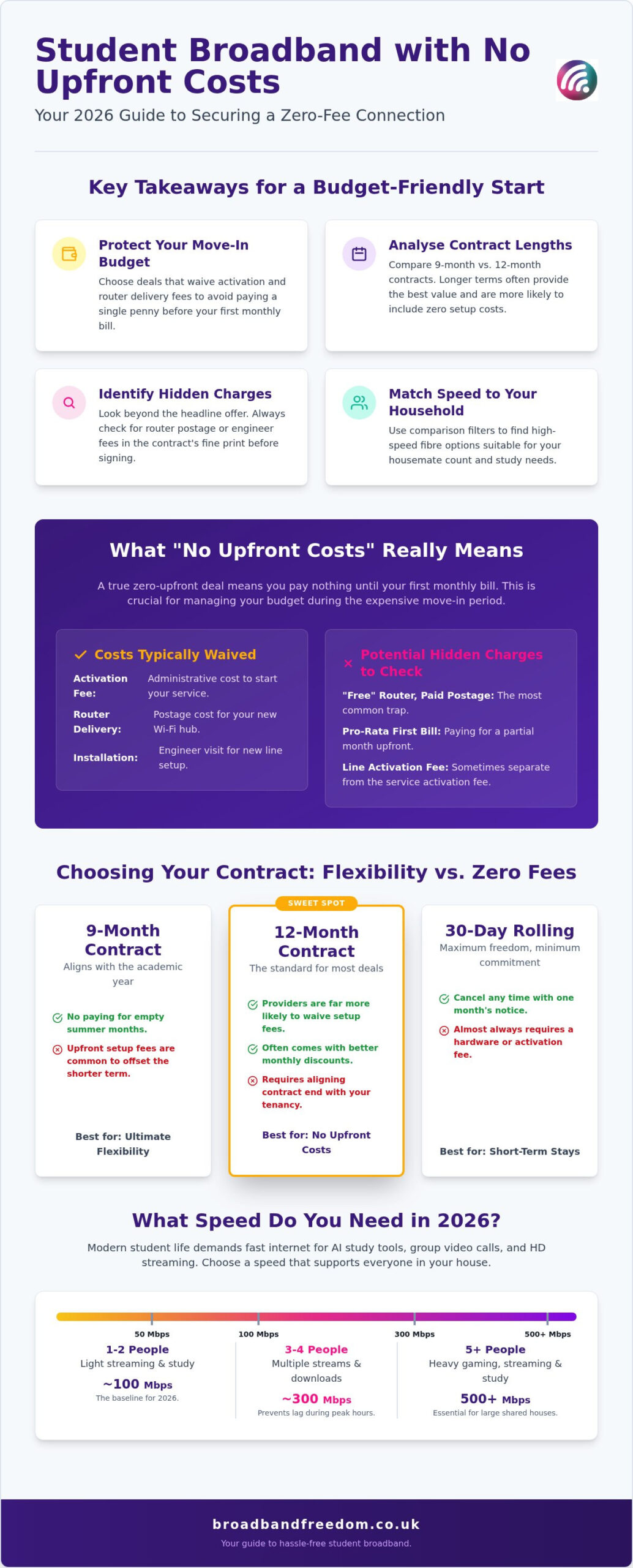
- Secure student broadband with no upfront costs by selecting deals that waive activation and router delivery fees to protect your initial move-in budget.
- Analyse the trade-offs between 9-month academic terms and 12-month contracts to find the best balance of flexibility and long-term value.
- Identify hidden charges such as router postage and engineer fees whilst utilising Ofcom’s price rise regulations to predict your total contract spend accurately.
- Apply targeted filters on comparison platforms to match high-speed fibre options with your household’s specific user count and study requirements.
Understanding Student Broadband with No Upfront Costs
When we talk about student broadband with no upfront costs, we refer to deals where the provider waives the activation fee, router delivery charges, and professional installation costs. Within the UK’s internet landscape, these incentives are becoming the standard for 2026 as providers compete for younger customers. This shift removes the initial financial barrier to getting online. Don’t forget to verify the small print for hidden delivery fees. Some companies claim zero setup but still charge for the physical router shipment. Finding a truly free start requires a quick check of the terms before you commit.
Why Cash Flow Matters in the First Term
Financial pressure peaks during the autumn move-in period. According to ONS student income data, managing initial outgoings like rental deposits and tuition fees leaves very little room for extra expenses. Avoiding a £35 to £60 setup fee isn’t just about saving money; it’s about better cash flow management. That saved amount can fund a week of groceries or essential textbooks whilst you wait for your loan. You can use the Broadband Freedom comparison tool to filter specifically for these zero-fee options and keep your bank balance intact.
Speed Requirements for 2026 Student Life
Modern academic life relies heavily on high-speed connectivity. With the rise of AI study tools and high-definition lecture streaming, 100Mbps is now the baseline for most shared houses. If you’re living with three or more people, you’ll need even more bandwidth to prevent lag during peak evening hours. Use our Broadband Freedom speed test to see what your connection delivers. Knowing your actual usage helps you select a plan that is both fast enough for your household and affordable enough for your budget.
Comparing Contract Lengths and Setup Fee Trade-offs
Choosing the right duration is as critical as selecting the speed. You’ll typically choose between 9-month academic terms, standard 12-month agreements, or 30-day rolling options. Whilst 30-day deals offer the most freedom, they almost always require a hardware or activation fee. To secure student broadband with no upfront costs, you must analyse how providers balance contract length against initial fees. Shorter commitments usually mean you pay more on day one to cover the provider’s equipment costs.
The 9-Month Academic Contract Pros and Cons
These plans align perfectly with your university year. You won’t pay for July and August when the house is empty. However, this convenience comes at a price. Because the provider has less time to recoup their investment, they often charge for setup or router delivery. Zero upfront fees are much rarer on these shorter terms. If you choose this route, calculate the total cost over nine months to see if the flexibility actually justifies the initial layout. Many students find that the setup fee outweighs the summer savings.
12-Month Deals: The Sweet Spot for Zero Fees
A 12-month commitment is often the most effective way to find student broadband with no upfront costs. Providers prefer the security of a full year and are far more likely to waive setup charges to win your business. Align your contract end date with your move-out date next summer to avoid early exit fees. Look for special student promotions that typically launch in August. These limited-time offers often combine zero setup fees with monthly discounts. You can compare these latest student offers today to see which contract length suits your household budget best.
Avoiding Hidden Charges and Setup Traps amongst “Free” Deals
Identifying student broadband with no upfront costs requires a sharp eye for the fine print. Whilst a headline might scream “£0 setup”, you could still face charges for router postage or line activation. These administrative fees often bypass the main marketing claims, appearing only at the final checkout stage. Always check the total cost of the first month to ensure no surprise line activation fees appear on your statement.
Hardware and Router Delivery Fees
Distinguishing between free installation and free delivery is vital. Installation usually refers to an engineer visit, whereas delivery covers the courier cost for your router. An activation fee is the administrative cost of turning on the signal at the exchange. If a provider waives the activation but charges for the router, it isn’t a truly zero-upfront deal. Verify these specific line items in the “Key Information Document” provided by all Ofcom-regulated providers before you sign.
Credit Checks and International Students
Many zero-upfront deals are strictly tied to a successful credit score. If you’re an international student without a UK credit history, you might be asked for a deposit or rejected entirely. Look for providers that offer “no credit check” options or rolling monthly plans, even if they have a small setup fee. This avoids the frustration of a failed application during move-in week.
Managing Mid-Contract Price Hikes
Mid-contract price hikes are a standard feature in 2026. These must now be stated in pounds and pence rather than confusing percentages. This clarity helps you budget for the entire academic year without unexpected shocks. To find the most transparent options, compare student broadband deals that explicitly list all potential cost increases and offer fixed-price guarantees where possible.
How to Secure the Best Zero Upfront Deal in 2026
Securing the right deal requires a systematic approach. First, use the Broadband Freedom comparison tool and apply the filter for “No Upfront Cost”. This immediately strips away options that demand immediate payment. Next, verify your household’s bandwidth needs. Whilst 100Mbps is a solid starting point for most, larger shared houses often require higher tiers to maintain performance across multiple devices. Finally, look for “Free Gift” incentives. These vouchers can act as a financial buffer, effectively reducing your total spend over the first term.
Using the One Touch Switch Regulation
The 2026 legal landscape has simplified the switching process significantly. Under Ofcom’s “One Touch Switch” regulation, your new provider is now legally required to manage the cancellation of your old service. This is a game-changer for students moving between properties. It removes the stress of coordinating end dates and prevents the risk of overlapping bills. You won’t have to worry about double payments during your first month. This streamlined transition ensures your internet is ready the moment you unpack your laptop, letting you focus on your studies instead of admin.
Maximising Value with Student Vouchers
Many providers sweeten their zero-upfront deals with high-value vouchers for Amazon, UberEats, or high-street retailers. Exploring Broadband with free gifts can often make the first few months of your service feel free. These incentives are designed specifically for the student market during the peak August and September period. Always check the expiration dates on these digital codes. Some vouchers must be redeemed within 30 or 60 days of your connection going live. Using these strategically allows you to secure student broadband with no upfront costs whilst gaining extra spending power for your flat.
Secure Your Connection for the 2026 Academic Year
Your university experience should be defined by your studies and social life, not by the stress of initial setup fees. By choosing student broadband with no upfront costs, you protect your bank balance during the expensive move-in period. We have explored how the 2026 One Touch Switch regulation removes the administrative burden of switching providers, ensuring a seamless transition into your new flat. Remember to look for 12-month deals that offer the best balance of zero-fee incentives and reliable fibre speeds.
Take Control of Your Term-Time Budget
Combining these deals with voucher incentives can significantly reduce your total contract spend. We’ve done the heavy lifting by researching the market to bring you daily updated 2026 pricing and expertly researched student guides. You can find your perfect no-upfront-cost student deal today by comparing over 30 top UK providers in one place. Take control of your home setup and start your term with the high-speed internet your uni life demands. You’re now ready to stay connected without the financial strain.
Frequently Asked Questions
Is student broadband really cheaper than standard deals?
Student broadband deals are specifically designed to be more affordable by offering lower monthly rates or bundled vouchers. Whilst standard contracts often lock you into 24-month terms, student options provide the flexibility of 9 or 12-month commitments. These plans frequently include incentives like high-street vouchers which effectively lower your total spend. You’ll find that student broadband with no upfront costs provides immediate financial relief compared to traditional household packages.
Can I get student broadband without a credit check?
Securing a connection without a credit check is possible, though your options may be limited to rolling monthly contracts. International students often prefer these plans to avoid the requirement for a UK credit history. Some providers might ask for a small security deposit in place of a check. It’s best to filter for “no credit check” options on comparison sites to find facilitators who prioritise accessibility over rigid financial scoring.
What happens to my broadband contract during the summer holidays?
Your responsibility during the summer depends entirely on your chosen contract length. If you signed a 9-month academic plan, the service will terminate automatically as you move out. For 12-month contracts, you must continue payments until the term ends, even if the property is empty. Some students mitigate this by finding a housemate to stay over summer or by choosing a plan that aligns with their specific tenancy dates.
Are there any truly “no upfront cost” deals for 9-month contracts?
Truly zero-fee setups are less common on 9-month contracts because providers have less time to cover their equipment and installation costs. Most student broadband with no upfront costs is found on 12-month terms where providers offer more aggressive incentives. However, during the peak August and September period, some specialist providers waive setup fees on academic plans to attract new students. Always check the final checkout page for hidden router delivery charges.
How long does it take to get student broadband installed in 2026?
Most providers aim to complete your installation within 10 to 14 working days. If your property already has an active line, the process can be much faster. Under the 2026 One Touch Switch regulations, your new provider handles the entire transition, which significantly reduces downtime. We recommend ordering your service at least two weeks before your move-in date to ensure your WiFi is active the moment you arrive.

Article by
Elaine Lang
Elaine has over 20 years across Marketing, Communications and Public Relations in the UK. She has worked across large UK corporations, including Commercial Banks and Airports, to online consumer finance and technology solutions. Elaine has post graduate qualifications in Marketing from the Chartered Institute of Marketing (CIM) and the Industry of Direct Marketing (IDM). She is a lifelong feline fan, sharing her home with around 4-6 cats for many years. This of course can be a challenge when trying to work at home, as they like to try to help!