Social Tariff Broadband: How to Qualify and Switch in 2026

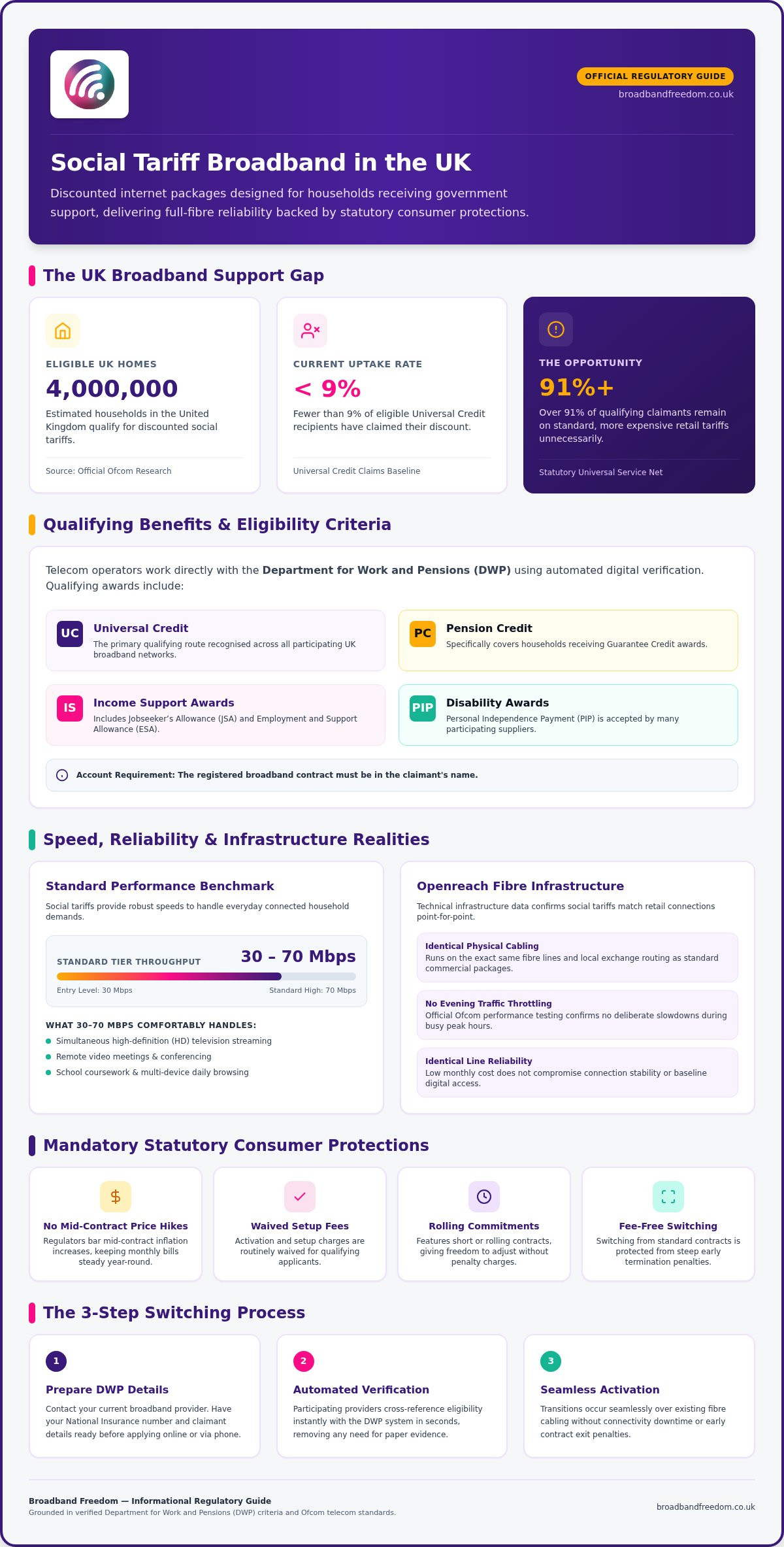
An estimated four million UK households qualify for discounted internet, yet fewer than 9% of Universal Credit recipients have actually claimed it. If you’re struggling with rising utility bills, switching to social tariff broadband offers an immediate way to trim monthly expenses without sacrificing connection quality. It’s completely natural to worry that cheaper packages mean sluggish speeds, or that your current provider will hit you with steep early exit fees. However, these tariffs run on the exact same fibre infrastructure as standard deals, backed by firm regulatory protections against mid-contract price hikes.
We understand the frustration of confusing eligibility rules. This guide cuts through the Department for Work and Pensions criteria so you can quickly confirm your status, protect your household budget, and switch penalty-free. You’ll discover who qualifies, how easy it is to keep a fast, dependable connection, and the straightforward steps to take control of your broadband today.
Key Takeaways
- Learn which DWP benefits qualify you for social tariff broadband and how automated checks streamline approval.
- Discover why discounted tariffs deliver the exact same speeds and reliability as standard commercial fibre packages.
- Master the step-by-step switching process to sidestep setup charges, mid-contract price hikes, and early exit penalties.
- Explore flexible, low-cost fibre and no-contract alternatives if your household does not currently receive qualifying benefits.
What Is Social Tariff Broadband and Who Qualifies?
Social tariffs represent heavily discounted internet contracts designed for households receiving government support. While standard retail prices continue climbing, official Ofcom research reports reveal that millions of qualifying homes remain on unnecessarily expensive tariffs. These low-cost packages exist to guarantee baseline digital access across the country without compromising everyday connection quality.
Understanding National Telecom Safety Nets
Regulated by government policy, social tariffs align with the statutory universal service obligation to ensure affordable communication for everyone. Telecom operators coordinate directly with the state to verify applicant claims swiftly. Using secure digital verification, the Department for Work and Pensions confirms applicant details in seconds, removing paperwork hassles.
Qualifying Benefits and Eligibility Criteria
The primary route into social tariff broadband is through Universal Credit, which all participating UK providers recognise. You can also qualify through several other key state awards:
- Universal Credit: The standard qualifying route across all participating networks.
- Pension Credit: Specifically Guarantee Credit awards.
- Income support: Including Jobseeker’s Allowance (JSA) and Employment Support Allowance (ESA).
- Disability awards: Many networks also accept Personal Independence Payment (PIP).
The registered broadband account must be in the claimant’s name.
Core Consumer Protections and Perks
Beyond low monthly bills, social tariffs provide mandatory statutory consumer safeguards. Regulators bar providers from enforcing mid-contract inflation price hikes, keeping bills steady year-round. Setup fees are routinely waived, and contracts feature short or rolling commitments. This structure gives you the freedom to adjust or cancel without facing penalty charges.
Broadband Speed and Performance on Social Tariffs
A frequent consumer concern is that discounted packages equate to sluggish internet. In practice, social tariff broadband relies on the exact same physical cabling as premium retail options. According to technical infrastructure data from Openreach network performance updates, entry-level fibre lines share identical local exchange routing, ensuring reliable throughput regardless of contract cost.
Everyday Internet Performance Realities
Standard connections delivering 30Mbps to 70Mbps comfortably handle simultaneous high-definition television streaming, remote video meetings, and school coursework. Official performance testing published by Ofcom guidance on social tariffs confirms that line reliability matches standard contracts point for point, meaning households experience no deliberate traffic throttling during busy peak evening hours.
Choosing Between Standard and Faster Fibre Tiers
Evaluating connected device volume is critical before selecting an appropriate speed profile. While modest speeds suit everyday browsing, busier family homes often require extra bandwidth to prevent buffering. If your household demands specialist high-tier capacity, you can explore independent market options and compare broadband deals nationwide to secure generous data allowances on terms that fit your family’s routine.
How to Switch to a Social Tariff Without Hidden Fees
Moving onto a discounted plan is simple when following established procedures. Regulators ensure that moving across causes minimal fuss, while official Ofcom guidance on cheaper broadband and phone packages mandates that major UK suppliers facilitate hassle-free transitions for qualifying households.
Navigating Provider Switching Rules
Contact your current broadband provider directly and ask specifically for their social tariff. Under industry agreements documented in Department for Business and Trade consumer reports, leading suppliers allow existing customers to move onto social tariff broadband without early exit penalties. If your current supplier lacks a dedicated package, request a fee-free contract release so you can take your business elsewhere.
Automated DWP Verification and Setup
Have your National Insurance details prepared before calling or applying online. Participating networks cross-reference your eligibility instantly through the automated Department for Work and Pensions verification system. This digital check bypasses cumbersome paperwork, ensuring immediate sign-off. Service transitions happen seamlessly over existing lines, meaning you won’t suffer connectivity downtime during the switch.
Reviewing Alternative Market Options
If your provider refuses to cooperate or their speeds don’t suit your household, you hold the freedom to switch suppliers. Take a moment to compare broadband deals to find flexible terms that fit your budget and keep you in total control.
Alternative Budget Options If You Do Not Qualify
Missing the criteria for state support doesn’t mean you’re locked out of competitive connectivity. While social tariff broadband provides crucial relief for eligible households, the wider UK telecoms market remains aggressively competitive. Budget-conscious consumers can capitalise on entry-level fibre promotions, challenger networks, and bundled allowances to keep household utility costs low without sacrificing dependable broadband performance.
Flexible Contracts and Budget Fibre Alternatives
Households prioritising financial agility should explore no contract broadband deals to avoid lengthy multi-year commitments. Independent alternative networks and challenger brands frequently run aggressive introductory discounts across standard and full fibre plans. If your living situation involves renting or regular relocations, these monthly rolling arrangements deliver complete freedom from painful early cancellation fees.
Take Control of Your Household Connectivity
Auditing your actual internet usage helps you stop overpaying for excessive, unused bandwidth. Most standard homes thrive on 30Mbps to 60Mbps fibre lines, making expensive gigabit packages an unnecessary expense. Maximise your monthly budget with these practical steps:
- Right-size your speed: Pick a tier matching your real everyday habits rather than premium peak claims.
- Combine services: Link landline or mobile SIM plans to secure combined multi-product account discounts.
- Shop the whole market: Regularly review independent listings to catch fresh promotional introductory offers.
Ready to secure better terms? Take a few minutes to compare broadband deals across up to 30 top UK providers and discover the ideal balance between speed, flexibility, and affordability.
Take Control of Your Broadband Bills Today
Switching to a social tariff broadband package offers a dependable route to lowering monthly utility bills without compromising speed or risking mid-contract price hikes. With automated DWP checks and fee-free switching rules, securing these discounted rates is straightforward for eligible households. Even if you don’t qualify for state support, you aren’t stuck with expensive standard contracts.
Compare Flexible Options for Your Home
Finding the right plan comes down to matching your household’s real digital needs with transparent terms. Broadband Freedom offers an independent comparison across up to 30 leading UK broadband providers, showcasing daily updated packages covering standard, superfast, and full fibre connections. Take charge of your monthly outgoings now. Find affordable broadband deals tailored to your lifestyle and keep your home connected with complete peace of mind.
Frequently Asked Questions
Can I get social tariff broadband if I am currently in a fixed contract?
Yes, you can usually switch to social tariff broadband even during an existing fixed contract. If your current supplier provides a social package, Ofcom rules require them to let you move across immediately without penalty. If they don’t provide an essential tariff, contact customer support directly. Many network operators will waive remaining contract periods and allow you to leave for another participating provider without incurring early cancellation fees.
Does switching to a social broadband tariff affect my internet speed?
No, moving to a discounted tariff won’t degrade your line quality or reliability. Social packages use the exact same physical fibre infrastructure, exchanges, and Wi-Fi router hardware as standard residential deals. Your connection will not experience deliberate traffic throttling or slowdowns during peak evening hours. Most providers supply reliable superfast fibre connections that comfortably handle continuous web browsing, video conferencing, and multi-device streaming for typical family routines.
Which state benefits make me eligible for social tariff broadband packages?
Universal Credit is the main qualifying benefit across all participating UK telecom providers. You can also qualify if you receive Pension Credit Guarantee Credit, Income Support, income-based Jobseeker’s Allowance (JSA), or income-related Employment and Support Allowance (ESA). In addition, several suppliers accept Personal Independence Payment (PIP) and Attendance Allowance. The broadband account must be registered in the name of the person receiving the qualifying benefit.
Will I be forced to pay early termination fees when switching to a social tariff?
You won’t have to pay early termination charges if you switch internally with your current broadband provider. Under regulatory standards, major telecom brands must move eligible customers onto their discounted tariffs completely free of charge. If your existing supplier doesn’t offer a qualifying social package, request a fee-free release so you can transfer your home service to an alternative provider that does support social plans.
Do social tariff broadband plans include annual mid-contract price increases?
No, social tariff broadband plans are legally protected against annual inflation price hikes. Unlike standard commercial broadband contracts that routinely increase each spring, social tariffs keep their rates fixed throughout your agreement. In addition, setup charges are usually waived and contract lengths remain flexible, meaning you can adjust your package or switch away at any time without facing unexpected penalties if your financial situation alters.

Article by
Elaine Lang
Elaine has over 20 years across Marketing, Communications and Public Relations in the UK. She has worked across large UK corporations, including Commercial Banks and Airports, to online consumer finance and technology solutions. Elaine has post graduate qualifications in Marketing from the Chartered Institute of Marketing (CIM) and the Industry of Direct Marketing (IDM). She is a lifelong feline fan, sharing her home with around 4-6 cats for many years. This of course can be a challenge when trying to work at home, as they like to try to help!