Best Value Broadband Deals 2026: The Ultimate UK Savings Guide

Did you know that the average UK household could save £183.60 every year just by switching their internet provider? It’s a significant figure, yet millions remain on expensive, out-of-contract plans. We understand that finding the best value broadband deals amongst thousands of packages feels like an impossible chore when you are faced with confusing terms like ‘Full Fibre’ and ‘Superfast’, or the constant worry of peak-time slowdowns.
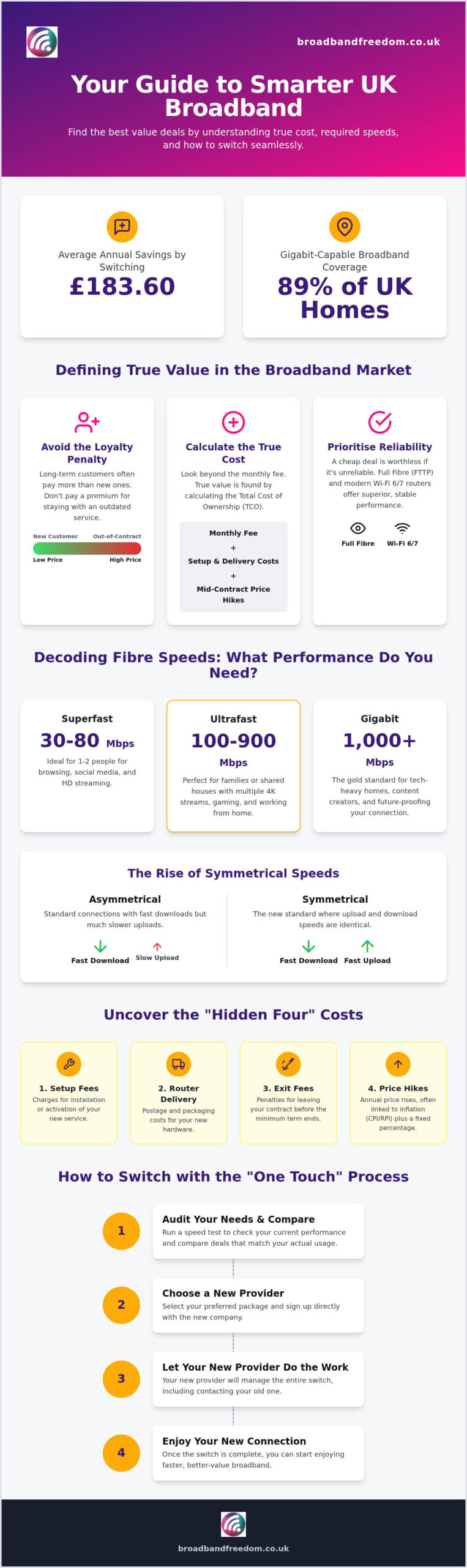
You deserve a reliable connection for streaming and remote work without the stress of hidden setup fees or unexpected price hikes. This guide simplifies your search by identifying packages with clear, upfront costs and robust speeds that actually deliver. We will explore the impact of the latest Ofcom switching rules, compare the top market providers, and provide the evidence-based tips you need to secure a high-speed connection that fits your budget perfectly. According to government data, gigabit-capable broadband reaches 89% of UK homes, making it easier to find a superior service for less.
Key Takeaways
- Identify true value by balancing connection reliability with contract flexibility, ensuring you are not paying a loyalty penalty for an outdated service.
- Audit your actual usage requirements with a speed test to ensure you secure the best value broadband deals without paying for performance you do not need.
- Uncover the “Hidden Four” costs, including setup fees and mid-contract hikes, to calculate the genuine total price of your broadband contract.
- Utilise the “One Touch Switch” process to transition to a new provider seamlessly, leaving your new company to handle the administrative heavy lifting.
Defining True Value in the 2026 UK Broadband Market
In 2026, the best value broadband deals aren’t just about the lowest monthly price. True value combines consistent speed, high reliability, and the flexibility to leave if your circumstances change. Many providers offer enticing introductory rates that skyrocket after 18 or 24 months. This is the loyalty penalty, where long-term customers end up paying significantly more than new ones. Avoid this by adopting a Total Cost of Ownership (TCO) mindset. TCO calculates the monthly fee, setup costs, and any scheduled price increases over the entire contract term to find genuine value.
Why Price Isn’t the Only Factor for Value
Reliability is the cornerstone of value. A cheap connection that drops during a crucial meeting is a poor investment. High-quality hardware, such as Wi-Fi 6 or 7 routers, ensures you actually receive the speeds you pay for. Full Fibre (FTTP) technology has become the baseline for value-seekers because it offers far fewer faults than older copper lines. Finding the best value broadband deals means looking beyond the monthly fee to the hardware and service quality behind the connection, ensuring your home remains connected when it matters most.
Understanding the 2026 Broadband Landscape
The UK broadband landscape has shifted dramatically. Government data shows that gigabit-capable broadband now reaches 89% of UK homes, making high-speed infrastructure more accessible than ever. This widespread rollout has increased competition, driving down the cost of premium tiers. You can now compare broadband deals that offer ten times the speed of previous generations for a similar monthly outlay. By understanding these trends, you can secure a future-proof connection without overspending on outdated technology or restrictive contracts.
Decoding Fibre Speeds: What Performance Do You Actually Need?
Understanding the difference between Superfast, Ultrafast, and Gigabit speeds is vital for finding the best value broadband deals. Superfast connections usually range from 30Mbps to 80Mbps, whilst Ultrafast reaches up to 900Mbps. Gigabit services exceed 1,000Mbps. Before upgrading, use a broadband speed test to audit your current performance. You may discover that your current hardware, rather than the connection itself, is the bottleneck. Upload speed is also a critical value factor often ignored. High upload rates ensure smooth video calls and fast cloud backups, which are essential for modern digital lives.
Matching Speed to Your Household Size
Household size and habits dictate your bandwidth needs. A single occupant might find 50Mbps sufficient for HD streaming and browsing. In contrast, a shared house with multiple occupants requires at least 500Mbps to avoid peak-time buffering. Each 4K stream consumes approximately 25Mbps, and smart home devices add constant background demand. If you work from home, having a buffer of extra speed prevents your connection from stalling during critical meetings. Checking your requirements first ensures you don’t overpay for unused capacity when you compare broadband deals online.
The Rise of Symmetrical Speeds in 2026
Symmetrical speeds, where upload and download rates are identical, represent the new gold standard for value. Most traditional providers offer asymmetrical connections, giving you fast downloads but frustratingly slow uploads. Symmetrical connections provide superior value for gamers, creators, and heavy cloud users. These features are typically offered by specialised Full Fibre providers. For guidance on moving to these advanced services, refer to the Citizens Advice switching guide. Transitioning to a provider that offers these premium features can significantly enhance your daily online experience without necessarily increasing your monthly costs.
The Strategy of Comparison: Uncovering Hidden Costs
Finding the best value broadband deals requires looking beyond the headline price. You must account for the “Hidden Four”: setup fees, router delivery charges, exit fees, and mid-contract price hikes. Whilst some providers offer low monthly rates, these secondary costs can erode your savings. If you value flexibility, no-contract broadband allows you to switch without penalties. Alternatively, broadband and phone packages often provide better value by consolidating your communication bills into a single, discounted monthly payment. Factoring in every fee ensures your budget remains protected.
Avoiding the Mid-Contract Price Hike Trap
Since January 2025, Ofcom has banned confusing percentage-based price hikes like CPI plus 3.9%. Providers must now state any increases in clear pounds and pence at the point of sale. This transparency makes it easier to calculate the total cost of your contract. Look for fixed-price providers that guarantee no increases for the duration of your term. These deals offer the highest level of financial predictability. Always check the small print for scheduled rises, as even a small monthly increase adds up over a typical 24-month agreement. Savvy research helps you avoid these common financial pitfalls.
Incentives and Free Gifts: Are They Worth It?
Reward cards and vouchers are common in the UK market. To find the true value, calculate the “effective monthly cost” by subtracting the gift value from the total contract price. For example, a £100 voucher on a 12-month deal effectively saves you £8.33 per month. However, don’t let a one-off gift distract you from a high base price or poor service ratings. Focusing on the long-term cost ensures you get the most for your money. To see how these incentives stack up against current rates, you can compare broadband deals from over 30 providers today.
How to Switch and Secure Your New Deal
The ‘One Touch Switch’ (OTS) process, mandated by Ofcom since September 2024, has revolutionised how you move between providers. It removes the need to contact your old company; your new provider handles the entire cancellation and setup. Before you start, use a full fibre availability tool to see which networks reach your door. This ensures you are targeting the best value broadband deals available in your specific area.
Step-by-Step Guide to a Seamless Switch
Follow these three steps for a frictionless transition. First, audit your current contract to check for any remaining time or exit fees. Second, compare broadband deals to find a package that matches your speed and budget requirements. Third, place your order. Your new provider will then coordinate the switch date with your existing ISP. This collaborative process is designed to ensure you only experience a few minutes of downtime during the actual handover.
What to Do if You Encounter Issues
On the day of the switch, keep your old router connected until the new service goes live. Once active, run a speed test immediately to verify you are getting the promised performance. Remember, you have a 14-day cooling-off period under the Consumer Contracts Regulations if the service doesn’t meet expectations. Finally, return any old equipment promptly. Most providers charge significant fees if routers aren’t sent back within 30 days. Securing the best value broadband deals involves following through on these administrative details to avoid unnecessary costs.
Keep the return postage receipt as proof of delivery. This small step protects you from disputes later. By staying organised and informed, you can enjoy your new high-speed connection with total peace of mind.
Secure Your Future-Proof Connection
Finding the right internet package doesn’t have to be a source of stress. By focussing on the total cost of ownership and auditing your actual speed requirements, you can avoid the loyalty penalty that exists amongst many providers. The 2026 market is built on transparency; pounds and pence price clarity and the seamless One Touch Switch process make it easier than ever to upgrade your home setup. You now have the autonomy to choose a service that fits your lifestyle without being tethered by hidden fees.
Compare and Save Today
We’ve done the heavy lifting by researching the market so you don’t have to. You can now Compare the best value broadband deals today across more than 30 leading UK providers. Our expert guides and transparent cost breakdowns ensure you see the full picture before committing. Start your journey towards a faster, more reliable connection and enjoy the financial relief that comes with a smarter contract. Your ideal connection is just a few clicks away.
Frequently Asked Questions
What is considered a good value broadband speed in 2026?
A good value speed in 2026 typically starts at 150 Mbps for average households. This provides enough bandwidth for multiple 4K streams and remote working without interruption. According to GOV.UK, gigabit-capable coverage is now a national standard, and for larger families, 500 Mbps or higher represents the best value broadband deals. Aim for a speed that matches your peak usage to avoid overpaying for bandwidth you cannot utilise.
How do I avoid mid-contract price increases on my broadband?
Seek out providers that offer fixed price guarantees for the duration of your contract. Since the January 2025 Ofcom ruling, any increases must be stated in pounds and pence rather than confusing percentages. You can filter for these fixed-rate options when comparing packages. Choosing a provider that commits to no mid-term rises is the most effective way to protect your monthly budget from inflation-linked adjustments.
Can I get high-speed broadband without a long-term contract?
Yes, many specialist providers now offer high-speed Full Fibre on rolling monthly contracts. These plans provide maximum flexibility, allowing you to switch or cancel with just 30 days’ notice. Whilst setup fees might be higher for these flexible options, they offer superior value if you are in temporary accommodation or anticipate a change in your living situation. This autonomy ensures you aren’t trapped in a restrictive 24-month agreement.
Is it cheaper to bundle my broadband with TV and phone services?
Bundling is often cheaper if you already use premium TV and landline services. Consolidating these into one package can lead to a lower total monthly outlay compared to paying three separate providers. However, always calculate the combined cost against standalone fibre deals and separate streaming subscriptions. Sometimes, the best value broadband deals are actually found by keeping your internet connection separate from your entertainment and landline phone requirements.
What happens if my broadband speed is slower than advertised?
Most major UK providers sign up to the voluntary Code of Practice on broadband speeds. If your connection consistently falls below the minimum guaranteed speed promised at the point of sale, your provider has 30 days to fix the issue. If they fail to resolve the slowdown, Citizens Advice notes you have the legal right to exit your contract without paying any early termination fees.

Article by
Elaine Lang
Elaine has over 20 years across Marketing, Communications and Public Relations in the UK. She has worked across large UK corporations, including Commercial Banks and Airports, to online consumer finance and technology solutions. Elaine has post graduate qualifications in Marketing from the Chartered Institute of Marketing (CIM) and the Industry of Direct Marketing (IDM). She is a lifelong feline fan, sharing her home with around 4-6 cats for many years. This of course can be a challenge when trying to work at home, as they like to try to help!