What broadband speed do you need for your UK home?
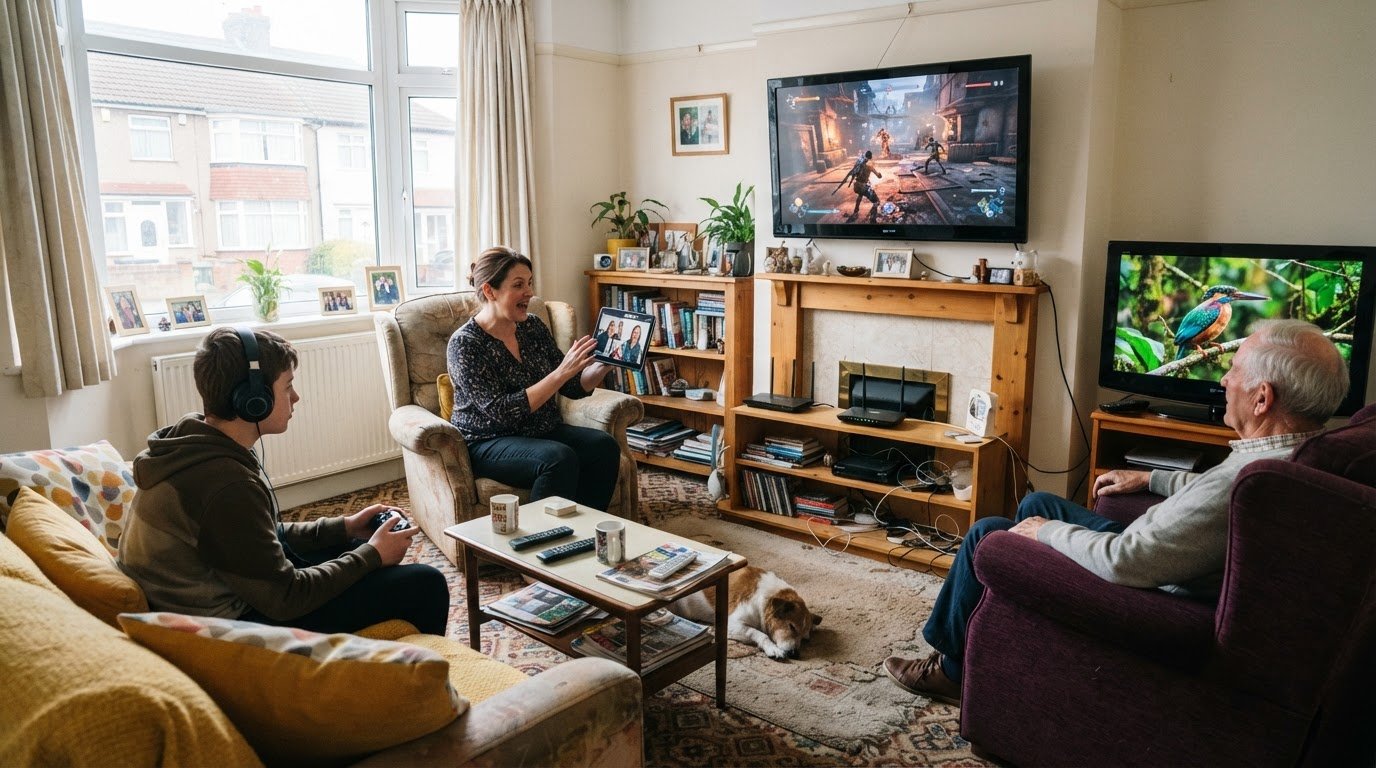
The fastest broadband package isn’t automatically the right one for your home. If you’re wondering what broadband speed you need in the UK, at least 50 Mbps is a useful starting point for a smooth online experience in most households. Your ideal speed depends on how many people are online at once and what they do, from browsing and video calls to 4K streaming and gaming.
It’s easy to focus on the speed in an advert, but that figure doesn’t tell the whole story. The speed available at your address, connection type and household internet use all matter when choosing a package.
This guide helps you match broadband speed to your household, understand the difference between advertised speeds and estimates for your address, and compare standard, partial-fibre and full-fibre connections. You’ll see what to prioritise without assuming everyone needs the fastest option.
Key Takeaways
- Match your speed to how many people stream, game and work online at the same time.
- Look beyond the advertised speed: a personalised estimate is more relevant to your address.
- Compare standard, partial fibre and full fibre to understand which connection type suits your household.
- Use your needs and available connection types to narrow down broadband deals without defaulting to the fastest package.
What broadband speed do you actually need?
To work out what broadband speed you need in the UK, start with what happens online at home at the same time. The right speed depends on streaming, work calls, gaming and the devices sharing your connection.
Speed needs for everyday activities
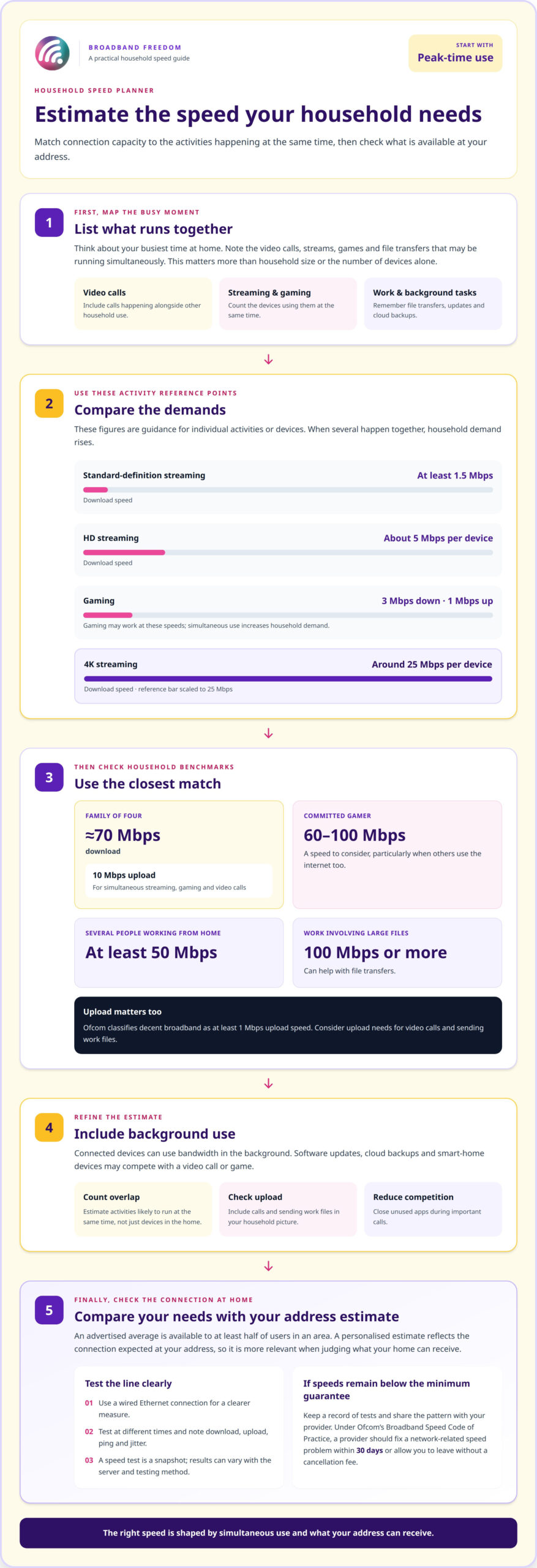
Speed guidance matches download capacity to activities such as browsing, streaming and gaming. That helps you choose a package that fits your routines. Basic browsing and email use little bandwidth, while standard-definition streaming needs at least 1.5 Mbps. Allow about 5 Mbps per device for HD, or around 25 Mbps per device for 4K. Gaming may work at 3 Mbps download and 1 Mbps upload, but simultaneous use raises household demand. If you’re asking what broadband speed do I need in the UK for evening streaming and gaming, count the activities running together.
Home working and video calls
Home-working speed needs depend on simultaneous video calls, file transfers and other household internet use. This matters because streaming or gaming shares connection capacity with work calls. Households with several people working from home benefit from at least 50 Mbps, while work involving large files can benefit from 100 Mbps or more. Ofcom classifies decent broadband in the UK as at least 1 Mbps upload speed. Close unused apps during important calls to reduce competition for bandwidth.
Typical UK home broadband speeds
Typical speeds vary across UK homes, from 8 Mbps to over 1 Gbps. The average home broadband download speed was 285 Mbps in 2025, an increase of 30% between 2024 and 2025. That average isn’t a target every household needs: browsing and occasional streaming place different demands on a connection than several simultaneous 4K streams. Fibre broadband can support faster connections, but an advertised package speed isn’t the only factor shaping your experience.
Before choosing faster broadband, run a speed test near your router and compare results with a wired connection. Improve Wi-Fi by placing the router centrally, in an open position, and reducing obstacles between it and your devices. For guidance on interpreting results, use this internet speed guide. If Wi-Fi remains slow in one room, the signal may be the issue rather than the broadband line.
Advertised versus personalised broadband speeds
Check your actual speed with a broadband speed test, ideally over Ethernet, and compare download and upload results with your personalised estimate. If results consistently fall below the advertised speed, record tests at different times and report the pattern to your provider.
Advertised and guaranteed speeds
An advertised average describes the download speed available to at least half of users in an area, while a personalised estimate reflects the connection expected at your address. This matters because distance from network equipment and connection type can affect the speed your home receives. A Minimum Guaranteed Download Speed is a provider’s commitment under Ofcom’s Broadband Speeds Code of Practice. A speed test is a snapshot, not a guarantee, and results can vary depending on the server and testing method.
Use a wired Ethernet connection for a clearer measure of your broadband line’s potential. Run tests at different times, noting download speed, upload speed, ping and jitter. Ping and jitter affect responsiveness, which matters for video calls and online gaming, even when downloads seem fast. If your results remain below the Minimum Guaranteed Download Speed, share the test record with your provider. Under Ofcom’s Broadband Speed Code of Practice, a provider should fix a network-related speed problem within 30 days or allow you to leave without a cancellation fee.
Advertised speeds at peak times
Peak-time advertised speeds are measured during the hours when internet use is typically busiest, from 8pm to 10pm. UK providers must make the advertised average available to at least 50% of users in the area during this period. That makes the figure more useful than a speed recorded only during quieter daytime hours, especially if your household streams or downloads in the evening.
A gigabit package may look faster on paper, but the personalised estimate is more relevant to your address. Compare that estimate with the speed your household needs, then consider whether evening slowdowns affect calls, streaming or downloads. If you’re weighing up packages, compare broadband deals against the speed available at home.
Choosing a speed for household size and connected devices
There’s no fixed speed allowance for each person; simultaneous activity matters more than household size alone. A family of four streaming, gaming and video calling at once needs about 70 Mbps download and 10 Mbps upload.
Speed estimates for household types
Household speed estimates match connection capacity to the number of people and their online routines. They help you avoid choosing only by headcount. A committed gamer should consider 60-100 Mbps, particularly when others use the internet too. Several people working from home benefit from at least 50 Mbps. If work involves large files, 100 Mbps or more can help with transfers.
Estimating household speed needs
Estimating your household’s needs means adding the demands of activities likely to happen together. This gives a more practical starting point than counting phones, televisions and laptops alone. List peak-time activities, such as video calls, 4K streams and online gaming, then consider which devices will run them simultaneously. Include upload as well as download, especially for calls and sending work files.
For example, a household of four with simultaneous streaming, gaming and video calls needs about 70 Mbps download and 10 Mbps upload. That’s a household estimate, not a per-person allowance. A couple who browse separately but rarely stream together may need less capacity than a smaller household running several demanding activities at once.
Connected devices also use bandwidth in the background. Software updates, cloud backups and smart-home devices can compete with a video call or game. Note which tasks run together during your busiest period, then use that pattern to assess the speed estimate for your address. When comparing providers, consider upload speed as well as how well the estimated download speed meets your household’s needs.
Choose for your busiest routine, not every device added together. A home with one gamer and several simultaneous users may suit a 60-100 Mbps range, while large work-file transfers can make 100 Mbps or more useful. This approach keeps household size, device use and connection needs in view.
Standard, partial fibre and full fibre connections
Connection type affects the speeds a provider can deliver, not just the packages on offer. In the UK, standard ADSL, partial fibre and full fibre differ in how far fibre reaches towards your home.
Standard ADSL uses copper telephone lines between the exchange and your home. UK ADSL connections have average download speeds of 10-11 Mbps, measured in megabits per second. That may suit basic browsing, but large files and several simultaneous streams can take longer. Distance from the exchange can also limit the speed this type of connection delivers.
Partial fibre brings fibre to a street cabinet, then uses copper wiring for the final stretch to your property. Its average speeds are 36-76 Mbps, and it’s available to around 99% of UK households. The copper section can affect performance, particularly when your home is far from the cabinet. This can make the speed available to you different from the package’s advertised figure.
Full fibre broadband uses fibre all the way to the property, removing that final copper section. It can offer average speeds exceeding 1,000 Mbps, or 1 Gbps, which can help households with large downloads, busy video calls and several connected devices. Gigabit-capable broadband reaches 84% of the UK, while full fibre or Virgin Media cable is available to about three-quarters of properties. These coverage figures describe different connection categories, so they aren’t interchangeable.
Choose by matching the connection’s available speed to your household’s busiest routines. ADSL may handle lighter use; partial fibre can suit everyday streaming and work; full fibre offers more capacity for demanding, simultaneous use. Your router and home Wi-Fi also affect the speed devices experience, so a faster line alone won’t fix a weak wireless signal. Compare broadband packages to find options that fit your needs and connection type.
Broadband Freedom
Broadband Freedom helps you compare broadband deals against your household’s speed needs and connection type. If your address supports full fibre, fibre or standard broadband, compare options that match your expected use instead of choosing by headline speed alone. Broadband and Phone Packages are also available if you want both services together.
Use your personalised speed estimate, busiest household routines and upload requirements to narrow down suitable packages. Broadband Freedom brings different UK broadband providers and connection types together, helping you focus on what fits your needs.
Contact Broadband Freedom to discuss your broadband options.
Choose a package that fits what comes next
Your internet needs can change with your routine. If you’re deciding what broadband speed you need in the UK, consider what may change at home, such as more video calls, larger work files or extra people sharing the connection. Plan ahead, but choose based on realistic needs rather than paying for capacity you’re unlikely to use.
Before switching, note the activities that matter most and when you rely on a steady connection. Keep that short list handy as you weigh up your options. It gives you a practical way to judge whether a package suits your household, instead of choosing by headline speed alone.
Broadband Freedom can help you turn those priorities into a shortlist of relevant deals. Compare broadband deals with Broadband Freedom and take the next step towards a connection that suits your home.
Frequently Asked Questions
How many Mbps does each activity need?
As a guide, standard-definition streaming needs at least 1.5 Mbps, HD streaming about 5 Mbps per device, and 4K streaming around 25 Mbps per device. Online gaming can work with 3 Mbps download and 1 Mbps upload, but other people and devices share the connection. Add the needs of activities happening together, rather than treating each figure as the whole household’s requirement.
What is a good internet speed?
A good internet speed is one that keeps your usual activities working smoothly, including during busy periods at home. At least 50 Mbps is a useful recommendation for a smooth experience in most UK homes. For instance, someone who mainly browses and streams on one screen may need less capacity than a household with simultaneous calls, gaming and several video streams. Consider upload speed too.
Decent, superfast, ultrafast, gigabit: what do they mean?
These labels describe broadband speed tiers. Decent broadband means at least 10 Mbps download and 1 Mbps upload; Ofcom identifies the upload threshold as 1 Mbps. Superfast starts at 30 Mbps download, ultrafast at 300 Mbps, and gigabit means 1,000 Mbps download. The tiers help you compare connection capabilities, but your address and household use determine which level is relevant.
Do you need to switch provider to get faster broadband?
Not always. First work out whether slow performance comes from your broadband line, Wi-Fi coverage or a busy device. A wired speed test can help distinguish Wi-Fi issues from line performance. If your current package is the limiting factor, switching may provide access to a faster connection if it’s available at your address. Compare personalised estimates, not just headline package speeds.
What download and upload speed do I need?
Download speed affects receiving content, such as streaming a programme or downloading a game. Upload speed affects sending data, including your camera feed during a video call or a large work file. Choose based on both directions: households with frequent calls, cloud backups or file sharing should pay particular attention to upload. Ofcom’s decent broadband threshold includes at least 1 Mbps upload.
What broadband speed is recommended for one person in the UK?
For one person, 30-50 Mbps is a useful range for everyday browsing and streaming, especially if activities rarely overlap. If you stream in 4K, download large files or work on video calls while using other services, consider more capacity. One person can still have several devices active at once, so base your choice on your busiest routine rather than household headcount alone.

Article by
Elaine Lang
Elaine has over 20 years across Marketing, Communications and Public Relations in the UK. She has worked across large UK corporations, including Commercial Banks and Airports, to online consumer finance and technology solutions. Elaine has post graduate qualifications in Marketing from the Chartered Institute of Marketing (CIM) and the Industry of Direct Marketing (IDM). She is a lifelong feline fan, sharing her home with around 4-6 cats for many years. This of course can be a challenge when trying to work at home, as they like to try to help!