Best Full Fibre Broadband for New Builds: The 2026 UK Guide

99% of new build properties in the UK now have full-fibre broadband availability, yet thousands of homeowners still find themselves offline on moving day. It’s a frustrating irony that while your home is built for the future, getting full fibre broadband for new builds activated can feel like a relic of the past. You likely expected that moving into a modern development meant instant, gigabit-capable connectivity without the hassle.
Instead, you might be facing a restrictive infrastructure lottery where your provider choice is limited or activation delays keep you disconnected. We know the relief that comes from a simple solution to a complex problem. This guide empowers you to take control of your home’s connectivity from the moment you get your keys. You’ll learn how to navigate private networks, understand your ONT hardware, and secure reliable gigabit speeds for remote work. We will also highlight the best 2026 deals to ensure you enjoy high-speed internet without the premium price tag.
Key Takeaways
- Understand how the “infrastructure lottery” determines your provider choice and why full fibre broadband for new builds is now the standard for pre-installed connectivity.
- Learn to compare major providers like BT and Sky against niche networks to find the most reliable and cost-effective service for your specific development.
- Secure day-one connectivity by following a pre-move checklist and ordering your service at least four to six weeks before your completion date.
- Identify strategies to negotiate better rates and avoid being locked into expensive, long-term contracts on exclusive private fibre networks.
The Infrastructure Lottery: Why New Build Broadband is Different
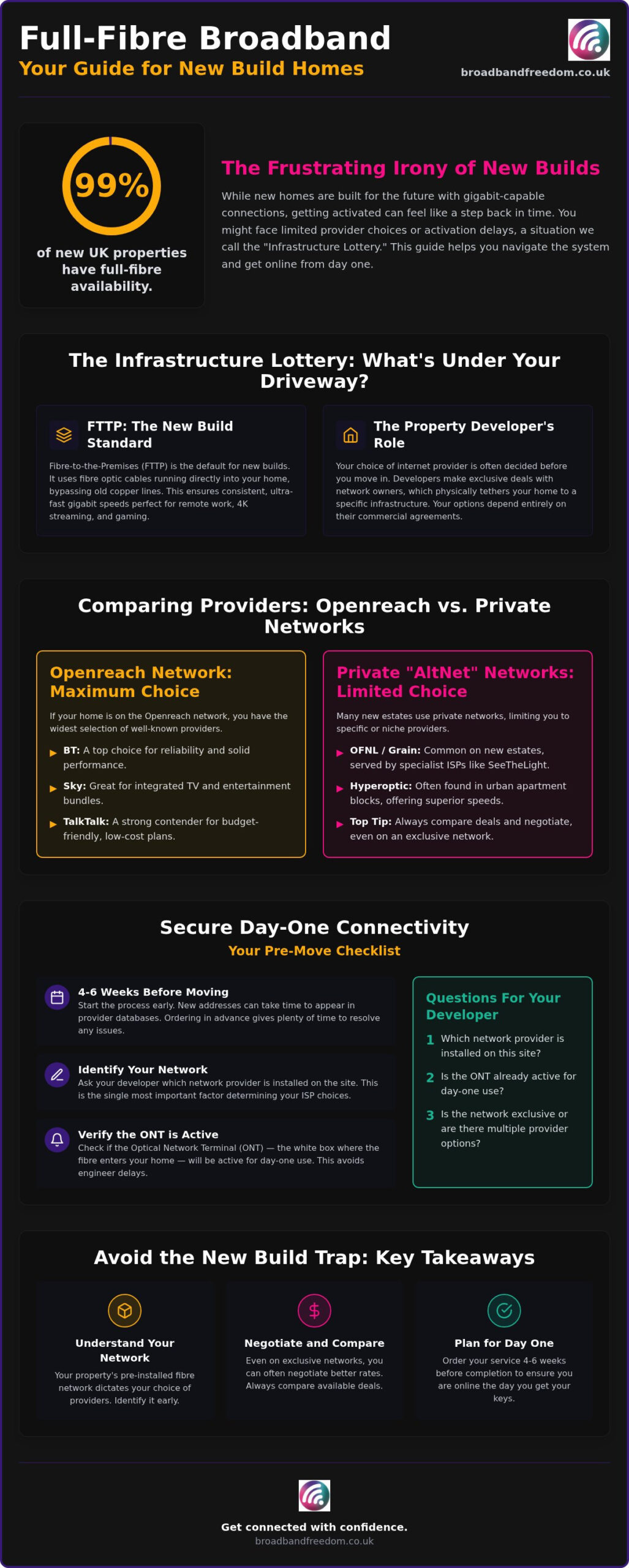
Moving into a new home should mean instant connectivity. 2026 Building Regulations mandate that new properties arrive with gigabit-capable infrastructure, following rollouts in England, Scotland, and Wales. This ensures you aren’t left with archaic copper lines. However, the cables under your driveway determine your provider choice. This is the infrastructure lottery. Developers partner with specific network owners before construction begins. While many sites use Openreach, others are exclusive to UK’s alternative network providers or private AltNets like OFNL and Grain. Your choice of full fibre broadband for new builds is often decided before you even see the floor plans.
Understanding FTTP: The New Build Standard
New builds bypass old copper technology. They use Fibre-to-the-Premises (FTTP), delivering data through light signals directly to your home. Unlike traditional FTTC, which loses speed over distance, FTTP offers consistent gigabit performance for remote work and streaming. Ofcom data shows that 99% of new UK developments now have full fibre access. Because new addresses often take time to appear in databases, using a full fibre broadband checker is essential to verify which full fibre broadband for new builds is actually available at your plot.
The Role of the Property Developer
Your developer’s commercial agreement dictates your digital options. If they chose a private network, you might not be able to use your preferred ISP. Your choice is physically tethered to the infrastructure in the ground. It’s a pragmatic reality of modern house buying. Don’t wait until moving day to discover a lack of variety. Ask your developer these questions during your viewing:
- Which network provider is installed on this site?
- Is the ONT (Optical Network Terminal) already active for day-one use?
- Are there multiple provider options, or is the network exclusive?
Comparing the Best Broadband Providers for New Build Homes
While Building Regulations for new homes guarantee the physical infrastructure is ready, the service quality depends entirely on your provider. If your plot is on the Openreach network, you have the greatest flexibility. BT remains a top choice for reliability, while Virgin Media offers competitive gigabit speeds up to 1130Mbps in many new developments. For high-usage households, searching for the latest fibre broadband offers ensures you get the bandwidth required for multiple 4K streams and simultaneous gaming without overpaying.
Top National Providers for Openreach Sites
Openreach developments allow you to choose from household names. BT is often the default, but Sky broadband deals are frequently more attractive for families wanting integrated entertainment bundles. TalkTalk is a strong contender for those seeking low-cost entry-level plans. Ofcom’s 2026 reports show that whilst satisfaction remains high across these giants, their prices vary significantly. It’s vital to check which full fibre broadband for new builds currently offers the best balance of speed and monthly cost.
Finding Value on AltNet and Private Networks
Many modern estates use private networks like OFNL or Grain. If you are on an OFNL-managed site, you might choose niche providers like SeeTheLight, who specialise in these specific setups. In urban apartment blocks, Hyperoptic often provides superior speeds. Even if your choices seem limited, you should compare broadband deals carefully. Smaller ISPs often provide more personal technical support than national giants. Never accept the first price on an exclusive network; there is often room to negotiate if you mention competing full fibre broadband for new builds. You can compare over 30 UK providers to find the best fit for your new postcode.
Securing Day-One Connectivity: A Pre-Move Checklist
Securing full fibre broadband for new builds requires foresight. Whilst the New Build Broadband Regulations ensure the physical infrastructure is present, the digital activation is your responsibility. Start the process at least four to six weeks before your completion date. This lead time allows providers to register your new address in national databases, preventing a digital blackout on your first night in the property.
The 4-Week Countdown to Connection
Organise your connectivity in three clear stages. First, identify your network owner. Some developers use Openreach, whilst others prefer private AltNets. Second, select an ISP that matches your moving date. Third, confirm the hardware is ready. During your home demonstration, ask the site manager to show you the Optical Network Terminal (ONT). This small plastic box is the gateway for your fibre. Ensure it’s powered and the lights indicate a healthy connection before you sign off on the property. If the ONT is missing or damaged, tell your developer immediately.
What to Do if Your Connection is Delayed
Delays happen, especially if the Royal Mail database hasn’t updated your postcode. If your activation stalls, you have specific rights. Under Ofcom’s automatic compensation scheme, you are entitled to payments for delayed starts if the provider is at fault. For a temporary bridge, consider using a 5G hub or no contract broadband. These rolling plans offer the flexibility you need whilst waiting for a permanent line. Once your service goes live, check internet speed immediately to ensure you are receiving the full gigabit performance promised in your contract. Don’t settle for less than the speeds you pay for.
Compare the best new build broadband deals today to secure your move-in date.
Avoiding the New Build Trap: Contracts and Long-Term Savings
Securing full fibre broadband for new builds often feels like a one-way street if your developer has signed an exclusivity deal. Being locked into a single provider removes the competitive pressure that keeps prices low. However, you can still find value by being a savvy negotiator. If you are stuck with a niche AltNet, ask for their best introductory rate. Mention national averages to show you have done your research. Most providers would rather offer a discount than lose a potential long-term customer.
Hidden Costs of New Build Internet
Don’t just look at the monthly headline figure. Many new developments carry high activation or installation fees that aren’t present in older properties. Compare the total cost of ownership over 24 months to see the true impact on your wallet. Fortunately, government-backed schemes and Ofcom regulations continue to push for open-access networks to prevent broadband monopolies in new estates. If your contract allows, set a calendar reminder for your end date. This prevents you from rolling onto expensive standard rates or facing automatic mid-contract price hikes without a plan.
Maximising Value with Multi-Service Bundles
Combining your utilities is a proven way to reduce the “new build premium”. If you need a landline for work, broadband and phone packages often provide better value than standalone services. For families, evaluating the latest broadband with TV packages can consolidate your entertainment costs into one manageable bill. Flexible contract terms are especially crucial for mortgage-holders in 2026. If your financial situation changes, having the ability to switch to a lower-cost plan or a shorter commitment provides essential peace of mind. You can compare over 30 UK providers to ensure your new home stays connected on your terms.
Take Control of Your New Home’s Connectivity
Securing full fibre broadband for new builds doesn’t have to be a source of moving-day stress. By identifying your network owner early and starting the ordering process at least four weeks before completion, you can bypass the common pitfalls of the infrastructure lottery. Navigating private networks and checking your ONT hardware during the home demonstration are vital steps for securing reliable gigabit speeds. Even on exclusive developments, you have the power to negotiate or bundle services to avoid the “new build premium”.
We’ve performed the heavy lifting by comparing over 30 UK providers and updating our offers daily for 2026. This expertise in Full Fibre technology ensures you find a plan that fits your lifestyle and budget from the moment you get your keys. Find the best broadband deals for your new home today and move in with total digital confidence. Your future-ready home deserves a connection that works as hard as you do.
Frequently Asked Questions
Can I choose any broadband provider for my new build home?
Your choice of provider depends entirely on which network owner your developer partnered with during construction. If your site uses Openreach, you can pick from over 30 national providers. However, many developments use private networks, which limits you to specific ISPs. Always check which full fibre broadband for new builds is available at your specific plot before signing a long-term contract. This avoids the frustration of being tied to a service that doesn’t meet your requirements.
Why is my new build property restricted to OFNL or Hyperoptic?
Developers often sign exclusive agreements with alternative network providers to install infrastructure at a lower cost during the build phase. This means the physical fibre cables in the ground belong to that specific company, and national giants like BT or Sky cannot access them. Whilst this limits your choice, these private networks often provide dedicated gigabit speeds that are specifically optimised for your development’s unique layout and high-density requirements.
How long does it take to get broadband installed in a new house?
Activation typically takes two to four weeks, but you should start the process at least one month before you move in. Delays often occur because new addresses aren’t immediately updated in national databases like Royal Mail. If the physical infrastructure is already active and your address is registered, some providers can get you online within days. Early planning is the best way to ensure you have a working connection on moving day.
What is an ONT and where will I find it in my new home?
An ONT, or Optical Network Terminal, is a small plastic box that converts fibre optic light signals into a digital connection for your router. Unlike old phone sockets, it’s usually mounted on an internal wall near a power outlet. You’ll typically find it in the hallway, under the stairs, or inside a dedicated utility cupboard. Ensure this hardware is powered and undamaged during your final home demonstration to prevent any technical setup delays.
Is 5G home broadband a good alternative for new builds?
5G home broadband is an excellent temporary bridge if your full fibre broadband for new builds activation is delayed. It offers high speeds without the need for physical line installation. While it’s great for flexibility, it rarely matches the consistent gigabit reliability of a wired fibre connection. Consider a no-contract 5G plan as a short-term solution whilst waiting for your permanent infrastructure to go live. It keeps you connected without long-term commitment.

Article by
Elaine Lang
Elaine has over 20 years across Marketing, Communications and Public Relations in the UK. She has worked across large UK corporations, including Commercial Banks and Airports, to online consumer finance and technology solutions. Elaine has post graduate qualifications in Marketing from the Chartered Institute of Marketing (CIM) and the Industry of Direct Marketing (IDM). She is a lifelong feline fan, sharing her home with around 4-6 cats for many years. This of course can be a challenge when trying to work at home, as they like to try to help!