Best Fibre Broadband Offers 2026: Compare the UK’s Top Deals

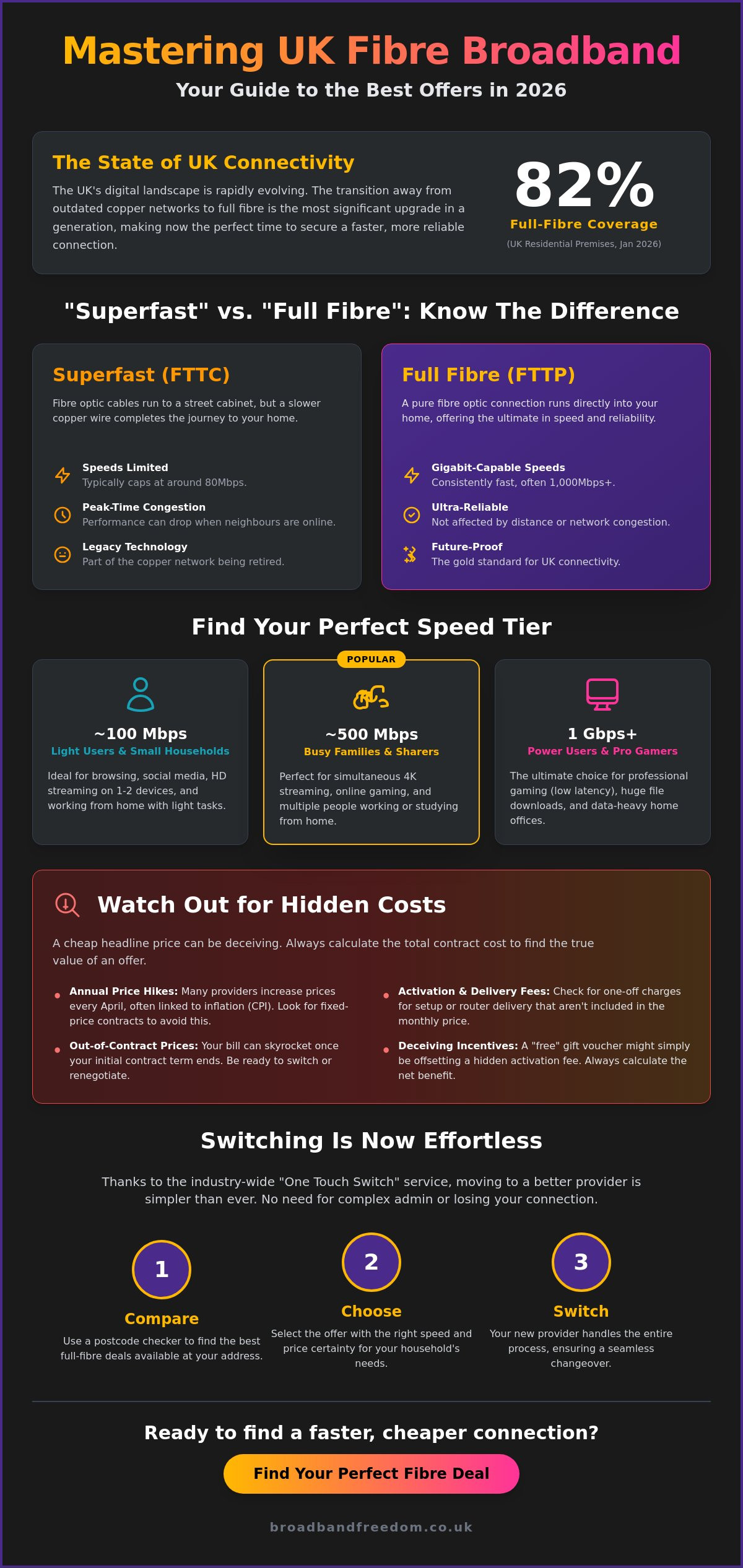
Did you know that 82% of residential premises in the UK now have access to full-fibre coverage, yet many households remain trapped on slower, more expensive legacy contracts? Finding the best fibre broadband offers in 2026 requires more than just looking at the headline price. You’re likely tired of mid-contract price hikes and the confusing jargon that blurs the line between “Superfast” and “Full Fibre” technology. We agree that your internet should be a reliable tool, not a source of financial stress or technical frustration.
This guide empowers you to master the UK market by identifying the fastest speeds and lowest prices available today. We’ll examine the impact of the Ofcom Telecoms Access Review 2026-31 and explain how the “One Touch Switch” service simplifies your move to a better deal. According to the 2025 Ofcom service quality report, providers like Plusnet are leading the way with a 91% satisfaction rate. You’ll discover how to bypass complicated installation processes and secure a stable connection that supports your entire household whilst keeping your monthly bills under control.
Key Takeaways
- Distinguish between “Superfast” and “Full Fibre” technology to ensure your home is equipped with a future-proof, gigabit-capable connection.
- Compare the latest fibre broadband offers from major providers and local altnets to find the best balance between monthly cost and long-term price certainty.
- Select the ideal speed tier for your lifestyle, prioritising low latency for gaming or high bandwidth for a busy work-from-home household.
- Use the simplified “One Touch Switch” process to move between providers effortlessly without losing your connection or dealing with complex admin.
Understanding the Fibre Broadband Landscape in 2026
Fibre broadband uses light signals transmitted through glass cables to deliver data. This technology is the cornerstone of the modern UK broadband landscape. As of January 2026, full-fibre coverage reached 82% of residential premises. This progress is documented in the Ofcom Telecoms Access Review 2026-31, which confirms Openreach remains regulated until 2031. FTTP (Fibre to the Premises) is the gold standard for UK connectivity; it’s the most reliable option for homes. Understanding these technical shifts helps you identify the most reliable fibre broadband offers currently available.
Fibre vs Full Fibre: What is the Difference?
The distinction between ‘Superfast’ and ‘Full Fibre’ is critical for performance. Superfast usually refers to Fibre to the Cabinet (FTTC), which uses copper for the final leg. This often limits speeds to 80Mbps. Full Fibre delivers light signals directly to your door, providing consistent speeds whilst avoiding peak-time congestion. You can read more in our guide to FTTP deals. Choosing the right technology ensures your connection remains stable even when the whole street is online.
The Retirement of the Copper Network
The traditional copper network is currently being phased out across the country. This transition is a major driver for the latest fibre broadband offers as providers migrate customers to digital lines. According to Openreach’s digital upgrade reports, the retirement of the old PSTN network is essential for a future-proof UK. Openreach experts state, ‘the transition to full fibre is the most significant upgrade in a generation.’ Moving to fibre today prevents service disruptions as legacy exchanges close permanently.
Comparing the Best Fibre Broadband Offers: Speed vs Value
Selecting the right speed tier is your first step to finding value. Most fibre broadband offers fall into three distinct categories: 100Mb for light users, 500Mb for busy families, and 1Gb+ for power users. The “Big Four” providers (BT, Sky, Virgin, and TalkTalk) provide nationwide reach and bundled services. However, “Altnets” like Community Fibre or Hyperoptic often provide symmetrical upload speeds that legacy networks can’t match. You should prioritise “Price Certainty” in your search. Many providers still link annual hikes to the Consumer Price Index, but savvy consumers now look for fixed-price contracts to avoid mid-term shocks.
Evaluating Total Contract Cost and Price Certainty
Don’t just look at the monthly fee. Calculate the total cost over the full 24-month term. This includes the introductory rate, any activation fees, and the inevitable April price increases. According to Which? research, these annual hikes can add significant sums to your bill. For example, some major providers have already scheduled increases for April 2027 and April 2028. If you want to avoid these fluctuations, you can compare broadband deals that offer fixed rates for the entire duration of your contract.
The Real Value of Free Gifts and Incentives
Incentives like Amazon vouchers or prepaid Mastercards are common. They look attractive, but they shouldn’t be your only reason to switch. You can find current broadband with free gifts listings to see which offers provide the best upfront value. Always check if a setup fee exists. If a provider charges for activation but gives you a voucher, your actual gain is reduced. It’s vital to read the small print to ensure the gift isn’t just offsetting a hidden cost. Focus on the net benefit over the contract life.
Spotting the Hidden Costs in Fibre Deals
Hidden charges can quickly turn a cheap deal into an expensive mistake. Watch out for router delivery fees and “out-of-contract” price jumps that occur the moment your initial term ends. The advertised price often excludes the 2027 price hike clause found in the terms and conditions. According to Ofcom guidance, providers must be transparent, but you should still verify activation fees, router delivery costs, and specific price increase dates. Staying informed helps you maintain absolute control over your household budget.
Finding Your Perfect Match: Tailoring Offers to Your Lifestyle
Fibre Offers for Remote Workers
Stable connectivity is a non-negotiable tool for the modern professional. If your job involves frequent video calls or large file transfers, look for fibre broadband offers with high upload speeds. A study by the Centre for Economic Performance (LSE) indicates that high-quality digital infrastructure directly correlates with increased worker productivity. Many premium packages now include mesh Wi-Fi hardware to eliminate dead zones in your home office. This ensures your connection remains stable even when other family members are online. You can compare broadband deals today to find a package that supports your career.
For those whose professional needs go beyond standard residential connectivity, such as managed IT services or cloud-based phone systems, you can check out Bunnji to see how specialised business-grade solutions can support a remote workforce.
Student and Renter-Friendly Fibre
Flexibility is the primary requirement for students and short-term renters. Traditional 24-month contracts often don’t align with academic years or tenancies. Many providers now offer 9-month terms specifically designed for the student market. These deals often include free gifts like high-street vouchers that appeal to younger users. According to a January 2026 Which? survey, providers like Zen lead in customer satisfaction, making them reliable choices during exams. Choosing a rolling monthly contract provides the autonomy to cancel or move without the burden of long-term debt.
How to Switch and Secure Your Fibre Offer Today
Switching is now a streamlined process thanks to the “One Touch Switch” system. You only need to contact your new provider to get started. They coordinate the entire transfer with your current supplier, including the cancellation of your old service. This system applies even when moving between different networks. If you aren’t ready to leave your current supplier, use the latest fibre broadband offers as leverage. Call their retentions department and ask them to match a competitor’s price to keep your custom. You can find detailed steps on the Ofcom switching guide.
What Happens on Installation Day?
Your installation experience depends on your property’s existing infrastructure. If your home already has an active ONT (Optical Network Terminal), you might qualify for a self-install. You simply plug in your new router and wait for the activation signal. However, upgrading to “Full Fibre” for the first time usually requires an engineer visit. They will run a new fibre optic cable from the street directly into your home. The Broadband Delivery UK (BDUK) initiative continues to oversee these infrastructure upgrades. Use our Fibre Optic Broadband Checker to see if your property is ready.
Rights and Protections for UK Consumers
UK consumer law provides a mandatory 14-day cooling-off period for all new broadband contracts. This gives you the autonomy to cancel without penalty if the service fails to meet your expectations. Additionally, Ofcom’s Automatic Compensation scheme ensures you receive payments if your service start date is delayed. Ofcom states that the scheme is designed to “ensure that consumers are treated fairly” when things go wrong. These protections remove the financial risk from the switching process. When you are ready to find a more reliable connection, you can Compare Broadband Deals to secure your 2026 saving.
Take Control of Your Home Connectivity in 2026
You now have the knowledge to navigate the UK’s shifting digital landscape with confidence. By distinguishing between technical marketing and genuine performance, you can secure fibre broadband offers that provide long-term value. Whether you are prioritising low latency for gaming or symmetrical speeds for a home office, the power is in your hands to choose a contract that respects your budget. The move away from legacy copper lines is an opportunity to reset your household costs and enjoy the stability of a future-proof connection that evolves with your lifestyle.
Expert Guidance for Smarter Switching
Our platform simplifies this decision by performing the heavy lifting for you. We compare over 30 top UK providers to ensure you never miss a daily updated deal or a hidden incentive. Our expert guides are designed to help you avoid the pitfalls of mid-contract price hikes and unexpected setup fees. Ready to upgrade? Find the best fibre broadband offers in your area today and start saving. We are here to ensure your transition to full fibre is as frictionless and rewarding as possible.
Frequently Asked Questions
What is the cheapest fibre broadband offer in the UK right now?
Altnet providers currently offer the most competitive rates in the market. Independent networks such as Community Fibre and Toob lead the way with entry-level full-fibre packages that often undercut the national providers. You can find these fibre broadband offers by checking availability in specific urban centres where these networks operate. These providers often provide symmetrical upload speeds as standard. This offers better value for money than traditional copper-based alternatives.
Can I get fibre broadband without a landline?
Yes, you can get fibre broadband without a traditional landline. Modern “Full Fibre” (FTTP) connections use dedicated glass cables that don’t rely on the old copper telephone network. This removes the need for line rental entirely. According to Ofcom guidance on the landline switch-off, the UK is moving toward a fully digital system. Voice calls will be handled over the internet rather than traditional sockets. If you currently pay for both services, reviewing broadband and phone packages could help you find a combined deal that better suits your needs and budget.
How long does it take to install full fibre broadband?
A standard full-fibre installation usually takes between two and four hours to complete. An engineer will need to drill a small hole to bring the fibre cable into your property. They also install an Optical Network Terminal (ONT) on an internal wall. Whilst the physical work is quick, you might wait several weeks for an appointment. You can track service standards through the 2025 Ofcom service quality report to see which providers are currently the most efficient.
Will my broadband price go up during my contract?
Most UK providers include a clause for annual price increases in their terms and conditions. These hikes typically occur every April and are often linked to the Consumer Price Index (CPI) plus an additional percentage. However, some providers now offer “Price Certainty” deals with fixed rates for the entire duration. Reviewing fibre broadband offers carefully is essential to identify which contracts protect you from the scheduled 2027 and 2028 increases. This helps you avoid unexpected monthly costs.
Do I need a new router for full fibre broadband?
Yes, you will almost certainly need a new router to support a full-fibre connection. Standard routers used for older ADSL or FTTC connections often lack the hardware required to process gigabit-capable speeds. Your new provider will usually supply a modern router designed to work with the Optical Network Terminal (ONT) installed in your home. These newer devices also offer better Wi-Fi range. They are built to handle multiple devices streaming at once without a drop in performance.

Article by
Elaine Lang
Elaine has over 20 years across Marketing, Communications and Public Relations in the UK. She has worked across large UK corporations, including Commercial Banks and Airports, to online consumer finance and technology solutions. Elaine has post graduate qualifications in Marketing from the Chartered Institute of Marketing (CIM) and the Industry of Direct Marketing (IDM). She is a lifelong feline fan, sharing her home with around 4-6 cats for many years. This of course can be a challenge when trying to work at home, as they like to try to help!