Broadband Jargon Buster 2026: Understanding UK Internet Terms

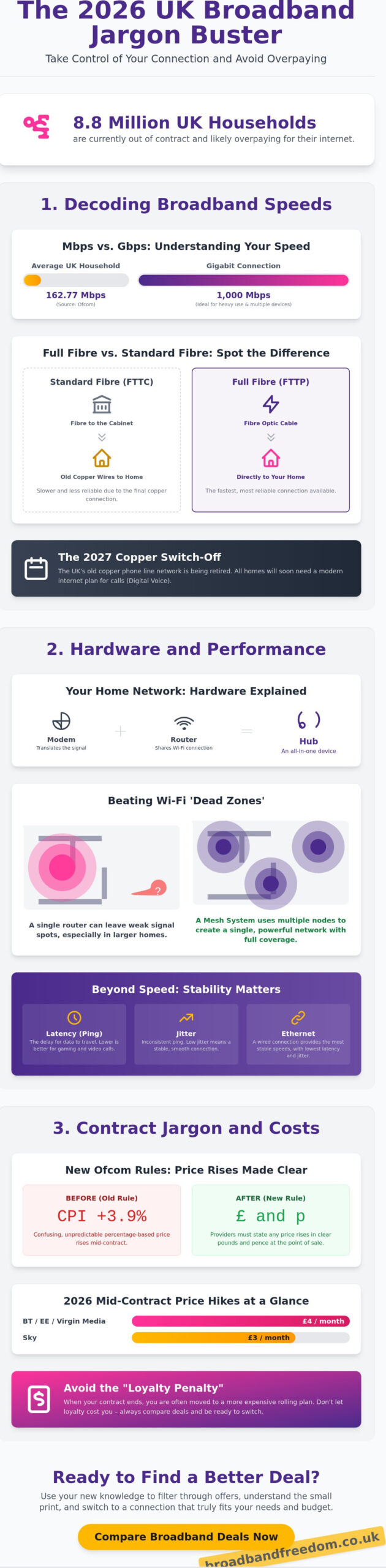
Did you know that 8.8 million UK households are currently out of contract and likely overpaying for their internet? It’s easy to feel overwhelmed by technical terms like FTTP and Wi-Fi 7, especially when you just want a reliable connection that doesn’t break the bank. This 2026 broadband jargon buster simplifies the complex landscape so you can take back control of your home connection. You’ll learn to distinguish between Mbps and Gbps, understand the latest Ofcom pricing rules, and gain the confidence to switch to a better deal whilst avoiding unnecessary costs.
We’ve cut through the noise to provide a clear guide to modern UK terminology. Recent reports from Ofcom show that while average download speeds have reached 162.77 Mbps, many users still confuse their router’s signal with their actual line speed. This misunderstanding often leads to paying for premium tiers you simply don’t need. This guide ensures you can spot hidden contract terms and avoid the loyalty penalty that impacts millions of households, whilst staying protected under the Consumer Rights Act 2015. By understanding these terms, you can ensure your next contract fits your lifestyle perfectly.
Key Takeaways
- Identify the difference between Mbps and Gbps to select a speed tier that matches your household’s actual usage and budget.
- Clarify the distinct roles of your modem and router to better manage your home network and improve your daily Wi-Fi performance.
- Use this broadband jargon buster to navigate mid-contract price rises and understand how the latest Ofcom rules protect your monthly bill.
- Discover how to filter through “Triple Play” bundles and “Broadband Only” offers to find the most cost-effective deal for your needs.
- Learn to spot hidden terms in your contract to avoid the common “loyalty penalty” and keep your connection costs as low as possible.
Decoding Broadband Speeds: Mbps, Gbps, and Connection Types
Understanding your connection starts with the numbers. This broadband jargon buster helps you see past the marketing fluff. In the UK, providers no longer use “Up to” speeds because it was often misleading. Now, they must show “Average” speeds, which means at least 50% of customers get that speed during peak times. This change gives you a much more honest picture of what you’re buying.
What is Mbps and Why Does it Matter?
Mbps stands for Megabits per second. Think of it like lanes on a motorway. The more lanes you have, the more data can travel simultaneously without causing a jam. According to 2026 data from Ofcom, the average UK download speed is now 162.77 Mbps. If you see “Gigabit” broadband, that’s 1,000 Mbps. You can find more definitions in this Glossary of Internet-related terms to help you compare.
Full Fibre vs Fibre: Spotting the Difference
Not all fibre is created equal. Standard “Fibre” (FTTC) uses glass cables to the green street cabinet but finishes the journey to your home using old copper wires. This slows things down. “Full Fibre” (FTTP) runs fibre optic cables directly into your house. It’s faster and far more reliable. Use our full fibre broadband checker to see if your street is ready for the upgrade.
The 2027 Copper Switch-off
The UK is currently phasing out the Public Switched Telephone Network (PSTN). By January 2027, traditional copper phone lines will be switched off entirely. This means everyone will eventually move to digital voice services. If you’re still on an old ADSL line, you’ll need to upgrade soon. Most modern plans now use SOGEA, which provides broadband without needing a traditional landline rental. You can check your internet speed here to see how your current line performs against these new standards.
Hardware and Performance: From Routers to Latency Explained
Your internet performance depends on two distinct factors: the signal coming into your house and how your hardware distributes it. This broadband jargon buster clarifies that your modem and router perform very different jobs. A modem acts as a translator, converting the signal from your provider into data your devices understand. Your router then acts as a distributor, sharing that data wirelessly. Most UK providers now supply a “Hub,” which combines both functions into a single box.
Routers, Hubs, and Mesh Systems
Many British homes have thick internal walls that block wireless signals. A Mesh system solves this by using several nodes to create a single, seamless network. By 2026, WiFi 7 (IEEE 802.11be) has become the gold standard for high-performance homes. According to the Wi-Fi Alliance, this technology uses Multi-Link Operation (MLO) to reduce interference. If you’re struggling with “dead zones” upstairs, upgrading your hardware is often more effective than simply buying more speed. You can explore how specific routers impact play in our guide on broadband for gamers UK.
Understanding Latency, Ping, and Jitter
Speed isn’t everything; stability matters just as much. Latency is the time it takes for a request to travel to a server and back. We measure this in milliseconds (ms) as your “Ping.” High ping leads to stuttering video calls and “lag” during gaming. Jitter refers to the inconsistency of these delays. Data from Ofcom confirms that a wired Ethernet connection provides a far more stable experience than WiFi. If your current provider’s hub is underperforming, it might be time to compare broadband deals to find hardware that supports your daily needs.
Beyond hardware, the software you run on your devices is vital for performance. AP4 Digital assists businesses in developing high-performance web systems and mobile apps that are optimised for speed and reliability, ensuring you get the most out of your connection.
Contractual Jargon: Understanding the Fine Print and Price Hikes
Jargon isn’t just about technical specs; it’s often used to obscure how much you actually pay. This broadband jargon buster helps you navigate the financial terms that impact your monthly bill. Until recently, providers used complex “CPI + 3.9%” formulas to calculate annual hikes. However, following Ofcom regulations introduced in 2025, providers must now state price increases in clear “pounds and pence” at the point of sale. This change ensures you aren’t left guessing what your bills will look like in twelve months.
The Reality of Annual Price Adjustments
For 2026, major UK providers have set fixed mid-contract increases. BT, EE, and Virgin Media have implemented a £4 monthly rise, whilst Sky has opted for a lower £3 increase. Consumer advocates often describe the sharp price jump at the end of a fixed term as a “loyalty tax” on customers who don’t switch. If your provider fails to meet their “Minimum Speed Guarantee,” you have a legal right to exit your contract early. It’s essential to know what to do when your broadband contract ends to avoid these unnecessary costs.
Social Tariffs and Symmetrical Speeds
Millions of households are eligible for “Social Tariffs” but don’t realise they exist. According to government data, these plans offer speeds of 36-67 Mbps for as little as £12 to £20 per month for those on Universal Credit. Another term to look for is “Symmetrical Speeds.” This means your upload speed matches your download speed, which is a standard feature of Full Fibre. This is vital for anyone who uploads large files or spends hours on video calls. To find a plan that respects your budget, compare broadband deals today.
Making the Switch: Using Jargon to Find Your Perfect Deal
Applying your broadband jargon buster knowledge is the final step toward achieving true internet freedom. When you filter results on a comparison platform, you can now ignore vague “Up to” speed claims and focus on the “Average” speeds that actually reflect reality. By 2026, the UK market has split into those who want the convenience of “Triple Play” bundles and those who prefer the simplicity of “Broadband Only.” Whilst packages combining TV and phone lines often look cheaper initially, always calculate the total cost over the full contract term to ensure the “Free Gifts” don’t hide a higher monthly rate.
Comparing Bundles and No-Contract Options
For renters or students, long-term commitments are often a financial burden. You might prefer no contract broadband, which offers 30-day rolling flexibility. Whilst these plans sometimes carry higher setup fees than fixed-term deals, they prevent expensive “Early Termination Charges” if you move house suddenly. According to Ofcom’s switching guidelines, the process is now “One-Touch,” meaning your new provider handles the cancellation with your old one. This reduces the administrative headache and prevents any gap in your service.
Final Steps to Broadband Freedom
Before you sign, verify the provider’s Service Level Agreement (SLA) to understand their commitment to uptime. Ask three specific questions: Is my speed guaranteed at the router? What is the specific fixed price rise for next April? Are there any hidden data caps? Data from government digital strategy reports suggests that informed consumers who switch regularly pay significantly less than those who stay out-of-contract. Use your new vocabulary to compare broadband deals and secure a price that reflects your actual usage rather than an industry average.
Secure a Fairer Internet Deal Today
Mastering this broadband jargon buster gives you the tools to stop overpaying for speed you don’t use. You now understand that your router’s signal isn’t the same as your line speed and that annual price hikes must be stated in clear pounds and pence. According to Ofcom, UK customers can save an average of £183.60 a year by switching providers. These protections, alongside the Consumer Rights Act 2015, ensure you stay in control of your digital life.
We’ve simplified the research process by doing the heavy lifting for you. You can Compare the latest UK broadband deals and save today across more than 30 top UK providers. Whether you need specialist student deals or the flexibility of no-contract plans, our daily updated offers ensure you find a package that fits your lifestyle. Take the first step toward a more reliable, cost-effective connection by using your new knowledge to filter out the noise. Your perfect home setup is just a few clicks away.
Frequently Asked Questions
What is the difference between bits and bytes in broadband speed?
Broadband speeds are measured in bits, whilst file sizes use bytes. There are eight bits in every single byte. If you download a 100MB file on a 100Mbps connection, it takes eight seconds rather than one. This distinction in our broadband jargon buster helps you calculate realistic download times. Most users see matching numbers and expect instant results, but the eight-to-one ratio is the standard rule.
Does “Unlimited Broadband” actually have any hidden limits or caps?
Truly unlimited broadband means you can use as much data as you want without facing extra charges or speed cuts. Most 2026 plans have removed the legacy “Fair Usage Policies” that once limited heavy users. However, some providers still use “Traffic Management” during peak hours to ensure everyone gets a stable connection. You can find more details in Ofcom’s guide on unlimited data.
What does “SOGEA” stand for and do I need a phone line for it?
SOGEA stands for Single Order Generic Ethernet Access and it removes the requirement for a traditional phone line. It delivers broadband over the same copper or fibre wires but without the voice call service. This is part of the UK’s transition away from the old Public Switched Telephone Network. It’s often cheaper because you aren’t paying for a landline service you likely don’t use.
What is a “Minimum Speed Guarantee” and how does it protect me?
This guarantee is a formal promise from your provider about the lowest speed you should expect at your router. If your speed stays below this level for three days and the provider can’t fix it within 30 days, you can leave the contract penalty-free. This is part of Ofcom’s Voluntary Code of Practice. It provides essential financial protection against unreliable service.
Why do broadband providers use “Up to” speeds in their marketing?
Providers previously used “Up to” speeds to highlight the best-case scenario, but current rules require them to show “Average” speeds instead. These figures represent what at least 50% of customers get during peak evening hours. This broadband jargon buster reminds you that average speeds are a better guide for your actual home performance. These standards are regulated by the Advertising Standards Authority to prevent misleading claims.

Article by
Elaine Lang
Elaine has over 20 years' experience across Marketing, Communications and Public Relations in the UK. She has worked for large UK corporations, including Commercial Banks and Airports, as well as online consumer finance and technology solutions providers. Elaine holds postgraduate qualifications in Marketing from the Chartered Institute of Marketing (CIM) and the Institute of Direct Marketing (IDM). She is a lifelong feline fan, having shared her home with around 4-6 cats for many years. This, of course, can be a challenge when trying to work from home, as they like to try to help!