Short Term Broadband: The 2026 Guide to Flexible UK Internet Deals

Did you know that 78% of UK homes now have access to gigabit-capable internet, according to the Ofcom Connected Nations report? Despite this infrastructure growth, many users feel forced into rigid 24-month agreements. If you are a student or a short-term renter, signing a two-year deal is a significant financial risk. You need short term broadband that adapts to your life, not the other way around. We understand the relief of finding a simple solution to a complex problem. You deserve total freedom.
Bridging the Gap to Flexible Connectivity
The UK Digital Strategy emphasises the importance of accessible, high-speed connectivity for a mobile workforce. This guide helps you secure high-speed internet without a long-term commitment by comparing rolling contracts, 5G hubs, and student plans. We focus on options that offer next-day setup and transparent costs, ensuring you stay connected whilst maintaining your freedom. Recent Ofcom regulatory updates suggest a shift towards better consumer flexibility, making 2026 the best year yet to switch.
Key Takeaways
- Identify why short-let renters and students benefit from 30-day rolling contracts that eliminate the risk of mid-contract exit fees.
- Contrast the immediate “plug and play” convenience of 5G home hubs with the performance and longer lead times of fixed-line fibre installations.
- Break down the true cost of short term broadband by factoring in setup fees and the modest monthly price premium for total contract freedom.
- Follow a simple two-step process to verify local coverage and data limits, ensuring your flexible plan supports high-demand activities like gaming and streaming.
- Master the switching process to move between providers effortlessly without the stress of managing overlapping contracts or service gaps.
What is Short Term Broadband and Who is it For?
Short term broadband refers to any internet service with a contract length under 12 months. Most commonly, this takes the form of a 30-day rolling agreement. It allows you to pay for your connection one month at a time. This is ideal for university students, short-let renters, and people between house moves. In 2026, the market has evolved significantly. You no longer have to settle for sluggish speeds to get flexibility. High-performance full-fibre and 5G options are now readily available without the burden of a two-year commitment.
The Rise of 30-Day Rolling Contracts in 2026
These contracts operate on a simple monthly cycle. You pay for the service you use and can cancel whenever your circumstances change. This model has gained traction as a way to avoid the mid-contract price hikes that plague traditional deals. According to UK broadband infrastructure data, the variety of providers offering these terms has expanded to meet consumer demand for autonomy. A 30-day rolling contract offers the ultimate autonomy, allowing users to switch providers as their lifestyle or budget changes.
Why Students and Renters Favour Flexibility
University life rarely fits into a standard 18-month or 24-month contract box. Most students only require a connection for the nine-month academic year. Signing a longer deal often leads to paying for an empty house over the summer. For those in broadband for shared houses, flexibility is a necessity. According to the ONS Private Rental Market Statistics, the demand for flexible living arrangements is rising amongst young professionals. You can compare no contract broadband deals to find options that respect your landlord’s property rules while delivering the speed you need. Short term broadband ensures you aren’t tied to a property you’ve already left.
This growing need for flexibility extends beyond just connectivity; for instance, travel professionals managing temporary accommodation often rely on HotelWebb to access wholesale hotel inventory and specialised distribution tools.
Comparing Short Term Broadband Technologies: Fibre vs 5G Hubs
Selecting the right technology for short term broadband depends on your location and how quickly you need to get online. Traditional fixed-line fibre offers unmatched stability, but it usually requires 10 to 14 days for activation. In contrast, 5G home broadband hubs provide a “plug and play” experience with next-day delivery. Before you decide, check Ofcom’s broadband speeds explained to ensure your choice handles your daily tasks. You can also gauge your specific requirements using our guide to internet speed.
Fixed-Line Rolling Fibre: Stability for Professionals
Full-fibre (FTTP) is the gold standard for remote workers who need a reliable connection for video calls. Whilst monthly costs for rolling fibre are often higher, the performance is consistent. According to the Ofcom guide to full fibre, these networks provide significantly lower latency than older copper lines. Many “Alt-Nets” have entered the market in 2026, offering flexible terms. Industry analysts suggest that “the rise of Alt-Nets has dismantled the monopoly on long-term contracts, making flexible fibre a standard expectation for 2026 consumers.”
5G Home Broadband: The Ultimate No-Contract Solution
A mobile hub is often the best choice for renters because it requires zero installation. There are no holes in walls, no wires, and no need for landlord permission. In 2026, 5G speeds in major UK urban centres frequently exceed 200Mbps. When comparing 5G vs fibre broadband, consider that 5G performance depends heavily on local signal strength. For a deeper look at these mobile-first options, explore our detailed breakdown of no contract broadband plans. You can compare broadband deals to see which local providers serve your specific postcode.
Calculating the Real Cost of No-Contract Broadband
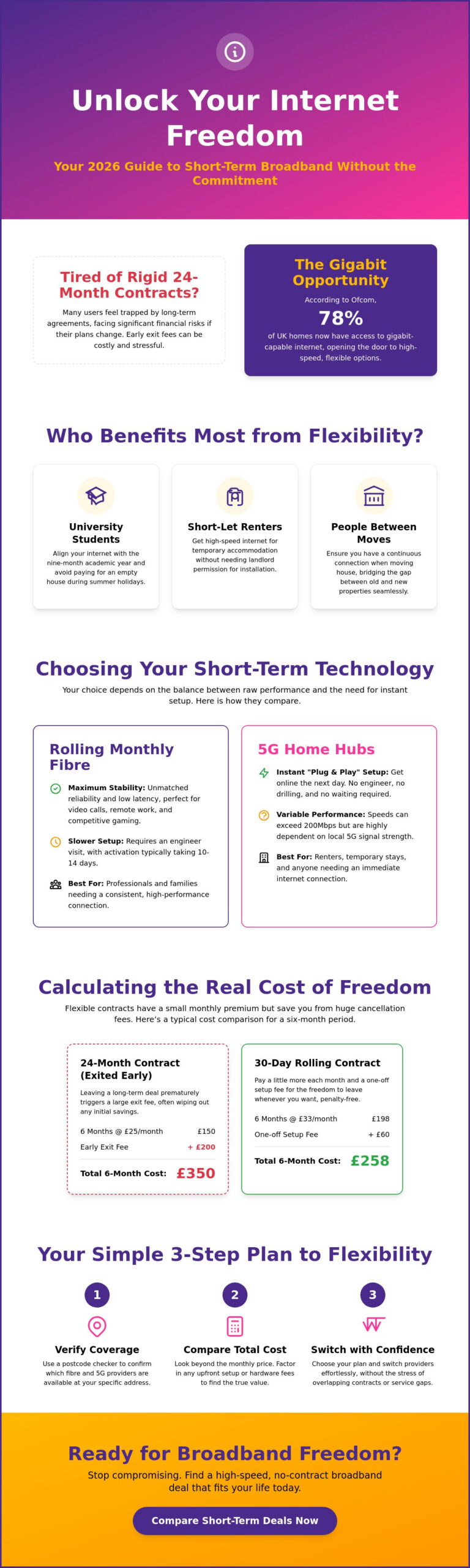
Understanding the financial landscape of short term broadband requires looking beyond the monthly price tag. While these deals often carry a “flexibility premium” of £5 to £10 more per month than standard contracts, they protect you from the “exit fee trap”. If you sign a 24-month contract and leave after six months, you could face a cancellation fee exceeding £200. To find the most cost-effective path, use a broadband comparison tool to filter by the total first-year cost. This approach ensures you aren’t blindsided by hidden charges.
Upfront Fees vs Monthly Savings
True value in short-term broadband is found by balancing the initial setup fee against the freedom to leave without a three-figure penalty. Consider a six-month stay. A rolling deal might require a £60 upfront hardware fee, but a long-term contract would penalise you for every remaining month upon departure. Data from the Office for National Statistics indicates that the median tenure for private renters in the UK is approximately 20 months. However, for those on short-term licences or in student digs, the rolling model is safer. You pay for the agility you actually need.
Hidden Clauses in Short-Term Agreements
Don’t assume that “no contract” means no rules. Under Ofcom rules on contract clarity, providers must give you a simple summary of terms before you sign. This includes the notice period, which is typically 30 days. If you forget to give notice, you will likely pay for an extra month of service. Additionally, check the equipment return policy. Some providers require routers to be posted back or they will levy a non-return fee. Finally, most flexible plans still require a credit check during the application process.
How to Find and Switch to the Best Short Term Deal
Finding the right short term broadband requires a methodical approach to avoid service gaps. Start by checking local coverage. Use the Ofcom mobile and broadband checker to verify both full-fibre availability and 5G signal strength at your specific postcode. Once coverage is confirmed, evaluate your household data consumption. If you stream 4K content or play games online, an unlimited data plan is essential to avoid restrictive speed caps or overage charges. This preparation ensures your flexible plan actually meets your performance needs.
Step-by-Step Selection and Ordering
Compare no contract broadband deals to identify the lowest upfront setup fees. While some providers offer zero activation costs, others may charge for hardware or delivery. If you choose fixed-line fibre, place your order at least 14 days before your move-in date. This allows time for engineer scheduling or router delivery. For 5G hubs, you can often wait until 48 hours before you arrive, as these are typically sent via next-day courier for immediate “plug and play” use upon arrival.
Broadband for Bad Credit: Flexible Options
Traditional fixed-line providers often have strict credit requirements that can block short-term residents. If you have a poor credit history, mobile broadband hubs are a pragmatic alternative. These providers frequently use “soft” credit checks that are easier to pass than those used by major infrastructure giants. For a “no credit check” solution, consider using a Pay-As-You-Go (PAYG) SIM card inside a compatible 5G router. This gives you total control over spending without any formal contract. Setting up a direct debit for your rolling plan can also help rebuild your credit score over time.
The Switching Process for Temporary Residents
Take Control of Your Connection Today
Choosing short term broadband is a savvy move that aligns your digital life with your physical location. You now understand that 5G hubs offer the fastest setup for urgent moves, whilst rolling fibre provides the stability required for intensive remote work. By calculating the total cost of ownership instead of just the monthly fee, you avoid the financial trap of long-term exit penalties. This pragmatic approach ensures you only pay for the service you actually need.
Our guide has highlighted how to navigate credit checks and switching processes with ease. We provide expert advice specifically for renters and students to ensure you don’t pay for service you won’t use. Our platform empowers you to compare over 30 top UK providers with daily updated flexible deals. This level of transparency helps you find a solution that respects both your budget and your autonomy.
Find the best short term broadband deals with Broadband Freedom and secure high-speed access without the long-term commitment. You deserve a connection that adapts as quickly as your lifestyle changes. Stay connected on your own terms.
Frequently Asked Questions
Can I get broadband for just one month?
Yes, you can secure a connection for a single month by choosing a 30-day rolling contract. These plans operate on a monthly cycle; you simply provide the required 30-day notice period to cancel the service. This is the standard definition of short term broadband in the UK market. It’s an ideal solution for temporary stays or whilst waiting for a permanent fibre installation to be completed in a new property.
Is short term broadband more expensive than long term?
Flexible plans typically carry a higher monthly cost compared to 18-month or 24-month agreements. You are essentially paying a small premium for the freedom to leave without incurring early termination charges. Additionally, you might face higher upfront setup fees for hardware or activation. However, for stays under 12 months, the total cost is often lower because you avoid the massive exit fees associated with long-term contracts.
Do I need a phone line for short term broadband?
You don’t need a traditional landline if you opt for 5G home hubs or Full Fibre (FTTP) connections. Modern 5G routers use mobile signals to provide high-speed access; they only require a power socket to function. Even with fixed-line fibre, many providers now offer “broadband only” deals that exclude line rental. This reduces your monthly outgoings and simplifies the setup process for temporary accommodation or student shared houses.
How long does it take to set up no-contract internet?
Setup times vary significantly depending on the technology you choose. Mobile-based 5G hubs offer the fastest turnaround; they are often delivered via next-day courier for immediate “plug and play” use. If you prefer a fixed-line fibre connection, expect a lead time of 10 to 14 days for activation or an engineer visit. Planning ahead is vital if you require a stable connection from the moment you move in.
Can I take my short term broadband with me if I move?
You can easily move a 5G home broadband hub to a new address. You simply unplug the device and plug it in at your new location; provided there is signal coverage. For fixed-line short term broadband, the service is tied to the physical property. You would need to cancel your current plan and start a new one at your next home. Always verify coverage for your new postcode before moving.

Article by
Elaine Lang
Elaine has over 20 years' experience in Marketing, Communications and Public Relations in the UK. She has worked across large UK corporations, including Commercial Banks and Airports, to online consumer finance and technology solutions. Elaine holds postgraduate qualifications in Marketing from the Chartered Institute of Marketing (CIM) and the Institute of Direct Marketing (IDM). She is a lifelong feline fan, sharing her home with around 4-6 cats for many years. This, of course, can be a challenge when trying to work from home, as they like to try to help!