Why Can’t I Get Fibre Broadband? A 2026 Guide to Availability and Checks

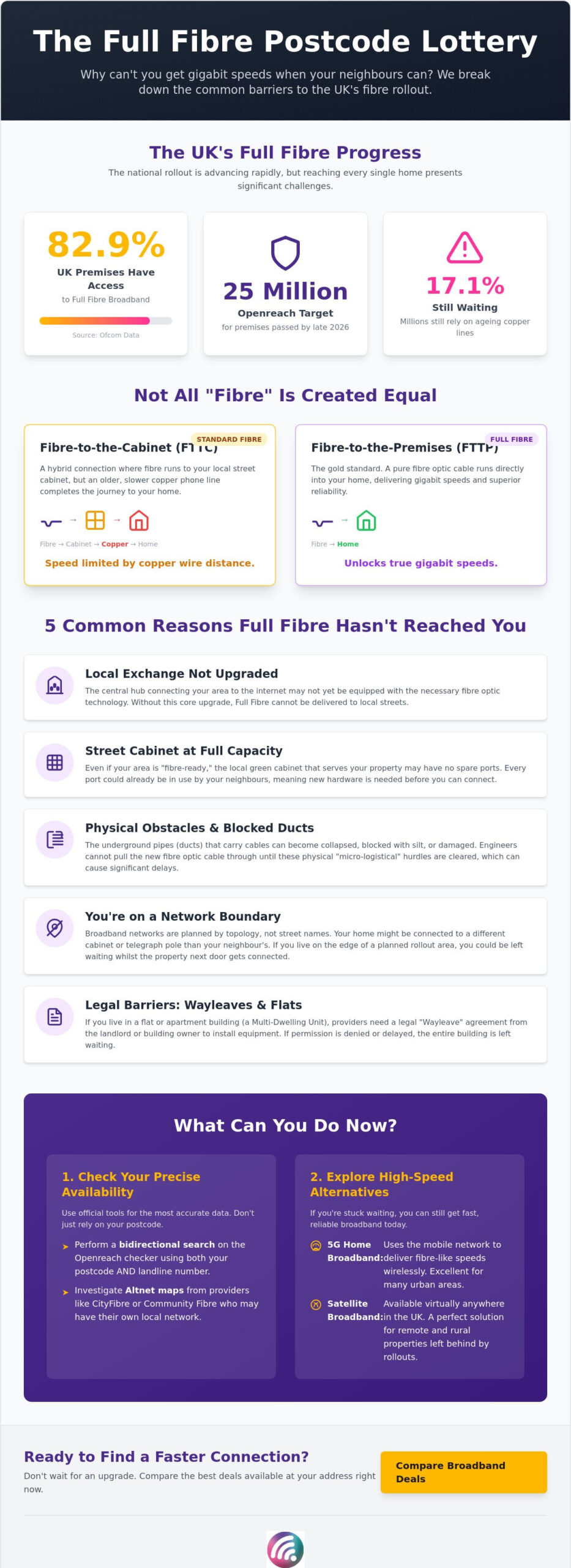
82.9% of UK premises have Full Fibre access, yet you might still be staring at a buffering wheel during work calls. If you find yourself asking, “why can’t I get fibre broadband” whilst neighbours enjoy gigabit speeds, you aren’t alone. According to Ofcom’s latest data, millions still rely on ageing copper. Openreach CEO Clive Selley noted their “build rate is higher than ever,” yet local engineering hurdles remain. This guide uses Project Gigabit records to reveal why service is missing and provide viable alternatives.
Key Takeaways
- Understand why the 2026 Full Fibre rollout hasn’t reached every doorstep and what the national backbone progress means for your home.
- Identify the specific technical barriers, such as exchange upgrades or full cabinet ports, that explain why can’t I get fibre broadband at your exact address.
- Master the use of bidirectional postcode and landline checks to uncover the most accurate availability data for your property.
- Explore reliable alternatives like 5G home broadband and satellite services to secure high speeds whilst you wait for a local upgrade.
Understanding Why Full Fibre Isn’t Everywhere in 2026
Full Fibre (FTTP) uses glass strands to transmit data at light speed. It is the most reliable connection available in the UK. Openreach currently adds over a million new premises per quarter. They aim to hit a 25-million target by late 2026. Reaching the final 20% of homes involves significant engineering challenges. A spokesperson for the Department for Science, Innovation and Technology noted, “The final push requires intensive civil works in both urban and remote landscapes.” This logistical complexity is why can’t I get fibre broadband at some addresses today.
The Difference Between Fibre and Full Fibre
Many “fibre” deals use Fibre-to-the-Cabinet (FTTC) technology. This hybrid system uses copper wires for the final journey into your home. These older wires limit your speed and stability. For true gigabit performance, you need Fiber to the x (FTTx), specifically FTTP. This requires a brand-new cable installed at your property. Data from Openreach’s 2026 reports shows that while 22.1 million premises are reached, legacy copper networks still serve 11.1 million homes. Improving your home setup starts with understanding these technical variations.
Government Targets and Project Gigabit in 2026
Project Gigabit is a £5 billion government scheme. It aims to connect the hardest-to-reach 5% of UK premises. Urban areas often wait for commercial Altnets to finish digging. However, rural locations are frequently prioritised through state-funded contracts. Your local council may have specific rollout dates listed under regional BDUK programmes. Check your current performance with our broadband speed test to see if you meet the “decent broadband” threshold. This initiative ensures geography no longer dictates your digital potential or limits your work-from-home capabilities.
Common Reasons for Fibre Unavailability at Your Address
Your local exchange is the hub connecting your street to the wider internet. If this centre isn’t upgraded to handle light signals, you’ll remain on copper. Even if your area is “fibre-ready,” you might face “Cabinet Capacity” issues. This happens when every port in your local green cabinet is already taken by your neighbours. In these cases, providers must install new hardware before they can accept your order. This is a primary reason why can’t I get fibre broadband even when the street looks ready.
Physical Obstacles and Blocked Ducting
Sometimes the problem is physical rather than digital. Fibre cables usually travel through underground pipes called ducts. If these are collapsed or blocked by silt, engineers cannot pull the new glass cables through. In rural or low-density areas, the cost of digging new trenches often exceeds the potential profit for a provider. According to Ofcom’s infrastructure reports, these “micro-logistical” hurdles are a leading cause of installation delays. You can compare broadband deals to see which networks have navigated your local terrain.
Why Your Neighbours Have It and You Do Not
It’s maddening to see a fibre reel outside your neighbour’s house whilst you’re stuck on ADSL. Broadband distribution is organised by network topology, not street names. Your house might be served by a different telegraph pole or underground chamber than the property next door. If your home sits on a “boundary line” where a provider’s rollout budget ended, you could be left waiting. This technical quirk is a common answer to why can’t I get fibre broadband when the house next door has it.
Legal Barriers: Wayleaves and MDUs
If you live in a flat or a Multi-Dwelling Unit (MDU), the barrier is often legal rather than technical. Providers need a “Wayleave” agreement to install equipment on private property. Landlords or building managers sometimes block these installations due to structural concerns or aesthetic preferences. Where structural integrity is a concern, specialist engineering firms like Composites Construction UK can provide structural strengthening to ensure buildings are prepared for modern infrastructure. The Department for Science, Innovation and Technology has introduced laws to help, but negotiations can still take months. Check with your residents’ association to see if a Wayleave has been denied for your building.
How to Check Your Postcode for Fibre Availability
Use the Openreach official status checker as your primary tool. It provides granular data on the national backbone. For maximum precision, perform a “bidirectional” search by entering both your postcode and your existing landline number. Postcodes often cover multiple properties, but a landline is tied to the specific entry point for your building. This helps resolve the mystery of why can’t I get fibre broadband when your neighbour across the street already has it. You can also verify local network health via the Ofcom Connected Nations report, which tracks regional infrastructure reliability.
Independent networks often build in areas that larger providers haven’t reached yet. Check Altnet maps for providers like CityFibre or Community Fibre to see if they have independent infrastructure near your property. These “overbuilds” are common in high-density urban areas. If you want to see what is currently live at your address, compare broadband deals to see a list of active providers. This ensures you don’t miss out on localised network expansions that might not appear on national checkers.
Interpreting the Results of a Broadband Checker
“Planned” typically means the area is in the design phase, whilst “Coming Soon” suggests an active build window. A “Work in Progress” status is more specific; it indicates engineers are on-site but may be facing a physical block. According to DSIT Project Gigabit progress updates, these delays often stem from complex ducting issues or local planning constraints. Use our broadband speed test to verify if your current connection is meeting its technical potential during the wait.
Troubleshooting False “Unavailable” Messages
If your home is a new build, it might be missing from the Royal Mail Postcode Address File (PAF). Providers cannot offer service if your address isn’t synchronised with this central database. Verify that your address format exactly matches your utility bills. Small discrepancies in house names or flat numbers often trigger “unavailable” messages. If you still find yourself asking why can’t I get fibre broadband despite visible cables, contact the network builder directly to request a manual database update.
What to Do Whilst You Wait for an Upgrade
Waiting for an engineering team to reach your street doesn’t mean you’re stuck with dial-up speeds. If you’re still asking “why can’t I get fibre broadband” despite the national rollout, consider 5G home broadband. As of January 2026, 5G coverage from at least one operator reaches 96% of the UK landmass. These plug-and-play routers offer speeds that often rival entry-level full fibre without the need for a physical line. For those in extremely remote or forgotten urban pockets, satellite services like Starlink provide a reliable, albeit more expensive, lifeline.
High-Speed Alternatives to Fixed Lines
Check if your cabinet supports G.fast, a technology that boosts speeds over copper for properties close to the green box. If your current contract is ending, it’s savvy to switch to a competitive standard fibre deal to lower your monthly outgoings whilst you wait for an upgrade. This ensures you aren’t overpaying for legacy services. You can also explore “Bonded ADSL,” which combines two phone lines to double your bandwidth, though this is becoming less common as mobile networks improve.
Optimising Your Current Connection
Squeeze every drop of performance from your existing copper line by plugging your router directly into the master socket. Avoid using extension cables, as these act like antennas for interference. If you live in a busy household, a mesh WiFi system can distribute your limited bandwidth more efficiently amongst multiple users. This prevents the “buffering battle” during peak evening hours. For more specific advice on managing heavy usage, refer to our guide on internet for shared houses.
Registering Interest with Providers
Infrastructure providers use data to decide where to dig next. Using “Register Interest” buttons on provider websites isn’t just a marketing gimmick; it signals high demand to commercial planners. If you and your neighbours act together, you can often trigger a faster rollout through community-led schemes. Collective demand amongst a cluster of houses can turn an “unviable” street into a priority investment. Don’t just wait in silence; make sure the network builders know exactly where the demand is located.
Take Control of Your Home Connectivity
You now understand that the answer to why can’t I get fibre broadband usually involves specific local engineering or legal barriers. Whether it is a blocked duct or a pending wayleave agreement, these hurdles are temporary parts of a massive national rollout. By using bidirectional postcode checks and registering interest with Altnet providers, you ensure your home is prioritised for the final leg of the 2026 expansion.
Don’t settle for frustratingly slow speeds whilst you wait for an engineer to arrive on your street. You can explore modern alternatives like 5G home broadband or find a better value deal on your existing line to keep monthly costs low. Find the best fibre deals available at your postcode today. We help you compare over 30 of the UK’s top broadband providers with daily updated offers. Our expert guidance covers everything from student plans to flexible no-contract options. High-speed internet is within your reach; stay informed and enjoy the relief of a simpler, faster digital life.
Frequently Asked Questions
Why can my neighbour get full fibre but I can only get standard fibre?
Your property and your neighbour’s might be served by different network branches or distribution points. Broadband infrastructure follows network topology rather than street names; meaning your house could be connected to an older telegraph pole or underground chamber whilst theirs is linked to a new fibre node. If your address sits on a boundary line between two different rollout phases, you’ll often find yourself asking why can’t I get fibre broadband whilst the house next door enjoys gigabit speeds.
How long does it take for fibre to become active after cables are laid in my street?
Activation typically takes between two and four weeks after the physical cabling is finished. Engineers must first test the light signals and ensure the connection is correctly registered in the national database. However, this process can stretch to several months if there are technical issues or database synchronisation errors. Once the status on your provider’s checker moves from “Work in Progress” to “Available,” you can place your order immediately.
Can I pay to have fibre broadband installed at my house privately?
You can request a private installation through schemes like Openreach’s “Fibre on Demand,” but the costs are often prohibitive for individual households. These bespoke builds require you to pay for the civil engineering work, which can run into thousands of pounds depending on your distance from the nearest fibre node. It is usually more cost-effective to join a community fibre partnership where the installation costs are shared amongst several neighbours or covered by government vouchers.
Will I lose my internet connection whilst switching to full fibre?
You won’t experience significant downtime during the switch. Most providers keep your existing copper or part-fibre service active until the new full fibre line is fully installed and tested at your property. There is usually a brief window of a few minutes whilst you swap your router or activate the new Optical Network Terminal (ONT) box. This seamless transition is part of the UK’s copper switch-off strategy, ensuring you stay connected whilst upgrading.
Do I need a new router if I finally get a full fibre connection?
You will almost certainly need a new router that is compatible with Fibre-to-the-Premises (FTTP) technology. Standard routers often lack the necessary WAN port required to connect to the ONT box that engineers install on your wall. Most providers include a pre-configured, high-spec router as part of their latest deals to ensure you can handle the significantly higher speeds. Check your current hardware for a dedicated “WAN” or “Internet” Ethernet port to see if it is compatible.

Article by
Elaine Lang
Elaine has over 20 years' experience across Marketing, Communications and Public Relations in the UK. Her experience spans large UK corporations, including Commercial Banks and Airports, to online consumer finance and technology solutions. Elaine has postgraduate qualifications in Marketing from the Chartered Institute of Marketing (CIM) and the Institute of Direct Marketing (IDM). She is a lifelong feline fan, sharing her home with around 4-6 cats for many years. This of course can be a challenge when trying to work from home, as they like to try to help!