CityFibre Broadband: Your Guide to Faster Full Fibre

Why are you still settling for broadband that treats upload speeds like an afterthought? As of June 2026, the city fibre network has reached over 4.7 million premises, yet many users remain tethered to ageing copper wires that cannot keep up with modern life. You’ve likely felt the frustration of a “superfast” connection that drops during a crucial video call or takes an age to back up your photos. It’s exhausting to navigate a sea of technical jargon like FTTP and FTTC just to get a reliable signal.
You deserve a connection that offers total liberation from these legacy constraints. This guide explores how CityFibre’s infrastructure delivers symmetrical gigabit speeds, ensuring your upload and download rates are finally matched. We’ll examine the latest provider offers from the likes of Vodafone and Zen Internet, while simplifying the installation process for your home. By the end, you’ll know exactly how to find the best full-fibre deals in 2026. According to Ofcom’s 2026 Telecoms Access Review, regulatory frameworks now strongly favour this fibre expansion. Recent data from CityFibre’s official reports confirms they were already connecting over 50,000 new customers every month by the end of 2025 to meet this growing demand.
Key Takeaways
- Learn how this wholesale-only network differs from traditional providers and why it offers more choice for your home.
- Discover how the city fibre network delivers symmetrical gigabit speeds that standard fibre connections simply cannot match.
- Identify which national and local providers offer the most competitive full fibre broadband deals to suit your specific household budget.
- Follow a simple step-by-step process to check your local availability and navigate the installation with ease.
What is CityFibre? Understanding the UK’s Largest Independent Full Fibre Network
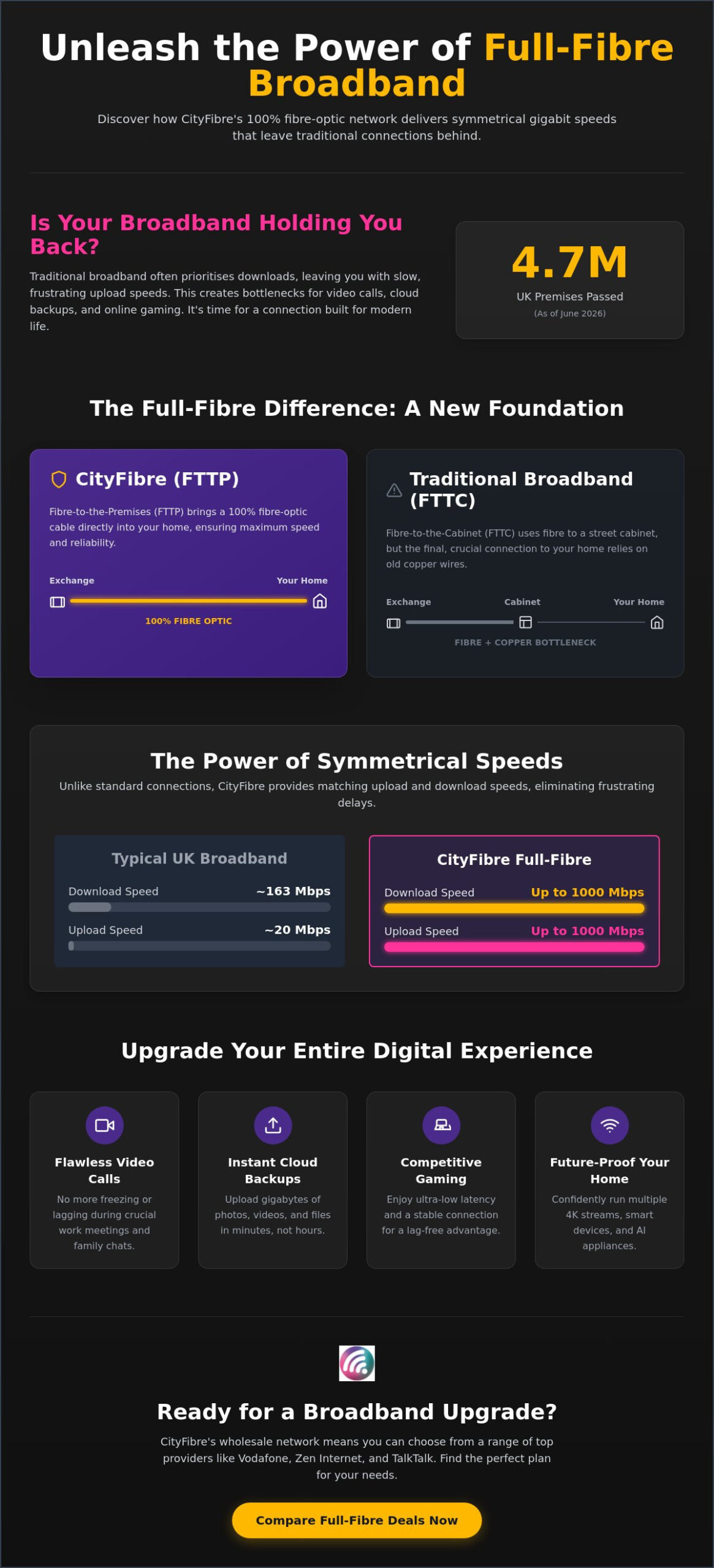
CityFibre is a wholesale-only network builder, meaning they focus entirely on laying the physical infrastructure for the UK’s digital future. Unlike traditional household names, they don’t provide the internet service themselves. Instead, they construct Fibre-to-the-Premises (FTTP) connections that bring fibre-optic cables directly into your home. This is a major leap from “Superfast” broadband, which often relies on ageing copper wires for the final stretch. As of June 2026, the city fibre network has already passed 4.7 million premises, moving steadily toward their long-term target of 8 million homes.
Wholesale vs Retail: Why You Need an ISP Partner
Think of the network as a motorway and your provider as the car. CityFibre builds the high-speed road, but you still need a vehicle to travel on it. You’ll buy your package from retail brands like Vodafone, TalkTalk, or Zen Internet. These companies handle your billing and customer support whilst using the underlying city fibre infrastructure. To find out which companies operate in your area, you should compare broadband providers to see who currently offers the best terms on this specific network.
CityFibre vs Openreach: A Comparison of UK Infrastructure
The main difference between these giants lies in their history. Openreach manages a vast legacy network that still contains significant copper elements. In contrast, CityFibre is built from the ground up as a 100% fibre-optic system. According to CityFibre’s history and background, this independent approach has been vital for UK competition. Ofcom’s Telecoms Access Review 2026-2031 highlights that these alternative networks are essential for driving investment. This competition ensures you aren’t stuck with a single infrastructure provider, giving you more autonomy over your home connection.
The Technical Advantage: Why Symmetrical Speeds and Reliability Matter
Standard broadband packages usually prioritise download speeds whilst leaving your upload capacity in the slow lane. On the city fibre network, this imbalance disappears. Symmetrical speeds mean you get identical performance for both sending and receiving data. If you have a 1Gbps connection, you can upload a massive 4K video file or back up your entire hard drive to the cloud just as quickly as you’d download a film. This reliability stems from the physical medium; industry experts at the Broadband Forum confirm that glass fibre-optic cables don’t suffer from the signal decay or electrical interference common in older copper lines.
Symmetrical Speeds: A Game-Changer for Remote Working
High-definition video conferencing has become a staple of modern life. Symmetrical bandwidth prevents the dreaded ‘video freeze’ that happens when your upload speed can’t keep up with your camera’s data output. Latency is the time taken for data to travel between your device and the server. For 2026 digital services, low latency is non-negotiable. According to Ookla data from May 2026, the average UK fixed-line download speed is 162.77Mbps, but many users on older networks still struggle with upload speeds below 20Mbps.
Future-Proofing Your Home for the 2030s
As we move toward the 2030s, our homes are becoming increasingly data-hungry. From AI-integrated appliances to sophisticated security systems, every new device adds pressure to your bandwidth. You can check your current internet speed to see if your current setup is already reaching its limits. CityFibre CEO Greg Mesch has highlighted that this infrastructure serves as the bedrock of the UK’s digital economy. The UK government’s Project Gigabit initiative underscores the national importance of this full-fibre rollout. If you’re ready for an upgrade, you can compare broadband deals available on the city fibre network today.
Which Providers Use CityFibre? Finding the Best Deals in 2026
Choosing a provider on the city fibre network gives you access to some of the most competitive rates in the UK. Even though the physical cables are identical, your monthly cost, hardware, and customer support will differ significantly between brands. National giants like Vodafone and TalkTalk often lead on price, whilst specialist providers like Zen Internet focus on technical excellence and fixed pricing. Some providers even entice new customers with broadband with free gifts, ranging from vouchers to high-end tech, specifically for those switching to full fibre.
National Giants vs Specialist Providers
Vodafone currently offers a 910Mbps symmetrical plan starting at £29 per month as part of their 2026 Summer Sale. This is an aggressive price point for gigabit speeds. In contrast, Sky Broadband has recently entered the market with a 900Mbps plan for £25 per month on a 24-month term. If you prefer stability over the lowest entry price, Zen Internet remains a top choice for customer satisfaction. Their 910Mbps package costs £39 per month, but they offer shorter 18-month contracts and a guarantee of no mid-contract price rises. This is particularly valuable following Ofcom’s April 2026 ban on inflation-linked percentage increases.
Finding Flexible and Student Options
Renters and students often need more adaptability than a standard two-year commitment allows. Fortunately, some partners on the network offer no contract broadband deals that provide total freedom to move without penalty. Whilst 24-month contracts generally offer the lowest monthly rates, 12-month or rolling options are increasingly available from smaller specialist providers. These ‘Altnet’ partners often score higher in customer service surveys because they cater to these specific user requirements. To see the full range of available packages at your postcode, you can compare broadband deals to find the perfect fit for your lifestyle.
How to Switch to CityFibre: Installation and Setup Guide
Switching to the city fibre network is now a streamlined process. Your first step is to use a full fibre broadband checker to confirm availability at your specific address. After confirming coverage, you can choose a retail provider based on your desired speed and contract length. The “One Touch Switch” system, introduced in 2024, allows your new provider to manage the transition. This means you don’t have to spend hours on the phone trying to cancel your old service yourself.
The Physical Installation: What Happens on the Day?
On your scheduled date, an engineer will install an Optical Network Terminal (ONT). This box is the bridge between the external fibre-optic cables and your home router. The engineer will run a discreet cable from the street to your property, ensuring a neat finish with minimal disruption. You’ll work together to decide the best placement for your router to maximise signal strength. Most city fibre installations are completed within two to four hours, leaving you with a fully active, high-speed connection by the time the engineer departs.
Navigating the Move from Virgin or Openreach
Moving from Virgin Media or Openreach requires switching between entirely different physical infrastructures. Because these networks don’t share the same “pipes,” a new entry point is usually necessary. To avoid any gap in your internet access, consider overlapping your old and new services for 24 hours. This ensures you aren’t left offline if there’s a slight delay in activation. Official data from Ofcom confirms that the new switching regulations are designed to make this process as frictionless as possible for every UK household.
Upgrade to a Faster, More Reliable Digital Future
You now have the practical knowledge to move beyond the limitations of legacy copper networks. By choosing a provider on the city fibre network, you gain access to symmetrical gigabit speeds up to 2.5Gbps and a verified 99.9% network reliability rate. These technical advantages ensure your home is fully prepared for the increasing data demands of the next decade. Whether you’re managing high-definition video calls or backing up large files to the cloud, this infrastructure provides the stability you’ve been missing.
The variety of partners available means you can find a package that matches your lifestyle, from budget-friendly national giants to flexible no-contract specialists. With the “One Touch Switch” system handling the heavy lifting of the transition, there’s no reason to settle for an underperforming connection. Take the first step toward a smoother, faster online experience by exploring the options available in your area. It’s time to enjoy the liberation of a truly modern full-fibre connection.
Compare the latest CityFibre broadband deals and save today
Frequently Asked Questions
Is CityFibre better than BT Openreach?
CityFibre often provides a technical advantage over BT Openreach because its entire infrastructure is built with 100% fibre-optic cables. Whilst Openreach is upgrading rapidly, many of its existing connections still rely on legacy copper elements that can limit performance. In contrast, the city fibre network supports symmetrical gigabit speeds, meaning your upload and download rates are identical. This makes it a superior choice for households that frequently use cloud storage or professional video conferencing.
Do I need a new phone line for CityFibre broadband?
You don’t need a traditional copper phone line to access this network. Because the service uses Fibre-to-the-Premises (FTTP) technology, a dedicated fibre-optic cable is run directly into your home, bypassing old BT-style wall sockets entirely. If you still require a home phone, most providers offer digital landline packages that work through your new router. This modern approach simplifies your setup and removes the need for separate line rental fees associated with older technology.
How long does a CityFibre installation take in 2026?
A standard installation typically takes between two and four hours to complete. An engineer will install an Optical Network Terminal (ONT) inside your property and connect it to the street via a small, discreet external box. Most setups are finished in a single visit with minimal disruption to your home. Since the “One Touch Switch” system now simplifies the transition between networks, you can easily coordinate your activation date to ensure you aren’t left without a connection.
Which broadband providers use the CityFibre network?
Several major national and local ISPs offer full fibre deals on this infrastructure. Key partners include Vodafone, TalkTalk, Sky, and Zen Internet, alongside various regional specialist providers. This wholesale model gives you the autonomy to choose a provider based on your specific needs for customer service, price, or contract flexibility. By using the city fibre network, these companies can offer competitive symmetrical speeds that are often unavailable on other national cable or phone line networks.
Can I get CityFibre if I live in a flat or apartment?
You can get a connection in a flat, though it sometimes requires a legal permission document known as a “Wayleave” agreement. This allows the network builder to install cables in the shared areas of your building. Many modern apartment blocks are already pre-wired for full fibre services to make this process easier. If your building isn’t yet connected, your chosen provider will usually manage the communication with your landlord or building management to arrange the necessary access for installation. In these scenarios, maintaining the building’s safety integrity is paramount; specialist contractors like National Fire Ltd help ensure that any new cabling through walls or doors adheres to strict passive fire protection and certification standards.

Article by
Elaine Lang
Elaine has over 20 years across Marketing, Communications and Public Relations in the UK. She has worked across large UK corporations, including Commercial Banks and Airports, to online consumer finance and technology solutions. Elaine has post graduate qualifications in Marketing from the Chartered Institute of Marketing (CIM) and the Industry of Direct Marketing (IDM). She is a lifelong feline fan, sharing her home with around 4-6 cats for many years. This of course can be a challenge when trying to work at home, as they like to try to help!