How to Choose the Best Broadband for Your Needs

Did you know that 8.8 million UK broadband customers are currently out of contract and likely overpaying for their connection? It’s easy to feel overwhelmed by the sheer volume of providers and the confusing technical jargon surrounding Fibre versus Full Fibre. You want a stable connection for working from home without the dread of mid-contract price rises or paying for bandwidth you never actually touch. Finding what is best broadband for you doesn’t have to be a chore.
This guide explains how to identify your ideal internet speed, choose the right contract type, and select a provider that offers genuine value. We will look at the impact of the January 2027 PSTN shutdown and show you how to save an average of £183.60 a year just by switching providers. By using data from Ofcom and official industry reports, we’ll help you secure a flexible, cost-effective package that fits your household’s unique requirements perfectly.
Key Takeaways
- Identify your specific usage profile to understand what is best broadband for you and avoid paying for ultra-fast bandwidth you never actually utilise.
- Master the choice between standard 24-month terms and flexible no-contract deals to ensure you never feel trapped in a package that no longer serves you.
- Decode the jargon of FTTC versus FTTP to understand why “Full Fibre” is the essential upgrade for those requiring a more stable home connection.
- Navigate the “One Touch Switch” system to transition to a new provider without the stress of manual cancellations or complex coordination.
Identifying Your Ideal Broadband Usage Profile
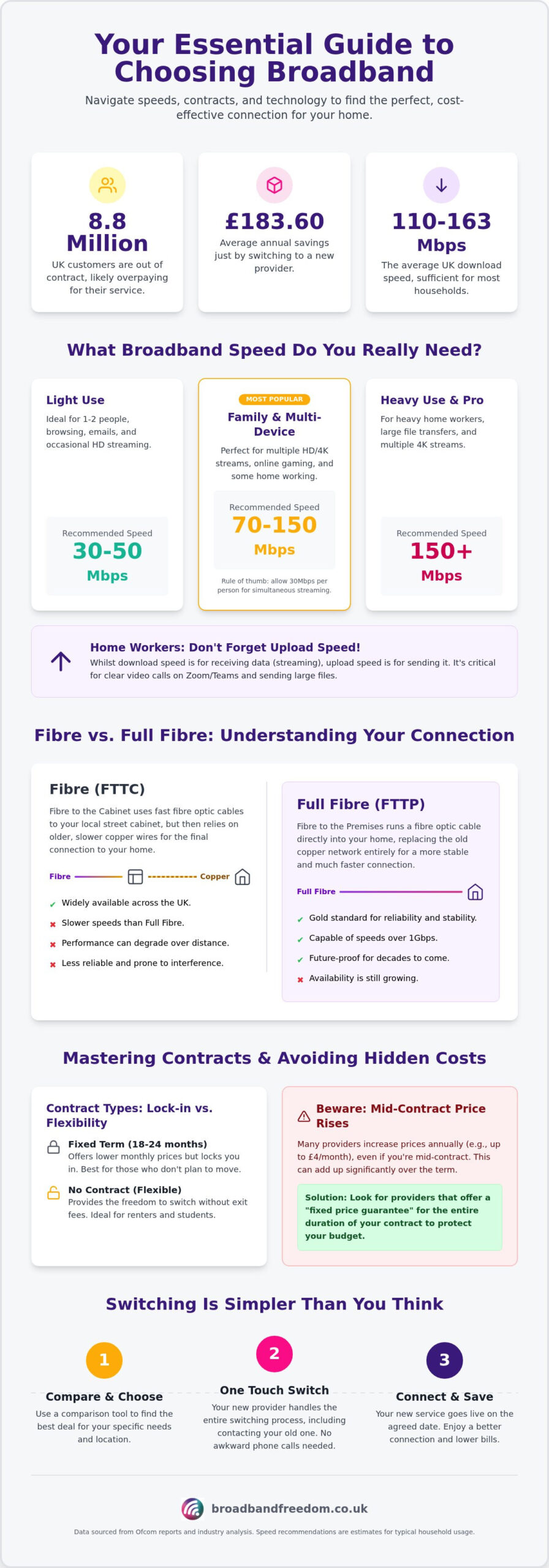
The “best” connection isn’t always the fastest one available on your street. Instead, think of it as the perfect intersection of speed, reliability, and cost-effectiveness. Whilst providers often push 1Gbps packages, these are frequently overkill for a typical two-person household. According to recent data, the average UK download speed sits between 110 Mbps and 162.77 Mbps, which is more than enough for most families. A solid rule of thumb is to allow 30Mbps per person for simultaneous HD streaming. This ensures you aren’t overpaying for capacity you simply won’t use.
Assessing Speed Requirements for Home Workers
If you work from home, your upload speed is just as critical as your download speed. Whilst downloading lets you receive data, uploading is what keeps your video clear on Zoom or Microsoft Teams. Tasks like sending large files or using cloud-based software rely heavily on this metric. You can check your current performance using our internet speed tool to see if your connection is actually meeting your professional needs. Understanding different types of internet access helps you decide if standard fibre or full fibre is necessary for your daily workload.
Understanding Bandwidth for Multi-Device Households
Modern homes are filled with background data consumers. Smart doorbells, security cameras, and even smart bulbs constantly sip at your connection. When you add multiple users streaming in 4K, the demand spikes significantly. To avoid buffering, you need “bandwidth overhead”. Bandwidth overhead is the extra capacity maintained to ensure performance stays stable during peak evening hours when every device is active at once. Calculating this buffer prevents the frustration of a lagging connection. Finding what is best broadband for you means accounting for every device, from your laptop to your smart thermostat.
Navigating Contract Types and Financial Flexibility
Finding what is best broadband for you involves more than just speed; it’s about financial control. Most major providers default to 18 or 24-month terms. These offer lower monthly rates but lock you in. For many, especially renters or students, no contract broadband is the superior choice. It removes the anxiety of exit fees and provides the freedom to switch if your circumstances change. The psychological relief of knowing you aren’t tied to a specific address for two years is invaluable. We also ensure inclusivity by providing options for broadband for bad credit, ensuring everyone has access to essential connectivity.
The Truth About Mid-Contract Price Hikes
Many UK consumers are blindsided by annual increases. In April 2026, major providers like BT and Virgin Media implemented fixed-pound increases of up to £4 per month. Consumer groups such as Which? have long highlighted the impact of these rises on household budgets. According to Ofcom’s 2026 data, millions of customers remain out of contract, missing out on potential savings of £183.60 annually. To protect yourself, look for providers offering “fixed price” guarantees for the duration of your term. Always calculate the “total cost of ownership” over the full contract period rather than just the initial monthly price.
Bundling Services for Maximum Value
Combining your utilities can simplify your monthly outgoings. Integrated broadband and phone packages often provide better value than purchasing services separately. However, be cautious with high-tier TV bundles. Only opt for these if you genuinely use the premium channels included. If you’re looking for the most efficient deal, you can compare broadband deals to see how bundles stack up against standalone fibre. This transparent approach ensures you never pay for “filler” services that don’t add real value to your daily lifestyle. Always check the “effective monthly cost” which accounts for setup fees and any free gifts or cashback offers included in the deal.
Technology Comparison: Fibre vs Full Fibre FTTP
Understanding the physical connection to your home is vital when deciding what is best broadband for you. Standard Fibre (FTTC) uses fibre optic cables to the street cabinet, but relies on old copper wires for the final leg to your door. Full Fibre (FTTP) replaces that copper entirely with fibre optic cables. This technology is significantly more reliable because fibre doesn’t suffer from the same interference or weather-related degradation as copper. Researching different types of internet access helps clarify why FTTP is now considered the gold standard for home connectivity.
Is Full Fibre Available in Your Area?
Checking your options shouldn’t involve endless sales calls. A simple way to verify your status is to look for an Optical Network Terminal (ONT) box, usually found near your front door or hallway. If it’s there, FTTP is already pre-installed. In some modern apartment blocks, developers have exclusive agreements with specific providers, which might limit your choice. Use our full fibre broadband checker to see which networks actually serve your specific building. As of June 30, 2026, FTTP coverage reached 84.5% of UK premises, nearing the government’s Project Gigabit targets.
Alternatives to Traditional Fixed-Line Broadband
For those in rural areas or waiting for fibre rollouts, 5G Home Broadband is a powerful alternative. It uses mobile signals rather than physical wires, offering high speeds with minimal setup. 5G is often better for short-term “Broadband Freedom” as it avoids long-term installation commitments. Satellite internet remains an option for the most remote properties, though it often comes with higher latency than fixed lines. Always check the latest Full Fibre deals first to ensure you aren’t missing out on a more stable fixed connection before committing to wireless alternatives.
A Step-by-Step Selection and Switching Process
Switching used to be a major headache. Now, the “One Touch Switch” system means you only need to contact your new provider. They handle the cancellation with your old firm, effectively minimising downtime. This process is designed to help you discover what is best broadband for you without the stress of manual coordination. If you are on Universal Credit or Pension Credit, always ask about “social tariffs”. These essential packages start from £12.50 per month and are exempt from annual price increases, providing a vital safety net for millions of eligible households.
Using Comparison Tools Effectively
Use our platform to compare broadband deals by filtering for your specific needs. Don’t just look at the headline monthly rate; instead, sort by “effective monthly cost”. This figure includes setup fees and the value of any broadband with free gifts like vouchers or smart devices. Marketing gimmicks often hide high activation or delivery fees for the hardware. Always calculate the “total contract cost” to understand exactly what will leave your bank account over the entire 18 or 24-month term.
Final Checklist Before You Commit
Before signing, verify your 14-day cooling-off period. This legal right allows you to cancel if the service doesn’t meet expectations once installed. Ensure the router provided is modern enough to handle your chosen speed; older hardware can often bottleneck a high-speed Full Fibre connection. Finding what is best broadband for you requires this final layer of due diligence. Once you’re confident in the hardware, the reliability, and the fixed price, you can proceed with total autonomy. Ready to find your perfect match? Compare the latest UK deals now and start saving today.
Secure Your Future Connection Today
Finding what is best broadband for you doesn’t have to be a confusing process of technical jargon and hidden fees. By matching your speed to your household’s actual usage and choosing contracts that offer genuine flexibility, you regain control over your monthly outgoings. We’ve explored how the transition to Full Fibre and the “One Touch Switch” process makes upgrading simpler than ever. You now have the expert knowledge to avoid overpaying for bandwidth you never use whilst ensuring your home connection remains stable.
Take Control of Your Home Connectivity
Our platform provides access to expertly curated deals from over 30 UK providers, with daily updates on the latest fibre and full fibre offers. We focus on your autonomy, providing independent advice tailored to your personal requirements and your “Broadband Freedom”. Compare the best UK broadband deals for 2026 and enjoy the relief of a simple, transparent solution. Take the first step toward better connectivity and lower monthly bills right now.
Frequently Asked Questions
What broadband speed do I actually need for working from home?
Can I get broadband without a long-term contract?
Yes, you can choose “no-contract” or rolling monthly deals if you require flexibility. These plans allow you to cancel with just 30 days’ notice, which is ideal for renters or those in temporary accommodation. Whilst the monthly price might be slightly higher than a 24-month commitment, you avoid heavy exit fees. This type of “Broadband Freedom” ensures you aren’t tied to a provider that no longer serves you.
Is Full Fibre (FTTP) available at every UK address?
Full Fibre is not yet available at every address, but coverage reached 84.5% of UK premises by June 2026. Availability depends on the local infrastructure rollout by networks like Openreach or various alternative providers. If FTTP isn’t in your street yet, you can still access standard fibre (FTTC) which uses copper for the final connection. Check our comparison tool to see the specific technologies currently available.
How much does it cost to switch broadband providers?
Switching is usually free if you’ve completed your current contract term. If you are still in your initial 18 or 24-month period, you may face early termination charges. However, many new providers offer incentives or “switching credit” to help cover these costs. When determining what is best broadband for you, always factor in potential activation or hardware delivery fees to calculate the true first-year cost of the service.
What happens to my internet connection during the switch?
You should experience minimal downtime, often lasting only a few minutes on the day of the transfer. Under the “One Touch Switch” regulations, your new and old providers coordinate the transition behind the scenes. This system ensures you don’t lose connectivity for days. You’ll receive a specific activation date, and once you plug in your new router, the service typically goes live almost immediately without manual cancellations.

Article by
Elaine Lang
Elaine has over 20 years across Marketing, Communications and Public Relations in the UK. She has worked across large UK corporations, including Commercial Banks and Airports, to online consumer finance and technology solutions. Elaine has post graduate qualifications in Marketing from the Chartered Institute of Marketing (CIM) and the Industry of Direct Marketing (IDM). She is a lifelong feline fan, sharing her home with around 4-6 cats for many years. This of course can be a challenge when trying to work at home, as they like to try to help!