Why Compare Broadband Deals? Save Money & Get Faster Speeds

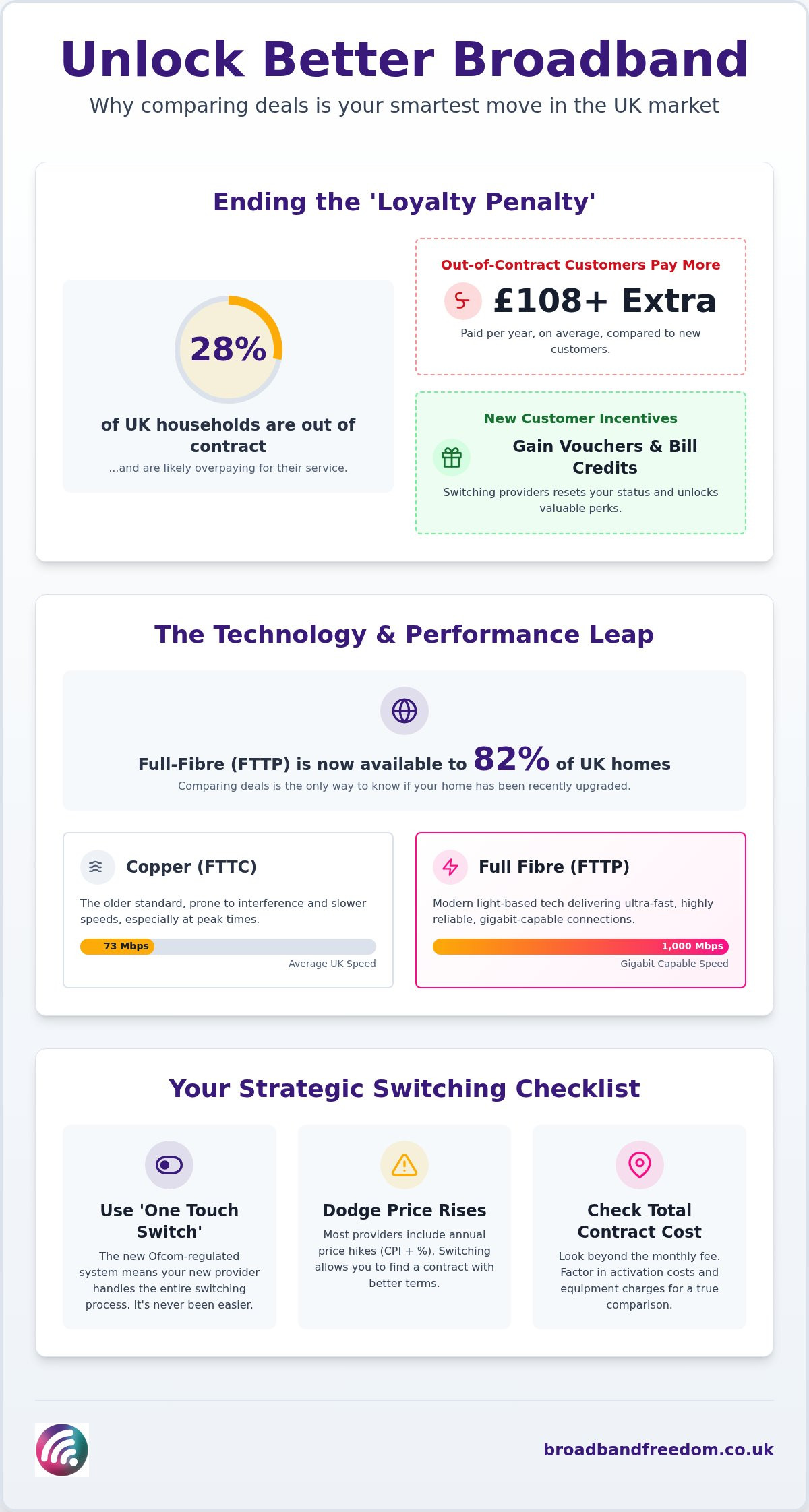
What if your current internet package is effectively a tax on your loyalty? With 28% of UK households currently out of contract, millions are paying significantly more for slower service than new customers. We agree that the terminology around FTTP and mid-contract price hikes is frustratingly complex. This guide promises to simplify the market, showing you how regular broadband comparison can save you hundreds of pounds whilst securing the fastest technology available. We will preview how to dodge the loyalty penalty, manage the 2026 price rises, and use the new One Touch Switch system to your advantage.
Why compare broadband deals now? According to Ofcom, switching has never been easier, with the regulator stating that the “One Touch Switch” process is designed to “give customers the confidence to shop around.” By checking the latest offers, you ensure your home is no longer restricted by outdated copper lines. With average UK speeds now reaching 73.21 Mbps according to Ofcom reports, moving to a modern provider ensures you aren’t paying a premium for a subpar connection.
Key Takeaways
- Identify how providers use competitive introductory rates to attract new customers, which often leaves long-term users paying significantly more for the same service.
- Learn how to check if your property is newly eligible for gigabit-capable Full Fibre (FTTP) technology to ensure you are not stuck with an outdated copper connection.
- Discover the three pillars of a great contract and how combining services into broadband and phone packages can simplify your monthly outgoings whilst lowering costs.
- Understand why compare broadband deals is the most effective way to upgrade your home network, especially now that your new provider manages the entire switching process.
Ending the Loyalty Penalty: Why Sticking Around Costs You Money
Strategic Cost Analysis
When you evaluate your options, look beyond the headline monthly price. Focus on the Total Contract Cost, which includes activation fees and equipment charges over the full term. The Consumer Rights Act ensures you are protected from unfair terms, but it’s your responsibility to move when a better deal surfaces. Don’t let inertia drain your bank account.
The Impact of Mid-Contract Price Hikes
Most UK providers now include annual price increases in their terms, typically linked to the Consumer Price Index (CPI) plus a fixed percentage. In April 2026, major providers like BT and Virgin Media implemented fixed monthly increases of £4. Before you sign, check the small print for these specific clauses to avoid surprises. You can learn more about navigating these terms in our guide to broadband contract renewal. Understanding these cycles is a key reason why compare broadband deals before your current term ends.
Financial Gains from New Customer Incentives
To attract new business, providers offer aggressive sweeteners that make the initial 18 to 24 months significantly more affordable. These often include bill credits applied to your first few months, high-value retail vouchers, or packages featuring broadband with free gifts like smart speakers or consoles. These incentives often offset the setup costs, making a switch a net gain for your household budget. By moving providers, you effectively reset your status to “new customer” and reclaim these financial advantages.
Beyond the Monthly Bill: Performance and Technology Gains
By January 2026, full-fibre broadband reached 82% of UK homes. This massive rollout means many properties previously restricted to copper-based Fibre to the Cabinet (FTTC) can now access Fibre to the Premises (FTTP). Checking your options is the only reliable method to see if your property is newly enabled for these gigabit-capable speeds. While your current provider might keep you on an older, slower plan, a quick search reveals if you’ve been unlocked for symmetrical upload speeds and lower latency. If you wonder why compare broadband deals, the answer lies in this rapid rollout of superior technology.
Upgrading to Gigabit-Capable Infrastructure
Gigabit broadband delivers speeds of 1,000Mbps, a significant jump from the UK’s average speed of 73.21 Mbps. This capacity is essential for multi-user households where 4K streaming and large file downloads happen simultaneously. Full Fibre technology effectively eliminates “bufferbloat,” the frustrating lag caused by high network traffic. According to Ofcom data, the growing demand for smart home devices makes these higher tiers a future-proof investment. Beyond just speed, moving to modern infrastructure is a key part of Ending the Loyalty Penalty by ensuring you get the best tech for your money.
Reliability: The Hidden Benefit of Modern Connections
Light-based fibre optics are far more resilient than traditional copper wiring, which is prone to interference and weather-related degradation. Switching to FTTP significantly reduces the risk of mid-day dropouts. When you check your current internet speed and compare it against newer offers, you also gain the chance to move to providers with superior customer service ratings. Reliability isn’t just about the wire; it’s about the support behind it. Another reason why compare broadband deals remains a strategic move is the ability to find a more stable connection. Use this opportunity to compare broadband deals and see if a better service is waiting for you.
A Strategic Framework: How to Evaluate Modern UK Deals
Evaluate every offer using three core pillars: price, speed, and contract flexibility. This logical approach is the most effective way of Tackling the loyalty penalty whilst ensuring your home technology remains current. Don’t just focus on the headline monthly fee. Look at broadband and phone packages to see if bundling services reduces your total household expenditure. Be wary of hidden setup costs. Activation fees or router delivery charges can sometimes negate the savings of a cheaper monthly rate, so always calculate the total cost over the full term.
Matching Speed to Your Household Behaviour
Select a speed tier that matches your daily digital habits. A single professional might find 100Mbps perfectly adequate for video calls and light streaming. Conversely, a household with four active users and multiple 4K streams will need at least 500Mbps to prevent friction. Check your current internet speed to see if your hardware is holding you back. If you frequently download massive gaming files, a gigabit-capable connection provides the necessary headroom. High-speed fibre ensures your connection remains stable even during peak evening hours when network demand is highest.
Contract Length and Your Lifestyle
Match your contract length to your personal circumstances. While 24-month terms usually offer the lowest prices, they aren’t ideal if you plan to move home soon. Renters should prioritise no contract broadband to maintain flexibility and avoid early exit fees. If you’re at university, student broadband deals are designed to fit the academic calendar. Understanding why compare broadband deals is about more than cost; it’s about control. Take charge of your home network today and compare broadband deals to find a plan that actually fits your lifestyle.
Simplified Switching: Using One Touch Switch to Your Advantage
The primary barrier to switching used to be “admin stress”. You’d have to call your old provider, wait on hold, and endure a long retention pitch. Since the Ofcom “One Touch Switch” regulation became fully operational in June 2026, those days are over. Your new provider now manages the entire cancellation process for you. If you’ve been wondering why compare broadband deals, this removal of friction is the ultimate reason to act. You no longer need to speak to your current ISP to leave.
Minimal Downtime and Maximum Ease
Most users fear being without internet during the transition. In reality, downtime is typically less than an hour. The coordination between broadband providers ensures a seamless handoff whilst you remain connected. This efficiency allows you to focus on the benefits of faster speeds rather than technical hitches. This regulated process removes the fear of a long, complicated transition that previously discouraged many households from seeking better value.
The Step-by-Step Switching Process
- Step 1: Compare deals on Broadband Freedom to find your ideal match.
- Step 2: Select your new deal and provide your current service details.
- Step 3: Receive your switching date; your new provider handles the rest.
Why Broadband Freedom is Your Best Advocate
You now have the tools to end the loyalty penalty and secure a faster, more reliable connection. By understanding why compare broadband deals, you can transition from outdated copper lines to gigabit-capable Full Fibre technology without the old administrative headaches. The One Touch Switch system ensures your move is seamless; your new provider handles the heavy lifting while you enjoy lower monthly costs.
We simplify the search by aggregating daily updated offers from BT, Virgin Media, and Sky. You can compare up to 30 of the UK’s top broadband providers in one place. Our expert guides help you navigate complex choices like Full Fibre and student deals with ease. Compare the latest broadband deals and start saving today.
Frequently Asked Questions
Is it better to switch broadband or haggle with my current provider?
Switching is consistently more effective than haggling. Consumer advocates have long argued that “loyalty doesn’t pay” in telecommunications, as providers use introductory rates to subsidise their business at the expense of long-term users. By moving, you reclaim these subsidies. This is more reliable than negotiating with a retention team that is often limited by fixed discount caps. Switching ensures you access the lowest possible market rate.
Can I switch broadband if I am still in the middle of a contract?
You can switch, but exit fees usually apply unless you meet specific criteria. Ofcom rules dictate that providers must allow customers to leave penalty-free if they implement price rises that were not clearly stated at the point of sale. If your service quality drops below the “minimum guaranteed speed,” you also have a right to exit. Always check your contract’s specific terms regarding mid-contract price adjustments.
What happens if my internet goes down during the switching process?
Downtime is typically less than sixty minutes. The One Touch Switch system was specifically designed to be robust. An Ofcom spokesperson stated the process is meant to “remove the hurdles” that previously discouraged consumers from switching. If your service is not restored within one working day, you are eligible for automatic payments under the Ofcom Automatic Compensation Scheme, ensuring you aren’t left out of pocket.
How much can I realistically save by comparing broadband deals in 2026?
Out-of-contract households typically save around £108 per year. However, why compare broadband deals becomes even more critical if you are eligible for a social tariff. A report by the Competition and Markets Authority highlighted that millions of households miss out on these essential savings. Comparing ensures you find these specialised rates, which can be significantly lower than standard commercial offers.
Do I need a new phone line to switch to a Full Fibre deal?
No, Full Fibre (FTTP) uses its own dedicated infrastructure. As the UK approaches the PSTN switch-off in January 2027, traditional phone lines are being retired in favour of digital alternatives. An engineer might install a small Optical Network Terminal (ONT) box inside your home, but your old copper line becomes redundant. This technological shift is a major reason why compare broadband deals to ensure your home remains connected.

Article by
Elaine Lang
Elaine has over 20 years across Marketing, Communications and Public Relations in the UK. She has worked across large UK corporations, including Commercial Banks and Airports, to online consumer finance and technology solutions. Elaine has post graduate qualifications in Marketing from the Chartered Institute of Marketing (CIM) and the Industry of Direct Marketing (IDM). She is a lifelong feline fan, sharing her home with around 4-6 cats for many years. This of course can be a challenge when trying to work at home, as they like to try to help!